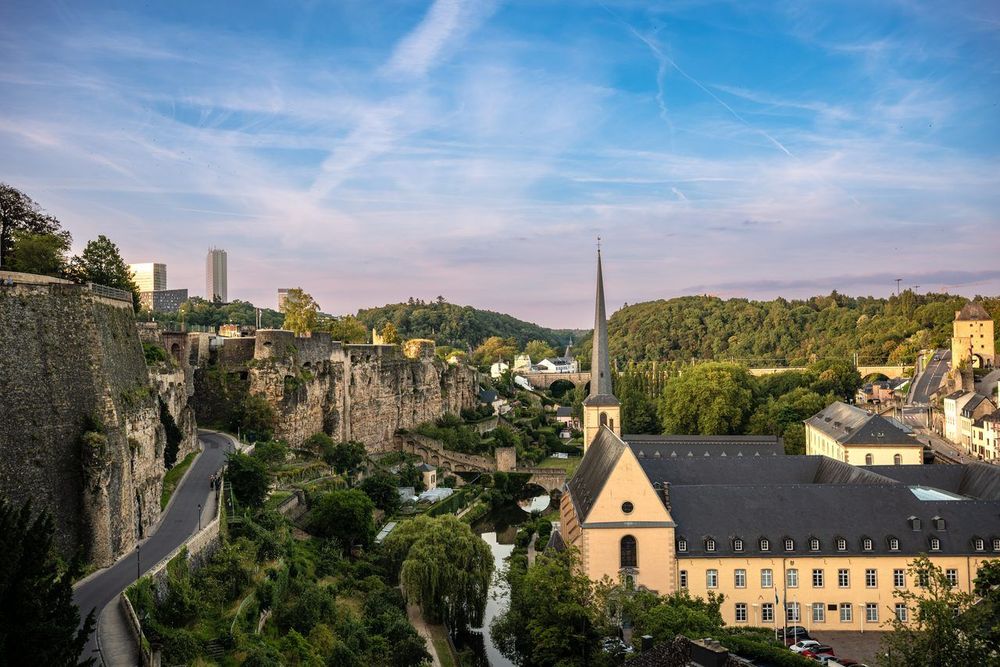
© Shutterstock
 Votre guide Ryo
Visiting Luxembourg Solo in 2026: Itinerary, Must-Sees, and a One-Day Budget
At 6 a.m., Luxembourg's station district is already buzzing with suits rushing toward the banks of Kirchberg. Twelve hours later, the same city seems to belong to a handful of solitary walkers leaning on the parapet of the Chemin de la Corniche, watching the rooftops of the Grund light up one by one. This may be the best argument for visiting Luxembourg solo: this miniature capital changes its face with the hour, and nobody needs to wait for a travel companion to enjoy it fully. You can head down alone into the underground galleries of the Casemates du Bock, reach Pfaffenthal via a glass panoramic elevator that plunges 71 meters down into the Alzette valley, then head to the Mudam without negotiating a group schedule. The Ryo audio-guided tour of Luxembourg City is designed precisely for this kind of free-roaming stroll, with commentary that triggers location by location, with no reservation or fixed meeting point required. In the pages that follow: the five sites that make up the historic heart, a full-day itinerary designed for walking alone, a safety briefing specific to solo travelers, and a detailed budget broken down line by line, down to the price of a dorm bed.
Luxembourg's Historic Heart: Iconic Squares and Landmarks
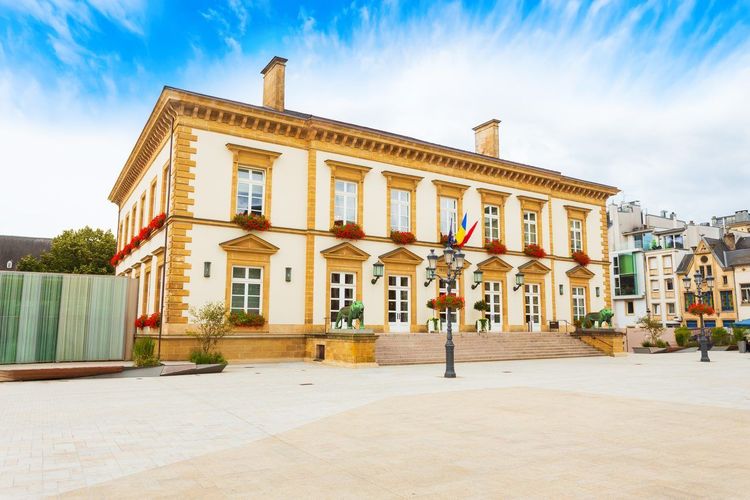
Luxembourg's old town can actually be covered quite quickly, making it an ideal setting for a first solo half-day without any complicated plan to follow. Everything starts at Place Guillaume II, which locals call "Knuedler", where the equestrian statue of the king-grand duke has stood since 1884. A market is still held there two mornings a week, on Wednesdays and Saturdays, and it is often where locals themselves will give you the best impromptu itinerary for the rest of your walk.
A two-minute walk away, the Grand Ducal Palace surprises with its modest dimensions for an official residence. A former town hall whose Renaissance façade dates from 1572, it still serves for the Grand Duke's audiences and is only open for visits in summer, during guided slots sold by the tourist office. For a solo traveler who prefers to avoid fixed-time reservations, the exterior is more than enough: the soldier on duty pacing in front of the entrance at a measured step invariably draws a few onlookers.
The Notre-Dame Cathedral is just a few streets away. A former Jesuit church completed in 1621 in a late Gothic style tinged with Renaissance elements, it was enlarged in the 1930s in a more eclectic style that sometimes puzzles purists. The interior is worth lingering in alone, with no one to rush you: the crypt houses the tombs of the grand-ducal family as well as that of John the Blind, Count of Luxembourg and King of Bohemia, who died at the Battle of Crécy in 1346. Admission is free outside of services, and it remains one of the rare spots in the old town where you can sit for twenty minutes without being asked to order anything.
Continue toward Place de la Constitution, recognizable by its obelisk topped with a golden statue, the Gëlle Fra. This Memorial Monument pays tribute to Luxembourg volunteers who fell during the First World War and subsequent conflicts. It is also from this square that one of the finest views over the Pétrusse valley opens up, a good excuse for a photo stop.
Round off this first loop at Saint Michael's Church (Rue Sigefroi, 2536 Luxembourg, rated 4.5/5 on Google with 502 reviews), the oldest place of worship in the city: the chapel of the comital castle was consecrated as early as 987. The current building, rebuilt in 1688, conceals behind its Baroque façade a much plainer nave where traces of several successive renovations can still be made out. The Ryo audio-guided tour links these five stops in exactly this order, with commentary that triggers automatically at each square or monument, with no need to keep your eyes glued to a map while walking alone. Allow about an hour and a half for this loop at a leisurely pace.
The Chemin de la Corniche, Europe's Most Beautiful Balcony
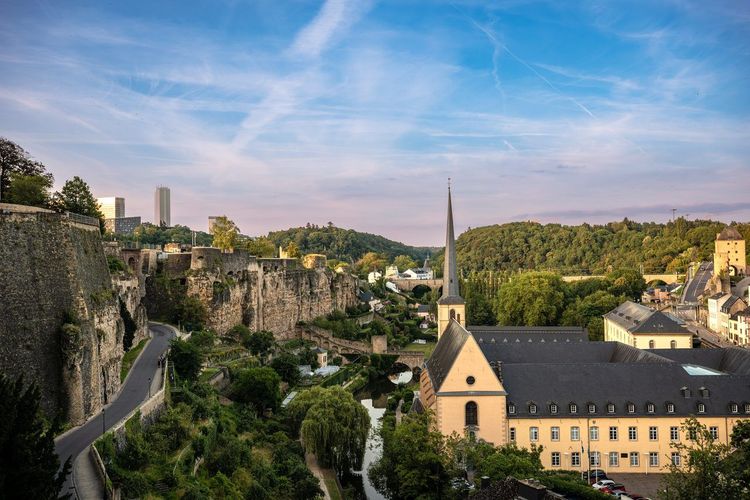
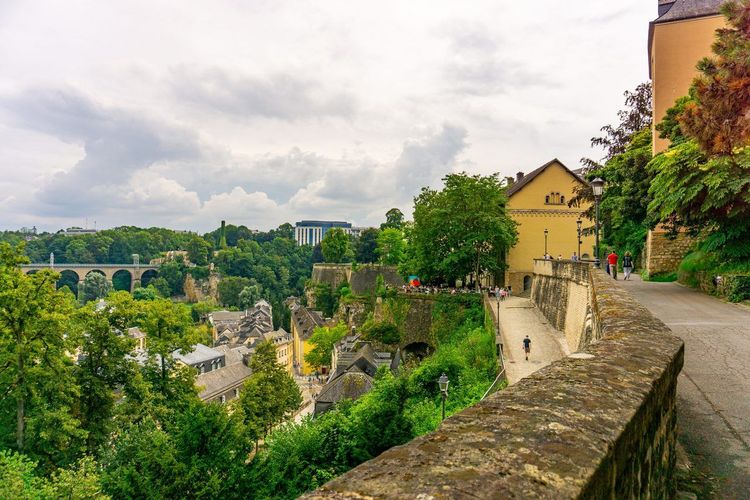
The Chemin de la Corniche (Corniche, 1364 Luxembourg, rated 4.8/5 on Google with 111 reviews) owes its slightly grandiose nickname of "Europe's most beautiful balcony" to Luxembourg writer Batty Weber, and nobody has seriously disputed it since. The promenade runs along the rampart overlooking the Grund and the Alzette valley, with an uninterrupted view over slate rooftops, the bell tower of Saint John's Church, and the Bock rock a little further along.
Fifteen minutes is enough to walk it from end to end. But if you are traveling solo, this is precisely the place to slow down: the benches scattered along the route are rarely crowded, even in high season, and the evening light on the towers makes the walk noticeably more beautiful than in the middle of the day.
This walkway dates back to the 17th century, when Spanish and then French fortifications encircled the city. Information panels trace the evolution of the fortress up to its dismantlement, imposed by the Treaty of London of 1867, which transformed Luxembourg from a military stronghold into an open city.
Free access at all hours. Just make sure to wear shoes with good grip: the cobblestones are slippery in wet weather, especially near the stairways leading down to the Grund below.
The Grund and the Pétrusse Valley: the Lower Town on Foot
Coming down from the Corniche, you land directly in the Grund, the former working-class district built along the Alzette, today one of the most photographed corners of the city. The old mills and tanneries that lined the river have been converted into bars, artists' workshops, and small restaurants, without the original architecture having really changed.
The name comes quite simply from the German word "Grund", meaning the bottom. Long considered the city's poor quarter, separated from the plateau by some sixty meters of elevation, it has gentrified noticeably since the 2000s. Today you are as likely to encounter European civil servants on terraces on a Friday evening as tourists who have come to photograph the Neumünster Abbey, now converted into a cultural center.
Push open the door of Neumünster if you pass by during the day: the former abbey, which also served as a prison until the mid-1980s, hosts free exhibitions, concerts, and a café whose terrace overlooks the cloister and the Alzette. It is easy to settle in alone with a book, without feeling as though you are occupying a table for four. A little further along, the abbey gardens offer the best angle for photographing the Corniche ramparts from below.
Looking for somewhere to have lunch alone without feeling out of place? The Grund lends itself particularly well to this: the waterside terrace tables are often small, designed for one or two people, unlike the long communal tables of the brasseries in the upper town.
Just to the south, the Pétrusse valley (Vallée de la Pétrusse, 1499 Luxembourg, rated 4.9/5 on Google with 36 reviews) extends the walk along a small tributary of the Alzette, transformed into a landscaped park following the dismantlement of the fortress. The paths wind beneath the bridges connecting the two banks, including the Adolphe Bridge, a true postcard image of the capital with its great stone arch spanning roughly 85 meters at 42 meters above the valley.
Getting between the two levels of the city requires neither a car nor any particular sense of direction: a free public elevator connects the Saint-Esprit plateau to the Grund, and several stairways do the same for those with good legs. The descent to the Grund is actually one of the passages covered in the Ryo audio guide for Luxembourg, with the story of the old mills and tanneries told at the exact moment you pass in front of their converted façades.
The Casemates du Bock, Fort Thüngen, and the Pfaffenthal Panoramic Elevator
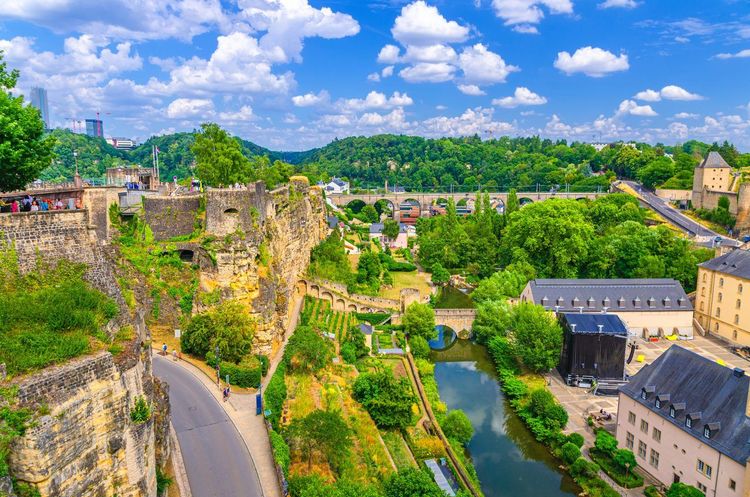
The Bock rock is the historic birthplace of the city: it was here that Count Sigefroi acquired in 963 the promontory on which he had his castle built, the starting point of what would become Luxembourg. Little remains on the surface, but beneath your feet stretch the Casemates du Bock, galleries carved into the rock from 1644 onward by the Spanish, then considerably extended under Austrian rule in the following century.
At their peak, the fortress casemates totaled around 23 kilometers of galleries, capable of sheltering thousands of soldiers, horses, workshops, and even bakeries in the event of a siege. Only a small portion, spread over several levels connected by staircases cut into the rock, is open to visitors today. Allow around 45 minutes for a self-guided visit.
On the practical side, the tourist office lists an adult ticket at 8 euros for 2026 (6.50 euros for students and seniors). In mid-season, from late March to June and then from September to November 8, the entrance opens at 9:45 a.m. with last entry at 5 p.m.; in winter, the time slots are considerably reduced (last entry at 2:45 p.m.). Arrive early in summer: the narrow galleries fill up quickly in the middle of the day.
After 1867 and the Treaty of London, the Luxembourgers spent sixteen years dismantling the fortress, deemed too strategic for a small state that was now neutral. Traces of this work can still be made out at several points along the galleries.
On the other side of the valley, on the Kirchberg plateau, Fort Thüngen and its three towers nicknamed "Dräi Eechelen" (the three acorns) complete this defensive ensemble. Restored from the 1990s onward, it now houses the Dräi Eechelen Museum, dedicated to the history of the fortress and Luxembourg's identity. Like many of the city's museums, it is closed on Mondays.
To descend from the upper town to Pfaffenthal, the Pfaffenthal panoramic elevator (Rue Plaetis, 2338 Luxembourg, rated 4.7/5 on Google with 7,304 reviews) remains the most spectacular option. Inaugurated in 2016 from the Pescatore park, it covers 71 meters of elevation in about thirty seconds, with a glass cabin that offers a bird's-eye view over the district, the Alzette, and the red Grande-Duchesse Charlotte bridge. Free and open from early morning to late evening, it spares you some fairly steep stairways, a real advantage when you have been walking solo all day. At the bottom, the nearby funicular goes back up to Kirchberg, handy for continuing on to Fort Thüngen.
The Casemates du Bock are among the richest stops on the Ryo audio-guided tour: the history of the galleries is told step by step as you descend, with no need to book a guided visit at a fixed time.
The Kirchberg Plateau: European Parliament and Mudam
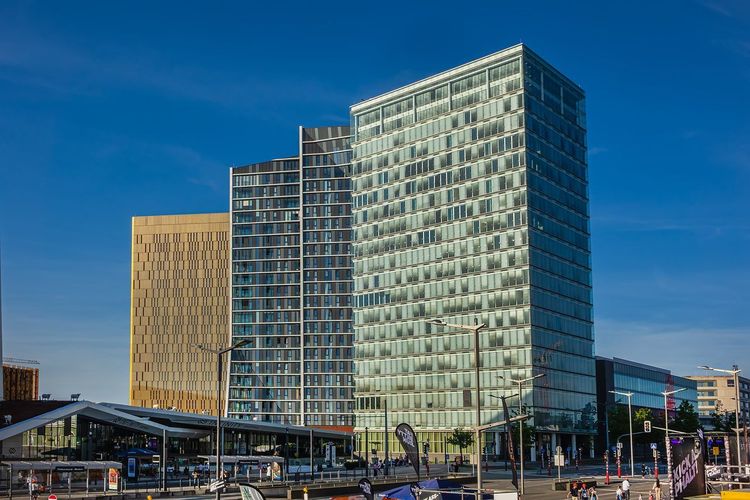
The Kirchberg plateau, about ten minutes away by tram from the center, concentrates Luxembourg's other face: that of a European capital. The general secretariat of the European Parliament occupies the vast Konrad Adenauer building there, while the two golden towers that dominate the district house the Court of Justice of the European Union.
The district was developed from 1961 onward on former agricultural land, designed from the outset to accommodate the European institutions. The tram, free like the rest of the Luxembourg network, connects the central station to Kirchberg with a service every few minutes during the day.
Access to the interior of the institutions is limited to organized visits requiring prior registration, often several weeks in advance, which sits poorly with a solo program put together day by day. The surroundings can be visited freely, however, with several public artworks scattered between the buildings.
Right next to Fort Thüngen, built on part of its foundations, the Mudam (3 Park Dräi Eechelen, 1499 Luxembourg, rated 4.2/5 on Google with 3,641 reviews) occupies a building designed by Ieoh Ming Pei, the architect of the Louvre pyramid. Opened in 2006, this contemporary art museum alternates between a permanent collection and temporary exhibitions renewed several times a year.
A museum remains one of the simplest activities to do alone: you move at your own pace between the rooms and leave whenever you want. The Mudam is closed on Mondays, open until 9 p.m. on Wednesdays, and costs 10 euros. A good deal if you are under 21 or hold a student card: admission is free, as it is for everyone on Wednesdays from 6 p.m. to 9 p.m.
For further reading, our Ryo article on the must-see museums in Luxembourg details the collections of the city's main institutions, from the Mudam to the National Museum of History and Art.
A One-Day Itinerary for Visiting Luxembourg Solo
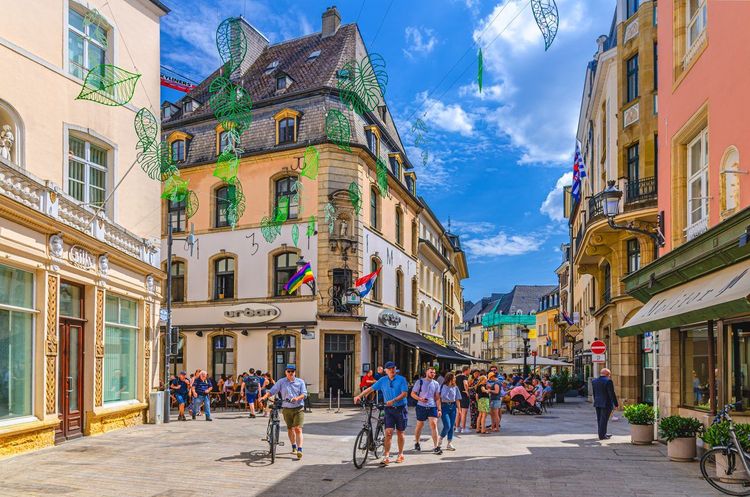
Is Luxembourg really worth the trip for a solo stay, or is it merely a stopover between two better-known capitals? Allow one full day to see the essentials without rushing, and a second if you want to venture as far as Kirchberg and wander without time constraints.
In the morning, start with the old town: Place Guillaume II around 9 a.m., when the terraces are just setting out their chairs, then the Grand Ducal Palace, Notre-Dame Cathedral, Place de la Constitution, and Saint Michael's Church. An hour and a half at a leisurely pace.
Move on to the Chemin de la Corniche, a five-minute walk from Saint Michael's, to make the most of the still soft light. Then head down to the Grund, where a coffee break or a brunch on a terrace by the Alzette is a must.
The afternoon belongs to the Casemates du Bock, followed by the Pfaffenthal elevator and the funicular that goes back up to Kirchberg, to reach Fort Thüngen. If time allows, finish with an hour at the Mudam, which closes at 6 p.m. (9 p.m. on Wednesdays).
Plan a light lunch around 1 p.m., before heading to Kirchberg: there are few restaurants on the institutional plateau. In case of rain, most of the program remains doable: the Casemates are covered, as are the Mudam and the Dräi Eechelen Museum; only the Corniche-Grund stretch becomes slippery.
In total, this route covers between 8 and 10 kilometers on foot. It follows almost exactly the thread of this same Ryo audio-guided tour: the same order of stops, audio stages timed to the actual distances between monuments, so you never have to unfold a map at every street corner when walking alone.
If you have two days, keep the second for a slower pace: museums missed the day before, a trip to the Pétrusse valley at sunset, or a morning with no fixed itinerary, deliberately getting lost in the backstreets of the Grund.
Unique Solo Activities: Treasure Hunts and Interactive Guided Tours
Would you prefer something more playful than a straightforward list of monuments? Several operators offer treasure-hunt-style games in the streets of Luxembourg, originally designed for groups but perfectly playable solo, smartphone in hand.
The "Luxembourg Highlights" game by Explorano, halfway between an escape room and a guided tour, starts on Boulevard Roosevelt, near the Gëlle Fra: each solved riddle unlocks the direction to the next stop, from Place de la Constitution to the Grand Ducal Palace via the equestrian statue of Guillaume II and the Chamber of Deputies. The myCityHunt format, listed from 12.99 euros, leans more toward historical anecdotes delivered at each stage than toward puzzle difficulty.
The "solo or team" question mainly arises at the point of booking: most of these games accept a single player, even though some treasure-hunt scenarios are calibrated for teams of 2 to 6. Read the description carefully before paying, and favor routes advertised as "self-guided".
The advantage for a solo traveler comes down above all to flexibility: no fixed departure time, no minimum group size, you start when you want and pause if a terrace holds your attention longer than expected.
These games differ from an audio guide in their logic: they ask you to solve a puzzle in order to progress, whereas audio commentary tells the story of a place at the moment you approach it, with no obstacle to overcome. The two complement each other well over a two-day stay, one for the fun, the other for historical depth. Expect to pay generally between 10 and 20 euros per person, bookable online a few hours in advance.
Safety: Traveling Solo in Luxembourg with Peace of Mind
Luxembourg regularly ranks among the safest European capitals, a fact that owes as much to its small size, around 135,000 inhabitants, as to the visible police presence in the center.
Tourist areas (old town, Grund, Kirchberg) remain quiet in the evening, including for a woman traveling alone. A little extra vigilance is recommended in the immediate vicinity of the central station and the Bonnevoie district after nightfall, particularly around Rue de Strasbourg, without this representing any particular danger for a brief passing through.
Public transport, free since 2020, runs late in the evening on the main lines, which avoids having to walk alone at night over long distances. If needed, dial 112, the emergency number valid throughout the country as in the rest of the European Union, or 113 to reach the Grand Ducal Police directly.
A few simple habits take care of the rest. Keep your phone charged (a small power bank is enough, as the audio guide, map, and photos drain the battery quickly), let someone close to you know your plans for the day, and identify the nearest tram or bus stop to your accommodation as soon as you arrive. Pickpockets are rare, but busy areas such as the Place d'Armes on concert evenings or the Winterlights walkways in December warrant keeping your bag closed in front of you. If you head out in the evening to the bars of the Grund or Clausen, be aware that the public elevators close later in the evening: check the time of the last ride up or the night bus that will take you back toward the station.
Having a geolocated audio-guided tour on your phone also means you never have to unfold a map in the middle of an intersection: a real advantage when you are traveling solo and prefer not to draw attention to yourself. It is one of the small comforts the Ryo app offers to anyone exploring the city without a travel companion.
Where to Stay in Luxembourg Solo: Hostels and Practical Neighborhoods
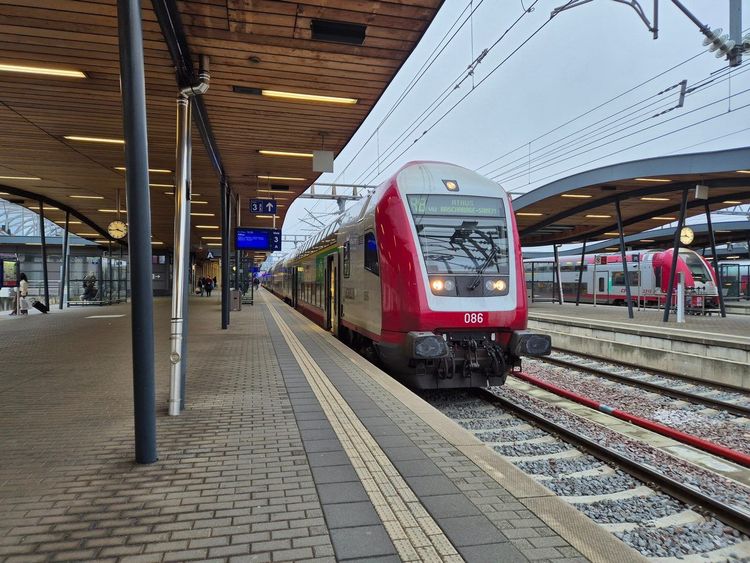
For a solo traveler, three areas stand out: the surroundings of the central station, fifteen minutes on foot from the old town, the historic center itself, pricier but lively in the evening, and Pfaffenthal, at the foot of the ramparts.
The station district concentrates the majority of budget hotels, with direct access to buses and the tram. It is the most logical base if you arrive by train from Brussels, Paris, Metz, or Trier.
The Luxembourg City youth hostel, managed by the Youth Hostels Luxembourg network, is located in Pfaffenthal, right beneath the Bock rock: dormitories of 4 to 8 beds, a shared kitchen, and a terrace with a view of the fortifications, a format that makes it easy to meet people if you are looking for company for a meal or an evening out. The nearby panoramic elevator takes you back up to the upper town in one minute.
Always compare prices before booking: rates vary considerably depending on the time of year and rise during institutional sessions or trade fairs.
The old town is home mainly to mid-range to upscale hotels, pricier but with everything on your doorstep: restaurants, monuments, and nightlife just a few minutes' walk away, a real selling point for a single night.
Mixed dormitories are generally safe for women traveling alone, with individual lockers in almost all establishments. Some hostels also offer female-only dormitories, an option worth checking at the time of booking.
Another option: a short-stay studio rental, which becomes competitive from two or three nights onward, with a kitchenette to help keep the food budget down. Book several weeks in advance: the hotel supply remains limited and budget rooms go quickly as soon as a European conference fills the calendar.
Budget: How Much Does a Solo Trip to Luxembourg Cost
Luxembourg has a reputation, partly deserved, for being one of the most expensive capitals in Europe. You can nevertheless keep costs down by making the most of the many free walks: the old town, the Chemin de la Corniche, the Grund, the Pétrusse valley, and the Pfaffenthal panoramic elevator cost nothing.
For accommodation, allow between 30 and 45 euros per night in a dormitory, and from 90 to 100 euros for a double room in single occupancy in the center, a rate that climbs quickly at weekends or during conference periods.
For meals, a simple lunch (sandwich, daily special at a bakery) comes to 8–12 euros, compared with 20 to 30 euros for a sit-down restaurant meal. Supermarkets such as Delhaize or Cactus allow you to put together a picnic for under 10 euros, perfect in the gardens of the Pétrusse.
Public transport has been free since 2020 (buses, trams, and trains in second class within the borders), which simply eliminates this line of expenditure entirely.
On the activities front, the Casemates du Bock cost 8 euros, the Mudam 10 euros (free on Wednesday evenings and for those under 21), and a treasure-hunt game between 10 and 20 euros. Around thirty euros a day covers paid activities comfortably.
Overall, a daily budget of 70 to 90 euros, hostel included, allows you to visit Luxembourg comfortably as a solo traveler, excluding the cost of getting there and back. By opting for picnics and free-entry visits, the most budget-conscious will come in under 50 euros a day.
As an example, a typical day for a solo traveler: 38 euros for a dorm bed, 4 euros for breakfast at a bakery, 10 euros for a daily special in the Grund, 8 euros for the Casemates, a sit-down dinner at 25 euros, and zero euros for transport. That is 85 euros, without depriving yourself. Replace the dinner with a picnic by the Pétrusse and visit the Mudam on a Wednesday evening, and you drop back below 65 euros.
Practical Info: Transport, Length of Stay, and Best Time to Visit
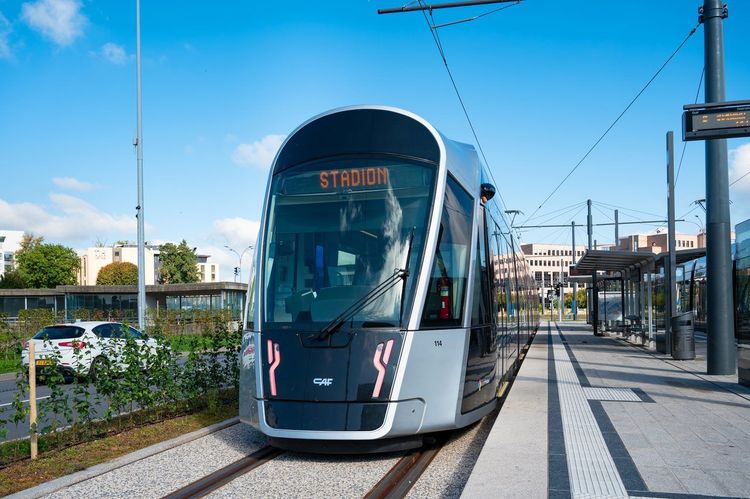
On 1 March 2020, Luxembourg became the first country in the world to make public transport free across its entire territory: buses, trams, and trains run without a ticket, except in first class.
Tram T1, in service since December 2017, crosses the city from the central station to Kirchberg and has served Findel airport since 2 March 2025. Buses complement the network to outlying districts, while the train remains the fastest option to Trier or Metz, less than an hour away (the journey becomes chargeable once you cross the border).
As for the length of stay, one full day is enough to see the essentials of the historic center and the fortifications. Two days allow you to add Kirchberg, an additional museum, and a more relaxed pace.
The best time to visit Luxembourg solo runs from April to October, when the terraces of the Grund and the Place d'Armes are in full swing and the long days leave plenty of time to chain everything on foot. Winter is not to be ruled out: the Winterlights and the Christmas market installed on Place Guillaume II, Place d'Armes, and Place de la Constitution from late November to early January give the old town an entirely different character.
From the airport, you can choose between the tram, direct to Kirchberg and the station, and city buses, all free: no taxi needed when arriving alone with luggage.
Three official languages coexist in daily life: Luxembourgish, French, and German, to which a widely spoken English is added. A French-speaking traveler will encounter no communication difficulties.
Tipping is not obligatory, as service is included in the bill, but rounding up is appreciated in cafés and restaurants in the center. And if you want to sample local cuisine alone at the counter, our selection of Luxembourg's culinary specialties will help you decode the menu, from Judd mat Gaardebounen to Gromperekichelcher.
To extend your stay, our Ryo top 6 things to do in Luxembourg lists a few additional ideas, useful if you are staying for more than two days.



FAQ
Is Luxembourg worth visiting?
Yes, at least for a full day: the old town, its underground fortifications, and its views over the Alzette valley form a dense ensemble, largely accessible without a ticket, and rarely matched within such a small area in Europe.
How many days do you need to visit Luxembourg solo?
One day is enough for the essentials of the historic center and the fortifications. Allow two days to add the Kirchberg plateau, a museum like the Mudam, and enjoy a more relaxed pace.
Is Luxembourg a safe city for solo travel?
Yes, Luxembourg ranks among the safest European capitals. Tourist areas remain quiet in the evening, including for a woman traveling alone. A little extra vigilance is recommended around the central station at night.
What budget should you plan for a solo trip to Luxembourg?
Allow between 50 and 90 euros per day depending on your comfort level, including hostel accommodation. Ticket-free walks and free public transport help keep daily spending well under control.
Where should you stay in Luxembourg when traveling solo?
The station district concentrates budget hotels, the youth hostel is located in Pfaffenthal beneath the Bock rock, and the old town, pricier, puts everything within easy reach for a short stay.
How do you get around Luxembourg City without a car?
Buses, trams, and trains have been free throughout the country since 2020. The tram connects the station, the city center, Kirchberg, and Findel airport, and several public elevators link the upper town to the lower districts.
What is the best time to visit Luxembourg solo?
From April to October, with open terraces and long enough days to chain sightseeing on foot. Winter is still worthwhile for the Winterlights and their Christmas market.
Luxembourg Solo: the Key Takeaways
Visiting Luxembourg solo turns out to be simpler than you might expect: the city can be covered on foot in a good full day, its underground fortifications and viewpoints rank among the most memorable in Europe, and free public transport eliminates one of the main headaches for a traveler without a companion.
It comes down to choosing your pace: a packed loop from morning to evening, or two more relaxed days with a detour to Kirchberg and its museums. Either way, the Ryo audio-guided tour of Luxembourg closely follows the route described above, from Place Guillaume II to the Casemates du Bock, so you can explore the city with your eyes on the façades rather than fixed on a map.