

Créé par Romane, le 7 mai 2026
Votre guide Ryo
© Shutterstock
When planning a trip to Rio, the image of its most famous statue almost immediately comes to mind.
Indeed, it's impossible not to think of Corcovado mountain, at the top of which a giant statue of Christ protects and blesses the wonderful city, embracing it with wide open arms.
With one statue, the city had acquired its symbol.
Here's all the information you need to understand the origin of this construction and to organize your visit!

What is the history of Christ the Redeemer?
It all begins with a breathtaking view…
The first Portuguese colonists were so fascinated by the view from the site that they nicknamed the mountain Pináculo da Tentação (Pinnacle of Temptation) before renaming it Corcovado (Hunchback). Later, they had a completely crazy idea for the time, that of building a road to reach its summit.
Then a tourist road…
In 1824, a 4 km long tourist road was inaugurated, a great first!
The feat of a railway…
60 years later, it was actually a railway line that takes you to the top of the mountain from Cosme Vehlo station. This nearly 4 km railway is the first in the country to be built solely for tourist purposes! It was by this same route that the material necessary for the construction of Christ the Redeemer would be transported.
In 1910, the train line would even be the first to be electrified, replacing the old steam wagons with more modern machines.
And an immense statue to crown it all!
The idea of erecting a religious monument at the top of Corcovado first appeared in 1859. It was the Lazarist priest Pedro Maria Boss who submitted the idea to Crown Princess Isabel of Brazil and asked her to finance his project.
The monument would not come to fruition and it wasn't until 1921 that the idea was submitted again, as part of preparations for the celebration of the centenary of Brazil's Independence which would take place the following year.
The Church wanted to reaffirm its presence in Brazil and the project was approved!
A great competition was then organized and it was the project of Brazilian engineer Heitor da Silva Costa that was selected. The construction, meanwhile, was entrusted to French sculptor Paul Landowski.
The first stone was laid in 1922, but work would not begin until 1926. Two years later, the metal structure was transformed into a concrete structure (also made by a Frenchman, Albert Caquot) and the statue was finally given its cross shape.
5 years of work later, the job was done and the statue was inaugurated on October 12, 1931.
Some figures…
- Corcovado is one of the largest statues of Christ in the world
- It attracts more than 600,000 visitors per year
- It has been classified as a historic monument since 1973
- It is part of the 7 new wonders of the world
- It is installed 710 meters high in the Tijuca national forest park
- It measures 38 meters high (30 for the Christ and 8 for the pedestal)
- It weighs 1145 tons
- The span between the two hands is 28 meters
- 220 steps allow you to reach the viewpoint platform. (today there are also escalators and elevators).
How to get to Corcovado?
To reach the famous Christ the Redeemer, you'll first need to arrive at the foot of Corcovado.
- By taxi or Uber (drivers know very well where to drop you off, don't worry!)
- By metro: get off at "Largo do Machado" station to take a shuttle or walk 30 min to Cosme Velho station where the ascent begins
- By bus. The stop is located at the start of the ascent. Bus 180 and 184 from the center. Bus 583 from Ipanema and Copacabana.
Once there, several options are available to reach the top of Corcovado: by train, by bus, or on foot!
By train
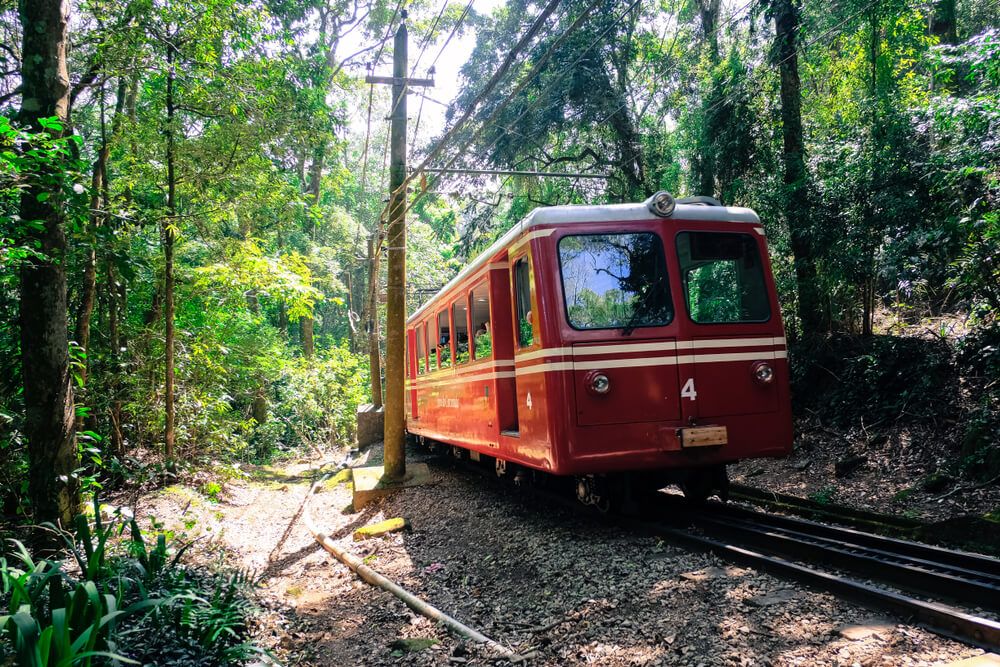
Taking the small cog train to reach the top of Corcovado is an experience in itself!
You cross the magnificent Tijuca national park and can enjoy a historic journey while having splendid views of the forest.
Good to know:
- Departure is from Cosme Velho station, accessible from downtown by bus or Uber.
- The journey takes about 20 minutes with departures every half hour.
- The train goes up at 15km/h and comes down at 12 km/h
- You can buy your tickets in advance on the official train website (trem do corcovado)
- The fare includes round-trip train and site visit.
- Saturday, Sunday and holidays are considered high season
More info on rates and schedules which constantly evolve on the official website: https://www.tremdocorcovado.rio/institutional/6/informations-pratiques.html
By shuttle
You can also choose to take the shuttle system set up by the Rio prefecture that takes you to the top of Corcovado.
They run daily from 8am to 5pm with departures approximately every 10 minutes. They leave from the Paineiras Visitors Center but some are accessible from Largo do Machado or Copacabana. In this case, the shuttles will make a stop at the Visitors Center where you will pay for the second part of your journey.
Since all travelers converge at Paneiras, it's preferable to buy your ticket online to avoid long queues.
https://ingressos.paineirascorcovado.com.br
The view is not as striking as by train, but the shuttle journey includes a stop at Dona Marta Viewpoint, from which you'll have a magnificent view of Tijuca national park and Corcovado on one side, and Sugarloaf and Guanabara bay on the other.
By car
If you come by car or motorbike, you can go up to Paneiras, but no further. From there you'll need to either take a shuttle or walk up!
On foot
Good news, you don't have to go through the tourist circuit to admire the view under the arms of Christ!
Many travelers decide to walk up and cross the Tijuca forest! You will then only have to pay the monument access fees.
The hike (trilha) takes about 1h30/2h depending on your level. No technical difficulty but the end is quite steep and be careful of the heat! Remember to bring enough water. It's preferable to be equipped with good shoes and leave during the coolest hours of the day.
The departure is from Parque Lage, next to the botanical gardens. You'll see a small forest hut that marks the trail entrance. The path is steep and climbs all the way. The view regularly opens onto the bay, offering you scenic pause opportunities, and ends, somewhat disappointingly, on the asphalt with the rest of the tourists arriving by road.

When to visit Corcovado
The site is open 7 days a week from 9am to 7pm.
Rio has an oceanic climate and is known for its mist, which tends to appear after 11am. It can add a nice mystical touch, but it can also quickly spoil the view! The best time of day to visit Corcovado is therefore in the morning! Plus there are fewer people, which is more pleasant.
Weather is really a point to consider and if you see the sky clouding over and clouds approaching, avoid the climb that will take you straight above the clouds. It can make for a nice photo, but it's still a shame not to see the bay and its incredible sugarloaves!
Another ideal time of day to go up to Corcovado: in the evening, when the city lights up. The sun sets early in Rio, at the height of summer, in December and January, it sets around 7:30 pm, but from February, you can see a sunset from 6:30 pm! 5 pm in winter!
Accessibility
Visiting Christ the Redeemer is completely possible for people in wheelchairs, the monument has an elevator to avoid steps, and the services and equipment on site are adapted.
Fun Fact!
You can get married at the foot of Christ the Redeemer!
At the base of the statue is a chapel dedicated to Nossa Senhora Aparecida, the patron saint protector of Brazil where weddings and baptisms can be celebrated!
Pretty nice view for the souvenir photo!