© Shutterstock
 Votre guide Ryo
Complete Guide to Going to the Calgary Stampede in 2026
For ten days every July, Calgary stops being an oil city and becomes something far more spectacular: the world capital of rodeo. White-collar workers swap their suits for plaid shirts, restaurants serve their dishes with house-made barbecue sauces, and a collective celebration takes hold of a metropolis of 1.3 million people. Going to the Calgary Stampede means finding yourself at the intersection of extreme sport and Alberta's Indigenous cultures, with more than a million visitors gathered under the July sun for "The Greatest Outdoor Show on Earth."
For French-speaking travellers, organising this trip requires real advance planning: a transatlantic flight to book months ahead, accommodation that disappears within weeks, and Grandstand tickets to purchase before the best seats are gone. This guide covers everything you need to know, from the 2026 dates to western dress codes and realistic budgets. And if you extend your stay to explore Calgary beyond the park, the Ryo app offers audio-guided tours of the city's historic neighbourhoods — a way to understand Alberta beyond the festival.
What Is the Calgary Stampede?
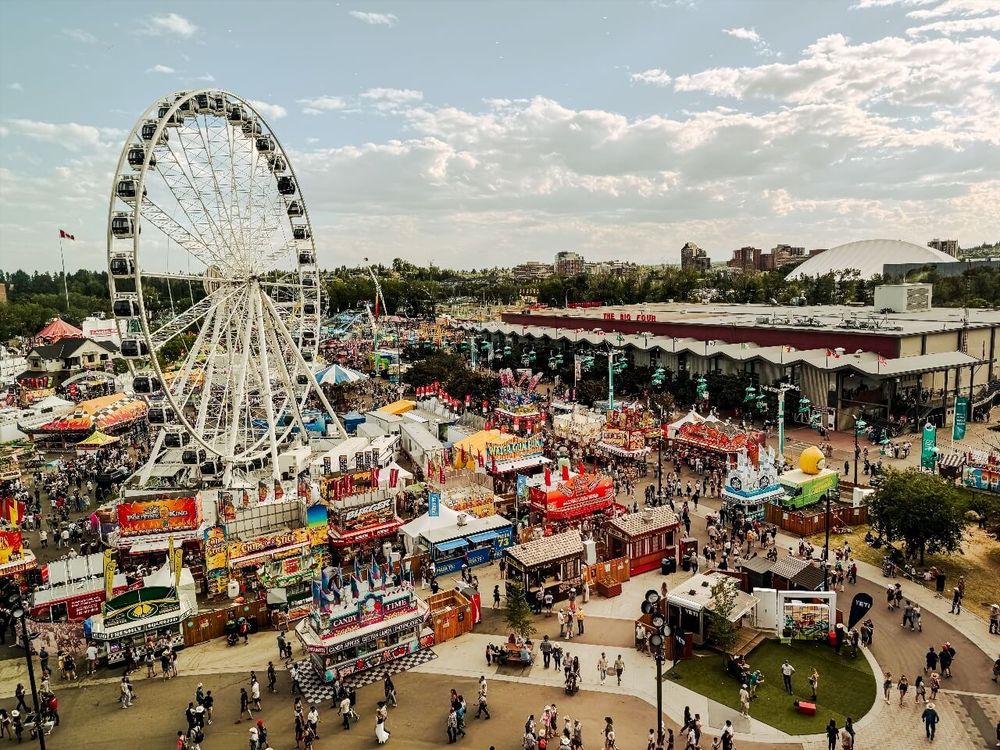
The Stampede was born in 1912, when Guy Weadick convinced Alberta ranchers to fund a grand rodeo exhibition. More than a century later, the event welcomes more than one million visitors over ten days in July, at Stampede Park (1410 Olympic Way SE, Calgary, AB T2G 2W1, rated 4.7/5 on Google with 48K reviews), a complex of more than 80 hectares (approximately 200 acres) just minutes from downtown Calgary.
Several worlds coexist within the park: professional rodeo (one of the richest in North America, with more than two million Canadian dollars in prize money), the legendary chuckwagon races, a full fairground, dozens of music stages including the famous Nashville North, and the Elbow River Camp, a cultural space dedicated to Alberta's First Nations.
What sets the Stampede apart from a simple festival is that all of Calgary takes part. Hundreds of businesses and community organisations host free pancake breakfasts in the streets. Hotels, bars, and even banks put up western decorations. Residents wear their cowboy outfits to the office. For ten days, the city lives differently.
2026 Dates, Programme, and Tickets
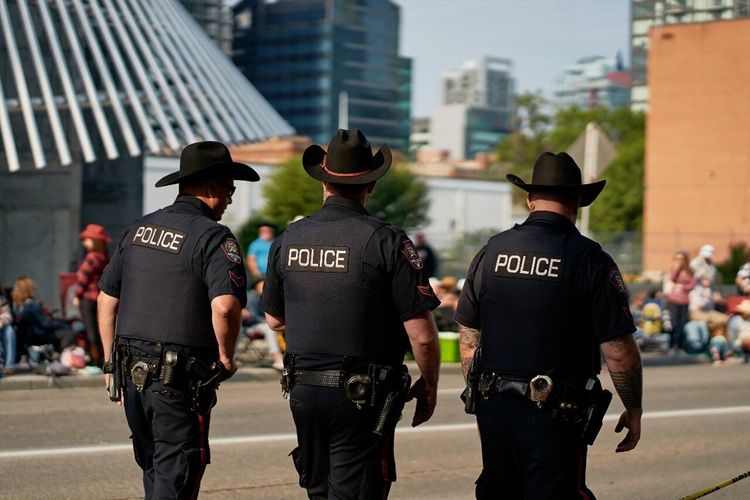
The 2026 Stampede runs from Friday, July 3 to Sunday, July 12, 2026 (ten consecutive days). The festivities kick off with the Stampede Grand Parade on Friday morning, running up 9th Avenue through downtown.
The programme is structured around several tiers of access:
General Admission (Grounds Admission): grants access to the park, the Midway, free stages, and exhibitions. Approximately CAD 18 to 25 per adult in advance, more at the gate.
The Grandstand: the central arena where the daytime rodeo and evening Grandstand Show take place. Tickets start at CAD 30 for the rodeo and CAD 40 for the night show. These tickets include grounds admission.
Chuckwagon races: races take place every evening in the Grandstand. Separate ticket or included in certain Grandstand packages.
The Stampede SuperPass: a worthwhile multi-event package if you plan to spend more than three days on the grounds. It provides access to several shows at a bundled rate.
Book your tickets several weeks in advance on the official Stampede website. Grandstand tickets for weekends sell out within hours of going on sale. The final Sunday rodeo — the grand finale with the highest prize money — is consistently sold out. If you only book one thing in advance, make it the Sunday, July 12 final.
How to Get to Calgary from France
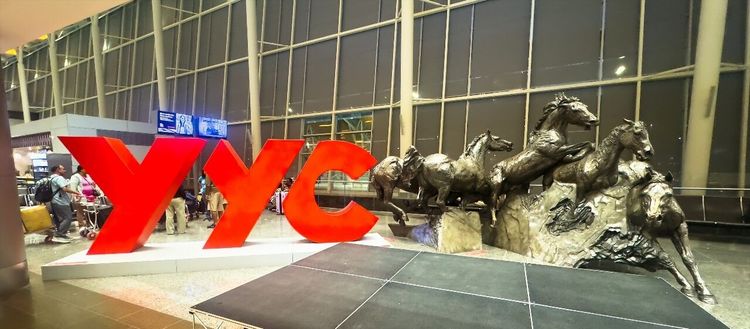
Calgary is accessible from Paris on a seasonal direct flight, operated by WestJet and, during the summer, Air Transat, departing from Paris-Charles de Gaulle. The flight duration is approximately 9h30 to 10 hours westbound. At other times of year, or if direct flights are full, connecting flights (Air Canada, KLM, Lufthansa, British Airways) transit through Toronto (YYZ), Montreal (YUL), Vancouver (YVR), or London (LHR) — allow 12 to 16 hours door to door.
During the Stampede period, direct flights from Paris are often fully booked by spring. A few pointers to help you plan ahead.
Book your flights 4 to 6 months in advance. Paris–Calgary airfares double during the first weeks of July. Outside the festival, a return ticket runs around 600 to 900 euros. During the event, the same routes reach 1,200 to 1,800 euros depending on dates and stopovers.
The time difference. Calgary is on Mountain Daylight Time (MDT in summer), UTC-6, which is 8 hours behind France on CEST. Adjustment takes 2 to 3 days. Arriving a few days before the festival begins gives you time to recover before the long days at the park.
Entry requirements. French nationals need an eTA (Electronic Travel Authorization) to enter Canada by air. The application is completed online through the Immigration Canada website for CAD 7 (approximately 5 euros) and is generally approved within minutes. It is mandatory before boarding — don't forget to apply when booking.
Recommended length of stay. Plan for at least 8 to 12 days: a minimum of 3 days at the Stampede, plus time to explore Calgary and the surrounding area (Banff, the Rockies). A transatlantic journey deserves a proper stay.
From the Airport to Stampede Park
Calgary International Airport (YYC) is about 20 minutes from downtown under normal conditions.
By taxi or rideshare, expect to pay CAD 35 to 50 to downtown, or CAD 45 to 60 directly to Stampede Park. This is the most straightforward option when arriving with luggage.
The CTrain (Calgary's light rail transit) connects the airport to downtown. During the ten days of the festival, Calgary Transit offers free CTrain rides to holders of a valid admission ticket. Get off at Victoria Park/Stampede Station, which opens directly onto the north entrance of the park.
If you rent a car to explore the region, be aware that parking around Stampede Park is scarce and expensive, between CAD 15 and 30 per day. Park in a downtown garage and take the CTrain for the last kilometre.
Where to Stay during the Stampede
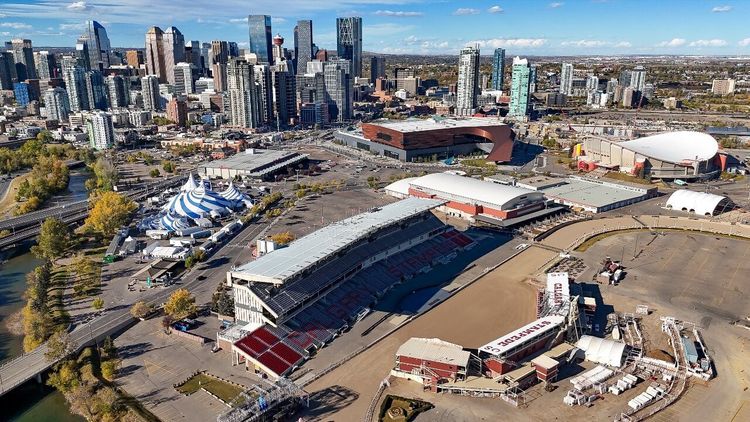
This is often the first surprise for travellers: hotels close to Stampede Park are booked months in advance, sometimes as soon as dates are announced the previous year. Rates triple or quadruple compared to normal periods.
Downtown Calgary: hotels close to the park, such as the Marriott Downtown, the Westin, or Hotel Arts, offer walkable access to the event. Expect CAD 200 to 400 per night during the festival, compared to CAD 100 to 150 outside the period. Book as early as possible — don't wait.
East Village: the neighbourhood between downtown and Stampede Park, undergoing major urban renewal, offers interesting Airbnb apartments. A 15-minute walk from the park, the atmosphere is quieter than the heart of downtown.
Calgary suburbs: Airdrie, Cochrane, and Okotoks offer significantly cheaper accommodation, accessible by car or public transit. Allow 30 to 45 minutes of travel time to the park.
Banff (1.5 hours west by car): some travellers use the mountain resort town as their base, combining the Rockies with the festival and driving in for days at the park. An original option if you want to maximise the trip, but tiring over several consecutive days.
Set a price alert on Booking.com or Hotels.com today for early July 2026 dates. Last-minute cancellations sometimes release rooms at less inflated prices. Don't rely on this as your Plan A.
The Rodeo: the Soul of the Stampede
The rodeo takes place every afternoon in the Grandstand, the vast central arena that can hold more than 17,000 spectators. Ten classic professional rodeo disciplines follow in succession: bull riding, saddle bronc riding, bareback bronc riding, steer wrestling, calf roping, team roping, and barrel racing, reserved for women.
Competitors come from Canada, the United States, Mexico, and Brazil — the best on the world circuit. Total prize money exceeds two million Canadian dollars, ranking the event among the most lucrative on the North American professional circuit.
For the uninitiated, bull riding condenses everything that makes rodeo what it is into eight seconds: the athlete must stay on a bull weighing 800 to 900 kg as it spins, bucks, and leaps. Eight seconds that feel endless from the stands. Judges score both the bull's performance and the rider's, with both counting toward the final score — meaning a bad draw can sink even the best competitor.
Arrive at the start of the afternoon to catch the programme from beginning to end. The most spectacular events, bull riding above all, are often scheduled at the end of the session when the crowd is at its peak. If you only attend one day of rodeo, make it the grand final on Sunday, July 12.
The Chuckwagon Races
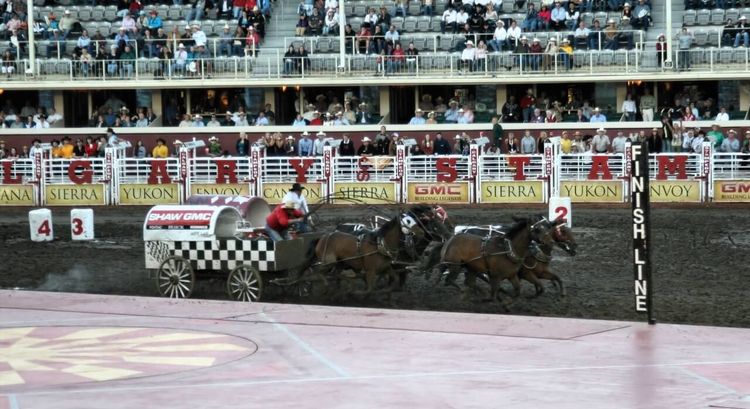
The chuckwagon races are a festival specialty that exists virtually nowhere else in the world. Four wagons, each pulled by four horses, launch simultaneously around an oval track after a series of manoeuvres in the starting enclosure. The speed on the straightaways, the precision through tight corners, and the thunder of hooves combine into a spectacle of an intensity that few sporting events can match.
The races take place every evening in the Grandstand, just before the night show. The final on the last Sunday draws tens of thousands of spectators. Book your tickets in advance: the final week is consistently sold out.
The Grandstand Show and Nashville North
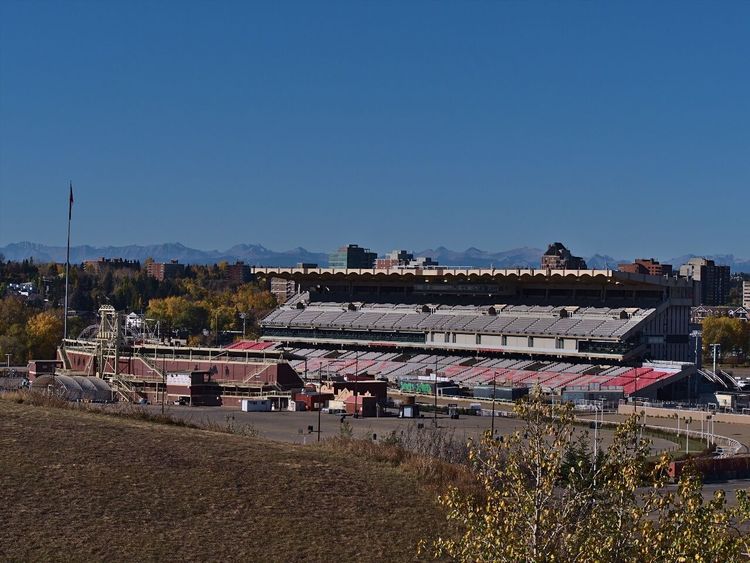
In the evening, once the chuckwagon races are over, the Grandstand Show takes over with a performance blending acrobatics, equestrian acts, dance, and pyrotechnics. The show lasts approximately one hour and concludes with a fireworks display visible from much of Calgary. It is often the most memorable moment of the evening for families and first-time visitors.
Just a few dozen metres away, Nashville North (Stampede Park, 1410 Olympic Way SE, Calgary, AB T2G 2W1, rated 4.4/5 on Google with 11,345 reviews) keeps the crowds dancing well into the night. The lineup alternates between local Canadian artists and North American country headliners. The atmosphere blurs the line between concert and western dance: the space is enormous, and hundreds of people line dance on the central floor.
Other stages scattered throughout the park offer a wider range of genres throughout the day. Check the schedule on the official Stampede app so you don't miss an unexpected headliner.
The Midway: Rides and Over-the-Top Food
The Midway is the Stampede's fairground, and it is massive. Dozens of rides cover every level — from children's carousels to stomach-turning roller coasters — alongside skill games with giant stuffed animals to win, and above all a concentration of street food vendors unlike anything else.
Midway food is an experience in its own right. Among the specialties that return every year: deep-fried Oreos (Oreo cookies fried in batter), chocolate-covered bacon on a stick, cinnamon mini-donuts — a historic Midway icon since the festival's earliest days — maple syrup funnel cakes, and portions of grilled Alberta beef of a generosity that leaves you speechless.
A reasonable budget for a Midway session: CAD 20 to 40 per person for food and a few games. Rides are priced separately or with an all-day wristband for approximately CAD 50 for adults.
Free Pancake Breakfasts: a Stampede Ritual
One of the festival's most endearing traditions — and one that often goes unnoticed by foreign visitors — is that during the ten days of the event, hundreds of Calgary businesses, community organisations, and neighbourhoods host entirely free pancake breakfasts in the city's streets.
Pancakes, sausages, eggs, and maple syrup, all served by volunteers in western attire, at dozens of locations spread across the city. Large sessions can draw 5,000 to 10,000 people on weekends. The full list of Stampede Breakfasts is published each year on the City of Calgary website.
Head out early: queues grow quickly from 9 a.m. onwards. It is also a great opportunity to mingle with locals rather than other tourists.
First Nations Culture
Since its beginnings, the Stampede has maintained a special relationship with Alberta's Indigenous peoples. The Elbow River Camp (Stampede Park, 1410 Olympic Way SE, Calgary, AB T2G 2W1, rated 4.4/5 on Google with 11,345 reviews) (formerly the Indian Village) brings together representatives of the five Treaty 7 signatory nations each year: the Siksika (Blackfoot), the Kainai (Blood Tribe), the Piikani, the Tsuut'ina, and the Stoney Nakoda.
Traditional tipis are erected for the entire duration of the festival. Dance demonstrations, beadwork, traditional craft-making, and discussions about each nation's history are offered, all included in grounds admission at no extra charge.
The Stampede Powwow is one of the most striking moments of the week. It is a traditional Indigenous dance competition, open to the public, where dancers from across Canada present elaborate costumes crafted over months. The sound of drums resonates throughout the park. Allow at least two hours at this site: it is a dimension of the festival that many visitors regret having underestimated, drawn away too quickly by the Midway rides.
Dress Code and Western Attire
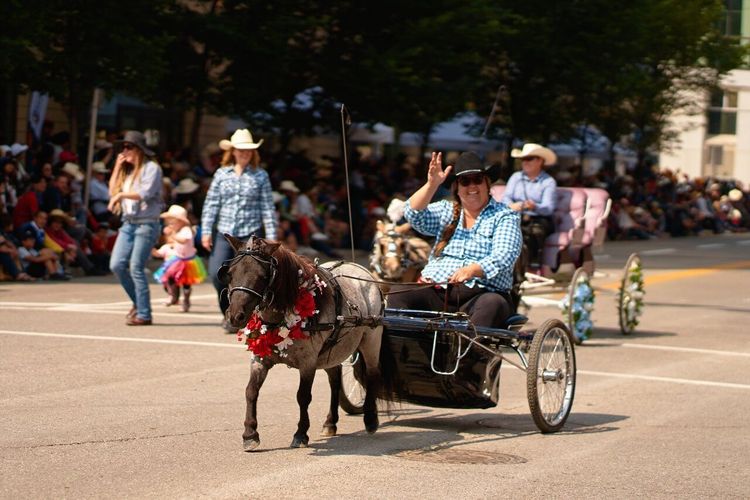
There is no mandatory dress code, but the Stampede is one of the rare occasions in the world where going out in a cowboy hat is not only acceptable but expected. Locals and tourists alike embrace the look without hesitation.
The basic kit: a cowboy hat (felt or straw for summer), jeans, a plaid or rodeo pearl-snap shirt, and ideally western boots. Dozens of shops in Calgary sell or rent gear for the duration of the festival. The Lammle's Western Wear chain is the local reference, found in several shopping centres.
Also bring sunscreen (the Alberta sun is intense in July), a light windbreaker for cool evenings, and comfortable insoles if you don't have boots — you will be walking for hours on the grounds.
Budget and Practical Tips
Estimated cost per person for a full day at the Stampede:
| Item | Estimated Cost (CAD) | |------|---------------------| | Grounds admission | 18–25 | | Grandstand ticket (rodeo + show) | 40–80 | | Food and drinks | 30–50 | | Midway (rides + games) | 20–50 | | Return transport | 0–15 | | Total per day | 108–220 CAD |
For a complete trip from France (flights, accommodation, tickets), budget 2,000 to 3,500 euros per person for a week, depending on hotel quality and how early you book.
A few tips that make a real difference:
Come on a weekday rather than the weekend. Festival weekends are packed, with up to 150,000 visitors per day on the opening Saturday and Sunday. On a Tuesday or Wednesday, attendance drops by 30 to 40 percent, queues disappear, and the overall experience is more enjoyable.
Arrive when the grounds open at 9 a.m. The first hours are ideal for exploring the Midway and the First Nations site before the crowds arrive. The rodeo doesn't start until early afternoon.
Stay hydrated throughout the day. July in Alberta can be dry and hot, with temperatures around 28–30°C without the humidity of the coasts. Drinking water fountains are available in the park — locate them as soon as you arrive.
Download the official Stampede app before you arrive: a real-time interactive map, a detailed hourly schedule for each stage, and alerts on wait times at popular attractions.
Bring some cash. Almost everything accepts card payments, but some Midway vendors operate on cash only. Having CAD 50 to 80 in your pocket avoids frustrating situations in front of a mini-donut stand.
For non-festival days, the Ryo audio guide takes you through Calgary's streets, from the Kensington neighbourhood to the Bow River riverwalk, with stories about a city built in two generations. A way to extend the trip beyond the grounds.
FAQ
When does the Calgary Stampede take place in 2026?
The 2026 Stampede runs from July 3 to 12, 2026, ten consecutive days. The event traditionally begins on the first Friday of July with the Grand Parade through downtown Calgary, followed by the grounds opening at 9 a.m. The gates close each evening after the Grandstand Show fireworks.
Should I book tickets in advance?
Yes, strongly. Tickets for the evening Grandstand Show, rodeo finals, and chuckwagon races sell out very quickly, sometimes within hours of going on sale. General grounds admission is more accessible, but prices rise as the event approaches. Buy everything through the official site calgarystampede.com to avoid scalpers and counterfeit ticket scams.
How Much does the Calgary Stampede Cost?
Budget between CAD 100 and 220 per person for a full day including admission, a Grandstand ticket, food, and a few Midway attractions. Without a Grandstand ticket, a day on the grounds with meals runs around CAD 60 to 100. For the full trip from France (flights + accommodation + tickets), plan on 2,000 to 3,500 euros per person for a week.
How do I get to Stampede Park from downtown?
The easiest option is the CTrain (Calgary's light rail). During the festival, Calgary Transit offers free rides to holders of a valid admission ticket. Get off at Victoria Park/Stampede Station, the north entrance of the park. By taxi or Uber from downtown: CAD 10 to 15 for a 5-to-10-minute ride. Walking from some downtown hotels takes 15 to 20 minutes.
Is the Stampede suitable for families with children?
Absolutely. The Midway has attractions for all ages, the Grandstand Show is suitable from age 5–6, and the Elbow River Camp is particularly educational for children. Reduced rates exist for ages 7–12. Children under 6 enter the grounds free. Bring ear protection for younger children during the Grandstand Show.
What is there to do in Calgary outside the Stampede?
Calgary offers much more than the festival. Banff National Park is 1.5 hours west by car, with Lake Louise, glaciers, and hikes through the Canadian Rockies. In the city itself, the Kensington neighbourhood, the Glenbow Museum, the Calgary Zoo, and Crossroads Market are all worth a visit. The Ryo audio guide for Calgary leads you through the city's streets with stories about its history — ideal for non-festival days.
Conclusion
The Stampede is one of those events that justifies the transatlantic journey. Not just for the rodeo or the chuckwagon races, but for the complete experience of a city that collectively transforms itself for ten days — a celebration that has been going strong since 1912 without ever losing its power to impress first-time visitors.
Plan well in advance: flights, hotel, and Grandstand tickets all need to be booked several months before early July. Come on a weekday to avoid weekend crowds. And if you extend your stay in Calgary after the ten days of the Stampede, the Ryo audio guide takes you through the neighbourhoods the festival never shows — Alberta's history is just as rich beyond the grounds of Stampede Park.