
Créé par Emilie, le 7 mai 2026
Votre guide Ryo
© Shutterstock
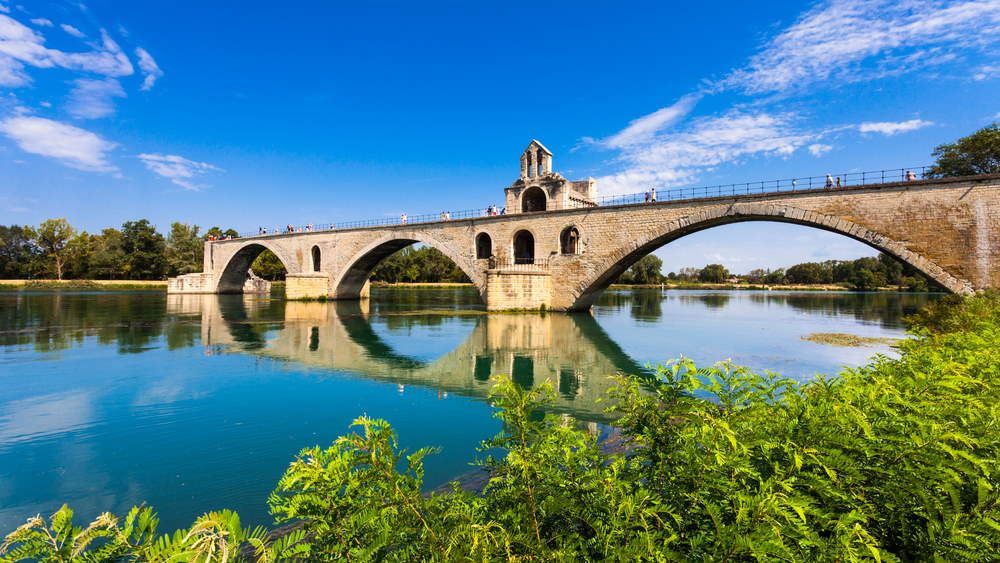
This bridge, which made all the children of France sing with its famous nursery rhyme, has a very particular history. Victim of the Rhône's whims and of men who never ceased to wage war, the Avignon Bridge is rich in history, anecdotes and legends that you can discover during your stay in Avignon. Because, yes, in the south, we don't say: at Avignon (it's not beautiful), but: in Avignon. Here's a first anecdote. To discover many others, don't hesitate to take our specially designed circuits to not miss anything of the beautiful city of Avignon and its famous bridge.
How to visit the Avignon Bridge or Saint-Bénezet Bridge?
You can admire the Avignon Bridge both day and night, as it is visible from afar. Magnificent photos can be taken from Avignon Intra-muros, or the Barthelasse Island. The Avignon Bridge has only good profiles! In the evening, the bridge lights up, and the advantage, if you're a photography enthusiast, is that there will be no one on it anymore.
It is of course possible to walk on the paved ground of the Avignon Bridge by purchasing a ticket, the bridge's history will be told to you through audioguides, exhibitions, films... You will also enjoy a breathtaking view of the Rhône and the city's ramparts.
Discover the entire Avignon Bridge, as it was originally
During your visit, films, an exhibition and touch tablets will allow you to discover the Avignon Bridge as it was at its construction. A true technical feat that represented an endless construction site for the workers of the time, in order to keep the two banks of the Rhône connected. Research teams under the aegis of Grand Avignon and CNRS have developed museographic devices allowing the 3D reconstruction of the bridge respecting the landscapes of different eras. A long-term work that is truly worth seeing! This unique experience is done through 3 devices:
- The museographic space "The Rediscovered Bridge" with films and an exhibition that will present you the enigmas of the Avignon Saint Bénezet Bridge.
- Touch tablets made available to visitors will reveal the tumultuous history of this mythical bridge through films, images, and very fun quizzes!
- Discovery of the Avignon Bridge legends through an exhibition to follow with an audioguide.
Practical info: hours, access, payment methods and Avignon Bridge prices
The Avignon Bridge is open all year round, 7 days a week.
1 – Visit hours:
- From January 1st to April 8th: 10:00 AM to 5:00 PM
- From April 9th to November 6th: 10:00 AM to 6:00 PM
- From November 7th to December 31st: 10:00 AM to 5:00 PM.
2 – Prices
- Full price: €5
- Reduced price: €4.
- Free for children under 8.
- Children between 8 and 17 + students: €4
3 – Payment methods
- Holiday vouchers,
- Cash,
- Check,
- American Express,
- Debit/credit card
4 – Facilities
Elevator, Restrooms, Parking, and Nearby parking.
The bridge site is accessible to people with reduced mobility.
A specific audio-guided commentary is available for visually impaired people.
Where to park to visit the Avignon Bridge?
1 – Free parking
You won't find any intra-muros, or very rarely, because locals know them well and prefer this parking mode.
Located at Piot and Italiens, you will find 2,500 free spaces at this location. A free shuttle takes you to the city center every 5 to 10 minutes from 7 AM to midnight from Italiens, and from 7 AM to 8:30 PM from Piot.
If you prefer to walk, it will take you 5 minutes from Piot and 15 minutes from Italiens to reach the city center.
The Epi parking is 10 minutes from the city center on foot, no shuttle serves this parking.
2 – Paid parking
A secure underground parking open all year round. This is the closest parking to the Avignon Bridge.
Rate: €0.20 to €0.50/15min from 8 AM to 8 PM except July and €0.10 to €0.60/15min in July.
How did the Avignon Bridge break?
The strong floods of the Rhône in 1603 destroyed a first arch, then 3 others collapsed 2 years later for the same reason. Repairs began in 1628, but the plague epidemic that was raging in the country at the time meant that the bridge would only be viable again in 1633. It would only take 2 months for the Rhône to destroy 2 arches again, but the city could no longer afford the multiple repairs and maintenance of the Avignon Bridge. It therefore remained as you see it today.
The History of the Avignon Bridge
If we believe the legend, it was a young shepherd from Vivarais named Bénezet who received the celestial order to build a bridge in Avignon.
In reality, if the real name of the Avignon Bridge is Pont Bénezet after the young shepherd, its construction, which was carried out over several centuries, began in 1177. A complicated construction, on a gravel bed, which turned into a permanent construction site. It then measured 900 meters by 4 meters wide and had 22 arches. Its role was essential, it allowed controlling river traffic, connecting Villeneuve to the city of Avignon (boat crossings being very often perilous), then it became indispensable to the papal court when it settled in the Palace of the Popes. But the climate changes of the 15th century and after, modified the hydrology of the Rhône, it became more powerful and more devastating, strong floods accumulated over the centuries. Despite the will and courage of the people of Avignon, the project had to be abandoned for lack of means in the 17th century. Louis XIV was one of the last to cross the Avignon Bridge, and despite his attachment to this building which he wished to own, he refused to pay for its reconstruction as did those who followed thereafter.