
Créé par Emilie, le 20 juin 2026
Votre guide Ryo
Bordeaux Without Tickets: 25 Experiences to Live for Free in 2026
© Shutterstock
Bordeaux was inscribed on UNESCO's World Heritage list in 2007, and among the free activities to do in Bordeaux, some rival any paid attraction in Europe. Its UNESCO perimeter of 1,810 hectares houses nearly 350 buildings classified or listed as Historic Monuments, making the city one of the best-preserved 18th-century architectural ensembles on the continent, the second largest after Paris. You can spend hours walking along the quays, getting lost in the alleys of Chartrons or sitting in front of the Water Mirror, on foot, without constraint. Want to explore Bordeaux at your own pace, with or without a budget? The Bordeaux Ryocity offers an audio-guided route with 29 audios over 6.2 km through the historic center, from the "sleeping beauty" to its least marked corners. This guide is made for you.
Among the experiences awaiting you: a forgotten 2nd-century Roman amphitheater in the city center, a Nazi submarine converted into an exhibition hall, five museums that open their doors without charge on the first Sunday of the month, a comedy club where the audience decides what they want to pay, a surviving medieval gate, open-air street art frescoes and the world's largest artificial water mirror. Bordeaux offers much more than its blonde stone facades.
Here are 25 ways to discover the city, heritage, cultural, lively, most of which are freely accessible, and among which are some of the best free activities to do in Bordeaux.
1. The Water Mirror, the World's Largest Artificial Water Mirror
At Place de la Bourse, the 3,450 m² of polished granite have changed the relationship of Bordeaux residents with their river. The Water Mirror operates in cycles: three minutes of filling, fifteen minutes of mirror effect with a 2-centimeter water layer that erases the boundary between sky and blonde stones, five minutes of emptying, then three minutes of mist drawn by approximately 900 micro-sprinklers dug into the ground. The system draws from an 800 m³ reservoir and runs continuously from May to October, from 10am to 10pm.
Designed by landscape architect Michel Corajoud and inaugurated in 2006, there was nothing comparable in Europe at the time. The original idea was almost simple: for the 18th-century facades of Place de la Bourse to be reflected in something at street level. The result far exceeds urban decoration; it is today Bordeaux's most photographed attraction, ahead of the cathedral and the Grand Theatre.
Come early in the morning on weekdays if you want to have it to yourself: before 11am in July-August, the square is still relatively deserted. You'll see the first wisps of mist rise in the raking light without a soul around. Sunday afternoon is the opposite, hundreds of children splash around and the atmosphere is festive, which is also worth the trip for another reason.
In winter, the slab is dried for maintenance but the square remains beautiful. The reflection of the facades in the wet cobblestones after rain offers a more austere, lesser-known version. Photography enthusiasts find their account there.
2. The Garonne Quays, 4.5 km of Redeveloped Riverbanks
From the Bourse to hangar 14, the Bordeaux quays (Quai Louis XVIII, 33000 Bordeaux, rated 4.6/5 on Google for 543 reviews) have been transformed since 2000 as part of the waterfront redevelopment project carried by the city hall. 4.5 km of riverbanks freed from expressways, restored to pedestrians and cyclists. This redevelopment directly contributed to the city's inscription on the world heritage list.
Along the route: basketball and beach volleyball courts near the Conservatory, playgrounds, bars and restaurants on summer evenings, and the gradual return of aquatic fauna in the Garonne. Rent a TBM bike (the metropolitan bike-sharing network) to cover the whole thing in an hour without effort, the stations are located every 300 to 400 meters on the quays.
The sunset facing the Garonne, from quai de la Douane or the stone bridge, is a moment difficult to equal in French cities of this size. If you follow the audio-guided route of the Bordeaux Ryocity, part of the stops directly line the quays, from the Water Mirror to the Chartrons district.
3. Saint-André Cathedral and Pey-Berland Tower
The Saint-André Cathedral is one of the most studied Romanesque and Gothic buildings in the Southwest. Its construction spanned from the 11th to 15th century, which explains the superposition of styles you observe when entering: the first Romanesque naves contrast with the rayonnant Gothic of the chevet, rebuilt in the 14th century. Louis VII and Eleanor of Aquitaine were married here on July 25, 1137, before Eleanor eventually divorced and married Henry II of England, permanently altering European geopolitics.
The interior is sober but imposing: 124 meters long, 23 meters under vault in the nave, 18th-century organs still in working order, and stained glass windows that date for some from the 14th century. Entrance is free every day. Take time to walk around the building from the outside, the north facade, opening onto Place Pey Berland, is often less photographed than the main portal but architecturally more detailed.
Right across stands the Pey-Berland Tower, detached bell tower built in the 15th century to avoid weakening the cathedral's foundations, whose marshy soil could not support the weight of an attached belfry. Its climb (233 steps) is paid, but the view from its terrace over the zinc roofs and bell towers of the city center is one of the widest in Bordeaux.
4. The Public Garden, 10 Hectares in the Heart of the 18th Century
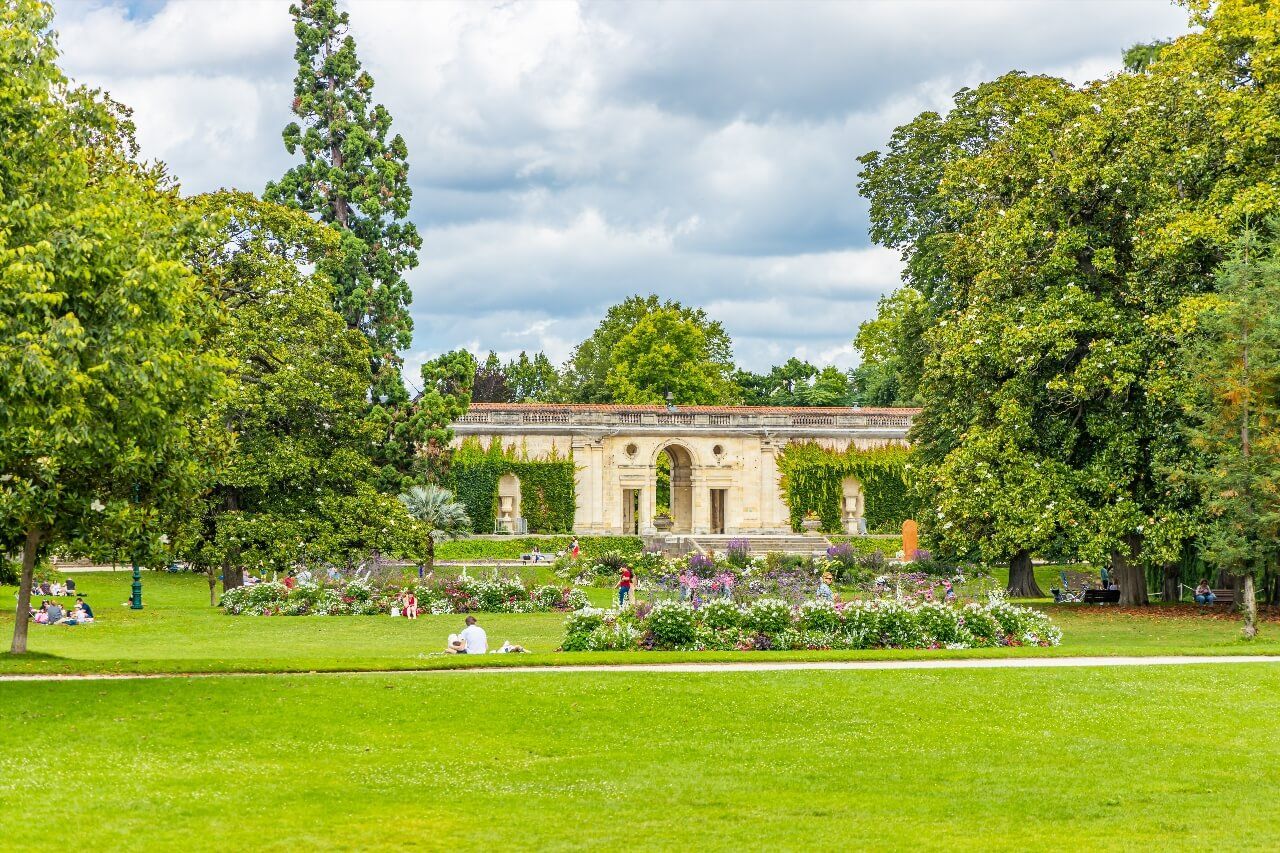
The Bordeaux Public Garden (Cours de Verdun, 33000 Bordeaux, rated 4.6/5 on Google for 14,502 reviews) opened in 1756, designed in the French style by Ange-Jacques Gabriel, the king's first architect, then redesigned in the English style in the 19th century on marshy land that the city had just drained. 10.5 hectares between Cours de Verdun and Rue Judaïque, with an integrated botanical garden (whose collections date back to 1629, transferred here in 1855, one of the oldest in France), a natural history museum at the main entrance, and a Guignol theater that has been performing since 1853.
Entry is free, the botanical garden too. The natural history museum, housed in the Hôtel de Lisleferme, a private mansion from 1781, since 1862, is open without reservation and offers permanent collections of paleontology, zoology and geology accessible Tuesday to Sunday. Check the hours before coming: it's closed on Mondays.
The central pond with its swans and ducks attracts park regulars, but the botanical garden, less frequented, deserves an extra half hour. The tropical greenhouses house species you won't see in ordinary parks.
5. The Grand Théâtre de Bordeaux, Listed Facade
The facade of the Grand Théâtre (Place de la Comédie, 33000 Bordeaux, rated 4.6/5 on Google for 9,792 reviews) opens directly onto Place de la Comédie, in line with Cours de l'Intendance. Built between 1773 and 1780 by architect Victor Louis, who would later design the galleries of the Palais-Royal in Paris, it is considered one of the most beautiful neoclassical theaters in Europe.
Its 12 statues on the facade represent the nine Muses and three goddesses (Juno, Venus and Minerva). From the opposite sidewalk, contemplating the facade is enough to understand why Garnier said he was inspired by the double revolution staircase of the foyer to design the Paris Opera. The foyer is accessible during guided tours, some are offered by the Bordeaux Tourist Office at reduced rates. The interior of the hall is accessible with a show ticket. But the monument is already worth the detour from the opposite sidewalk.
6. Municipal Museums, Free Access on the 1st Sunday of the Month
Bordeaux has five municipal museums that open their permanent collections without a ticket on the first Sunday of each month, except in July and August. It's one of the most generous cultural policies in France for a city of this size, and the cornerstone of any serious list of free activities to do in Bordeaux.
The CAPC Contemporary Art Museum is housed in the Entrepôt Lainé, former colonial goods warehouse built in 1824 and rehabilitated by architects Denis Valode and Jean Pistre between 1984 and 1990: a nave of 3,422 m² of exhibition space under an industrial glass roof, devoted to contemporary art exhibitions. The building itself justifies the visit.
The Musée d'Aquitaine (20 Cours Pasteur, 33000 Bordeaux, rated 4.5/5 on Google for 4,691 reviews) traces 25,000 years of regional history through collections of prehistory, antiquity and modern history. Its room devoted to the slave trade, Bordeaux was the second slave port in France in the 18th century after Nantes, is one of the most documented in France on this subject.
The Fine Arts Museum (two pavilions flanking the City Hall) has collections from the 16th to 20th century, with a Titian, a Rubens and several Delacroix in the permanent rooms. The Museum of Decorative Arts and Design is housed in an 18th-century private mansion and covers applied arts from the Renaissance to the present day. Finally, the Submarine Base (see section 17) is part of the same admission rights. The Frac Nouvelle-Aquitaine MÉCA, on the quays, also applies free admission every first Sunday of the month (from 1pm to 6pm).
Note: the first Sunday covers permanent exhibitions. Temporary exhibitions may remain paid depending on the establishment.
7. The Grosse Cloche, Surviving Medieval Gate
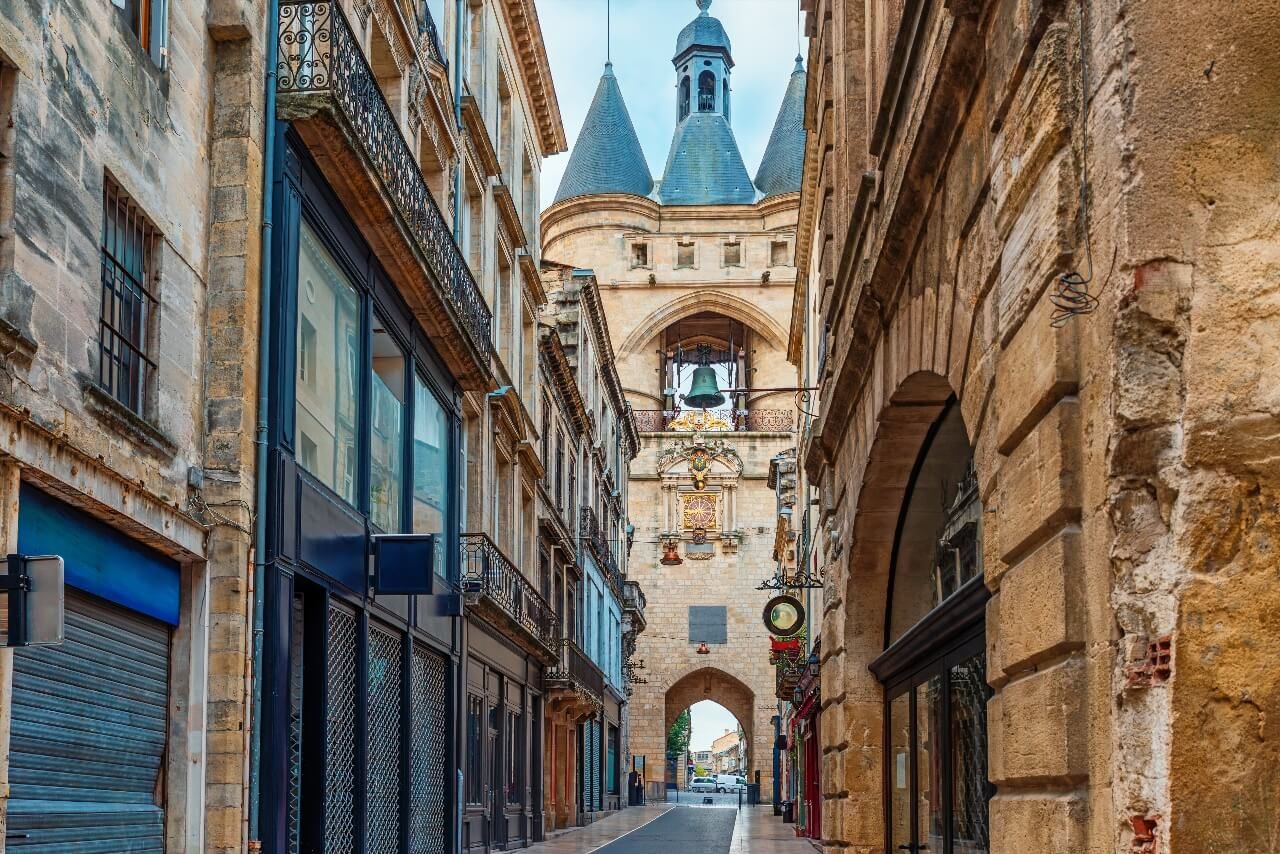
At the end of Rue Saint-James, the Grosse Cloche is Bordeaux's best-preserved medieval gate. Built in the 15th century on the remains of a 13th-century gate, it is one of the few to have survived the destructions of the Haussmann period. Its two round towers frame a belfry that still houses the bell cast in 1775 by founder Turmeau, 7,800 kg, two meters in diameter, rung only on special occasions.
The gate can be visited from the outside at any time. The interior is accessible during certain heritage days or special events.
8. Saint-Michel Basilica and Its 114m Spire
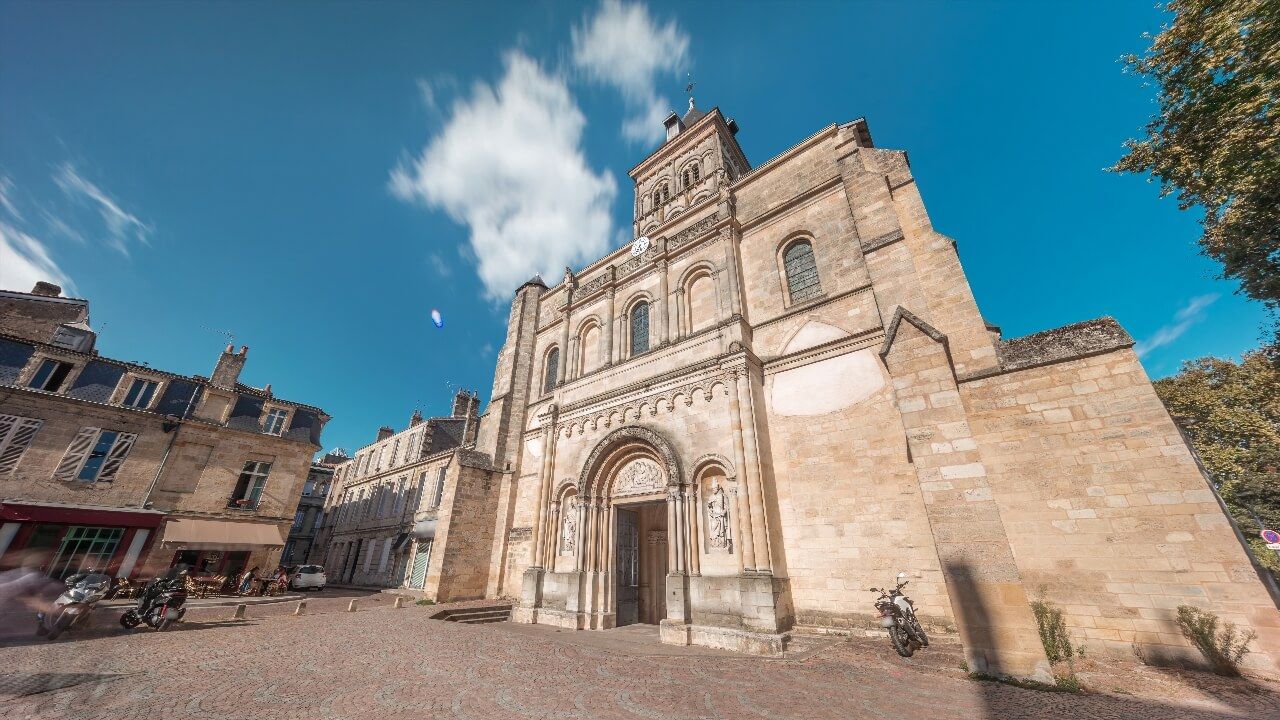
The Saint-Michel Basilica occupies a tight quadrilateral between Place Canteloup and Place Meynard, in a historically popular and cosmopolitan district since the Middle Ages. Its construction lasted from the 14th to 17th century, the flamboyant Gothic style of the chevet is particularly elaborate.
What distinguishes Saint-Michel from all other Bordeaux churches is its autonomous spire: the 114-meter tower is a detached bell tower, built separately for the same structural reasons as the Pey-Berland tower (marshy soil). Completed in 1492, it is today France's second highest bell tower. The spire underwent a long restoration, its reopening is scheduled for June 2026 as part of the Chahuts festival. Formerly, its basement housed an ossuary famous for its mummies, now transferred to the Musée d'Aquitaine.
The flea market held every Sunday morning around the basilica deserves the trip alone. Vinyl record dealers, antique crockery and vintage clothing occupy Place Canteloup from 7am. Arrive before 10am for the best pieces.
9. Palais Gallien, Vestige of a Roman Amphitheater
At the turn of a street in the Grands Hommes district, arches of red stone and brick emerge between two Haussmann buildings. The Palais Gallien (Rue du Palais Gallien, 33000 Bordeaux, rated 4.2/5 on Google for 2,100 reviews) is what remains of the Roman amphitheater of Burdigala, built at the beginning of the 2nd century for a city that then had about 20,000 inhabitants. Its original dimensions: 132 × 111 meters, for an estimated capacity of 22,000 spectators, equivalent to a modern Stade Chaban-Delmas.
The site is accessible on foot from the outside at any time. A few arches remain at height, protected by railings, in the middle of a landscaped green space. Few explanatory panels on site: read a bit about the history of Burdigala before coming, you'll look at these stones differently. It is, in the 21st century, the only ancient vestige still visible in Bordeaux.
10. Saint-Seurin Basilica, Bordeaux's Oldest Monument
Less visible from the major tourist arteries, Saint-Seurin Basilica (Place des Martyrs de la Résistance, 33000 Bordeaux, rated 4.5/5 on Google for 1,068 reviews) nevertheless deserves a stop. It is Bordeaux's oldest monument still standing: a paleochristian basilica whose first foundations date back to the 4th-5th century, built on the site of an ancient necropolis still partially excavated under the forecourt. Inscribed on UNESCO's World Heritage list in 1998 as a stage on the Santiago de Compostela pilgrimage routes, it is regularly ignored in favor of more central buildings.
The interior reveals a superposition of styles that tells fifteen centuries of history in a single building: the 11th-century Romanesque porch, the 13th-century Gothic nave, chapels added until the 16th century. The treasury houses goldsmith pieces from the early Middle Ages. Entry is free, the archaeological crypt is accessible on request during opening hours. Allow 30 to 40 minutes to go through the whole thing without rushing.
11. Chartrons, the District of Antique Dealers and Galleries
The Chartrons owe their name to the Carthusian monks who settled there in the 14th century. But it was in the 18th century that the district took on its current face: the great wine merchants, Flemish, Irish, German, built their warehouses along the Garonne and their private mansions in the perpendicular streets. The result is a remarkably homogeneous district, with its chais (wine warehouses) converted into galleries, its permanent antique dealers and its Rue Notre-Dame lined with 18th-century facades.
The Village Notre-Dame, along Rue Notre-Dame, brings together about twenty permanent antique dealers, forming the Southwest's first antique gallery. 18th-century Bordeaux furniture, earthenware, old lighting, rare books: each shop is a reserve in its own right, and the owners are often ready to tell the provenance of their pieces.
The Ryo audio-guided tour of Bordeaux crosses Chartrons in several stops, with the stories of merchant families who shaped the architecture of Rue Notre-Dame and Quai des Chartrons. 29 audios in total for a complete walk of about 2h30 over 6.2 km, from the Water Mirror to Chartrons and back.
If you're wondering what to eat around Chartrons, head to the Chartrons market (market square, Sunday morning): Gironde producers sell hot canelés, aged cheeses, Bassin oysters and prepared dishes to take away for two or three euros.
12. The Stone Bridge, 17 Arches Over the Garonne
First bridge built over the Garonne in Bordeaux, the Stone Bridge was inaugurated on May 1, 1822 by order of Napoleon I, after ten years of work begun in 1812. Its 17 brick arches correspond, according to local legend, to the 17 letters of "Napoléon Bonaparte", the reality is more prosaic: this number of arches was needed to resist the violent currents of the Garonne. Before it, inhabitants crossed the river only by ferry since the Middle Ages, this bridge literally reconfigured exchanges between the two banks.
From the middle of the bridge, the view of the quays and Saint-André Cathedral in the background is one of Bordeaux's most photographed. The walk across takes less than 10 minutes. In the evening, the cast iron streetlights and reflections in the Garonne give the place an atmosphere that few French bridges can match. Do it at sunset if your schedule allows.
13. Darwin Ecosystem, the Converted Military Wasteland
On the right bank, in the Bastide district (Bordeaux, Quai des Queyries, 33000 Bordeaux, rated 4.4/5 on Google for 1,200 reviews), the former Niel barracks has been rehabilitated since 2011 into an ecosystem spread over more than 3 hectares of former military wastelands on the banks of the Garonne. Darwin is not a museum or a park: it's a living place where offices, an organic supermarket, a restaurant, an indoor skatepark (10,000 m² of hangars shared with an urban farm, capacity of 300 skaters), a concert hall and murals that cover the red brick facades coexist.
Entry into the courtyard is free at any time. The exterior frescoes change regularly as artist residencies unfold. The indoor skatepark, one of France's largest to date, is accessible to practitioners. On weekends, the organic market attracts a local clientele that transforms the courtyard into a living space. The view of the quays from the Garonne side, from the embankment in front of the main building, is one of Bordeaux's most original.
14. Street Art Around Darwin and Bastide
The right bank concentrates most of Bordeaux's large murals. The Bastide district, between Darwin and the Saint-Jean station on the left bank (connected by tram), has become since 2015 an open-air gallery with contributions from local and international artists.
Several pedestrian routes have been marked by the city's cultural associations, ask for a map at the Tourist Office or search online for "street art tour Bordeaux Bastide". Allow 45 minutes to 1h30 depending on the itinerary. The concentration of pieces around Rue Achard and the Garonne banks on the Bastide side easily justifies half a day.
15. Rue Sainte-Catherine and the Golden Triangle
With 1,250 meters in one piece, Rue Sainte-Catherine is France's longest pedestrian shopping street. Pedestrian since 1974, it runs from Place de la Victoire to Place de la Comédie, crossing the city center from south to north. Strolling its entire length, stopping in the adjacent streets of the Golden Triangle (Cours de l'Intendance, Allées de Tourny, Cours Georges-Clemenceau), takes between 45 minutes and half a day depending on your appetite for shop windows.
The architectural heritage is dense: 18th-century private mansions, Art Deco cinemas, covered passages. Look up above the commercial ground floor.
16. Porte de la Monnaie, the Most Discreet of Historic Gates
At the bottom of the quays, almost at the end of Cours Victor Hugo, the Porte de la Monnaie (1 Rue de la Porte de la Monnaie, 33000 Bordeaux, rated 4/5 on Google for 74 reviews) is barely noticeable in its modern environment. Built in 1758, it takes its name from the neighboring Hôtel de la Monnaie where Bordeaux coinage was minted. It's the smallest of Bordeaux's remaining great gates, and the least visited. You can see it from the sidewalk in a few minutes, before going up towards Saint-Michel Basilica.
17. The Submarine Base, Concrete and World War II History
The Bordeaux submarine base (Boulevard Alfred Daney, 33000 Bordeaux, rated 4.6/5 on Google for 7,878 reviews) is one of five bases that Nazi Germany built on the Atlantic coast between 1941 and 1943, in the Bacalan floating dock No. 2. Its 11 cells (submarine boxes, seven that could accommodate one submarine and four that could accommodate two), carved into a reinforced concrete block 245 meters long, 162 meters wide and 20 meters high, have walls up to several meters thick, indestructible by Allied bombs of the time. The base effectively survived all bombing.
Since the early 2000s, the building has hosted contemporary art exhibitions, concerts and festivals. The exteriors, the Garonne-side facade, access bridges, loading dock, are freely visible. The interior of the exhibition halls is accessible during opening hours, with reduced or no rates depending on events and the first Sunday of the month (except July-August). Check the base's program on their website before your visit.
The building is in itself an architectural experience: the brutality of reinforced concrete, the scale of the cells, the relationship with the river just behind. Even from the outside, you understand why this place fascinates architects as much as historians. Go at sunset, when the concrete facades turn orange: few photo spots in Bordeaux are as unique.
18. Bordeaux Conservatory, Concerts Open to the Public
The Conservatoire à rayonnement régional Jacques-Thibaud (Quai Sainte-Croix) hosts nearly 2,200 students and offers auditions and concerts open to the public throughout the school year, from October to June. Orchestra, chamber music, jazz, world music, theater, dance: the programming is varied and the level often remarkable.
Access is free, without reservation for most sessions. The calendar is available on the Conservatory website or by calling the cultural action service. A way to integrate the city's real musical life into your visit route.
19. Engrenage Comedy Club, One Hour Pay-What-You-Want Show
Every Tuesday and Wednesday evening (doors at 7:30pm, show at 8pm), the Engrenage Comedy Club (8 Rue Castelnau d'Auros, 33000 Bordeaux, rated 4.5/5 on Google for 603 reviews) (Rue Castelnau d'Auros, near Gambetta) presents six comedians in a one-hour open stage format. Booking is free, the show ends with a hat: you give what you want, or nothing, if you think it wasn't worth it.
It's one of Bordeaux's most active stand-up stages, with regular renewal of artists. The atmosphere is unpretentious, the room small, contact with comedians direct. Evenings often sell out at 7:45pm, come 20 minutes early to be sure of a seat.
20. Marché des Capucins, the "Belly of Bordeaux"
Historic market established since the 19th century in this district south of the city, the Marché des Capucins (Place des Capucins, 33000 Bordeaux, rated 4.4/5 on Google for 4,485 reviews) today occupies covered halls open Tuesday to Friday from 6am to 1pm, Saturday and Sunday from 6am to 2pm (closed Mondays). Cheeses, charcuterie, fish, seasonal fruits and vegetables, canelés fresh from the oven, this is where Bordeaux residents have been shopping for generations. Entry is free, on-site tasting is paid per piece.
Saturday morning is the liveliest time, but also the busiest. Come instead on Tuesday or Wednesday morning to see the market in its everyday life, without the tourist crowd. The "Sunday breakfast" around the oyster bars has become a local institution: a dozen number 3s and a glass of white for less than fifteen euros, standing at the counter, at 9am.
21. Place de la Bourse, 18th-Century Facade and Golden Night
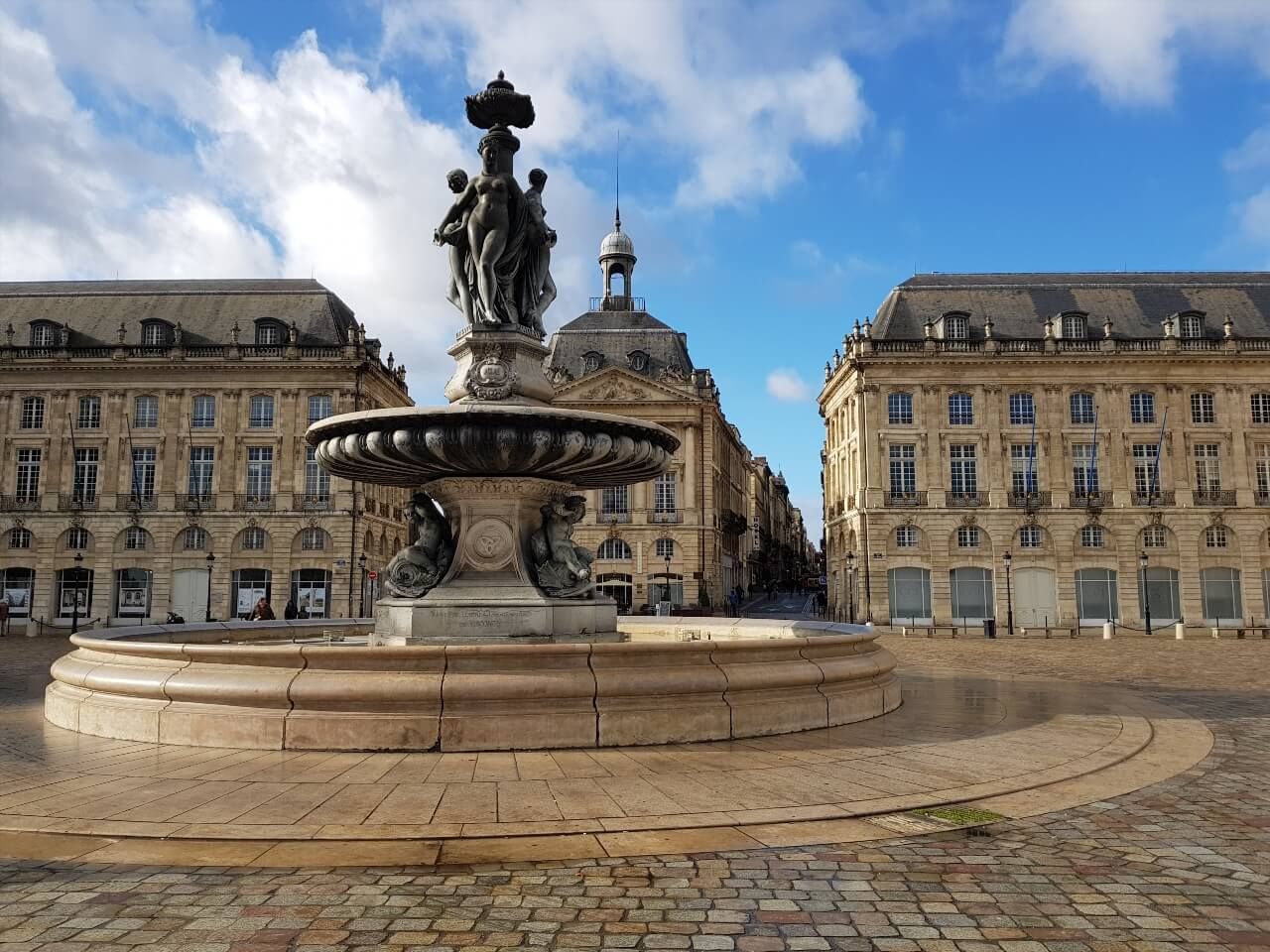
A stone's throw from the Water Mirror, Place de la Bourse is one of Europe's most photographed urban compositions. Designed by Ange-Jacques Gabriel and his son, completed in 1755, it was conceived to open the medieval city, then enclosed in its ramparts, onto the Garonne. In the center, the Fountain of the Three Graces (1869) replaces an equestrian statue of Louis XV destroyed in the Revolution. At night, the lighting of the blonde stone facades and the reflection on the Water Mirror are worth the trip alone.
22. Place des Quinconces, One of Europe's Largest Squares
With its 126,000 m², Place des Quinconces is regularly cited among Europe's largest squares. Planted with trees in a quincunx pattern (hence the name), it hosts the Girondins Monument (1902), a 43-meter column topped with a bronze genius, erected in tribute to the Girondist deputies guillotined during the Terror. The square receives the pleasure fair twice a year (spring and autumn), a large circus in winter, and many free concerts in summer. The rest of the time, it's a breathing space at the foot of the Golden Triangle.
23. Bordeaux Lake Banks, Urban Beach in the North
About ten minutes by tram (line C, Lac terminus), Bordeaux Lake (Boulevard Jacques Chaban Delmas, 33300 Bordeaux, rated 4.3/5 on Google for 5,800 reviews) offers 160 hectares of natural space away from the city, with a supervised beach in summer (June to September), a fitness trail, a bike path around the water body and a Bords du Lac park suitable for picnics. Swimming is free there, access to the area is free year-round. It's one of the rare free activities to do in Bordeaux that combines water, sports and fresh air without leaving the municipal boundaries.
24. Parc Bordelais, 28 Hectares to Breathe
In the Caudéran district, Parc Bordelais is the city's largest intra-muros green space: 28 hectares of lawns, century-old avenues, playgrounds, a mini-farm with goats and ponies, an old carousel and a small train that runs on weekends. Open every day of the year, it is free access, perfect for half a day with family. The mini-farm and animal observation are free, the small train is paid per ride (around 2 euros).
25. Wine and River Festivals, Programming on the Garonne Banks
Every two years, in June, Bordeaux hosts the Wine Festivals (even years) or the River Festivals (odd years). Access to the quays is free, outdoor concerts, nautical entertainment (regattas, old sailboat parades) and pyrotechnic shows follow each other for four days. Only wine tastings are paid (a tasting pass around 25 euros gives access to 25 glasses). To enjoy the visual and sound spectacle without spending a penny, just come stroll on the quays. Check the official program a few weeks before to spot the fireworks and concerts not to miss.
FAQ
Which Museums Are Free in Bordeaux?
Five municipal museums open their permanent collections on the first Sunday of each month, except in July and August: the CAPC (contemporary art), the Musée d'Aquitaine (regional history), the Musée des beaux-arts, the Musée des arts décoratifs et du design, and the Base sous-marine. The Frac Nouvelle-Aquitaine MÉCA also applies this free admission every first Sunday of the month (from 1pm to 6pm). Outside this time slot, some museums offer reduced rates for under-26s or job seekers.
Is the Water Mirror Accessible Year-Round?
No. The Water Mirror operates from May to October, from approximately 10am to 10pm. Outside this period, the granite slab is present but the water jets and mist are turned off for maintenance. Place de la Bourse remains accessible and photographable year-round.
Can You Visit Bordeaux on Foot Without a Paid Guide?
Yes. The historic center is compact and very well signposted. Most sites mentioned in this article are accessible on foot from Place de la Bourse in less than 20 minutes. To go further into anecdotes and history of each place, the Ryo audio-guided tour of Bordeaux allows you to explore the center in 2h30 with 29 audios over 6.2 km, available on smartphone without connection.
Are There Concerts and Shows in Bordeaux with Free Entry?
Yes, several. The Conservatoire de Bordeaux Jacques-Thibaud organizes open auditions from October to June. The Engrenage Comedy Club offers pay-what-you-want evenings on Tuesdays and Wednesdays. In summer, the Bordeaux Open Air program brings together several electronic music stages outdoors, with some editions accessible without reservation. The quays also host spontaneous events during the River Festivals, as well as a program of free concerts on Place des Quinconces in July-August.
What Is the Best Time to Visit Bordeaux?
Spring (April-May) and early autumn (September-October) are the best periods: mild temperatures, moderate crowds and the Water Mirror in operation. July-August is very touristy and the municipal museums don't offer the first Sunday free admission during these two months. Winter offers a more authentic city, with producer markets and raking light on the blonde stones.
Is the Cité du Vin Free?
No. The Cité du Vin is a private museum whose entrance ticket costs around 22 euros per adult (2026 rate). It includes a tasting glass at the top of the Belvedere (8th floor, 360° view over Bordeaux). To discover Bordeaux wine culture differently, the Musée du vin et du négoce in Chartrons offers symbolic entry and the Musée d'Aquitaine addresses wine history in its permanent collections (accessible the first Sunday of the month).
Free Bordeaux, User's Manual
Bordeaux keeps its promises to those who devote time to it. These 25 places barely scratch the surface of what a UNESCO-listed city of this magnitude can offer, and the free activities to do in Bordeaux are not limited to this guide: neighborhood markets on Sunday mornings, monthly flea markets, gallery openings in Chartrons, Tourist Office guided tours some Saturdays. Everything, or almost everything, can be chained together on foot or by tram over two or three days.
To go further into each street, each building, each era, the audio-guided tour of the Bordeaux Ryocity accompanies you in 29 audios through 6.2 km of the historic center, from the Water Mirror to Chartrons via Saint-Michel and Place de la Bourse, with anecdotes that commemorative plaques don't tell. Available on smartphone, no connection required once downloaded: you keep control over your itinerary, your pace, your coffee breaks. Bordeaux deserves better than a hurried glance, this audio guide gives you the keys to truly read it, without spending a euro more than what you decided.