
Créé par Romane, le 4 juin 2026
Votre guide Ryo
10 Must-See Volcanoes to Visit in Auvergne
© Shutterstock
Auvergne is home to France's largest regional natural park, an exceptional volcanic territory classified as a UNESCO World Heritage site. From majestic peaks to spectacular craters, including lakes nestled in the heart of mountain ranges, this region offers unique landscapes shaped by millions of years of volcanic activity. Whether you're an experienced hiker or simply a nature lover, Auvergne's volcanoes promise unforgettable discoveries. Pack your hiking boots and set out to conquer these sleeping giants that tell the geological history of our planet.
1. Puy de Dôme
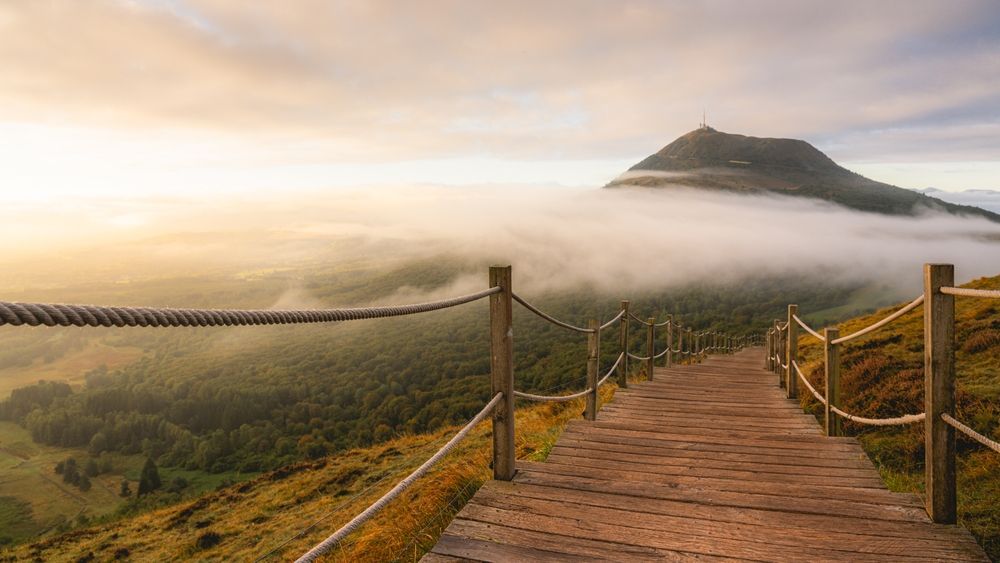
It's impossible to talk about Auvergne's volcanoes without mentioning Puy de Dôme, the true emblem of the region. Rising to 1,465 meters altitude, this giant of the Chaîne des Puys is visible from Visit Clermont-Ferrand, the Auvergne capital. Classified as a UNESCO World Heritage site, it offers a breathtaking 360-degree panorama over the regional natural park, the Limagne Plain and the entire Chaîne des Puys.
To reach the summit, you have two options. Comfort lovers will take the Panoramique des Dômes, a rack railway that takes you to the top in just 15 minutes. The more athletic will prefer the muleteer's path, a historic trail that winds along the volcano's slopes. Whatever your ascent method, the reward is worth it: at the summit, you'll discover the remains of the Temple of Mercury, the largest mountain sanctuary in Roman Gaul.
The site is perfectly equipped to welcome visitors with numerous activities: paragliding, mountain biking, zip-lining and rock climbing will delight thrill-seekers. Puy de Dôme is an essential stop when visiting Clermont-Ferrand and its surroundings, offering total immersion in the Auvergne volcanic universe.
2. Puy de Sancy
At 1,886 meters altitude, Puy de Sancy holds the prestigious title of highest point in the Massif Central. This majestic summit dominates the Monts Dore and offers spectacular views over the Chaîne des Puys, the Monts du Cantal and Forez. Access to the summit is facilitated by a cable car that drops you just steps from the goal, leaving you only to climb a developed stairway for about 20 minutes to reach the top.
The hikes around Puy de Sancy are among the most beautiful in Auvergne. The trails lead you through unique geological formations, ancient solidified lava flows and crater lakes with emerald waters. Nature lovers will be delighted by the diversity of landscapes: bubbling waterfalls, century-old fir forests and breathtaking panoramas follow one another along the paths.
The site can be enjoyed in all seasons. In summer, hiking trails invite discovery and contemplation, while in winter, surrounding ski resorts like Mont-Dore or Super-Besse offer numerous slopes for skiing enthusiasts. Activities abound: rock climbing, zip-lining, mountain biking and even paragliding for the most daring. Puy de Sancy embodies all the majesty of Auvergne's volcanoes.
3. Puy Mary
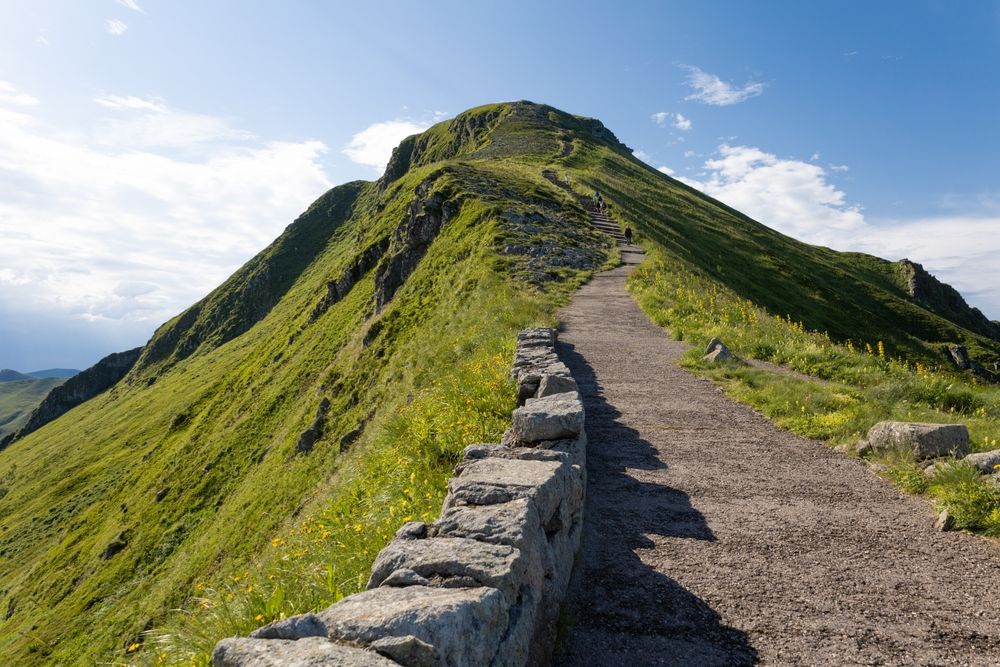
In the heart of the Monts du Cantal stands Puy Mary, Europe's largest stratovolcano. Rising to 1,783 meters, this pyramid-shaped giant obtained the prestigious Grand Site de France label in 2012. Although not the highest in the massif, its characteristic silhouette makes it one of the most photogenic and recognizable volcanoes in Auvergne.
The ascent of Puy Mary is an unforgettable experience for hikers. The most accessible start is from Col de Peyrol, the highest road pass in the Massif Central. A well-developed trail leads you in about 1h30 to the orientation table at the summit. From up there, you'll enjoy an exceptional 360-degree panoramic view over the glacial valleys that radiate all around the volcano like flower petals.
On clear days, the luckiest visitors can even glimpse the snow-capped peaks of Mont Blanc in the distance. Hikes around Puy Mary offer varied routes for all levels, from family walks to more technical circuits. The site is also renowned for its preserved fauna and flora, notably featuring marmots, chamois and remarkable alpine flora.
4. Puy de la Vache
Puy de la Vache and its twin Puy de Lassolas are among Auvergne's youngest volcanoes at only 8,400 years old. Located in the commune of Saint-Genès-Champanelle, these twin volcanoes are distinguished by their perfectly preserved crater shaped like a gaping mouth and their scoria flows with colors ranging from bright red to deep black.
The hike to Puy de la Vache is one of the most spectacular in the region. The trail takes you through an old quarry where you can observe volcanic bombs, these solidified lava projectiles ejected during eruptions. However, be warned: the ascent is demanding with significant elevation gain and many high steps that test your legs. But the effort is amply rewarded!
At the summit, perched at 1,167 meters altitude, you'll face the majestic Puy de Dôme rising proudly before you. The panorama embraces the entire south of the Chaîne des Puys, offering a unique perspective on this alignment of UNESCO-classified volcanoes. The lava flows from Puy de la Vache and Puy de Lassolas formed Lake Aydat, adding even more charm to this exceptional geological site.
5. Puy Griou
Puy Griou stands out from other Auvergne volcanoes by its particular rock: phonolite, which gives it a characteristic gray-green color. Rising to 1,690 meters in the Cantal massif, this summit is shrouded in local legends. It's said that a benevolent fairy protects the herds and watches over the region from Griou's heights, adding a mystical touch to this already impressive volcano.
Visitors have two options to discover Puy Griou. Motorists can enjoy a developed parking area nearby to admire the panorama without effort. Passionate hikers will prefer the ascent from the village of Mandailles, a climb that's admittedly vertiginous but reserves surprises at every turn. The trail crosses verdant forests before opening onto high-altitude pastures where Salers cows graze peacefully.
From the summit, the view is absolutely magnificent: you dominate the Cantal puys and the Mandailles cirque, a natural amphitheater carved by glaciers. Puy de Griou also overlooks the valleys of the Cère and Jordanne rivers, two waterways that flow on either side of this volcanic ridge. In good weather, the panorama extends to the snow-capped peaks of the Alps, offering a natural spectacle of rare beauty.
6. Puy de Lemptégy
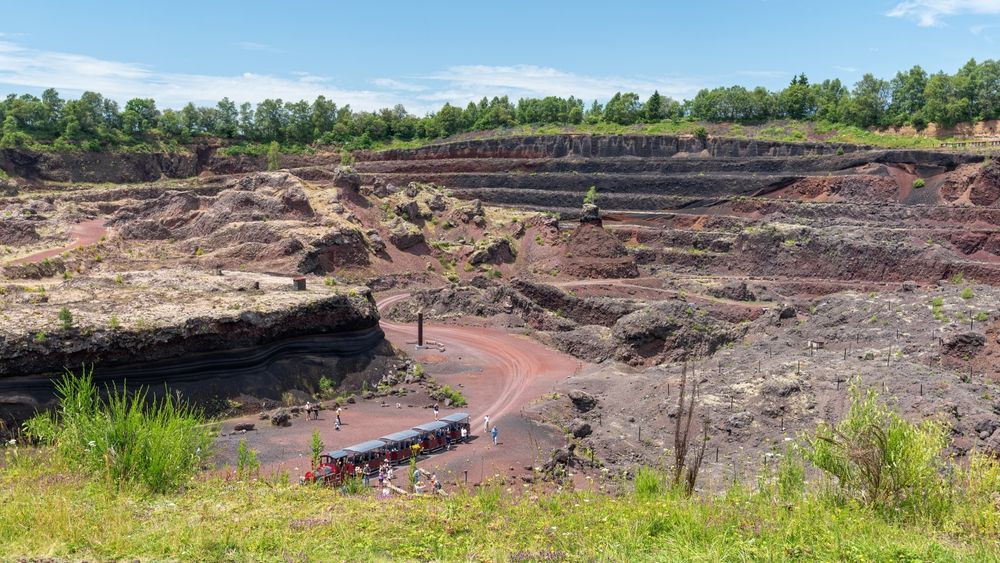
Puy de Lemptégy occupies a unique place among Auvergne's volcanoes. Located in the commune of Saint-Ours-les-Roches, this extinct volcano about 30,000 years old offers an extraordinary feature: its crater is perfectly visible from the inside. This exceptional characteristic is explained by the exploitation of the volcano's scoria, used to rebuild French cities devastated during World War II.
Today, Puy de Lemptégy has become a true open-air volcanology textbook. The site is not served by public transport, but remains easily accessible by a 25-minute car ride from Clermont-Ferrand station. What makes this volcano unique is the possibility of literally exploring the heart of a natural volcano, an experience you won't have anywhere else in France.
The visit can be done on foot or by small train on a playful route of about 3 kilometers. You'll discover different geological layers, volcanic chimneys, bombs and multicolored scoria that testify to intense past activity. Passionate guides explain eruption mechanisms and the fascinating history of this site. Puy de Lemptégy is located facing the famous Vulcania park, allowing you to combine scientific discovery with field exploration.
7. Puy de Lassolas
Puy de Lassolas, a basaltic-type volcano perched at 1,188 meters in the commune of Saint-Genès-Champanelle, shares a common history with its twin, Puy de la Vache. Born about 8,500 years ago, it owes its name to the Auvergne word "lassourias" meaning "the burned one," a direct reference to the red and black scoria that dot its slopes and testify to its tumultuous volcanic past.
These two twin volcanoes present a remarkable geological feature: their ancient lava flows joined together, preventing their craters from forming completely. This volcanic union gave birth to Lake Aydat, Auvergne's largest natural lake, a true jewel set between the two sleeping giants. This unique geological phenomenon perfectly illustrates nature's power and creativity.
Whether you access Puy de Lassolas by car or via a walking hike, you'll be rewarded with a spectacular view over the Chaîne des Puys and Monts Dore. The panorama also embraces the Sancy Massif, glacial valleys sculpted by ages and picturesque villages nestled in the relief's hollows. A practical tip: favor a winter visit rather than summer, as volcanic scoria can make the ground particularly slippery in summer, especially after a shower.
8. Puy de la Nugère
Located just 20 kilometers from Clermont-Ferrand, Puy de la Nugère is a strombolian-type volcano 11,000 years old. Rising to 994 meters, this volcano cut on its flank by an old quarry is famous for giving birth to an emblematic material of the region: Volvic stones. These trachy-andesite flows have shaped local architecture and constitute an essential element of Auvergne heritage.
Although Puy de la Nugère is not the most spectacular volcano in the Chaîne des Puys in appearance, it can boast of being the birthplace of modern volcanology. Its entrails house an underground extraction gallery, originally dug to stem an epidemic that was ravaging the region. This gallery now releases a large quantity of water at the place called les Goulets, giving birth to the famous Volvic waters, known worldwide.
You can reach the site by car or take the hike from Col de la Nugère. The trail crosses a magnificent undergrowth forest before reaching the crater, literally plunging you into the heart of the region's historical and cultural heritage. This walk offers a beautiful immersion in Auvergne's geological and human history, where nature and industry have harmoniously met over the centuries.
Download the audio-guided circuit to discover Clermont-Ferrand on foot and independently
To complete your exploration of Auvergne's volcanoes, don't miss visiting Clermont-Ferrand, the Auvergne capital that serves as an ideal starting point for your excursions. Thanks to the Ryo app, discover the city at your own pace with an audio-guided circuit of Clermont-Ferrand that will take you through the city's 21 major points of interest. Let yourself be guided in your urban exploration before setting out to conquer the volcanic giants surrounding the city.
9. Puy de Montchal
Despite being only 7,000 years old, Puy de Montchal is one of the youngest volcanoes in metropolitan France. Located in the Monts Dore at 1,407 meters altitude in the commune of Besse-et-Saint-Anastaise, this volcano is part of a remarkable geological ensemble. It's one of four volcanoes in the region having experienced successive eruptions, alongside Puy de Montcineyre and the maars of Estivadoux and Pavin.
Puy de Montchal's crater, now entirely covered with majestic conifers, offers few viewpoints over the surroundings, but instead creates an absolutely enchanting forest setting. It's the ideal place for a pleasant forest excursion, away from tourist bustle. In summer, the flowered prairie bordering the volcano transforms the landscape into a true impressionist painting, with its bright color touches that contrast beautifully with the firs' dark green.
Take advantage of your visit to Puy de Montchal to reach Lake Pavin, a mysterious maar nestled in the midst of luxuriant vegetation. Born from the explosive encounter between rising lava and a phreatic aquifer, this almost perfectly circular lake fascinates scientists and visitors. Although swimming is forbidden, the site allows you to find magnificent viewpoints and practice numerous outdoor sports in the surroundings, in a preserved natural setting.
10. Puy de la Tache
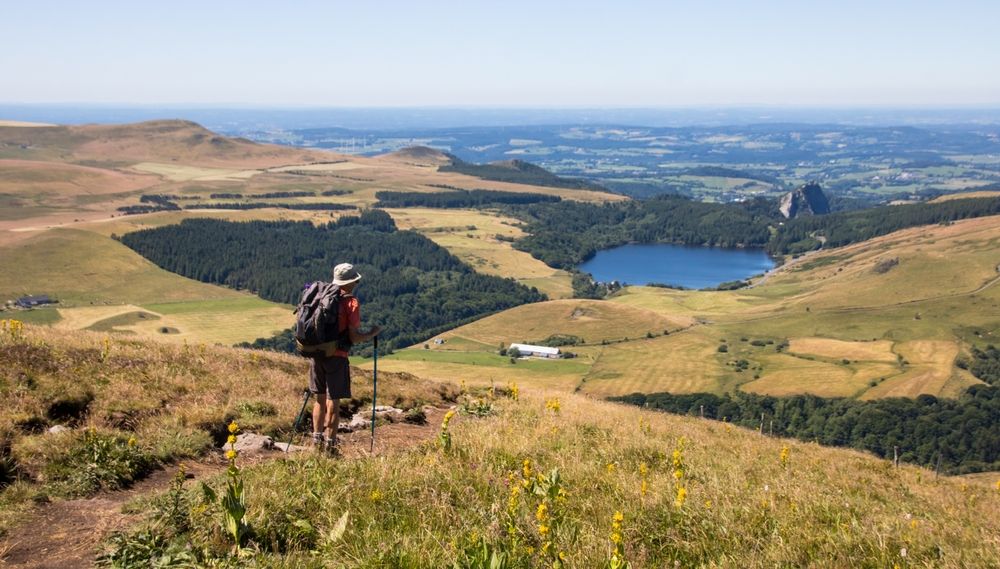
Perched at 1,629 meters altitude on the Sancy ridges, Puy de la Tache occupies a strategic position between Lakes Guéry and Chambon. This strombolian volcano presents the feature of being of volcanic origin while being independent of neighboring puys, making it a fascinating geological site for volcanology enthusiasts and hikers seeking tranquility.
Access to Puy de la Tache is facilitated by the proximity of Col de la Croix Morand, accessible by car. The hike departure is on the opposite side of a typically Auvergne buron, renowned for its delicious regional dishes. Don't miss stopping there before or after your ascent to taste authentic Auvergne gastronomy, notably the famous truffade, local cheeses and artisanal charcuterie.
The hike takes you in less than two hours to Puy de la Tache's summit. Your arrival is marked by a traditional cairn, these stone piles that have guided walkers for centuries. The panorama before you justifies the effort alone: an unobstructed view over Puy de l'Angle, Puy de Monne and Puy du Barbier in the heart of the Adventif Massif. Don't forget your camera to immortalize the verdant pastures, deep valleys and spectacular rock formations that characterize this unique volcanic landscape. Also consider using the Ryo itinerary to optimize your travels between the region's different volcanic sites.
In conclusion, Auvergne's volcanoes constitute an exceptional natural heritage that amply deserves a visit. From the majesty of Puy de Dôme to the intimacy of Puy de Montchal, passing through the grandeur of Puy de Sancy and the originality of Puy de Lemptégy, each volcano tells a unique geological story. These sleeping giants offer not only breathtaking panoramas, but also a multitude of activities for all tastes and levels. Whether you're passionate about hiking, geology enthusiast or simply a lover of beautiful landscapes, volcanic Auvergne promises unforgettable discoveries. Don't hesitate to visit Clermont-Ferrand and let yourself be guided by the Ryo audio-guided itinerary for a complete exploration of this fascinating region.
Frequently Asked Questions
What's the best period to visit Auvergne's volcanoes?
The best period extends from May to October, with a preference for June and September which offer ideal climate, fewer tourists and magnificent landscapes. Summer allows you to fully enjoy hiking, while winter transforms some sites into ski resorts.
How much time should I plan to visit Auvergne's volcanoes?
To discover the 10 must-see volcanoes, plan a minimum of 4 to 5 days. This will allow you to hike without rushing, enjoy the panoramas and immerse yourself in each volcanic site's unique atmosphere. A week-long stay is ideal for complete exploration.
Are Auvergne's volcanoes accessible to families with children?
Yes, several volcanoes offer easy access suitable for families. Puy de Dôme with its train, Puy de Sancy with its cable car and Puy de Lemptégy with its playful visit are particularly recommended for children. Developed trails allow for short and accessible walks.
Do you need to be athletic to visit Auvergne's volcanoes?
No, Auvergne's volcanoes adapt to all levels. Some sites offer mechanized access (train, cable car) while others propose hikes of different difficulties. Average physical condition is sufficient for most ascents, although some summits require more endurance.
Where to stay to visit Auvergne's volcanoes?
Clermont-Ferrand constitutes an ideal base, offering a wide choice of accommodations and quick access to main volcanoes. Villages like Mont-Dore, Super-Besse, Orcines or Saint-Nectaire also offer charming accommodations in the heart of volcanoes, perfect for total immersion in Auvergne nature.