
Créé par Emilie, le 7 mai 2026
Votre guide Ryo
© Shutterstock
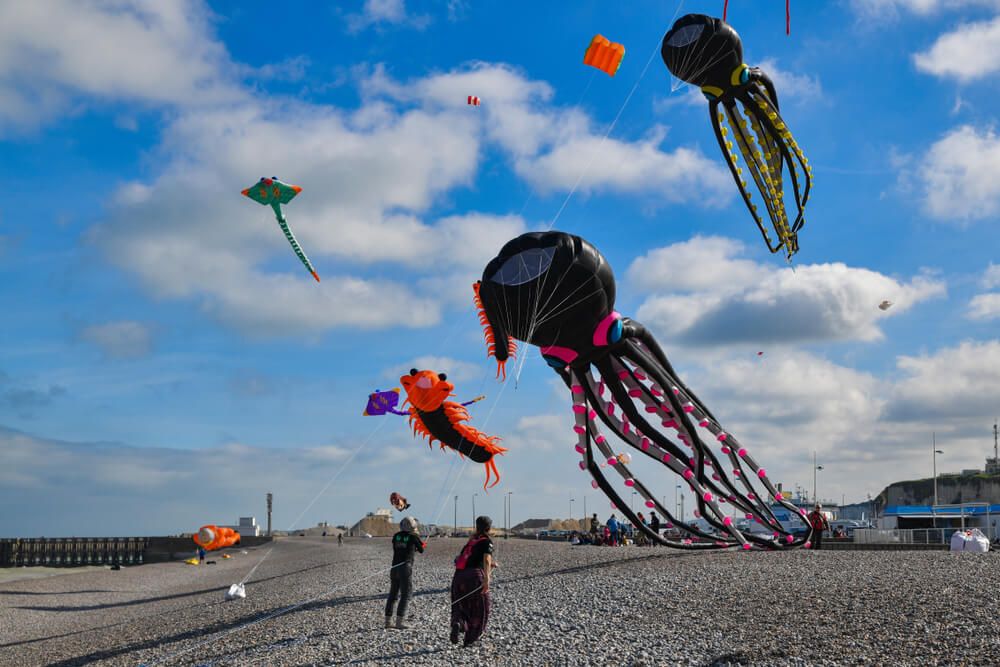
Among all the memories of beach afternoons, there are those around a funny game of racquetball, a fishing net session, a sandcastle workshop and those of high-flying action with our faithful kite. You know, that classic single-line model recognizable by its diamond shape and rainbow colors. With few exceptions, we've all known one!
Sometimes, this childhood leisure activity transforms for some into an authentic passion. More than seeking to pilot them with excellence, they design them from A to Z for a fabulous, even unusual final result.
To witness this, there exists in France the perfect event: the Dieppe international kite festival. A dance of charming UFOs floating in the wind that shows all colors, to both young and old alike!
1. All the colors of the world in Dieppe
Many don't know this, but in France, kiting is a discipline considerably practiced by a real fan club of amateurs and professionals. Children, but adults too! Their preferred playground is obviously the beaches, which they invade when the wind cooperates or when a festival is dedicated to their ancestral activity.
On these last words, we can't help but mention the Dieppe International Kite Festival. Does that ring a bell?
Full spotlight on the kite!
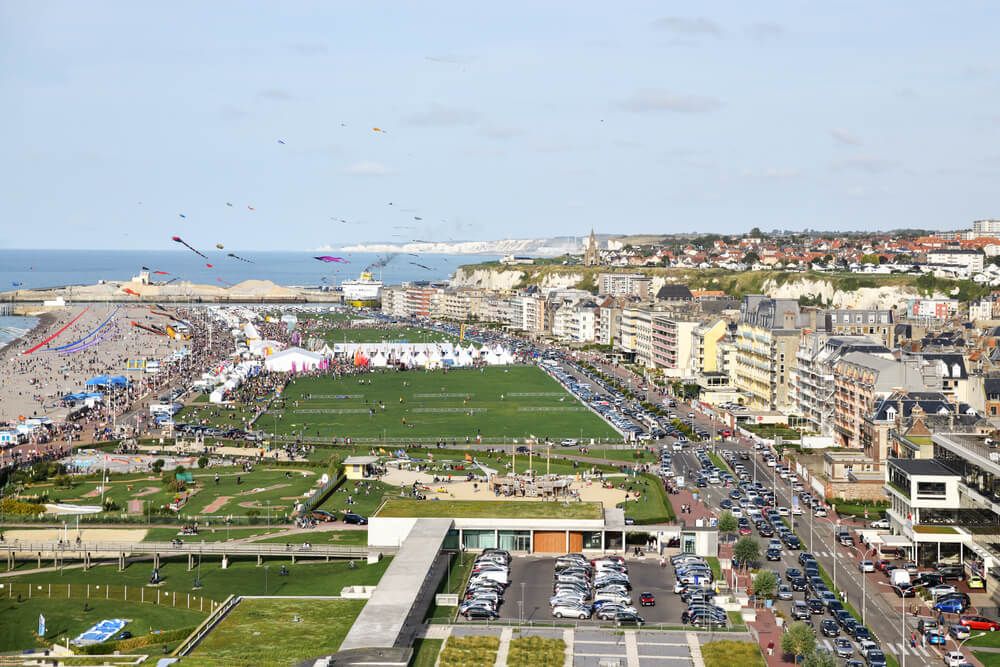
Organized over 10 days in September, in even years only, this Dieppe event is the largest gathering of kite flyers in the world. Yes, you read that right, in the world!
To not run out of space, on land as in the air, the 8 hectares of lawn between the seafront and the castle, as well as the long neighboring pebble beaches are requisitioned for the occasion. This way, thousands of visitors and thousands of participants can peacefully indulge in their task. Dreaming for some and making others dream!
Of international scope, the festival brings together an average of forty nationalities sometimes close like Finns, English, Moroccans or more widely distant like Senegalese, Canadians or even Cambodians. Great enthusiasts from the four corners of the globe united around the same passion and the same goal: to highlight (or rather colorize) the world's kite heritage and all the know-how that flows from it.
Launch, chronology and fame
It was in 1980 that the very first kites of the festival invited themselves into the Dieppe sky like a gigantic open-air playground. At the time, and like any new program launching, the event only counted half a dozen European countries. A rather timid score, but no matter, the appointment was maintained every two years.
While the 4th edition (1986) opened the way to more distant delegations like China and Thailand, the 5th edition (1988) was classified as "the largest event of this kind in Europe". Could these be the beginnings of long-awaited success? And how!
In 1990, the festival attracted 120,000 visitors for 400 kite flyers from 21 different countries. 2 years later, for the 7th edition, it was 30,000 additional visitors and 100 kite flyers from 22 diverse nationalities who made the trip. In 1994, the event was declared "the most important of its kind in Europe" and in 1996 the consecration was in full swing. It was 300,000 spectators and more than 1,100 actors from 30 nations from all continents that placed Dieppe on the international scene.
Edition after edition, the festival's fervor took off never to come back down. During its 30th anniversary, in 2010, the event even made a place for itself among the 300 largest world events!! This is what happens when you reach the heights…
2. A well-thought-out takeoff
Programming: In the air, but not only!
In barely two years of preparation and ten days of celebration, the Dieppe kite festival puts everything in order programming-wise to be visually stunning. And the least we can say is that wonder and the feeling of escape take hold of both sky and earth at each edition.
Usually, here's how the entirety of the festivities brilliantly unfolds:
1st and 2nd day (1st weekend):
- The village opening with music
- The festival inauguration with presentation and commented takeoff of the invited delegations
- The downtown parade with a start generally at quai Henri IV. Hundreds of guests parade in traditional costume presenting their models, each more original and colorful than the others to an admiring crowd.
- The wind creation contest
3rd day: Children's day (offering fun and original workshops like kite building, piloting initiation…)
4th day: Grand takeoff of Dieppe territory businesses
5th day (2nd weekend):
- The combat kite world cup* at the Rouxmesnil-Bouteilles hippodrome
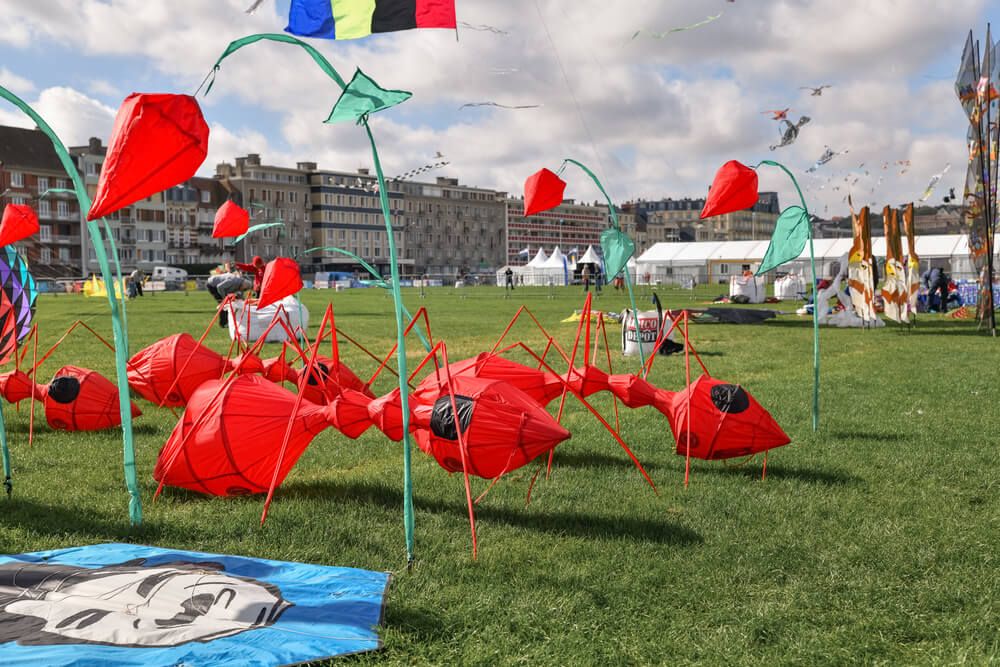
- The artistic kite creation contest. There's everything, from giant animal-shaped models to unique hand-painted recyclable material specimens.
- Night flying with sound and light for a magical atmosphere (subject to weather conditions)
* In kite battles, the objective is to cut your opponents' flight line using special coatings.
The round of themes
One of the strengths and successes of this festival is undoubtedly its diversity. In all its forms! Here's the proof!
First, there's this multitude of kites with mismatched but harmonious colors and whimsical but unique designs. Second, the presence of international guests so proud to share their culture with us through this aerial discipline and beyond.
And third, this continuous commitment to associate each new edition with a very specific theme as the common thread of the festivities. Since 2000, some of these themes deemed "strong", current, original and exotic, have marked the festival's history.
In 2004, the edition's theme was "Woman". Two years later, honor was given to "Fauna and Flora" with the support of the Nicolas Hulot foundation around all these environmental protection issues.
In 2008, the multiple traditions and cultures of Latin America took over the Dieppe coastline against a backdrop of traditional music and kites in the colors of these trans-Atlantic nations. 8 years later, Mayan, Aboriginal or Native American arts paid tribute to the theme "primitive arts".
And in 2021, after 4 years of absence following the Covid-19 pandemic, the Dieppe international kite festival couldn't have chosen a better subject than… "Protecting the planet"! A way to raise public awareness about one of the most urgent issues of our time.
3. Preparing your visit
Whether the next edition of the festival is in a few weeks, months or in 2 years, you're sure of one thing, you'll be present at this one. But then, even if you have your head in the clouds, will this be as a participant or spectator?
Green light to be a participant
Kite flying has almost no secrets for you and you aspire to display in broad daylight the model(s) you have carefully crafted. It's time to get down to business.
The procedure to follow is quite simple. You just need to go to the festival's official website, fill out the online registration form (while taking into account the information provided) and provide the necessary documents for the competitions you wish to enter. Child's play, isn't it?
Warning: All participation requests are individual.
Green light to be a spectator
Since your earliest childhood, you've loved kites or you're just curious about seeing hundreds sweep across the sky before your amazed eyes… What can we say except that Dieppe, in September, is just waiting for you.
Beyond the emblematic shows, acrobatic ballets and strategic kite battles, the Dieppe international kite festival is above all a popular event not only open to all ages, but also FREE!
And if the urge to take action by flying a kite suddenly takes you, know that part of the lawn is specially devoted to amateur trials. So, on track!
Did you know?
At its invention, well before the 4th century, in China, Indonesia or somewhere in Asia, the kite was more about regiment than amusement. Indeed, the military used it to transmit messages, give a signal, or even transport a man in the air for scout missions. This shows the eras the kite has traveled through to end up in our innocent hands.