© Shutterstock
 Votre guide Ryo
Alphonse Daudet's Windmill in Fontvieille: Visit, History, and Tips 2026
In Provence there is a hillside where the cicadas drown out the sound of the wind. On this limestone plateau above Fontvieille, Alphonse Daudet's windmill has become one of the most visited literary sites in southern France — not because Daudet wrote there, but precisely because he never really did. This tension between legend and reality is at the heart of the visit, and it makes the experience far more interesting than a simple tourist pilgrimage.
This guide takes you to the heart of the site: the true history of the Moulin Saint-Pierre (built in 1814 and listed as a historic monument in the 20th century), its interior architecture and restored milling mechanism, the Alphonse Daudet museum in the neighbouring house, the garrigue trail up from the village, the five stories from the Lettres de mon moulin directly linked to Fontvieille, and day trips to Les Baux-de-Provence, Arles, and Saint-Rémy within a 25-kilometre radius. If you are exploring the Alpilles with the Ryo app, several points of interest around Fontvieille are listed in our Provence routes.
History and Legend: Did Daudet Really Write Here?
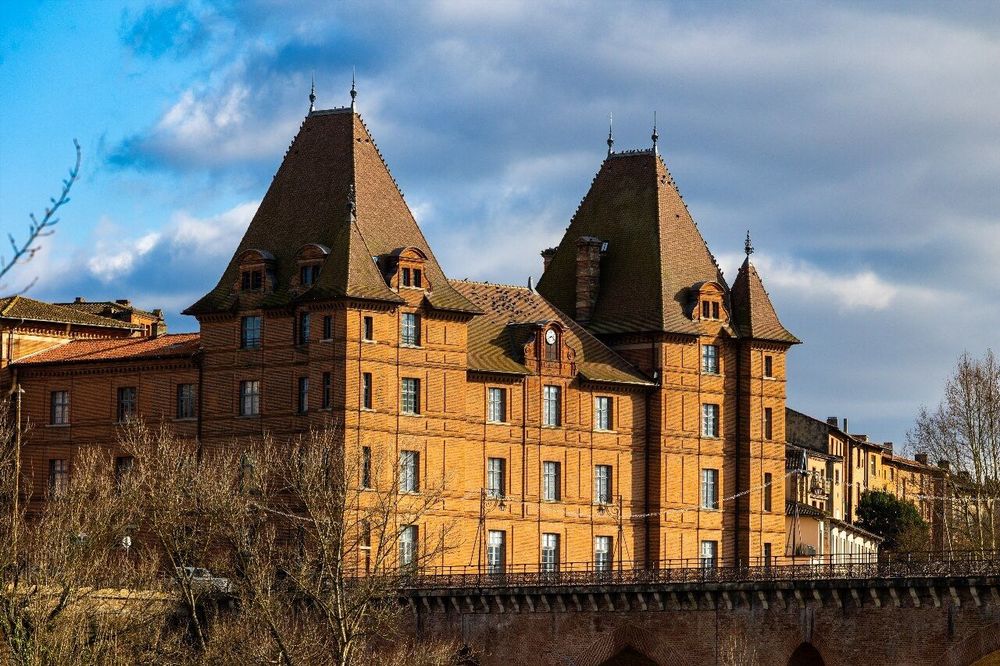
The question long embarrassed local historians, until they eventually turned it into a point of pride. Alphonse Daudet was born in Nîmes in 1840 and grew up in an impoverished family. At 17 he was a junior teacher at a school in Alès; at 20 he moved to Paris to try his luck. It was from the 1860s onward, during repeated stays in Provence as a guest of the Ambroys at the château de Montauban, that he forged the images that would feed his Lettres de mon moulin.
The Moulin Saint-Pierre, officially built in 1814, stood atop the hill alongside three other windmills. Daudet often walked up to the mill to daydream and observe, but the Lettres de mon moulin were published as serialised stories from 1866 onward, then collected by Hetzel in 1869, written in Paris and at the château de Montauban — never in the mill itself. The Moulin Saint-Pierre was nothing more than a romantic backdrop, a poetic pretext.
Daudet knew this and almost boasted of it. In his preface he speaks of a mill "rented for three years", of a room "amid the cicadas and the rosemary". The epistolary fiction was complete. What readers remembered was the image — the motionless sails, the slanting evening light, the fig tree against the white wall — far more than any bibliographic truth.
Posterity did the rest. Restored during the 20th century, the windmill is today a listed historic monument — not solely for its milling heritage but for its literary association. The commune of Fontvieille quickly understood that Daudet's name was a resource as much as a heartfelt tribute. Today the legend is acknowledged, explained, and unpacked, and all the more endearing for it.
What You Will See: the Exterior of the Windmill
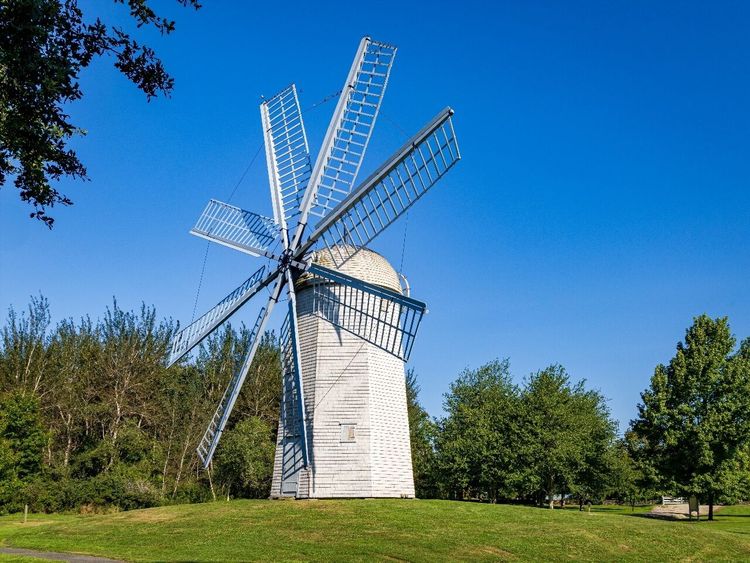
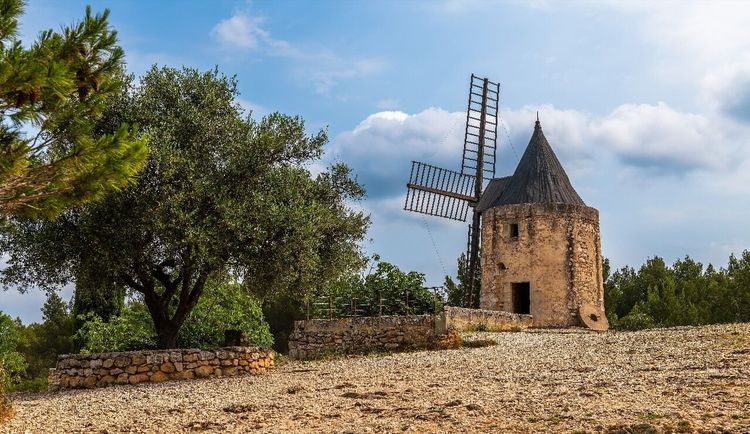
Arriving at the site holds a few surprises, especially if you are expecting a conventional museum with a ticket office and cloakroom. The cylindrical limestone tower, with its four restored sails, is freely accessible from the approach path. There is no entrance fee to see the windmill from the outside and photograph it from every angle.
The interior, however, is closed to the public most of the time, except during the Journées du Patrimoine (third weekend of September) or occasional cultural events. This regularly surprises visitors who imagine they will discover a recreation of the writer's studio. The windmill is a restored monument, not a permanent museum space.
What strikes you more forcefully is the panorama from the hilltop. The windmill stands at around 100 metres above the plain of La Crau. On a clear day — which is common in Provence — you can make out the ridges of the Alpilles to the north, the Montagnette to the east, and a sweep of pines and olive trees stretching towards Arles to the south. The light is particularly beautiful in the late afternoon, when the low sun gilds the pale stones of the mill.
Around the windmill, interpretation panels evoke Daudet's life and work: extracts from the Lettres, period photographs, reproductions of book covers. Take a moment to sit on the low wall facing the plain — it is perhaps here that you will best understand why this place captivated the writer, even though he never set pen to paper here.
The Interior Mechanism: the Architecture of a Tower Mill
On the rare occasions when the interior is accessible, the visit reveals a remarkably well-restored industrial building. The Moulin Saint-Pierre is a Mediterranean tower mill: a two-storey cylindrical limestone body topped by a rotating cap that the miller would angle with a pole to face into the wind. On the first floor, two superimposed granite millstones — the bedstone and the runner — are driven by an oak shaft connected to the sails via a lantern gear; the second floor gives onto the gearing and the hopper that channels the grain. The mechanism, restored using period materials, remains complete even though it is no longer operated.
The Alphonse Daudet Museum: Behind the Legend
To go beyond the monument and understand who the writer really was, the Alphonse Daudet Museum (Mas de Montauban, 13990 Fontvieille, rated 4.1/5 on Google based on 775 reviews) is the essential next stop. It is housed in the château de Montauban, just below the windmill — the very place where Daudet used to stay. This municipal museum, managed by the commune of Fontvieille since the collections were installed at the château in 2012, offers a sober yet well-documented display.
The collections are organised around three themes: Daudet's life (his childhood in Nîmes, his rise in Paris, his stays in Provence), his literary work with first editions and handwritten letters, and the historical context of the Lettres de mon moulin — how a newspaper serial became a classic. Personal objects, painted and engraved portraits, and documents about life on the Montauban estate at the time are also on display.
One room is specifically dedicated to adaptations of his work: theatre, silent cinema, operas derived from L'Arlésienne with Bizet's celebrated score, and comic books. This serves as a reminder of the considerable cultural reach of a writer too often reduced to his Lettres alone.
Admission is charged at a modest rate (around €2.50 for full-price entry, free for young children). Temporary exhibitions change each season. Allow 45 minutes to one hour for a thorough visit.
The Lettres de mon Moulin: Five Stories Set in Fontvieille
The Lettres de mon moulin (1869) bring together twenty-two stories set in Provence, several of which use Fontvieille or its immediate surroundings as their backdrop.
"L'Installation" opens the collection: the narrator fictionally takes possession of an old abandoned mill, describing the plateau, the view over the plain, the cicadas. It is the founding story, the one that sets the scene for the entire collection.
"Les Étoiles" tells of a night spent by a young shepherd on the mountainside with a shepherdess he secretly admires. The sensory precision — the starry sky, the sounds of the garrigue, the cold descending — speaks to direct observation.
"La Mule du Pape" unfolds partly in Avignon, but the landscapes traversed correspond exactly to the roads between Fontvieille and the Rhône that Daudet knew by heart.
"Le Curé de Cucugnan" portrays a village priest confronted with the indifference of his parishioners — a picture of rural Provence in the 1860s that remains surprisingly accurate.
"Les Deux Auberges" contrasts two inns on the road to Beaucaire — one wretched, the other thriving — as a meditation on hospitality and happiness. The setting, the July heat, the dusty road, the cicadas, faithfully mirrors what Fontvieille still offers today.
Re-reading these stories before or after the visit transforms the experience: the landscape descriptions become precise, the village names take their place on the map, and the windmill itself takes on an entirely new dimension.
The Walk up to the Windmill: the Sentier des Moulins
The proper way to reach the windmill is on foot. From the centre of Fontvieille, the sentier des moulins sets off from the avenue des Moulins and climbs through garrigue scented with thyme and rosemary before reaching the promontory. Allow 20 to 30 minutes of walking depending on your pace, with no technical difficulty.
The path is accessible to all walkers. All-terrain pushchairs can manage the first section, but the final 150 metres are stonier. In summer, bring water and sunscreen: vegetation thins out as you approach the windmill and the sun is strong between 11 a.m. and 4 p.m. In May and June, the flowering broom makes the trail particularly pleasant.
Along the way you will pass the ruins of several other windmills — the hill above Fontvieille had around ten of them in the 18th century. The Moulin Sourdon and the Moulin Tissot-Avon are visible from the trail, some in better condition than Daudet's mill itself, and far less crowded.
A few practical tips: come early in the morning (before 10 a.m. in summer) or in the late afternoon (after 5 p.m.) for the best light and cooler temperatures. If you climb on a weekday morning outside peak season, you may have the site almost to yourself — a rare privilege for such a well-known monument.
Fontvieille: the Village to Explore after the Windmill
Fontvieille is a village of around 3,500 inhabitants in the heart of the Alpilles, 12 km from Arles and 30 km from Avignon. Its historic centre is pleasant to explore on foot: stone alleyways, Provençal fountains, century-old plane trees on the central square. Local shops remain lively — bakery, grocery, cafés where residents actually sit — which is not so common in a tourist village.
The place de l'Église hosts a Wednesday-morning market — small but well stocked with cheeses, marinated olives, and olive oil produced on surrounding estates. The main street concentrates most of the shops: Provençal ceramics, lavender, books, with a Daudet section in every local bookshop.
500 metres east of the centre, the Carrières de Fontvieille deserve a mention: former shell-limestone quarries (the "pierre de Fontvieille" was used to build structures throughout the Rhône delta) with impressive galleries accessible during the Journées du Patrimoine or via organised visits.
Two kilometres from the village, the Roman aqueduct of Barbegal is one of the most remarkable archaeological sites in the region: a complex of Roman hydraulic mills dating from the 2nd century AD, with sixteen overshot wheels arranged in pairs on two parallel channels — the largest such complex preserved from Antiquity. Entry is free, with no ticket required.
Les Baux-de-Provence and the Alpilles: Day Trips from Fontvieille
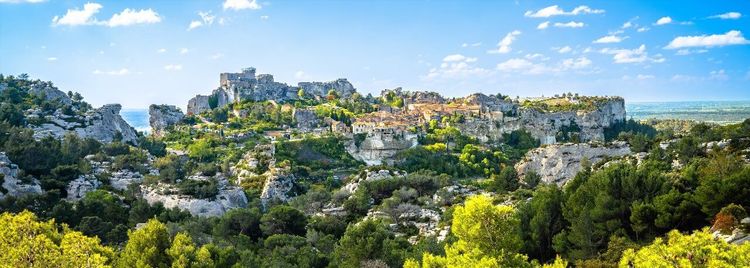
Fontvieille is an excellent base for exploring the Alpilles. Within a 25-kilometre radius you have access to some of the most remarkable sites in the region.
Les Baux-de-Provence are 10 km to the north-west, 15 minutes by car. The village perched on a rocky spur overlooking the plain ranks among the most beautiful villages in France. The ruined castle offers a breathtaking panorama, and the medieval village has preserved a rare troglodyte architecture. In peak season, arrive early or in the evening to avoid the crowds.
The Carrières de Lumières (Route de Maillane, 13520 Les Baux-de-Provence, rated 4.7/5 on Google based on 29,502 reviews), at Les Baux, are also well worth the detour. This spectacular venue — former white limestone quarries worked until 1935 — has hosted immersive digital art exhibitions since 2012, projected across 7,000 m² of rock walls. Sessions last around 35 minutes and online booking is strongly recommended in season.
Saint-Rémy-de-Provence is 20 km to the north-east. This is where Van Gogh stayed at the Saint-Paul-de-Mausole asylum and painted The Starry Night in 1889. The archaeological site of Glanum and the roadside Roman municipal arch are among the best-preserved ancient monuments in Provence.
Arles finally, 15 km to the south-west, is an unmissable stop if you are extending your stay. The still-active 1st-century arena, the Musée Départemental Arles Antique, and LUMA Arles (a cultural complex designed by Frank Gehry, opened in 2021) offer a full day of visits. With the Ryo app, the Ryo audio-guided tour of Arles connects the major Roman and medieval monuments in a coherent itinerary that you follow at your own pace.
If you enjoy walking, the GR 6 long-distance trail crosses the Alpilles massif from east to west and allows you to walk from Fontvieille to Les Baux in around 3 hours. Bring sturdy shoes and a good supply of water: the garrigue dries out quickly in summer and water points are scarce on the ridges.
Where to Eat and Where to Stay in Fontvieille
Fontvieille is not a top gastronomic destination, but the village has good addresses for lunch or dinner after your visit.
Several Provençal restaurants and bistros around the place de l'Église offer local set menus: Alpilles lamb, house-made tapenade, local cheeses. Establishments change from season to season — check with the village tourist office for current recommendations when you visit. For a quick and tasty meal, the bakeries and delicatessens in the centre allow you to put together a quality picnic to enjoy on the sentier des moulins.
For accommodation, the village has several chambres d'hôtes and charming gîtes in dressed stone, with terraces and views over the hills. Prices are reasonable compared with Les Baux-de-Provence or Saint-Rémy: expect between €90 and €150 per night for a double room in high season. Provençal farmhouses available for seasonal rental within 5 km of the village offer olive-tree gardens and swimming pools at often attractive rates — book several months ahead in July and August.
In Arles (15 km), the hotel offer is far broader, ranging from two-star hotels to design boutique hotels. Arles also makes a good base for combining the windmill with an exploration of the Camargue.
Practical Information: Opening Hours, Prices, and Getting There in 2026
The windmill (exterior and panorama) is freely accessible, without a ticket, every day of the year. The interior is only open on exceptional occasions, most notably during the Journées du Patrimoine (third weekend of September).
The museum housed at the château de Montauban is open in season. Exact opening hours vary from year to year and may be affected by ongoing works — check with the Alpilles Tourist Office (alpillesenprovence.com) before making the trip. Indicative admission: €2.50 full price, with reductions for children.
By car: Fontvieille is 20 km from Arles (D17), 30 km from Avignon (A7 then D570), and 25 km from Tarascon. Free parking is available on the avenue des Moulins, a 10-minute walk from the village centre.
By train and bike: Arles station (TGV from Paris in 3h45, TER from Marseille in 50 min). From Arles, the Alpilles cycling route links Fontvieille in around 1h30 by bike, along a near-flat itinerary following the marshes of La Crau. Bike hire is available in Arles.
Best season: spring (April–June) and autumn (September–October) offer mild temperatures, flowering or colourful vegetation, and manageable crowds. July and August are very busy and hot (35 °C or more outdoors). In winter, the light on the windmill's stones is remarkable and crowds are almost non-existent.
Accessibility: the path up to the windmill is not suitable for wheelchairs. The museum at the château de Montauban is largely accessible at ground level.
FAQ
Can you visit the inside of Alphonse Daudet's windmill?
The interior of the windmill is not open to the public except on special occasions, most notably the Journées du Patrimoine (third weekend of September). For the rest of the year, the visit is limited to the exterior of the monument and the panoramic view from the hilltop. If the interior is important to you, check the programme from the Fontvieille town hall or the Alpilles Tourist Office for occasional events.
Did Alphonse Daudet really write his stories in this windmill?
No. Daudet never lived in the windmill. He stayed at the château de Montauban, the property of his friends the Ambroys, during his visits to Fontvieille. The Lettres de mon moulin were written mainly in Paris, based on memories and observations from his stays in Provence. The windmill is a literary backdrop, not a residence or a writing studio.
How much time should you plan to visit the windmill and the museum?
Allow half a day for a complete visit: 30 minutes to walk up via the trail, 30 to 45 minutes at the windmill site, then 45 minutes to 1 hour for the museum. Add 1 to 2 hours if you wish to stroll around the village of Fontvieille after coming back down.
Is the site accessible to people with reduced mobility?
The path leading up to the windmill is an unmaintained garrigue trail with a stony surface that is not suitable for wheelchairs. However, the museum at the château de Montauban is largely accessible at ground level. Contact the Alpilles Tourist Office for details on current accessibility arrangements.
Can you combine the visit with the Carrières de Lumières in Les Baux-de-Provence?
Yes, this is a popular itinerary in the area. Head to the windmill and Fontvieille in the morning, have lunch in the village, then drive to Les Baux-de-Provence (10 km) for the afternoon: the medieval village, the ruined castle, and a session at the Carrières de Lumières in the late afternoon. Online booking at the Carrières is strongly recommended in season. The Ryo audio guide will help you organise this sequence, with commentary available on-site for each location.
Where can you park to visit the windmill?
Free parking is available at the entrance to the sentier des moulins, on avenue des Moulins in Fontvieille, about a 10-minute walk from the village centre. During peak season (July–August), this car park can fill up as early as 9 a.m., so arriving early is advisable. A second car park is located in the village centre, from which the trail is a 5-minute walk further.
Conclusion
Alphonse Daudet's windmill is not quite what one expects — and that is precisely what makes it unforgettable. A literary monument built on a beautiful fiction, an exceptional viewpoint over the Alpilles, a gateway into one of the most unspoiled landscapes in Provence: the hilltop of Fontvieille offers far more than a postcard cliché to those who take the time to look closer.
Combine the walk up to the windmill with a visit to the museum, stroll through Fontvieille, and push on to Les Baux or Arles to round off the day. With the Ryo audio-guided tours available for Arles and the Alpilles sites, every detour becomes a story — just like in the Lettres de mon moulin.