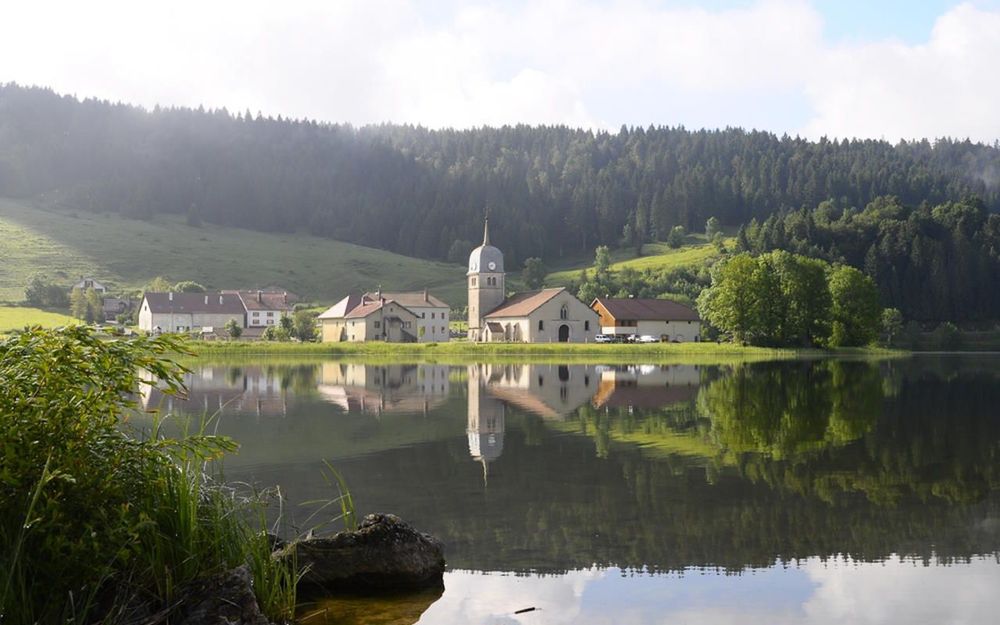
© Shutterstock
 Votre guide Ryo
25 Must-See Things to Do in Jura in 2026
What to do in Jura when you only have a handful of days to get lost there? Jura surprises. You expect a quiet retreat, and find yourself standing before a waterfall that drowns out every sound, beside a turquoise lake ringed with fir trees, in a medieval village suspended above a reculée carved over millions of years. This département of Franche-Comté packs an exceptional density of landscapes into its size: four major natural lakes, a hundred catalogued waterfalls, the most distinctive vineyard in France with its vin jaune aged under a veil of yeast. To explore all of this without missing the essentials, the Ryo app lists the key sites with detailed descriptions and up-to-date practical advice for each location.
In the sections that follow, you will find a regional nature park of 70,000 hectares of forests and peat bogs, villages listed among the most beautiful in France, one of the oldest Benedictine abbeys in the region, and the secrets of a cheese aged for a minimum of 4 months under the watchful eye of Poligny's master cheesemakers. Not a catalogue of everything that exists, but a selection of the 25 experiences that are truly worth the trip in 2026.
1. The Cascades du Hérisson
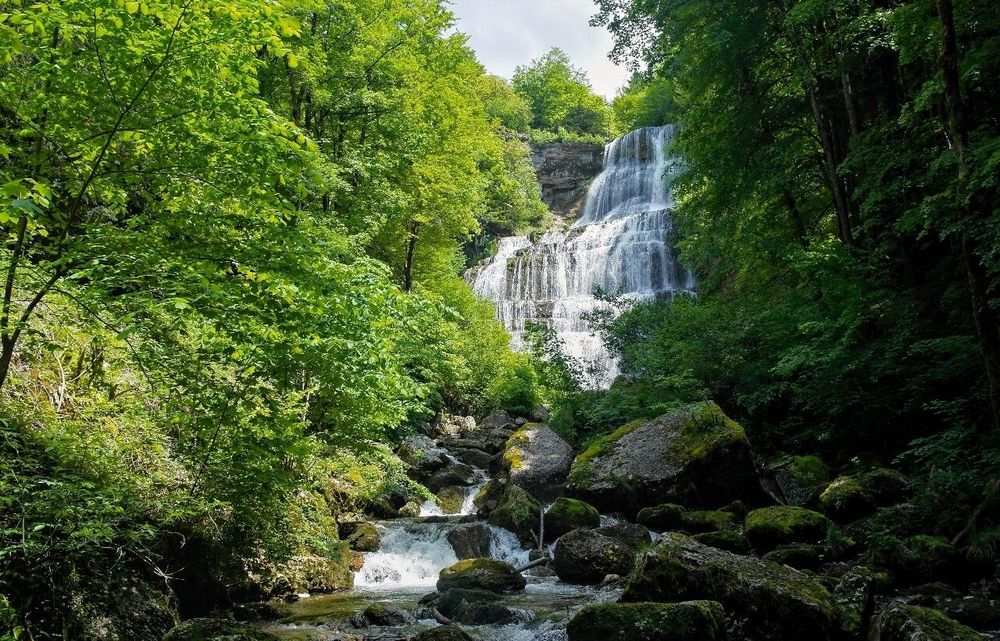
Some natural sites justify a journey all on their own. The cascades du Hérisson (Vallée du Hérisson, 39130 Ménétrux-en-Joux, rated 4.6/5 on Google from 6,973 reviews), in the eponymous valley between Bonlieu and Ménétrux-en-Joux, belong to that category. The Hérisson is a torrent that tumbles down from the plateau des Mille Étangs to the lac de Chalain, losing 265 metres in altitude over just a few kilometres. Along the way, it strings together no fewer than 31 catalogued waterfalls, some of them among the most impressive in France.
The centrepiece is the Grand Saut, a vertical drop of 60 metres that you hear well before you see it, just behind the Éventail, which reaches 65 metres itself. The permanent mist surrounding it cools the air even in midsummer — you will appreciate it. Upstream, the Saut Girard (36 m) and the Queue de Cheval (25 m) each deserve a stop. The main trail, waymarked and relatively accessible, follows the valley for about 3.5 kilometres from the Bonlieu car park to the belvédère du Hérisson. Allow 2 hours one way if you take time to stop at each waterfall, longer if you descend to the edge of the pools.
The ideal season is between April and June, when snowmelt feeds the waterfalls at their maximum flow. In July and August the site is busy and the paths wet; arrive before 9am or after 5pm to avoid bottlenecks on the trail. In autumn, the beeches and maples provide a vivid backdrop that easily rivals the summer beauty. In winter, the waterfalls partially freeze and form ice stalactites that attract well-equipped photographers.
Wear waterproof hiking boots: the trail is permanently damp and some sections run close to the riverbanks. Entry to the valley is free, but the Bonlieu car park is paid (€4 to €6 depending on the season). A seasonal shuttle sometimes links the valley from Clairvaux-les-Lacs in July and August — check with the local tourist office before you go.
2. Château-Chalon, the Village That Overlooks the Vineyard
Some villages can be seen from a distance. Château-Chalon (Rue du Château, 39210 Château-Chalon, rated 4.7/5 on Google from 3,100 reviews) catches the eye from the departmental road that runs alongside the vineyard: a handful of pale-stone houses perched on a rocky ledge, dominating the hillsides from 60 metres up. This is no stage set — it is one of the best-preserved villages in the region, listed among the Plus Beaux Villages de France, perched here since the Middle Ages.
The village has barely 200 permanent residents, yet its name crosses borders thanks to vin jaune. The Château-Chalon appellation is the strictest and most prestigious in Jura: the tasting committee can decide, in certain years, to downgrade the entire harvest if quality does not meet the standard. The appellation's winegrowers produce in clavelins, those 62 cl bottles with a unique format — a nod to the 62 centilitres that remain after six years of evaporation under the veil in the cellars.
In the village, the walk follows the rue du Château up to the ruins of the medieval fortress and the panoramic terrace, from which the view stretches over the vineyard, the reculée de Voiteur, and the first ridges beyond. The collegiate church of Saint-Pierre (11th century) is worth a stop for its Romanesque capitals. A few tasting cellars open directly onto the main street; expect to pay €12 to €25 for a clavelin of vin jaune depending on the vintage.
3. Baume-les-Messieurs: Abbey, Reculée, and Blue Spring
If you can only choose one natural site in all of Jura, Baume-les-Messieurs makes a compelling case. The village sits at the end of a reculée — one of those dead-end valleys typical of the Jura plateau, carved into limestone by glacial and then fluvial erosion, opening abruptly onto a breathtaking panorama. Here, the cliffs of the reculée de Baume reach 200 metres in places, draped in forests clinging to the rock.
The Benedictine abbey that gives the village its name is one of the oldest in Bourgogne-Franche-Comté: its origins go back to the early Middle Ages, and tradition attributes its founding to Saint Columbanus, although historians place its earliest documented mentions in the Carolingian era. Its role in European monastic history is well established: in 909, Abbot Berno left Baume with a few monks to found the famous abbey of Cluny. The cloister, the conventual buildings, and the abbey church can be visited between April and October (€5 for adults, free for children under 12). The interior preserves an exceptionally well-conserved 16th-century Flemish triptych and carved wooden choir stalls that reward close attention.
Downstream from the abbey, the source des Tufs trickles in threads over a wall of moss and calcareous tufa, one of the most photographed geological formations in the département. The colour of the water shifts from emerald green to cerulean blue depending on the light and season. To see the reculée from the viewpoint, you need to climb for about 45 minutes along a waymarked path from the village. The panorama from the belvédère des Roches de Baume justifies the physical effort, even for less experienced hikers.
The village itself has a handful of 17th-century houses and a small inn offering the traditional Jura menu — chicken in vin jaune, morels, comté — at reasonable prices for such a popular site.
4. The Lakes of Jura: Chalain, Bonlieu, and Clairvaux
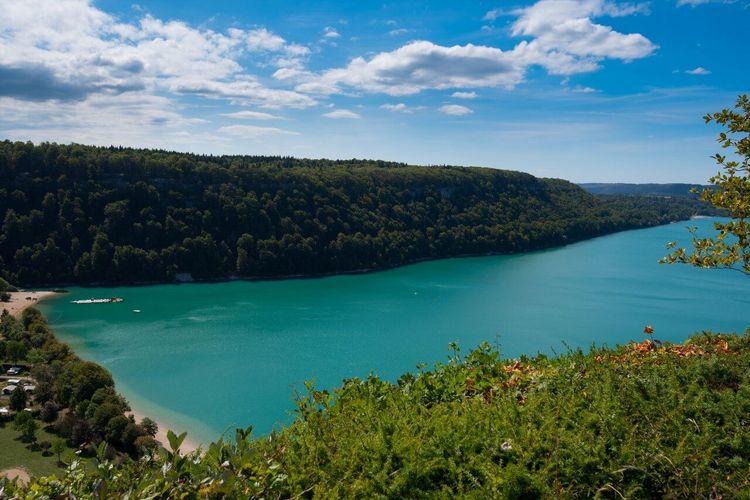
Jura is the département of natural lakes. There are several dozen in the Petite Montagne area alone, but four stand out for their character, accessibility, and what they offer visitors.
The lac de Chalain is the largest natural lake in Jura: 208 hectares, a maximum depth of 20 metres, turquoise water edged by wooded cliffs on its northern shores. In July and August, the Chalain beach draws thousands of visitors a day; the site is managed by the Département du Jura with a paid entry (€4 to €9 depending on the season). Out of season, it is a place of absolute calm, with paths circling the lake in about 4 hours. Archaeologists have found traces of prehistoric lake-dwellings beneath its waters, listed as UNESCO World Heritage.
The lac de Bonlieu is smaller but often more beautiful: surrounded by a mixed forest of firs, spruces, and beeches, it has a deep-green tint that contrasts sharply with the blue-turquoise of Chalain. Access is free, and the circuit around the lake takes 45 minutes on a flat path. The light there is particularly lovely in late afternoon.
Clairvaux-les-Lacs (Grande Plage, 39130 Clairvaux-les-Lacs, rated 4.3/5 on Google from 266 reviews) gives access to two connected bodies of water, the Grand Lac (215 hectares) and the Petit Lac. The resort is the best equipped for water sports (kayak, paddleboard, sailing) and has a developed beach open in season. It is also a good base from which to explore the whole lakes region on day trips. To go further in discovering Jura's lakes, Ryo's article on the most beautiful lakes in Jura details the five must-not-miss choices with their access points and individual character.
5. The Belvédère des 4 Lacs and the Pic de l'Aigle
If you are looking for the finest panorama reachable by car in Jura, the belvédère des 4 lacs (Route des 4 lacs, 39130 Mesnois, rated 4.7/5 on Google from 595 reviews) is the answer without hesitation. From this promontory at 786 metres above Frasnois, the eye takes in at once the lakes of Ilay, Narlay, Grand Maclu, and Petit Maclu — four mirrors of water nestled in forests at slightly different altitudes, giving them distinct hues depending on the light.
A few hundred metres from the viewpoint, the Pic de l'Aigle offers a slightly different angle with, on a clear day, a view stretching to the Swiss Alps and the Mont-Blanc massif. The whole area is reachable from the car park in 10 minutes on a well-marked path. There is no entry fee, just a car park that can fill up in summer. Arrive early in the morning for the best photographic light and to avoid the crowds.
Experienced hikers can combine this viewpoint with the Grande Traversée du Jura (GTJ), a waymarked long-distance route of several hundred kilometres that passes nearby. For a day hike, the circuit des 4 lacs from Ilay (12 km, 3h30) descends to the shores of each lake and returns through conifer forests.
6. Dole, the Forgotten Capital
Dole is the main city of Jura that too often gets left out of tourist itineraries. Yet this former capital of the Comté de Bourgogne packs a remarkable density of architectural heritage for a city of 25,000 inhabitants. The old town is a protected heritage area, its cobbled lanes and 17th-century hôtels particuliers bearing witness to an era when Dole rivalled Dijon for regional influence.
The collégiale Notre-Dame de Dole (Place Nationale, 39100 Dole, rated 4.7/5 on Google from 969 reviews) dominates the city with its 73-metre bell tower, the tallest in Franche-Comté. Built between the 15th and 17th centuries, it blends Flamboyant Gothic and Burgundian Renaissance in a rare balance. The interior preserves chapels decorated with a generosity that reflects the wealth of the merchant and legal families who funded the works. Entry is free.
Dole is above all the birthplace of Louis Pasteur, born on 27 December 1822 in a house in the tanners' quarter, now transformed into a museum. The Pasteur birthplace (43 rue Pasteur) meticulously traces the scientist's life and the conditions in which he grew up, long before his great discoveries on vaccines and pasteurisation. Admission: €6 for adults, €4 reduced rate. The city celebrates its illustrious son with a pride that spills onto the menus of local restaurants — pasteurised beers, cheeses named after Pasteur, chocolates shaped like vials.
The canal des Tanneurs runs through the historic quarter and makes for a pleasant walk between the old leather-industry buildings. The Dole market, held on Tuesday, Thursday, and Saturday mornings on the place des Verdannes, is one of the liveliest in the département — fresh comté, smoked charcuterie, Bresse poultry, and market-garden vegetables.
7. Arbois and the Jura Vineyard
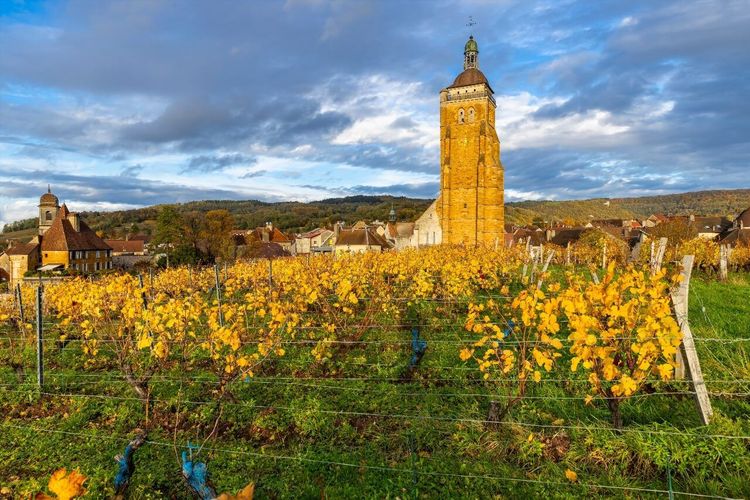
The town of Arbois (Place de la Liberté, 39600 Arbois, rated 4.5/5 on Google from 900 reviews) has a dual identity it wears with ease. On one hand, a town of character with its stone-built winegrowers' houses, its place de la Liberté overlooked by the church of Saint-Just, and its century-old cellars. On the other, the birthplace of the Jura vineyard and a pilgrimage site for lovers of natural wines and indigenous grape varieties.
Arbois holds the title of France's first wine AOC, recognised in 1936. Its vineyards spread across some 800 hectares within a few kilometres of the town. The flagship grape varieties are savagnin (for vin jaune), trousseau, and poulsard — varieties almost exclusive to Jura, found virtually nowhere else. Vin jaune, aged for a minimum of 6 years and 3 months under a veil of yeast in untopped barrels, develops aromas of fresh walnut, curry, and beeswax unlike anything else in the world of wine.
The cellars of Rolet (a family estate founded in 1942), Henri Maire (the largest producer), and Tissot (biodynamic, highly rated by the specialist press) all offer tours and tastings. Expect to pay €8 to €15 for a tasting of 4 to 6 wines. The Percée du Vin Jaune, an annual festival held on the first weekend of February in a different vineyard village each year, draws tens of thousands of visitors for the ritual opening of that year's clavelins.
Louis Pasteur lived in Arbois for many years, owning a house and vines there. The Louis Pasteur house in Arbois (83 rue de Courcelles) can be visited from May to September (€6 for adults); unlike the birthplace in Dole, it shows the man in his private life and his research on wines and beers.
8. Poligny, World Capital of Comté
Poligny claims the title of 'comté capital' with absolute legitimacy: the town is home to the Comité Interprofessionnel du Gruyère de Comté and several of France's most important ageing workshops. Comté is France's best-selling AOP cheese (around 70,000 tonnes per year), and Poligny is its beating heart.
The Maison du comté (5 Rue du Comté, 39800 Poligny, rated 4.5/5 on Google from 2,077 reviews) (place des Déportés) is the logical starting point for understanding this cheese. The permanent exhibition traces the stages of production, the role of the fruitières (dairy cooperatives), the work of the affineurs, and the different ways to taste it. Free entry. In the industrial zone, several ageing caves offer guided tours with comparative tastings of cheeses at different stages — 4 months (fruity, supple), 8 months (more pronounced, slightly granular), 12 to 18 months (tyrosine crystals, powerful aromas). The difference is striking.
The old town of Poligny is worth a stroll: the collegiate church of Saint-Hippolyte (15th century) preserves a remarkable ensemble of Gothic statues, and the town-centre lanes are lined with well-preserved medieval houses.
9. Salins-les-Bains and Arc-et-Sénans, a UNESCO Duo
Salins-les-Bains is a spa town whose history and fortune owe everything to the medieval saltworks buried beneath it. The Grandes Salines de Salins, excavated from the 13th century onwards in the limestone bedrock, have been inscribed on the UNESCO World Heritage List since 2009, together with the royal saltworks of Arc-et-Sénans (Grande Rue, 25610 Arc-et-Sénans, rated 4.3/5 on Google from 6,936 reviews), with which they are intimately linked. The guided tour descends into the underground galleries (45 min, €8 for adults) to show how salt-saturated water was pumped from underground springs and channelled to the bernes (evaporators) for crystallisation.
Some 25 kilometres from Salins, the royal saltworks of Arc-et-Sénans is the work of architect Claude-Nicolas Ledoux, commissioned by Louis XV in 1775. This semi-circular complex, unique in 18th-century architecture, was intended as the prototype of an ideal industrial city that was never fully realised. Today a museum and UNESCO site, it can be visited year-round (€11 for adults, combined ticket with Salins available). The permanent exhibition on Ledoux's architectural utopia is fascinating even for non-specialists.
Salins-les-Bains also has a thermal spa still in operation — the saline water at 32 g/l has been used for rheumatological treatments for centuries. Day treatments are available without a medical prescription.
10. Lons-le-Saunier, between Thermal Baths and the Marseillaise
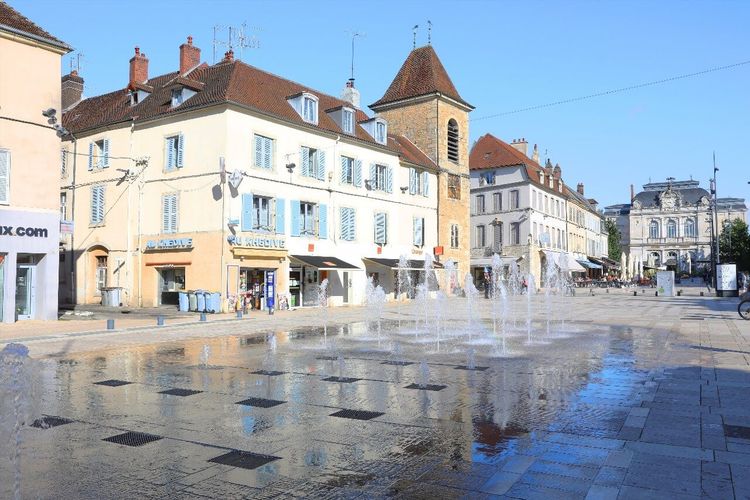
Lons-le-Saunier is the prefecture of Jura, a town of around 17,000 inhabitants, less spectacular than Dole but useful as a base for exploring the lakes region and the vineyard. It is known as the birthplace of Claude Rouget de Lisle, the author of the lyrics and composer of the melody of the Marseillaise, written in Strasbourg on the night of 25 to 26 April 1792. His birthplace (rue du Commerce) is open to the public and recounts the composer's life in the atmosphere of the late 18th century.
The town has a thermal spa whose sodium chloride waters at 24°C are reputed for rheumatological treatments. The thermal hospital also offers wellness treatments without a prescription. The arcaded rue du Commerce, typical of regional architecture, hosts a lively market on Wednesday and Saturday mornings. Nearby, the Musée des Beaux-Arts holds a respectable regional collection with some Flemish canvases and 19th-century Jura paintings.
11. The Lac de Vouglans
The lac de Vouglans (Belvédère du Regard, 39260 Moirans-en-Montagne, rated 4.5/5 on Google from 739 reviews) is not a natural lake — it is a reservoir created by an EDF dam built between 1965 and 1968 on the Ain river. But with its 35 kilometres in length, 1,600 hectares of surface area, and limestone cliffs plunging straight into emerald water, it has long since earned its tourist credentials independently of its industrial origins. It is the third largest reservoir in France, after Serre-Ponçon and Sainte-Croix.
The landscape is striking, particularly from the viewpoints of the Regard or Surchauffant, where the view plunges onto the meanders of the lake between wooded cliffs. For water-sports enthusiasts, Vouglans has several bases (sailing, wakeboarding, water-skiing) clustered around the villages of Moirans-en-Montagne and Orgelet. Hiking around the lake is possible on 80 kilometres of waymarked paths that pass successive viewpoints.
The village of Cernon, partially submerged when the lake was filled, sometimes re-emerges during periods of drought — the walls of the old church break the surface, creating an eerie spectacle that locals call 'l'apparition de Cernon'.
12. Saint-Claude and the Jura Pipe
Saint-Claude is a mountain town set in a deep gorge of the Ain and Tacon rivers, at 450 metres altitude in Haut-Jura. It has an improbable industrial speciality that made it world-famous: the manufacture of briar pipes. In the 19th century, the town concentrated several dozen workshops that exported their pipes to England, Germany, and the United States. Today, a few craftsmen keep the tradition alive and the Musée de la Pipe et du Diamant (Rue Pré-Millet, 39200 Saint-Claude, rated 4/5 on Google from 936 reviews) (rue Pré-Millet) traces its history with a collection of more than 3,500 pieces.
The cathédrale Saint-Pierre (14th–15th century) is the main Gothic church of Haut-Jura, with remarkable 15th-century carved choir stalls. Saint-Claude is also the starting point for several hikes in the Parc Naturel Régional du Haut-Jura — La Faucille, La Dôle on the Swiss side, and the gorges du Flumen.
13. Les Rousses and Haut-Jura in Summer
The Les Rousses resort (Route de Genève, 39220 Les Rousses, rated 3.6/5 on Google from 102 reviews) is known to skiers for its north-east-facing slopes that guarantee good snow cover from December to March. But it is in summer that Les Rousses reveals its best side for those looking to explore Haut-Jura on foot or by bike.
At 1,100 metres altitude, the Les Rousses plateau enjoys a welcome freshness in July and August — temperatures run 5 to 8°C cooler than in the plain. The lac des Rousses (around 90 hectares) offers swimming, fishing, and pedalo rental in a setting of meadows and spruce forests. The circuit around the lake takes 1h30 on an easy path.
Haut-Jura gives access to Switzerland less than 10 kilometres from Les Rousses — the border at La Cure is open and cross-border hikes pass the lac de Joux on the Vaud side. For those who prefer two wheels, the véloroute du Haut-Jura (a former railway line converted over 37 km) links Les Rousses to Saint-Claude on an entirely flat, forested route. The Ryo audio guide covers this area with anecdotes on pipe-making and the history of the border resorts — an effective way to explore the territory without missing its secrets.
14. Nozeroy, the Intact Medieval Village
Nozeroy (Place des Annonciades, 39250 Nozeroy, rated 4.4/5 on Google from 580 reviews) is one of Jura's hidden gems. This medieval market town of 600 inhabitants, perched at 750 metres in the Petite Montagne, has kept its 15th-century ramparts, its porte de l'Annonciades, and its star-shaped lanes converging on the place des Annonciades — the former stronghold of the lords of Chalon. The town is listed among the Sites Remarquables du Goût for its cheeses and mountain honey.
The porte de l'Annonciades, the last medieval gate still standing in Jura, is photographed by every visitor from the chemin de ronde. Inside the walls, a few grocery shops sell local honey, aged comtés, and Jura genevers (liqueurs). The view from the ramparts stretches over lush green meadows and the first wooded summits of Haut-Jura.
15. The Upper Valley of the Saine
Less well known than the Hérisson valley, the upper valley of the Saine (Route de Boujailles, 39300 Mouthe, rated 4.7/5 on Google from 327 reviews) is a wild hiking retreat in Haut-Jura. The Saine is a tributary of the Ain that rises near Foncine-le-Haut and flows for 35 kilometres before reaching the plain. Its upper course is flanked by wet meadows, fir forests, and a handful of isolated farms — a landscape typical of Jura at altitude.
The Saine trail follows the river for about 12 kilometres through its upper section. The elevation gain is moderate and the route is suitable for families with children over 8 years old. In winter, the area is accessible on cross-country skis via the groomed pistes of the Haut-Jura Nordic network.
16. The Pertes de l'Ain
The Pertes de l'Ain (Pont-de-Poitte, 39130 Pont-de-Poitte, rated 4.7/5 on Google from 1,297 reviews) constitute a rare geological phenomenon. At Pont-de-Poitte, the Ain river literally disappears into the porous limestone of the plateau — part of its flow is swallowed by underground caves before resurfacing further on as springs. This phenomenon of sinkholes (or ponors) is well documented by speleologists, who have mapped part of the underlying network.
The site is accessible from a viewpoint arranged at the river's edge. In spring at high water, the flow is impressive and the roar of the water can be heard from afar. In summer, the level drops and the limestone rocks become accessible for exploration on foot along the banks. The area is popular with anglers for its trout and Arctic char.
17. The Jura Vineyard on a Circuit
The Jura vineyard extends in an arc of roughly 80 kilometres from north to south, between Salins-les-Bains and Saint-Amour, with a maximum width of 6 kilometres. It is not a large vineyard by area (2,200 hectares in production), but it is one of France's most distinctive — five local grape varieties and two unique ageing methods (under veil for vin jaune, on straw for vin de paille).
The Route des Vins du Jura (Avenue de la Gare, 39600 Arbois, rated 4.5/5 on Google from 55 reviews) is waymarked from Salins-les-Bains to Saint-Amour. It passes through the villages of Pupillin (nicknamed the 'poulsard capital'), Montigny-lès-Arsures (trousseau terroir), and of course Château-Chalon and Arbois. Most estates offer direct sales — a day of tasting allows you to visit 4 to 5 estates comfortably. Designate a driver or bring spittoons.
By bike, the wine route is manageable on 55 kilometres of dedicated cycle path. The elevation change is moderate (the vineyard sits on the first hillsides between 250 and 450 metres altitude). Bike rental is available in Arbois and Lons-le-Saunier.
18. Hiking and Outdoor Sports in Jura
Jura is one of France's best-equipped départements for outdoor activities. The waymarked trail network covers more than 6,000 kilometres of walking, mountain biking, cross-country skiing, and equestrian routes.
The Grande Traversée du Jura (GTJ) (Office de Tourisme, 39000 Lons-le-Saunier, rated 4.5/5 on Google from 189 reviews) links Mandeure to Culoz over nearly 400 kilometres that can be broken into segments by activity. It exists in versions for walking, mountain biking, cross-country skiing, snowshoeing, and even horse-riding. Refuges and gîtes d'étape are plentiful along the route; a complete traverse on foot takes 3 to 4 weeks of walking.
For water sports, the gorges of the Ain between Pont-de-Poitte and Clairvaux-les-Lacs offer canyoning and climbing from June to September, with several qualified operators. Via ferrata enthusiasts will also find routes accessible to beginners with a guide near Pont-de-Poitte. The Ryo app lists trails and activities by area, with practical information on access conditions and local providers.
19. Jura Gastronomy: Comté, Vin Jaune, and Morels
You cannot spend a week in Jura without confronting its gastronomy. That is not a figure of speech — it is an obligation.
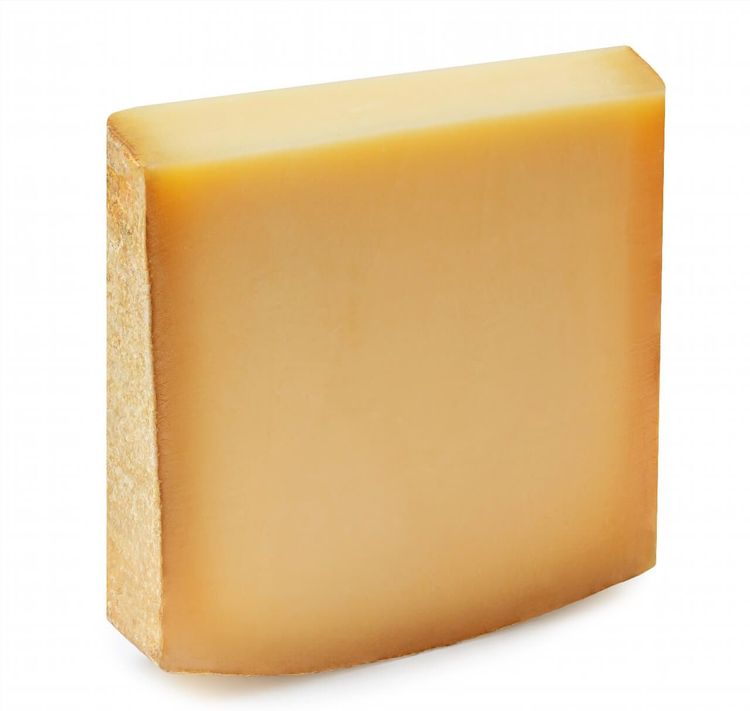
Comté is France's best-selling AOP cheese by volume, produced since the Middle Ages in the fruitières (cheese cooperatives) of the Jura Massif. Each wheel weighs between 32 and 45 kilograms and requires around 400 litres of milk from Montbéliarde or Simmental cows. Ageing varies from 4 to more than 36 months; long-aged cheeses develop crunchy tyrosine crystals and aromas of hazelnut, burnt butter, and dry hay that are absolutely singular.
Vin jaune is the natural partner of Jura sauces. The classic recipe of chicken with vin jaune and morels perfectly illustrates the region's culinary identity: the sauce combines the oxidative richness of vin jaune, the woody fragrance of dried morels, and the cream of the neighbouring Bresse plain. Jura morels, gathered from April to May in woodland on sunny hillsides, are the subject of an almost ritual foraging among locals. Fresh, they fetch between €60 and €120 per kilo; dried, they keep and rehydrate on demand.
The saucisse de Morteau (smoked in the tuyé, the traditional large Comtoise chimney) and brési (air-dried beef from the high plateaux) are the essential charcuterie. For good food at low prices, look for ferme-auberges — working farms that serve their own produce in a converted barn, at prices lower than those of town restaurants.
20. Unusual and Secret Places in Jura
Jura rewards the curious who stray from the waymarked paths.
The grottes de Baume in the eponymous reculée can be visited from May to September with a guide (access from the abbey). The tour descends into galleries carved in limestone by an underground river over several millennia — an unexpected mineral spectacle after the tranquillity of the village.
The belvédère de la Chapelle, in the forest above Baume-les-Messieurs (Route des Grottes, 39210 Baume-les-Messieurs, rated 4.5/5 on Google from 1,213 reviews), must be earned via a path from the village (30 min walk) and rewards the effort with a plunging view over the abbey and the reculée. Poorly signposted and rarely crowded — exactly the kind of place our Ryo app lists for travellers who want to escape the crowds.
The tour de Château-Chalon, accessible from the viewpoint to the east of the village, offers a different perspective over the vineyard — less photographed than the main belvedere. In Poligny, the reculée de Vaux and its cliffs tower over the lower town, a mineral backdrop unknown even to passing tourists. And for geology enthusiasts, the limestone plateaux around Baume are rich in fossils and concretions that thematic trails allow you to observe.
21. The Reculée de Baume Seen from Above
We mentioned Baume-les-Messieurs at village level (section 3), but the reculée deserves an additional angle: that of the Roches de Baume viewpoint (D471, 39210 Granges-sur-Baume, rated 4.7/5 on Google from 212 reviews), accessible from the Granges-sur-Baume plateau via the D471. The road overhangs the cliffs at a vertiginous height — around 200 metres above the valley floor.
Looking down, you can make out the abbey, the village rooftops, and the ribbon of the Seille threading between the cliff faces. It is one of the most photographed viewpoints in Jura, and probably the most striking in stormy weather when clouds frame the cliffs. The roadside car park is free and accessible by ordinary car.
The Roches de Baume trail (yellow waymarking) circles the plateau rim for 7 kilometres, combining viewpoints with beech forests. There is also a variant that descends into the reculée and returns by a different path — allow 4 to 5 hours for the full loop.
22. Cheese Dairies and Ageing Caves: Behind the Scenes of Comté
Visiting a fruitière or ageing cave is an experience not to be missed in order to understand what makes Jura comté special. This is not an industrial cheese — the bulk of production takes place in cooperative fruitières that collect milk locally (within a radius of 25 km of the fruitière).
The cave of the Fromagerie Marcel Petite at Fort Saint-Antoine (on the Doubs side) is a 19th-century military fortification converted into a giant ageing cave — tens of thousands of comté wheels mature simultaneously in a cool, very humid atmosphere. The guided tour (by reservation, around €10 for adults) is one of the most memorable experiences you can have in Jura, even if you are not a cheese enthusiast.
To buy comté directly from a fruitière, prices are often lower than in supermarkets for at least equivalent quality. Always ask to see the wheel before it is cut — master affineurs will slice to order.
23. Métabief and High-Altitude Sports
Métabief is Jura's main winter sports resort, perched at 1,000 metres altitude on the slopes of the Morond (highest point: 1,419 m). In winter, the resort offers several dozen kilometres of alpine ski runs, a snowpark for freestyle enthusiasts, and a cross-country ski network that connects to Franco-Swiss pistes. For a family on a winter break, Métabief is accessible from Besançon (1 hour) or Pontarlier (20 minutes).
In summer, the transformation is complete. The resort becomes a bike park with mountain bike descents at several difficulty levels and panoramic rides from the summit. The chairlift (open in summer) reaches the top in minutes for a view of the Swiss Alps on clear days. An easy ridge path links the Morond summit to neighbouring ridges in 3 hours return.
24. The Forêt de la Joux
The forêt de la Joux (Route forestière de la Joux, 39300 La Chaux-du-Dombief, rated 4.9/5 on Google from 8 reviews), on the border of Jura and Doubs, is one of France's finest silver-fir forests — 2,700 hectares of silver firs with impressive trunks, some exceeding 40 metres in height and 200 years of age. It is managed by the ONF according to the principles of the cathedral high forest: high-standing trees left to grow freely over centuries.
It is home to the Sapin Président, long considered the tallest fir tree in France: more than 45 metres tall, around 45 cubic metres of timber, and several centuries old. It is accessible via a short path from the Clairière du Maréchal car park. The ONF organises guided nature walks in the forêt de la Joux by reservation. The forest road is used by cyclists and walkers year-round. The forest is also a managed hunting territory: partial closures apply on weekends from October to January — check before setting out.
25. Practical Tips for Planning Your Stay in Jura
A few concrete facts to prepare your visit without unpleasant surprises.
When to go? Jura is a four-season destination. Spring (April–June) is the best time for the waterfalls (maximum flow) and hiking (before the crowds arrive). Summer (July–August) is the high season for the lakes, but the major natural sites are very busy — book accommodation 3 to 4 months in advance for July weekends. Autumn (September–October) offers exceptional colours and reduced visitor numbers. In winter, Haut-Jura transforms into a Nordic territory.
How to get around? A car remains essential for most sites. The departmental coach network (Lignes du Jura) covers the main towns but not isolated natural sites. From Paris, the TGV reaches Dole in 2 hours and Lons-le-Saunier in 2h30.
Where to stay? Rural gîtes are the most fitting accommodation — Jura has several hundred labelled gîtes, often in farmhouses or characterful villages. The town centres of Dole, Arbois, and Lons-le-Saunier offer mid-range hotels. Lakeside campsites are in high demand in July and August.
Average budget: allow €60 to €90 per person per day (gîte accommodation, lunch and dinner out, site entry fees). Natural sites (waterfalls, viewpoints, forests) are almost all free; museums and ageing caves charge €5 to €12 on average.
FAQ
What is the best time to visit Jura?
Spring (April–June) is optimal for the waterfalls, hiking, and the vineyard in bloom. Summer (July–August) is the peak season for the lakes. Autumn (September–October) combines forest colours with a welcome return to tranquility. Winter is perfect for cross-country skiing and the snowy landscapes of Haut-Jura.
How long does it take to visit Jura?
A stay of 3 days allows you to cover the must-sees: the cascades du Hérisson, Baume-les-Messieurs, Château-Chalon, and a lake. One week is the ideal duration. Two weeks allow you to explore lesser-known sites such as Nozeroy or the Pertes de l'Ain at a leisurely pace.
Can you visit Jura without a car?
With difficulty. The major natural sites (cascades du Hérisson, lac de Chalain, belvédère des 4 lacs) are not accessible by public transport. The TGV connects Paris to Dole and Lons-le-Saunier, but a rental car is necessary from these cities. By bike, the Jura plain and the Route des Vins are manageable, but the terrain of Haut-Jura is demanding.
What is vin jaune and how should you taste it?
Vin jaune is a white wine aged under a veil of yeast for a minimum of 6 years and 3 months in untopped barrels, giving it aromas of walnut, curry, and beeswax. It is best enjoyed at 13–14°C, paired with aged comté, foie gras, or chicken with morels. Tradition calls for opening it with the thumb pressed on the wax stopper. A clavelin (62 cl) costs between €12 and €30 depending on the producer and vintage.
Where can you buy comté directly from the producer?
The cooperative fruitières of Poligny, Arbois, and many vineyard villages sell their production directly. The Maison du comté in Poligny (free entry) is the best starting point to identify producers. Fort Saint-Antoine (Fromagerie Marcel Petite) also offers direct sales after the tour. The markets in Dole, Arbois, and Lons-le-Saunier also sell fresh and aged comté at reasonable prices.
What activities can you do in Jura with children?
The cascades du Hérisson, the belvédère des 4 lacs, the beaches of the lakes at Chalain and Clairvaux-les-Lacs, and a visit to a cheese fruitière are all family-friendly activities. Métabief offers a rail luge and a bike park from summer onward. The forêt de la Joux delights nature-curious children. The caves of Baume-les-Messieurs (guided tour) are accessible from age 6.
Conclusion
Jura is a territory that does not impose itself. It lacks the monumental scale of the Alps and the fame of Provence, and that is precisely what makes it endearing — every discovery requires a little effort, whether at the end of a damp trail, deep inside an ageing cave, or in a village fruitière that nothing announces from the road.
To prepare your visit, the Ryo app lists the key sites with audio-guided descriptions and up-to-date practical recommendations. Find in particular the most beautiful lakes in Jura on Ryo to refine your itinerary around the lakes — because in Jura, each lake has its own personality and deserves time devoted to it.