© Shutterstock
 Votre guide Ryo
Visit Lusignan: between myths and legends
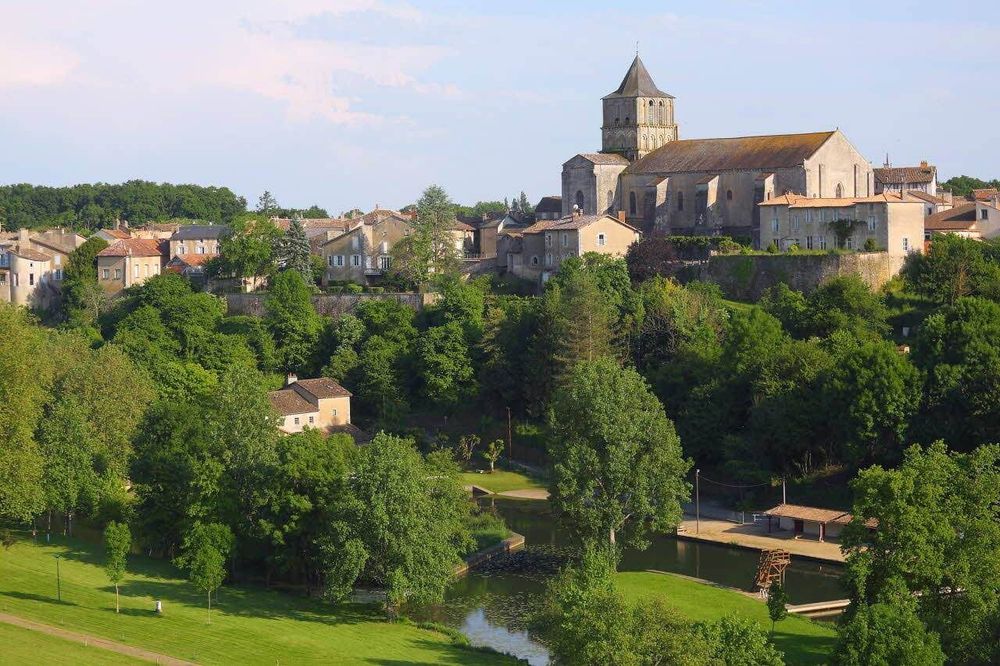
20 km southwest of Poitiers, between the Poitevin marshes and Futuroscope, lies the charming medieval town of Lusignan.
Cradled by the legend of the fairy Mélusine, its history dates back to Celtic times and brings us its share of historical heritage.
An interesting and pleasant visit awaits you in the heart of the land of 6 valleys and an escapade not to be missed from Poitiers!
The history of Lusignan
First of all, let's take a brief overview of the city's history.
As we said, Lusignan was already what we call an oppidum (a fortified city) in Celtic times, that is in the 2nd and 1st century BC.
But it was between the 10th and 14th centuries that the city really gained importance, linking its destiny to that of the powerful family of the lords of Lusignan, who became kings of Jerusalem, Armenia, then kings of Cyprus during the great crusades.
In the 14th century, Lusignan thanks to its fortress, was then considered a stronghold of Poitou.
But in the 16th century, during the 5th war of religion, the count of Montpensier besieged the city and took the castle of Lusignan which was finally destroyed by order of Henri III.
In the 17th century, the fortifications were razed and the city developed thanks to its merchant position on the route between Paris and La Rochelle.
During the French Revolution, in Lusignan, people were on the side of the revolutionaries! They planted the tree of liberty, which was, in the 19th century, a symbol of the Revolution as much as Marianne. It's actually this tree that you see on French 1€ and 2€ coins.
Today, Lusignan is a rural commune of about 3000 inhabitants, marked by the importance of its agricultural lands, and is labeled "Station Verte", France's first ecotourism label!
The legend of Mélusine

You'll quickly realize that Lusignan is still marked by the legend of the fairy Mélusine, who would be the matriarch of the great lineage of the lords of Lusignan.
Besides, the inhabitants are called "Mélusins" and "Mélusines"!
The legend begins in the Kingdom of Albania (in Scotland, nothing to do with present-day Albania). King Elinas meets the fairy Pressine there, whom he marries and with whom he has 3 daughters: Mélusine, Mélior and Palestine. Without going too much into the details that precede our story, know that Pressine and Elinas will quarrel, that the fairy will leave with her daughters and complain about her ex-husband and that her daughters will try to avenge their mother by locking their father on a mountain. But the fairy Pressine, far from being happy with her daughters' action, decided to punish them by casting a spell on them. For Mélusine, it would be her transformation into a serpent woman every Saturday. She could take a husband on condition that he agreed never to see her on Saturday.
And, as you can imagine, Mélusine will meet lord Raymondin, who went with his uncle, the count of Poitiers, boar hunting. Raymondin accidentally kills his uncle and goes wandering, miserable in the forest.
At midnight, exhausted and pursued, he meets, at the edge of the fountain of thirst, three women, including Mélusine, who offers to help him, to make sure he has no problems with this accident and to make him a powerful lord. On condition that he marries her and never tries to see her on Saturday.
It was done, and Mélusine kept her word. She made her husband a powerful lord, at the head of a long lineage and built castles and fortresses on his kingdom.
They had 10 children, all bearing a strange trait, like a lion's claw on the cheek or a boar's tusk in the mouth. All except the last two.
As promised, Raymondin left his wife the discretion of her Saturdays. But one day, pushed by his brother, the count of Forez, jealous of his younger brother, he decided to see what the devil his wife was doing locked up all day! Here, two versions of the legend end the story. Here's the best known:
Raymondin splits the lock of the chamber with his sword and finds himself face to face with beautiful Mélusine, half woman he loves, and half serpent.
She then flies away through the window with bat wings, like a dragon, uttering curses against all the places she had built for her husband.
It is said that she regularly returns to haunt the ruins of the castle.
What to do and see in Lusignan?
# 1: Notre-Dame and Saint-Junien Church
It was built between 1024 and 1110 by the Lords of Lusignan, then remodeled in the 15th century with the creation of a Gothic porch. You will also see a statue of Mélusine there. Don't hesitate to go see the 12th century crypt, located under the apse.
# 2: The Blossac promenade
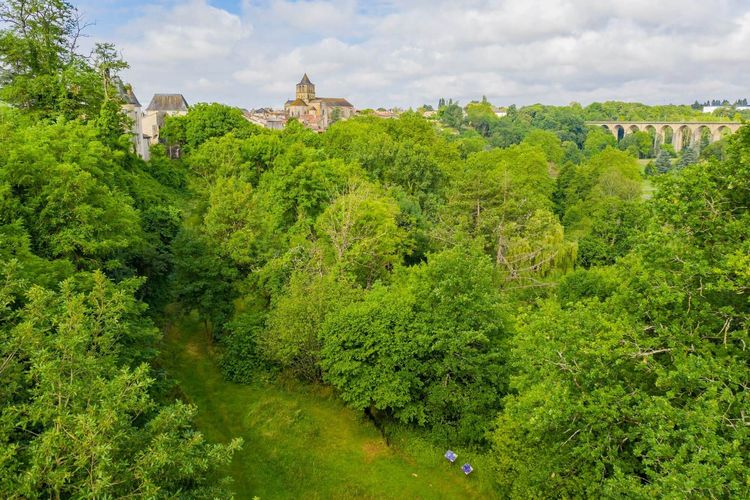
The former castle of Lusignan, which was in its time one of the largest fortified castles in France, became a simple stone quarry after its destruction in the 16th century.
In the 18th century, the count of Blossac, then intendant of Poitou, decided to completely raze it and transform the place into a beautiful public park, still appreciated today.
#3: The medieval market halls
Listed as Historic Monuments, these beautiful wooden halls were built in 1853 to replace the old medieval halls. Made of stone and wood, they are a surprising choice at this time when the great fashion was for metal halls!
#4: The Grand Parc communal forest
This former hunting domain, once surrounded by walls, now represents an exceptional natural site of 160 hectares! A botanical trail and numerous marked circuits allow you to discover it.
#5: The Viaduct
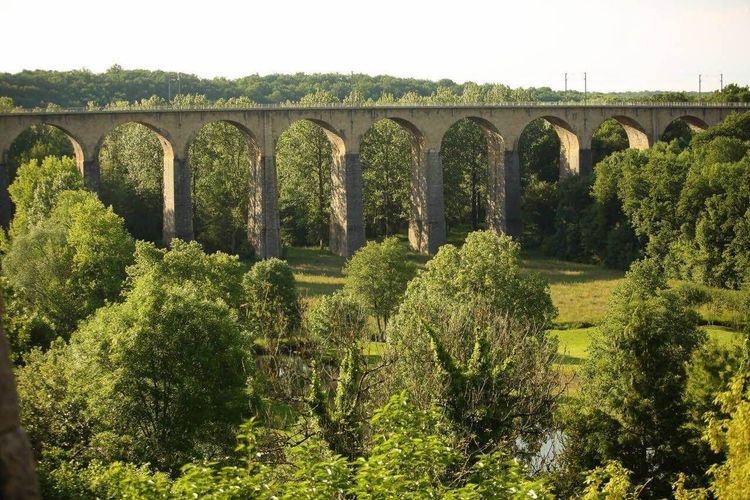
The Lusignan Viaduct, also called the Mélusine Viaduct (you can look for its sculpture) was erected in just 3 years, in 1856. Its 22 arches of almost 33 meters high cross the Vonne over 433 m long.
#6: Place du Bail
At the time of the castle of Lusignan, you would have been in the lower courtyard. This is where the inhabitants gathered in case of siege. Today, you will see a modern metal sculpture of Mélusine taking flight.
#7: The Governor's house
Located at 25 rue Saint-Louis, and built in 1615 on the former wall of the castle, the Governor's house served as residence for the king's representative on his lands. It has been classified as a historic monument since 1935.
# 8: The Saint-Sauvant forest
This 800-hectare oak forest is crossed by numerous pedestrian trails, including the GR 364 which connects the Grand Parc woods of Lusignan to those of Rom (Deux-Sèvres).
You will also find a remembrance trail about World War II, a discovery trail to travel with family and equestrian and mountain bike circuits. The pond trail, meanwhile, allows you to discover, further north, the typical fauna and flora of wetlands.
In conclusion
The visit to Lusignan allows a day trip, between nature and history, heritage and legend, just a stone's throw from Poitiers.
If you're passing through the region, don't hesitate and say hello to Mélusine for us!