
Créé par Emilie, le 7 mai 2026
Votre guide Ryo
© Shutterstock
This city, built in the heart of Marseille in Bouches-du-Rhône from 1947 to 1957, is a wild idea straight from the mind of a well-known great architect: Le Corbusier.
Listed as a historic monument since 1986, the cité radieuse revolutionized building architecture with its extraordinary design. Located at 280 boulevard Michelet in the 8th arrondissement of Marseille, this residence is surprising, colorful, and can be visited year-round by reservation through the Marseille Tourism Office.
Between the corniche and the pointe rouge, the cité radieuse is a place to visit absolutely if you pass through Marseille.
The Cité Radieuse – Le Corbusier, extraordinary architecture
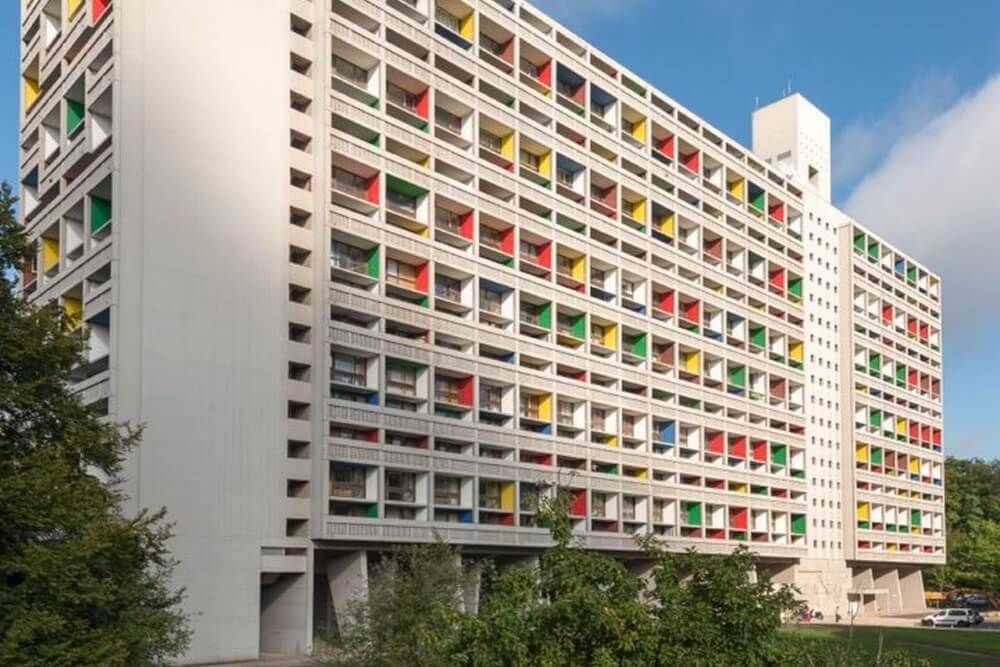
Built on concrete stilts, this building aimed to "show a new art of building that transforms the way of living" with 5 main principles: pilotis, roof garden, free plan, ribbon window and free facade. It was meant to give the impression of a vertical village that would feel friendly thanks to large living spaces. The walkways inside the building are reminiscent of streets, they lead to 337 apartments, all duplex, and equipped with a private terrace.
Large windows let light into the through apartments, and the outdoor gardens are spacious, perfect for families. There used to be shops and offices.
Today, they have been replaced by a hotel restaurant, a bookstore, a food store and a school. The playground is located on the rooftop terrace of the building, where you can also find a swimming pool reserved for residents, a gymnasium, and finally, a painting workshop.
It must be said that the breathtaking view of the city of Marseille was itself a major asset for this large complex.
The 18 levels for 9 floors are perfectly optimized thanks to a well-thought-out human-scale arrangement, and the view overlooks not streets, but the green spaces of the park. Le Corbusier wanted, above all, to offer spaces where one feels good and that are comfortable to live in daily.
The cité radieuse in numbers
- 36 concrete stilts 7 meters high support each building,
- 3 hectares of green spaces.
- Capacity to house 2,000 tenants,
- 337 dwellings, including 23 different types,
- 1 hotel with 21 rooms,
- 137 meters long, 24 meters wide and 56 meters high.
Why was this building built?
During World War II, many French cities had suffered bombings and many dwellings had completely or partially disappeared. Marseille experienced the dynamiting of the panier district and the port by the Germans.
The housing crisis, and particularly social housing, had already been very problematic for a long time, but it intensified after this last world conflict to the point that solutions had to be found in order to quickly house a maximum of homeless people or those "living" in slums. It was during this period that the construction of large housing complexes began to respond to this urgent need: housing the French.
Who was Le Corbusier?
Charles-Edouard Jeanneret-Gris, his real name, loved to travel to find inspiration and improve his techniques, he had a great interest in knowledge from here and elsewhere. A man inclined to modernity, he wanted to create functional buildings with clean lines while including nature in his architecture.
Le Corbusier, in addition to being an architect, was also an urban planner, painter, man of letters and designer.
Le Corbusier, during the inauguration speech, said about the Cité Radieuse that it was: "Made for men, made to human scale, in the robustness of modern techniques, manifesting the new splendor of raw concrete, to put the sensational resources of the era at the service of the home."
In 60 years of career, Le Corbusier created numerous buildings in 12 countries on 4 of the 5 continents.
What is the modulor?
It is a measurement system invented by Le Corbusier in 1945. It consists of mixing the 2 measurement systems generally used at that time: the Anglo-Saxon foot-inch, not very practical, but which takes into account body measurements, and the metric system very practical, but which does not take into account body measurements. This in order to obtain a measurement system that would bring maximum comfort to human beings in their living space. For example:
- Ceiling height: 226 cm
- Table height: 70 cm
- Height of a kitchen element: 86 cm...
Practical information for visiting the Cité Radieuse Le Corbusier
Visits are booked through the Marseille tourism office.
Prices
- Adult guided tour: €10.00
- Guided tour 6 to 12 years: €5.00
- Guided tour under 6 years: free
Reservation is mandatory, the city is open to all public as well as groups. Tour departures are at 2 pm and 4 pm Monday to Friday and some Saturdays.
You will have the opportunity to visit the housing unit, a classified apartment open to the public, the roof terrace, the commercial street, all with a lecturer guide who will answer all your questions about this extraordinary city.
Following this visit, you will have the opportunity to discover an audio tour recorded with the voices of residents of the Cité Radieuse past and present, who will guide you through the site.
Warning: it should not be forgotten that this complex is inhabited and it is therefore necessary to respect the places and its inhabitants.
Little secrets about the Cité Radieuse...
- Do you know what the Marseillais nickname it? La Maison du Fada, a building of this size on stilts, you had to think of it... peuchère!
- This site is listed as a UNESCO World Heritage Site.
- There were 5 housing units built in total on the park.
- This city was, at the time of its construction, considered as a laboratory based on a housing system that was completely different from what had been done until then.