
Créé par Emilie, le 7 mai 2026
Votre guide Ryo
© Shutterstock
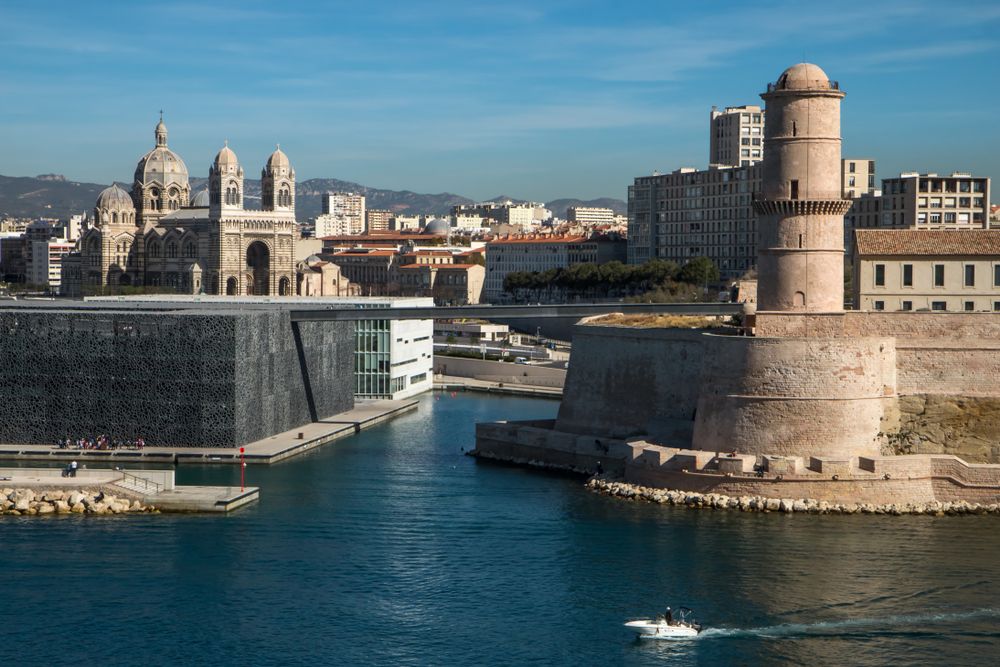
Majestically positioned at the entrance to Marseille's Vieux-Port, MUCEM (Museum of European and Mediterranean Civilizations) stands as one of the most emblematic cultural sites in southern France. Inaugurated in 2013 during the year when Marseille was European Capital of Culture, this exceptional national museum brilliantly combines contemporary architecture with historical heritage. Between the J4 building designed by Rudy Ricciotti and the majestic Fort Saint-Jean, MUCEM offers a unique cultural experience around Mediterranean civilizations, with fascinating exhibitions, breathtaking panoramic terraces and outdoor spaces perfect for strolling facing the sea.
What is MUCEM?
MUCEM, the acronym for Museum of European and Mediterranean Civilizations, is much more than just a museum. It's the first national museum established outside Paris, an exceptional venue that explores the cultural, historical and anthropological riches of the Mediterranean basin. Spread across three main sites – the J4 building, Fort Saint-Jean and the Conservation and Resources Center (CCR) – MUCEM offers a fascinating immersion into the history of civilizations that have shaped Mediterranean identity, from Antiquity to the present day.
This innovative museum presents exceptional permanent collections complemented by high-quality temporary exhibitions addressing diverse themes: migrations, religions, gastronomy, commerce, contemporary art and geopolitics. MUCEM is distinguished by its desire to create bridges between past and present, between tradition and modernity, offering visitors deep reflection on contemporary Mediterranean issues. Let yourself be guided through your discovery of the Phocaean city with the Ryo audio-guided itinerary for Marseille, which will help you optimize your visit to the city.
MUCEM's history
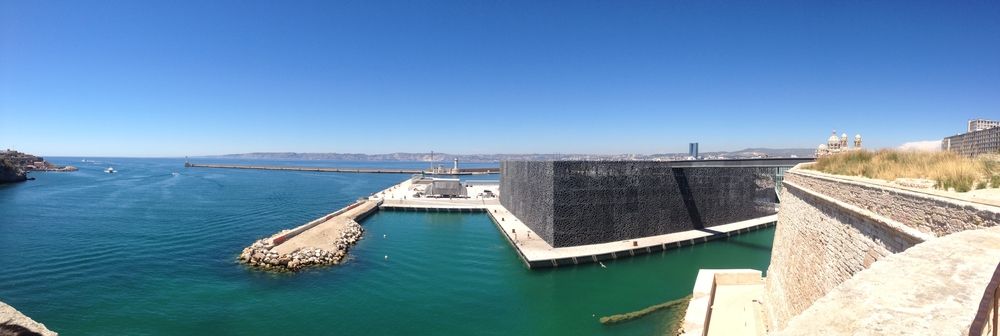
MUCEM's adventure truly begins in 1992, when Marseille applied to become European Capital of Culture in 2013. The ambitious project involved creating an internationally significant museum dedicated to Mediterranean civilizations, heir to the National Museum of Popular Arts and Traditions in Paris. The chosen location, the former J4 pier at the entrance to the Vieux-Port, demonstrates the desire to create a dialogue between the city, its port and the sea.
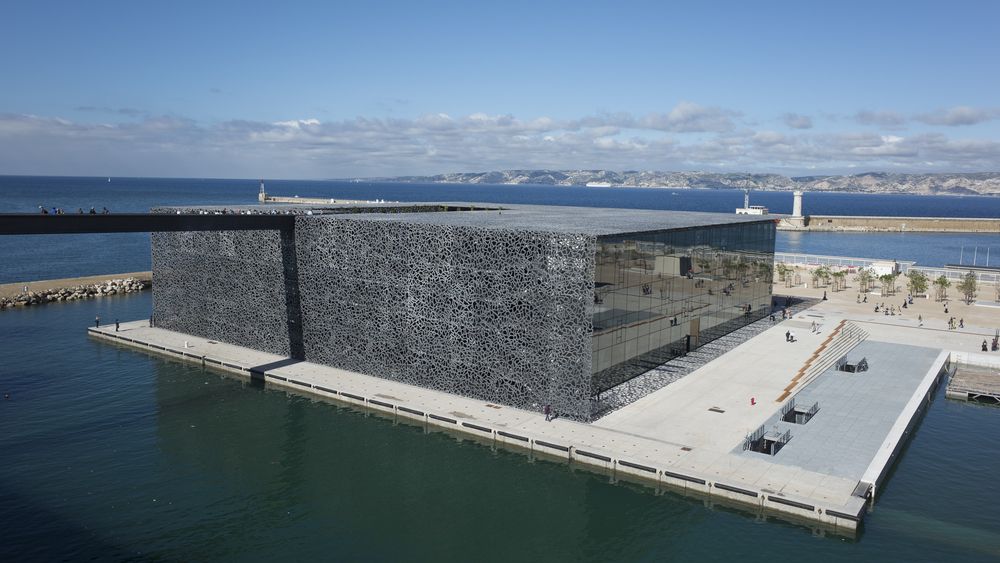
Architect Rudy Ricciotti, associated with Roland Carta, won the competition in 2003 with a bold architectural project: a concrete cube pierced with a screen inspired by Mediterranean lacework. Work began in 2009 and the museum opened on June 7, 2013, immediately becoming a major architectural symbol of Marseille. Fort Saint-Jean, a historical monument dating from the 12th century, was integrated into the project after meticulous restoration, creating a striking link between medieval heritage and contemporary architecture.
Since its inauguration, MUCEM has welcomed over 8 million visitors and has established itself as an international cultural reference. In 2015, it received the prestigious Council of Europe Museum Award, recognizing its innovative approach and intercultural dialogue mission. Today, visiting MUCEM in Marseille means discovering a living place where history meets current events, where cultures dialogue and where architecture sublimes heritage.
MUCEM's exceptional architecture
The J4 building: an architectural feat
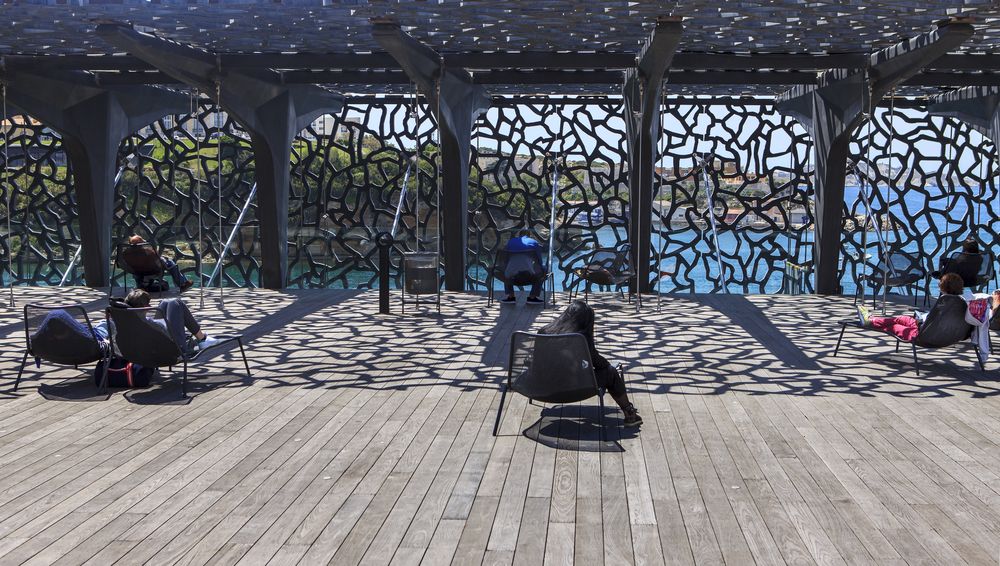
The J4 building, MUCEM's contemporary heart, is a true architectural feat signed by Rudy Ricciotti. This 72-meter-sided cube is distinguished by its ultra-high performance fiber concrete (UHPFRC) envelope, whose thickness doesn't exceed a few centimeters. The facade is adorned with a perforated screen inspired by traditional Mediterranean claustra and lacework, creating an absolutely magical play of shadow and light inside the museum.
This concrete lacework, the building's true signature, filters Mediterranean light and sea breeze while protecting the exhibition spaces. The J4 building houses 3,690 m² of exhibition space across two levels, a bookstore-shop, an auditorium and the Le Môle Passédat (MCM) restaurant on the top floor, offering a spectacular view of the Mediterranean. The architecture perfectly embodies the museum's philosophy: creating dialogue between interior and exterior, between heritage and modernity.
Fort Saint-Jean: witness to history
Fort Saint-Jean, an emblematic historical monument, constitutes MUCEM's second architectural pillar. Built in the 17th century on Louis XIV's orders, this military fort has overlooked the entrance to the Vieux-Port for centuries. It rises on a historically charged site, where remains of the first Greek occupation from the 6th century BC were discovered, testifying to the site's exceptional historical richness.
Restored and integrated into MUCEM in 2013, Fort Saint-Jean has preserved its historical character while opening to the public with new facilities. Its spaces host temporary exhibitions in historically charged rooms, while its Mediterranean gardens offer a bucolic walk with incomparable views of the sea and city. The Tower of King René, Saint-Jean chapel and ancient fortifications constitute fascinating architectural testimonies to discover during your visit.
The footbridges: a symbolic link
Two spectacular pedestrian footbridges connect the J4 building to Fort Saint-Jean, creating a unique aerial path above the water. The first, 130 meters long, overlooks the fort and offers vertiginous perspectives of the Vieux-Port, the Major cathedral and Marseille's rooftops. The second footbridge connects the fort to the J4 esplanade, facilitating circulation between the museum's different spaces.
These footbridges are not mere functional links: they embody MUCEM's very concept of creating bridges between cultures, eras and civilizations. They allow visitors to experience a unique architectural experience, suspended between sky and sea, while admiring the exceptional panoramas offered by this privileged site at the entrance to Marseille's port.
What to see and do at MUCEM?
1. Permanent exhibitions
MUCEM's permanent exhibitions constitute the heart of the museum's cultural offering. The Gallery of the Mediterranean, the museum's flagship exhibition, proposes an exceptional chronological and thematic journey that traces 3000 years of Mediterranean history. You'll discover archaeological objects, artworks, ethnographic testimonies and contemporary installations that illustrate the richness and diversity of Mediterranean basin civilizations.
Among the themes addressed: the invention of agriculture and deities, city-states and empires, Jerusalem and the three monotheisms, ancient citizenship, and the great voyages of discovery. Permanent collections also explore contemporary subjects like migrations, commercial and cultural exchanges, conflicts and cooperation that have shaped Mediterranean identity. The immersive scenography and multimedia devices make the visit particularly lively and accessible to all audiences.
2. Temporary exhibitions
MUCEM regularly offers high-quality temporary exhibitions that explore specific themes related to Mediterranean civilizations. These exhibitions, which are renewed several times a year, address subjects as varied as Mediterranean gastronomy, contemporary art, fashion, photography, architecture and current geopolitical issues.
Temporary exhibitions occupy different museum spaces, both in the J4 building and Fort Saint-Jean, thus offering very different atmospheres depending on the venues. Some exhibitions feature internationally renowned contemporary artists, creating specific installations for MUCEM's spaces. It's recommended to consult the museum's official website before your visit to know the current programming and not miss any cultural offerings.
3. The Garden of Migrations
The Garden of Migrations, arranged in the heart of Fort Saint-Jean, constitutes a unique botanical and poetic experience. This landscaped path vividly illustrates the cultural and commercial exchanges that have shaped Mediterranean flora over the centuries. You'll discover over 250 plant species from the Mediterranean basin and elsewhere, witnesses to the multiple influences that have enriched the region.
The garden is organized into several thematic spaces that tell the story of traveling plants: aromatic herbs, fruit trees, medicinal plants, essences from the Orient, Africa or the Americas. This bucolic walk also offers exceptional viewpoints of the sea and constitutes a welcome moment of relaxation during your MUCEM visit. The museum's gardeners regularly offer guided tours to discover the secrets of this extraordinary garden.
4. Panoramic terraces
MUCEM's panoramic terraces rank among Marseille's most beautiful viewpoints. The J4 building's terrace, freely accessible, offers an absolutely spectacular 360-degree panorama. You can admire the infinite Mediterranean, the majestic nearby Major cathedral, the entire Vieux-Port, and in the distance, the emblematic silhouette of Notre-Dame-de-la-Garde basilica watching over the city.
Fort Saint-Jean's terraces offer different, more intimate perspectives on the port and Marseille's historic districts. These outdoor spaces, true belvederes over the Mediterranean, are particularly appreciated in late afternoon when the golden sunset light illuminates the Phocaean city. Don't hesitate to linger here to photograph the city from its most beautiful angles and enjoy the unique atmosphere of the place.
5. Outdoor spaces and promenade
MUCEM's outdoor spaces are freely accessible and deserve a visit in themselves. The walk begins on the J4 esplanade, continues on the aerial footbridges and extends into Fort Saint-Jean's gardens. These routes offer a unique strolling experience, between contemporary architecture and historical fortifications, between land and sea.
Fort Saint-Jean's ramparts have been arranged to allow pleasant and secure circulation, offering varied viewpoints of Marseille's coastline. The fort's shaded alleys, bordered by Mediterranean vegetation, create welcome cool zones during hot summer days. These spaces constitute a privileged promenade location for Marseille residents and visitors alike, allowing full enjoyment of the site's exceptional setting.
Download the audio-guided circuit to discover Marseille on foot and independently
To extend your discovery after visiting MUCEM, the Ryo app offers you a complete audio-guided circuit to explore Marseille. This 7.3 km itinerary takes you to discover 24 must-see places in the Phocaean city in 3 hours, including the Vieux-Port, the Panier district, the Major cathedral and many other Marseille treasures. Let yourself be guided by fascinating audio commentary that reveals Marseille's history and secrets while walking at your own pace.
Practical information for visiting MUCEM
Opening hours
MUCEM is open every day except Tuesday, with hours varying by season. From May to October, the museum welcomes visitors from 10 AM to 7 PM, while from November to April, hours are 10 AM to 6 PM. Last admission is 30 minutes before closing. The museum is closed on May 1st and December 25th. Outdoor spaces (footbridges, Fort Saint-Jean gardens, terraces) remain freely accessible during site opening hours.
It's recommended to plan at least half a day to comfortably visit MUCEM and enjoy all its spaces. A complete visit, including permanent and temporary exhibitions as well as discovering outdoor spaces, can easily take 3 to 4 hours. To avoid crowds, prefer a weekday visit or early morning on weekends.
Prices and tickets
The standard MUCEM entry ticket is €11 and gives access to all J4 and Fort Saint-Jean exhibitions open on the day of your visit. A reduced rate of €7.50 is offered to 18-25 year-olds, job seekers and holders of certain cards. The family ticket, at €18, allows entry for 2 adults accompanied by up to 5 children under 18. Entry is free for under-18s, people with disabilities and their companion.
Free entry is also offered to all visitors the first Sunday of each month, during the Night of Museums (mid-May) and European Heritage Days (September). Tickets can be purchased directly on-site or booked online on MUCEM's official website (7 Promenade Robert Laffont, 13002 Marseille, rated 4.5/5 on Google for over 37,000 reviews). A free audioguide is available from your smartphone via visit.mucem.org.
How to get to MUCEM?
MUCEM enjoys a privileged location, easily accessible from Marseille's center. By metro, get off at Vieux-Port station (line 1) or Joliette (line 2), then count about 10 minutes walking. By tram, République-Dames or Joliette stop (line 2) drops you nearby. Several bus lines serve the site: line 49 (Église Saint-Laurent stop), line 83 (MUCEM Saint-Jean stop) and lines 60, 82 and 82S (MUCEM St Jean stop).
For those arriving by car, several paid parking lots are in immediate proximity: Indigo Vieux-Port/Fort Saint-Jean parking (Esplanade J4) offers 526 spaces, Q-Park Joliette parking (37 Rue Mazenod) and Q-Park Vieux Port/Hôtel de Ville parking. Parking spaces reserved for people with reduced mobility are available. MUCEM is also accessible on foot from the Vieux-Port in about 15 minutes by a pleasant walk along the quays, which you can enrich using the Ryo audio-guided itinerary.
Accessibility and services
MUCEM pays particular attention to accessibility for all. The museum is fully accessible to people with reduced mobility, with elevators, ramps and adapted routes throughout all spaces. Wheelchairs are available free of charge on reservation. The J4 building entrance is recommended for wheelchair visitors. Guide and assistance dogs are allowed throughout the museum spaces.
The museum has a free cloakroom for storing your personal effects, a bookstore-shop offering a selection of books and objects related to exhibitions, as well as several dining options. Le Môle Passédat (MCM) restaurant, located on J4's top floor, offers refined Mediterranean cuisine with sea views. Picnic areas are also arranged in Fort Saint-Jean's gardens for those who wish to bring their own food.
Our tips for a successful visit
1. Book your tickets online
To avoid queues, particularly during high tourist season and weekends, it's highly recommended to book your tickets online on MUCEM's official website. This reservation allows you direct access to exhibition spaces without going through the ticket office, thus saving you precious time. Additionally, you can consult the temporary exhibition programming in advance and organize your visit according to your interests.
2. Prefer early morning or late afternoon
To best enjoy your visit in optimal conditions, arrive right at opening at 10 AM or late afternoon from 4 PM. These time slots are generally less crowded, allowing you to appreciate the exhibitions with more serenity and take time to observe the works without crowds. The late afternoon light on the terraces is also particularly magical, offering ideal conditions to photograph Marseille and the Mediterranean.
3. Start with outdoor spaces
A wise strategy is to begin your visit by discovering the outdoor spaces and terraces, freely accessible, before diving into the interior exhibitions. This approach allows you to familiarize yourself with the site's exceptional architecture, admire the panoramas and understand the place's geography. You can then devote yourself fully to indoor exhibitions without being tempted to go outside during your visit.
4. Download the free audioguide
MUCEM offers a free audioguide accessible from your smartphone by connecting to visit.mucem.org or scanning QR codes present in exhibition spaces. This tool considerably enriches your visit by providing detailed information about works, themes and the museum's architecture. Remember to bring headphones and ensure your phone is sufficiently charged, or bring an external battery.
5. Plan good shoes and sun protection
Visiting MUCEM involves a lot of walking, particularly to explore outdoor spaces, use footbridges and tour Fort Saint-Jean's gardens. Comfortable shoes are therefore essential. In summer, terraces and outdoor spaces have little shade: plan a hat, sunglasses and sunscreen. In windy weather, frequent in Marseille, a light jacket may also be useful, particularly on the aerial footbridges.
6. Combine with other nearby sites
MUCEM is located in a heritage-rich district. After your visit, extend your discovery by exploring the Major cathedral, just 5 minutes walk away, or strolling through the Panier district, Marseille's oldest neighborhood. The Vieux-Port is also in immediate proximity. To optimize your day and not miss any Marseille treasures, let yourself be guided by the Ryo circuit which connects all these emblematic places coherently and enrichingly.
MUCEM with children
MUCEM is perfectly adapted to family visits. The museum regularly offers educational workshops, guided tours adapted to children and free activity booklets available at reception. These playful resources allow young visitors to discover exhibitions interactively and entertainingly. The family rate (€18 for 2 adults and up to 5 children) makes the visit very accessible for large families.
Outdoor spaces constitute an ideal playground for children: footbridges offer guaranteed sensations, gardens invite exploration, and terraces allow safe running with an incredible view. Strollers are allowed and can circulate easily throughout the museum thanks to elevators and access ramps. Changing tables are available in restrooms. However, plan varied activities to maintain younger children's attention throughout the visit.
Events and activities at MUCEM
MUCEM isn't limited to its permanent and temporary exhibitions. Throughout the year, the museum offers rich and varied cultural programming: conferences, film screenings, concerts, performances, artistic performances, meetings with authors, researchers or creators. These events deepen the themes addressed in exhibitions and create moments of exchange and reflection around contemporary Mediterranean issues.
In summer, the terraces and Fort Saint-Jean gardens host particularly appreciated outdoor events: sunset concerts, cinema under the stars, dance or theater performances. These summer activities contribute to making MUCEM a dynamic cultural life venue, well beyond its museum function. Check the museum's agenda on its official website to not miss any of these exceptional cultural appointments.
Where to eat at MUCEM and around?
Le Môle Passédat (MCM) restaurant, directed by starred chef Gérald Passédat, offers a refined Mediterranean gastronomic experience on the J4 building's top floor. The restaurant's terrace offers an exceptional panoramic view of the sea while enjoying cuisine inspired by Mediterranean basin flavors. If the gastronomic restaurant exceeds your budget, the museum also has a café with lighter and more affordable dining options.
Around MUCEM, the district is full of dining options for all budgets. The Vieux-Port, a few minutes walk away, concentrates numerous fish and seafood restaurants where you can taste the famous Marseille bouillabaisse. The Panier district, accessible via the Major cathedral, offers authentic small restaurants and typical cafés. For a complete Marseille gastronomic experience after your MUCEM visit, don't hesitate to explore these emblematic districts following the recommendations of the Ryo app.
In conclusion, visiting MUCEM in Marseille represents much more than a simple museum visit: it's a unique cultural, architectural and sensory experience that plunges you into the heart of Mediterranean civilizations. Between fascinating exhibitions, bold architecture, Mediterranean gardens and breathtaking panoramas, MUCEM perfectly embodies Marseille's soul, a city of encounters and cultural mixing. Whether you're passionate about history, contemporary art lover, photographer seeking spectacular viewpoints or simply curious to discover an exceptional place, MUCEM will amaze you. Don't forget to extend your discovery of the Phocaean city by exploring its other treasures with the Ryo audio-guided itinerary for Marseille, which will guide you through historic alleys, emblematic monuments and authentic districts of this fascinating city where East and West have always mingled.
Frequently Asked Questions (FAQ)
How much time should you plan to visit MUCEM?
For a complete MUCEM visit including permanent exhibitions, one or two temporary exhibitions and discovering outdoor spaces, plan between 3 and 4 hours. An express visit concentrated on main exhibitions can be done in 1.5 to 2 hours, but you risk missing some important aspects of the site.
Can you visit MUCEM's outdoor spaces without paying?
Yes, MUCEM's outdoor spaces (footbridges, terraces, Fort Saint-Jean gardens) are freely accessible during site opening hours. Only exhibitions inside the J4 building and Fort Saint-Jean are paid.
Is MUCEM accessible to people with reduced mobility?
Yes, MUCEM is fully accessible to people with reduced mobility. The museum has elevators, access ramps and adapted routes. Wheelchairs are available free of charge on reservation. It's recommended to use the J4 building entrance.
Can you take photos at MUCEM?
Yes, photography for personal use is allowed in most MUCEM spaces, including exhibitions. However, some temporary exhibitions may prohibit photography for copyright reasons. Flash and tripods are prohibited. Outdoor spaces and terraces are particularly suitable for photography.
Where can you park to visit MUCEM?
Several paid parking lots are in immediate proximity to MUCEM: Indigo Vieux-Port/Fort Saint-Jean parking on Esplanade J4 (526 spaces), Q-Park Joliette parking (37 Rue Mazenod) and Q-Park Vieux Port/Hôtel de Ville parking. Spaces reserved for people with reduced mobility are available.
Is there a restaurant at MUCEM?
Yes, Le Môle Passédat (MCM) restaurant, directed by starred chef Gérald Passédat, is located on the J4 building's top floor. It offers refined Mediterranean cuisine with panoramic sea views. The museum also has a café for lighter dining. Picnic areas are arranged in Fort Saint-Jean gardens.
Does MUCEM offer guided tours?
Yes, MUCEM offers 1-hour or 1.5-hour guided tours with specialized lecturers. These tours can focus on temporary exhibitions, permanent collections or the site's architecture. Reservations are made on the official website or by phone. A free audioguide is also available from your smartphone.