
Créé par Emilie, le 7 mai 2026
Votre guide Ryo
© Shutterstock
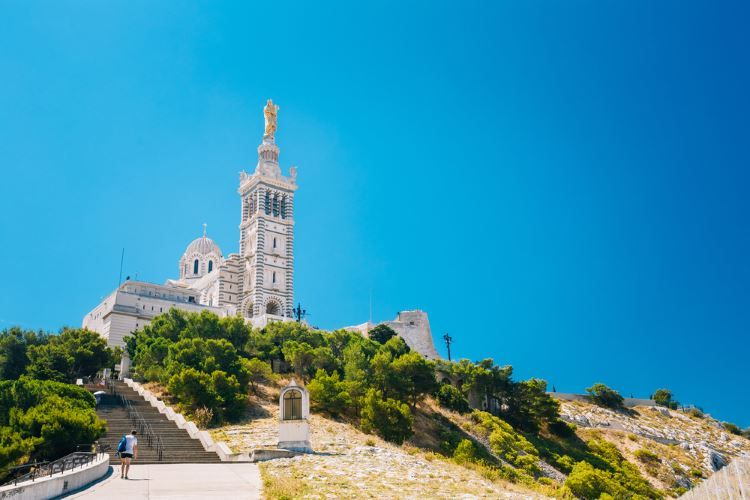
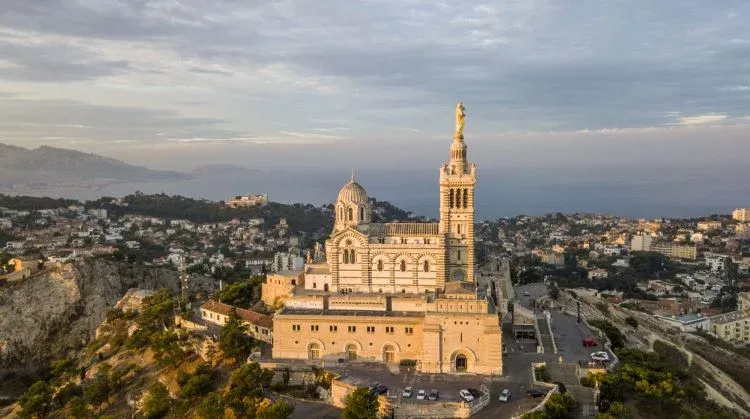
Perched on top of its hill at 150 m altitude, Notre-Dame de la Garde has watched over its city and its inhabitants since the 13th century. Let me warn you right away, this symbol very dear to the hearts of Marseille residents is well-deserved! Indeed, to reach the building, you'd better have good calves and good shoes to climb slopes that can reach 14% depending on the route taken, especially if you're with young children. However, if you want your vacation to remain a vacation, you can also take the bus or the tourist train to get there! Whatever way you choose to reach the bonne mère, what is certain is that a stay in Marseille cannot be done without visiting Notre-Dame de la Garde!
Prices/rates, schedules, access, guided tours, all practical information about Notre-Dame de la Garde
Price
The visit to Notre-Dame de la Garde is completely free. If you wish to participate in the maintenance of the building, you will find in the edifice, as in any religious building, collection boxes where you can make a donation.
If you go through a tour guide, the visit in their company will of course be paid.
Notre-Dame de la Garde opening hours
The Notre-Dame de la Garde basilica is open every day from 7 am to 6:15 pm in low season and 7:15 pm in high season.
How to get to the Notre-Dame de la Garde basilica?
Here's how to visit Notre-Dame de la Garde:
1 – On foot
- Through the Puget hill garden starting from the Vieux-Port. A good climb ahead, but with a possible stop halfway in the park.
- Via Boulevard André Aune starting from the Vieux-Port. Quite a sporty route.
- Via Vauban starting from the Vieux-Port, be careful the stair climb is quite steep at the end!
- Via Roucas-Blanc starting from the Vieux-Port and passing through Quai de Rive Neuve. This old pilgrimage path has the advantage of taking you through the typical neighborhoods of Marseille.
2 – By bus
Line 60 takes you directly to the basilica.
3 – With the Marseille tourist train
The tourist train departing from the Vieux-Port will allow you to discover during its circuit: the corniche, the seaside and mythical places like Fort Saint-Jean, Fort Saint-Nicolas, Palais du Pharo, Abbaye St Victor, a superb view of the Pont de la Fausse Monnaie, Château Valmer, and finally, the famous Vallon des Auffes.
In the distance, you will see the Frioul islands and Château d'If. The train then heads towards Vallon de l'Oriol where you will discover magnificent "Marseille" residences on the hillside.
Departure every 20 minutes in high season and every 40 minutes in low season.
Why visit Notre-Dame de la Garde?
- It's the emblem of Marseille, Marseille without the bonne mère is no longer Marseille, she has watched over the city and the people of Marseille for 8 centuries.
- Millions of visitors are attracted each year by its beauty, its grandeur, its history and, of course, as a place of worship.
- When you are at the top of the Garde hill, you enjoy an exceptional 360° panorama over the city of Marseille. Landscape and photography enthusiasts will have plenty to look at and images to add to their memory albums!
- For its neo-Romanesque style architecture adorned with Byzantine-inspired mosaics.
- For the statue of the bonne mère, a magnificent golden statue of the Virgin Mary 11.20 m high and weighing nearly 1 ton.
- To admire the white marble from Carrara, the red marble from Brignoles and the Byzantine-style mosaics that adorn the interior of the Notre-Dame de la Garde basilica.
What is the history of Notre-Dame de la Garde?
In 1214, a priest from Marseille named Pierre had a sanctuary dedicated to the Virgin Mary built. Sailors are very attached to this place where they come to pray when they have escaped a shipwreck. As pilgrims are always more numerous to come and pray and ask for the Virgin's protection, another chapel is built in the 15th century, then a fort all around under François 1st, in order to protect them from the attacks of Emperor Charles V.
During the revolution, the fort becomes a prison and worship is forbidden, the revolutionaries pillage, sell or destroy all liturgical objects, ex-votos, paintings, crosses... The place would not become a place of worship again until 1807.
The Notre-Dame de la Garde basilica as you know it today takes shape from 1850. The place had again become too small to accommodate all the believers, knowing that it had, moreover, become a place of pilgrimage to fight against cholera. Monseigneur de Mazenod then had the plan to build a Basilica, and thus, according to the plans of architect Henry-Jacques Espérandieu, its construction began in 1853.
It took more than 40 years to build this edifice:
- A nave 32.7 meters long and 14 meters wide,
- Side chapels 3.8 meters by 5.4 meters.
The statue of the Virgin Mary sits at the highest point of the basilica, and her gaze, turned towards the sea, protects the Phocaean city and its sailors. One can only note the attachment of the people of Marseille to their bonne mère by the number of ex-votos present in the basilica (offerings in the form of plaques, paintings, models...) in gratitude for an answered prayer. Unfortunately, many of these testimonies from the past were vandalized or sold by the revolutionaries. But the epidemics, wars and shipwrecks post-revolution have covered the walls with these new testimonies of gratitude.
Did you know?
- The statue of the Virgin was made by the Christofle company using a completely new process in the 19th century: electroplating. The four sections were made using latex molds, the copper was deposited on these sections by electrolysis.
- About thirty years ago, it was still possible to climb to the top of the statue by a staircase and see Marseille through its eyes. A privilege that can now only be glimpsed through photos...