© Shutterstock
 Votre guide Ryo
Visiting the Millau Viaduct: Complete Guide 2026
Visiting the Millau Viaduct means experiencing the rare sensation of rising above the clouds. In foggy conditions over the Tarn valley, the pylons pierce through the layers of mist and drivers literally travel above a sea of clouds. That image best captures what first-time visitors feel when they discover this engineering marvel: a sense of unreality, of standing on the boundary between earth and sky. Inaugurated in December 2004 by Jacques Chirac, the bridge is the world's tallest road bridge, with one pylon reaching 343 metres — taller than the Eiffel Tower. Built in just three years by Eiffage, it mobilised up to several hundred workers simultaneously, with no fatalities on the construction site — an extraordinarily rare achievement for a structure of this scale.
This guide explains how to make the most of the site: the panoramic area, the Sentier des Explorateurs, hikes beneath the pylons, driving across the bridge, and night-time excursions. You will also find 2026 prices, opening hours, access tips, and suggestions for spending a few hours in the town of Millau itself. For independent explorers, the Ryo app offers audio-guided tours in several towns across southern France — a great way to extend your journey beyond the viaduct.
The Millau Viaduct by the Numbers: Record-Breaking Statistics
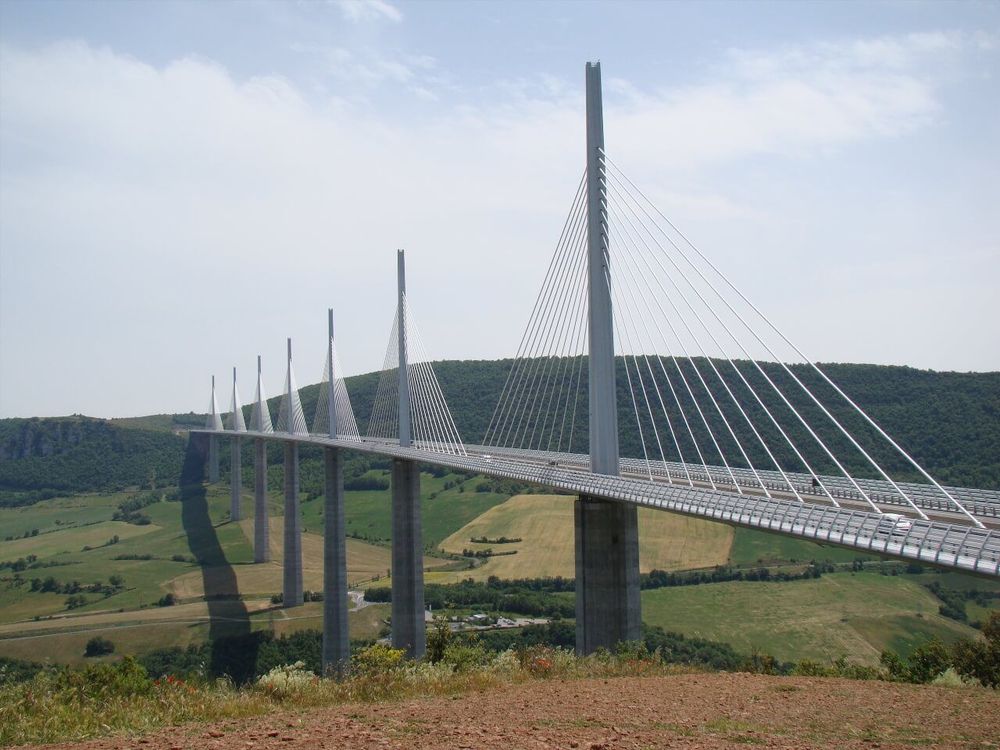
Before lacing up your walking shoes, a few figures to help you grasp what you are about to see. The structure stretches 2,460 metres across the Tarn valley, in the Aveyron department. It rests on 7 pylons, the tallest of which reaches 343 metres — pylon P2 — ranking it among the tallest vertical structures ever built in Europe.
The bridge deck sits 270 metres above the valley floor at its highest point. For comparison, the Eiffel Tower stands 330 metres tall (with its antenna): pylon P2 exceeds that by around 13 metres. The project represented an investment of around 394 million euros and was financed entirely by Eiffage through a 78-year motorway concession (until 2079), with no public money spent on its construction.
When it opened in December 2004, it held the title of the world's tallest road bridge. That record still stands in 2026 for cable-stayed bridges. The architectural design belongs to Norman Foster, who worked closely with engineer Michel Virlogeux to achieve the instantly recognisable slender silhouette. It was Virlogeux who conceived the idea of a multi-cable-stayed viaduct spanning the valley in a single sweep, rather than routing the road around the gorge at a lower level.
One lesser-known fact: the viaduct expands. The thermal variation between summer (sometimes +40°C in the valley) and winter causes the deck to expand by around 27 centimetres. Expansion joints continuously absorb this movement, and the deck itself can sway by several tens of centimetres under the effect of wind, which can exceed 200 km/h at altitude.
Where Is the Millau Viaduct?
The viaduct is located in the southern Massif Central, at the junction between Aveyron and Hérault, above the Tarn valley. The town of Millau lies about 2 kilometres to the north-east. In terms of distance from major cities: Montpellier at 117 km, Toulouse at 113 km, Clermont-Ferrand at 181 km, Paris at 637 km.
The viaduct spans the A75 motorway (toll-free from the north until Millau, then tolled on the viaduct itself). The toll is paid directly on the bridge in the direction of travel; rates vary by vehicle category, around 11 to 14 euros for a car in 2026. To reach the viaduct area (the main viewpoint), take the D809 exit before or after the bridge depending on your direction of travel.
From Millau town, the viaduct is visible from many points in the city. The D992 departmental road heading south-west runs along the valley and offers unobstructed views. By public transport, several coach companies run services from Montpellier and Toulouse with a stop in Millau; from the station, allow around 20 minutes on foot or 5 minutes by taxi to reach the viaduct area.
The Millau Viaduct Area: Your Starting Point
The Millau Viaduct area (D809, 12100 Millau, rated 4.4/5 on Google based on 6,582 reviews) is the first unmissable stop. Freely accessible, it offers the widest view of the entire structure — all seven pylons, the deck disappearing into the sky, and, depending on weather conditions, layers of cloud clinging halfway up.
On site, you will find a museum space (paid entry): a permanent exhibition on the construction of the viaduct, engineering decisions, construction phases and technical challenges. Scale models and construction films help you understand how the pylons were erected and how the two deck sections were launched from each bank to meet in the centre. The panoramic terrace (included with the museum ticket) offers a 180° view over the Tarn valley. A shop, restaurant and toilet facilities round out the offer.
The museum space is open every day from mid-March to mid-November (generally 9am–7pm in high season). Entry is around 5 euros for adults, free for children under 7.
Practical tip: arrive early in the morning (before 9:30am) to avoid group tours. In July and August, the area can welcome several thousand visitors per day, and parking is charged in season.
The Sentier des Explorateurs: a Guided Tour at the Foot of the Pylons
The Sentier des Explorateurs is the most complete visiting experience offered on site. This guided tour takes you literally beneath the structure, right to the base of the pylons, along paths that follow the foundations.
The route lasts around 1h30 and covers approximately 3 kilometres. A certified guide tells the story of the construction, the geological challenges posed by the valley's limestone, the techniques used to anchor the pylons in the ground, and anecdotes from the building site. Seeing the pylons up close completely changes the sense of scale. From the road or the panoramic area, the viaduct looks almost delicate; from here, it is overwhelming.
The tour includes a section along the former construction tracks used by civil engineering machinery during the three years of work. These earthen tracks, now adapted for visitors, allow access to areas that are normally off-limits.
Practical information:
- Duration: approximately 1h30
- Distance: ~3 km
- Departure: viaduct area
- Price: around 12 euros for adults, child discount available
- Booking: recommended in July–August
- Walking shoes recommended, suitable from age 6
Along the Former Construction Tracks: Exploring the Valley
Outside of the guided tour, the former construction tracks are partially accessible for independent hiking. These paths were carved out between 2002 and 2004 to allow construction machinery to reach the pylon foundations from the valley floor. Now waymarked, they offer an upward-looking perspective on the pylons found nowhere else.
The terrain is hilly and stony, so hiking boots are essential. The elevation gain remains moderate (150–200 metres depending on the route chosen). The causse vegetation (junipers, boxwood, wild lavender) contrasts strikingly with the metal of the pylons — a visual combination that photographers particularly appreciate at the end of the day, when raking light turns the pylons ochre.
From certain points along these tracks, the view plunges down to the Tarn river below and sweeps up to the deck above. In clear weather, you can make out cars on the bridge, reduced to ants at 270 metres. Allow 1 to 2 hours for a comfortable round trip. The starting point is either the viaduct area or the Abeilles car park, 1.5 km away. These paths are open year-round with no booking required.
Hikes and Excursions around the Viaduct
The Tarn valley around the viaduct offers several walking circuits of varying difficulty, managed by the Millau Grands Causses tourist office.
The "Around the Viaduct" excursion (approximately 8 km, 3 hours, moderate elevation gain) is the most popular. It makes a full loop of the site along causse paths on both sides of the valley, with the viaduct visible for almost the entire route from constantly changing angles. This hike is suitable from age 8 with a reasonable level of fitness.
The discovery hike (5 km, 2 hours, easy) is ideal for families or those who prefer a relaxed pace. It follows the Tarn river for a stretch, climbs to a viewpoint and returns via the opposite bank. For the more athletic, the experience hike (12 km, 5 hours, technical) ventures up onto the Larzac plateau to the north, with sections along exposed limestone ridges — the views of the viaduct from this plateau are among the most impressive available, the structure appearing as a horizontal line suspended against the sky.
All these hikes are waymarked in yellow and available for download on the tourist office website. Several mountain bike and e-bike loops are also waymarked from Millau town.
The Night Hike beneath the Viaduct after Dark
This may be the most memorable experience the site has to offer: the "Beneath the Viaduct at Night" hike. This guided outing sets off at dusk and takes participants beneath the illuminated pylons.
The viaduct is fitted with a lighting system that highlights the pylons and deck once night falls. From the valley floor, the effect is spectacular: the pylons become columns of light rising into the dark sky. The steady, low hum of cars in circulation adds an almost industrial dimension to the walk.
This outing lasts around 2 hours and covers 4 km on easy terrain. It runs in July and August several times a week. Booking is mandatory and places fill up quickly. Price is around 15 euros per adult.
Driving across the Viaduct: the A75 Experience
For many visitors, driving across the viaduct by car is an experience in itself — and often the only way they first encounter the structure, during a journey between Paris and Montpellier on the A75.
The crossing takes around 2 to 3 minutes at cruising speed (110 km/h permitted on the viaduct). The road is slightly curved, the deck following a 20-kilometre radius arc to ease driving. In low fog, you enter the clouds before even reaching the deck; in clear weather, the view over the Tarn valley is extraordinary from the passenger seat.
A tip: sit on the right-hand side when travelling north to south (Paris towards Montpellier) for the best view of the valley. In the opposite direction, it is the left side that offers the most open perspectives.
The toll is paid on the bridge itself. In 2026, approximate rates are:
- Class 1 (car): around 11–14 euros depending on season
- Class 2 (motorcycle): around 5–7 euros
- Class 3 (light van): around 16–19 euros
Liber-t electronic toll badges are accepted. Stopping on the viaduct is prohibited except in an emergency, although an emergency parking area is available on the bridge.
Millau: the Town Worth Exploring after the Viaduct
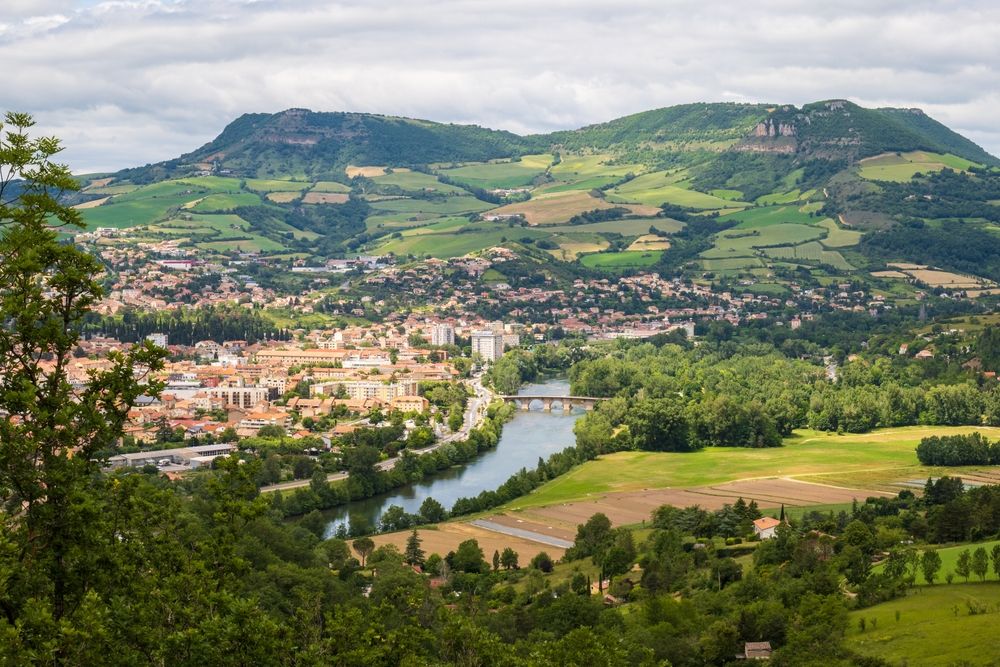
Many visitors make the mistake of only seeing the viaduct and leaving without going into town. Millau deserves at least half a day. This town of 22,000 inhabitants sits in a bend of the Tarn river, at the crossroads of three causse plateaux (Larzac, Noir and du Comtal). It is renowned for its production of lambskin gloves, a craft tradition dating back to the Middle Ages that earned the town its nickname of 'glove capital'.
The Place du Mandarous, the lively heart of the town, is surrounded by cafés and shops. Nearby, the 12th-century belfry (a listed historic monument) rises above the old town and offers a view over Millau's rooftops and, in clear weather, the viaduct in the distance.
The Millau Museum (Place du Maréchal Foch, 12100 Millau, rated 4.6/5 on Google based on 426 reviews) houses a remarkable collection of Gallo-Roman pottery from La Graufesenque, a ceramic workshop that produced millions of pieces exported throughout the Roman Empire between the 1st and 2nd centuries. Archaeologists have uncovered tally records mentioning up to 500,000 vessels fired in a single kiln load.
For dining, town-centre restaurants serve Aveyron specialities: aligot (mashed potato worked with fresh tomme cheese), tripoux, and roquefort from the nearby caves. The Thursday morning market is the weekly gathering point for local producers.
Millau is also an outdoor sports hub: via ferrata in the Tarn gorges 20 km away, rock climbing on the Larzac cliffs, paragliding from the causse plateaux. The local free-flight association organises tandem flights with views of the viaduct. To explore the old town at your own pace, a Ryo audio guide lets you walk from one landmark to the next with no group or set schedule.
If you are extending your stay in the region and would like to explore other towns in southern France with an audio guide, the Ryo audio guide for discovering Sète covers this Mediterranean destination just a short distance away — a perfect addition to your itinerary around Millau.
Practical Information: Prices, Opening Hours and Bookings 2026
Viaduct area and museum space
- Open: mid-March to mid-November, every day
- High season hours (July–August): 9am–7pm
- Museum space entry: ~5 euros adult, free under 7
- Panoramic terrace included with ticket
- Parking: charged in season (~3–4 euros/hour)
Sentier des Explorateurs
- Duration: 1h30 | Distance: ~3 km
- Price: ~12 euros adult, child and family discounts available
- Booking: recommended in July–August
- Departures: several times daily in high season
Night hike
- Availability: July–August, several times a week
- Price: ~15 euros adult
- Booking: mandatory
- Duration: ~2h, 4 km, easy terrain
Driving across (A75)
- Car toll: ~11–14 euros depending on season
- Speed limit on the viaduct: 110 km/h
- Liber-t electronic toll badge accepted
Public transport access
- Millau station: connections from Montpellier and Toulouse
- Taxi or shuttle from the station to the viaduct area: 10–15 minutes
Accommodation Numerous options in town and on the surrounding causse plateaux, ranging from town-centre hotels to causse gîtes. Book in advance for July–August: the site welcomes more than 400,000 visitors per year.
FAQ
Is the Millau Viaduct Free to Visit?
Access to the viaduct area is free and open: you can observe the viaduct from the outdoor viewpoints without paying. However, the museum space is paid (around 5 euros per adult). The Sentier des Explorateurs costs around 12 euros. Driving across on the A75 requires paying the toll (~11–14 euros depending on the season). The night hike costs ~15 euros with mandatory booking.
How Many People Died during the Construction of the Millau Viaduct?
Construction lasted 3 years (2001–2004) and mobilised up to several hundred workers at the height of the project. Officially, there were no fatalities on the construction site — an exceptional result for a structure of this scale and duration, achieved through very strict safety protocols, particularly for work at height on the pylons and during the launching of the deck.
What Is the Best Season to Visit the Millau Viaduct?
Spring (April–June) and autumn (September–October) are the best periods: fewer crowds, pleasant temperatures for hiking, and favourable light for photography. In July–August, the site is very busy but all activities are available. In winter, the museum space is closed, but the viaduct remains freely accessible, and valley fog creates spectacular visual effects.
How Do You Get to the Viaduct Area from Millau?
From the centre of Millau, follow the D809 towards the viaduct (well signposted). Allow 10–15 minutes by car. On foot from the station, the journey takes around 40 minutes via the D992. A taxi service is available from the station. In high season, check with the tourist office whether a shuttle is running from the town centre.
Is the Millau Viaduct Profitable?
Yes. The viaduct was financed by Eiffage through a 78-year concession (until 2079), with no public funding. Toll revenues have allowed Eiffage to recoup the initial investment of around 394 million euros, with annual traffic regularly exceeding 8 million vehicles. The project is considered a model public-private partnership.
How Do You Take the Best Photos of the Millau Viaduct?
The best photo viewpoints are: the terrace of the museum space, the viewpoints along the D809, the heights of the causse to the north (accessible by path from the area) and from the Tarn river by kayak (rental available in Millau). Early morning and late afternoon offer the best light. In winter, valley fog creates exceptional visual effects as the pylons emerge from the clouds.
Conclusion
Visiting the Millau Viaduct is not simply about admiring an engineering record: it is about experiencing the physical sensation of having walked beneath something awe-inspiring, in a landscape of causse plateaux and gorges you would never suspect from the motorway. Whether you spend half a day at the viewpoint or a full weekend exploring the Tarn gorges and the Roquefort caves, you will leave with far more than a photograph.
If you are planning a trip to southern France and would like to discover other sites with a detailed audio guide, the Ryo audio-guided tours in towns across the region let you travel at your own pace, with no group or set schedule. The viaduct is well worth the detour; Millau and its surroundings are worth lingering over.