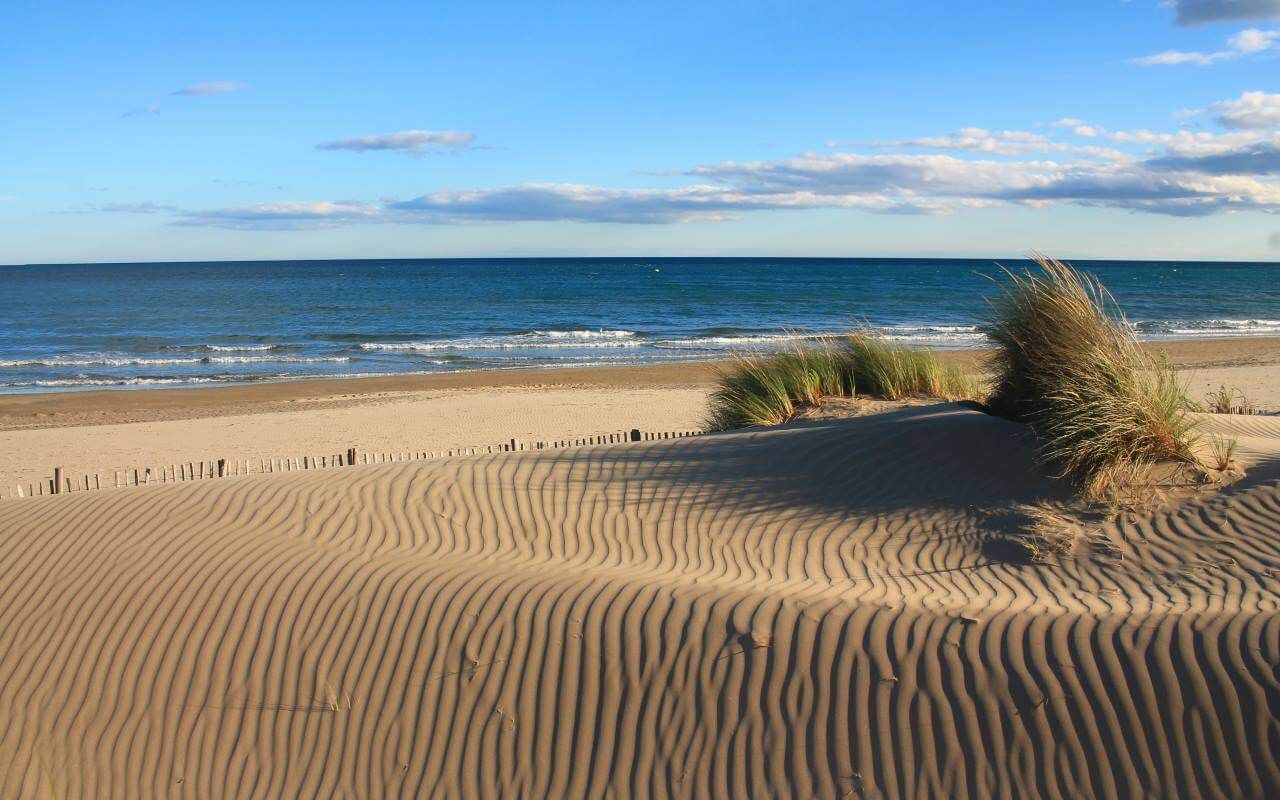

La Grande-Motte
Emilie

Créé par Emilie, le 3 juin 2026

Votre guide Ryo

The Best Beaches of Montpellier: 6 Spots to Choose According to Your Profile (2026)

© Shutterstock

Montpellier beaches surprise those who imagine primarily a lively university town, focused on its squares and bars. That's also true, but we often forget that the sea is there, at 12 km, and that the coastline stretching at its feet is one of the most varied in Languedoc. Beachwise, Montpellier actually has several faces. From 12-meter-high dunes without a single construction in sight at l'Espiguette, a 12th-century Romanesque cathedral visible from the sand of Maguelone, remarkably calm turquoise waters at Carnon, a 7 km beach with surf clubs at La Grande-Motte: the choice exists, you just need to know where to go. Before or after your day at sea, the Ryo audio-guided tour of Montpellier, 19 stops, 1h30 in the 'Gifted One', will give you another reading of this city we think we know.

This guide reviews the six most interesting beaches in the area, plus two confidential alternatives, transport and bike access, and time slots to avoid the most saturated situations of July-August. This is not an exhaustive list: it's a tool to choose right among Montpellier's beaches and surroundings.

Palavas-les-Flots: the Iconic Beach of Montpellier Residents

Palavas-les-Flots is 12 km from downtown Montpellier. It's the reference beach for residents, connected by public transport: tram line 3 to Pérols Étang de l'Or stop, then shuttle or bus towards Palavas, about 40 to 50 minutes depending on connections. By car, count 20 to 25 minutes depending on summer traffic on the D986.

The town is cut in two by the Rhône-to-Sète canal. East of the canal, the central beach concentrates most of the activity: it stretches for several kilometers, is supervised from mid-June to mid-September, well equipped with showers, lifeguard posts and restaurants. Parasols crowd together in July, street vendors circulate, it's the Provençal seaside atmosphere in all its expression, assumed and without complex.

What many visitors don't know: west of the canal, the face changes radically. The western beach, called 'Maguelone side', is wider, less crowded, bordered by low dunes and vegetation. The sand is slightly coarser there but the atmosphere gains greatly in calm. Palavas regulars know that's where to go on a Saturday in full August. Count 10 minutes walking from the center or direct access via the D185 with easier parking off high season.

The village itself deserves an evening stop. The canal quays host terraces, local chip shops serve fresh tellines, these small shells collected locally, and the morning market, daily in summer and weekly the rest of the year, offers fish directly from trawlers and regional products.

Practical: supervised beach from mid-June to mid-September. Paid parking in high season on the east side. Public transport connection via tram line 3 and shuttle from Pérols. The Ryo audio guide of Montpellier complements well a day started in town before going down to the sea.

Carnon, Petit-Travers: the Calm Turquoise Waters of the Area

Carnon is the beach that parents of young children always end up adopting, and for good reasons. Petit-Travers beach (Chemin du Petit-Travers, 34280 Carnon-Plage, rated 4.3/5 on Google for 3,797 reviews) stretches over 3 km of fine, clear sand at 14 km from Montpellier, bordered by a shallow lagoon formed by a sand barrier. The water color, between turquoise and blue-green depending on the time, contrasts with what you see elsewhere on this coastline.

The water stays calm even with sea wind, waves remain modest and the gradual depth allows children to paddle far from shore without risk. The beach is supervised in season and properly equipped: showers, toilets, restaurants and snacks accessible from the sand. It's not the wildest beach in the area, but it's probably the most pleasant for a family day without surprises.

The port of Carnon, adjacent to the beach, is an often underestimated asset. Its quays concentrate several seafood restaurants with lunch formulas at often more reasonable prices than in Palavas. In July-August, arrive before 10am: paid parking saturates quickly on weekends. On weekdays, Carnon remains manageable even in the heart of the season.

To reach Carnon from Montpellier, the car remains the most direct solution (D986 direction La Grande-Motte). But the bike path along Étang de l'Or offers a serious alternative: about 12 km of green way connecting Montpellier to Carnon, count 45 to 55 minutes by bike from the southern suburbs of the city, on a flat route without traffic.

La Grande-Motte: 7 km of Sand and Architecture That Divides

We can't approach La Grande-Motte without mentioning its pyramids. These apartment buildings designed in the 1960s-70s by Jean Balladur fascinate modern architecture enthusiasts and annoy those seeking an unspoiled coastline. Inspired by pre-Columbian sites, these pyramidal forms earned the city the classification '20th Century Heritage' since 2010, an official recognition that doesn't prevent strong opinions.

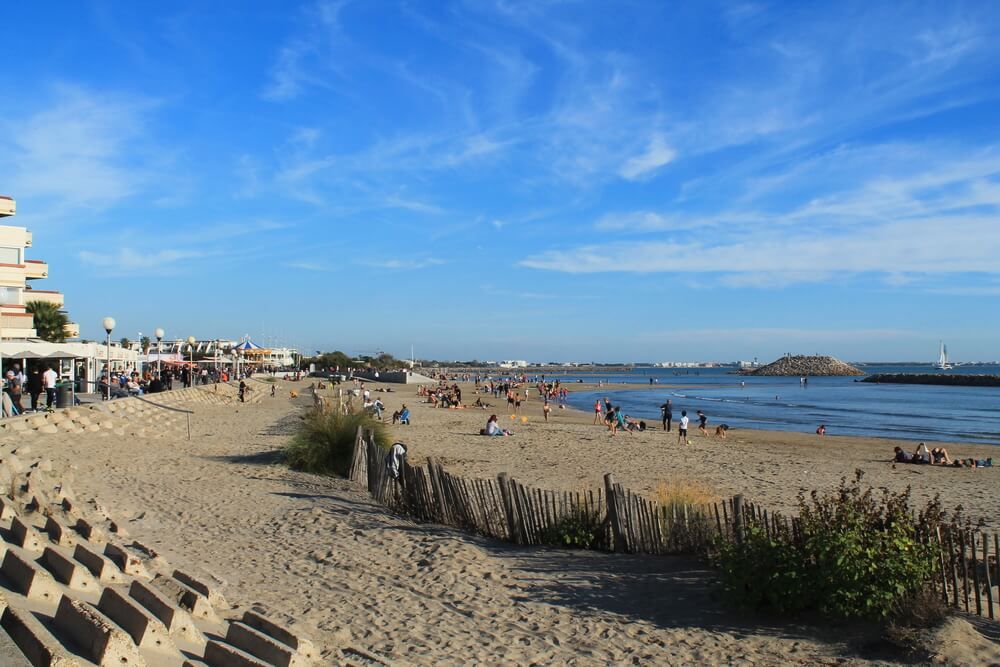
But the beach itself is frankly beautiful. 7 km of fine sand stretch on both sides of the center, with very lively sections around the port and much calmer portions to the east, towards Le Ponant. The central beach is wide, sometimes 80 to 100 meters between the dune and the sea, which dilutes the crowd even in high season. The water is clean, sandy bottoms are gradual, and moderate waves suit most swimmers.

The facilities are complete: beach clubs, paddle and kayak rental, surf schools (the spot works in southeast wind), cafes and restaurants on the seafront. The marina is one of the most important in Languedoc with nearly 1,500 moorings. The promenade along the seafront extends for several kilometers, it's a pleasant walk away from bathing, even off season.

Distance from Montpellier: 22 km, about 25 minutes by car via the D21. Paid parking in high season on seaside esplanades. There is no direct public transport connection from central Montpellier, take the car or bike via Carnon.

Villeneuve-lès-Maguelone
© Shutterstock

Villeneuve-lès-Maguelone: the Medieval Beach Between Lagoon and Sea

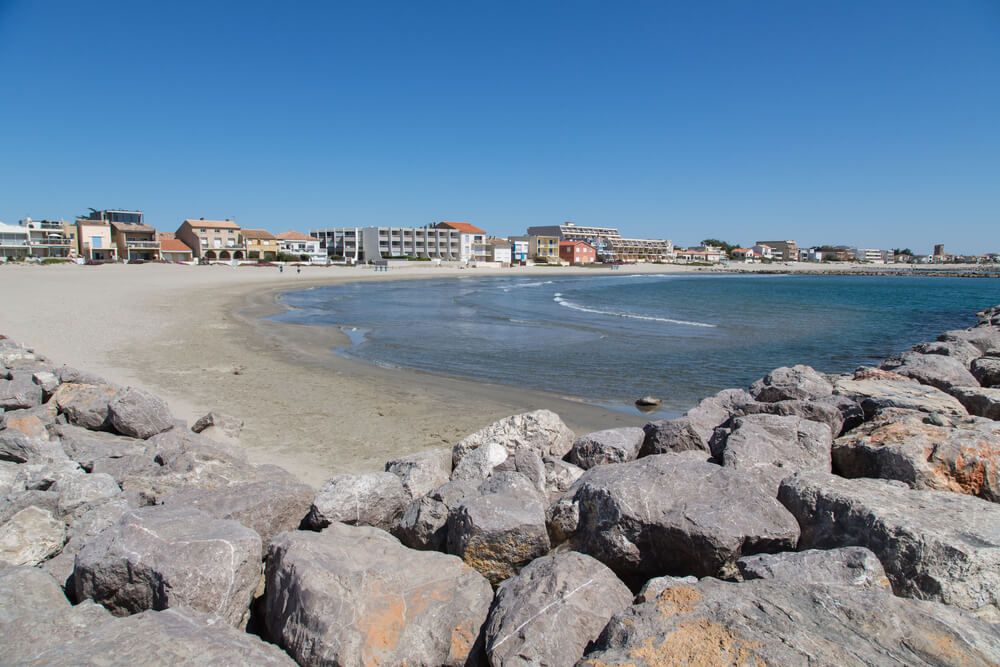
Villeneuve-lès-Maguelone (Route du Lido, 34750 Villeneuve-lès-Maguelone, rated 4.5/5 on Google for 741 reviews) is probably the most singular of Montpellier's beaches and surroundings, and one of the most unknown outside local residents. It extends on a coastal barrier 200 to 300 meters wide only, wedged between Vic lagoon on the land side and the Mediterranean on the sea side. This geography creates a radically different atmosphere from the other beaches in the guide.

From the sand, you can see pink flamingos on Vic lagoon and, on the horizon, the silhouette of Saint-Pierre de Maguelone cathedral, built on a former island, in its Romanesque form from the 12th and 13th centuries, seat of the regional bishopric for centuries before Montpellier stole the show. The cathedral is accessible on foot from the beach by a path on the spit: count 20 to 30 minutes each way, on a path crossing a classified Natura 2000 wetland. A small train also connects the parking to the Maguelone peninsula from May to September.

The beach itself is natural, undeveloped. A few lifeguard posts in season, no dense commercial infrastructure, no beach club music. This is precisely its appeal: clean sand, clear water, an end-of-the-world atmosphere at 14 km from Montpellier. The low dunes shelter typical Mediterranean spit vegetation, marram grass, sea blue thistles, and serve as rest areas for several migratory bird species.

Car access is via Palavas (D185 then D116). From west Palavas, it's possible to reach the beach by bike in 20 minutes on low road. Parking possible at west Palavas parking lots with a 30 to 40 minute walk. For those seeking to explore Montpellier with the same spirit of discovery, the Ryocity of Montpellier offers 19 audio stops in the streets of the 'Gifted One'.

Practical: supervised beach in season on equipped sectors. Distance Montpellier: 14 km. Ideal in the morning or late afternoon off August weekends.

L'Espiguette: 10 km of Wild Dunes on the Camargue Side

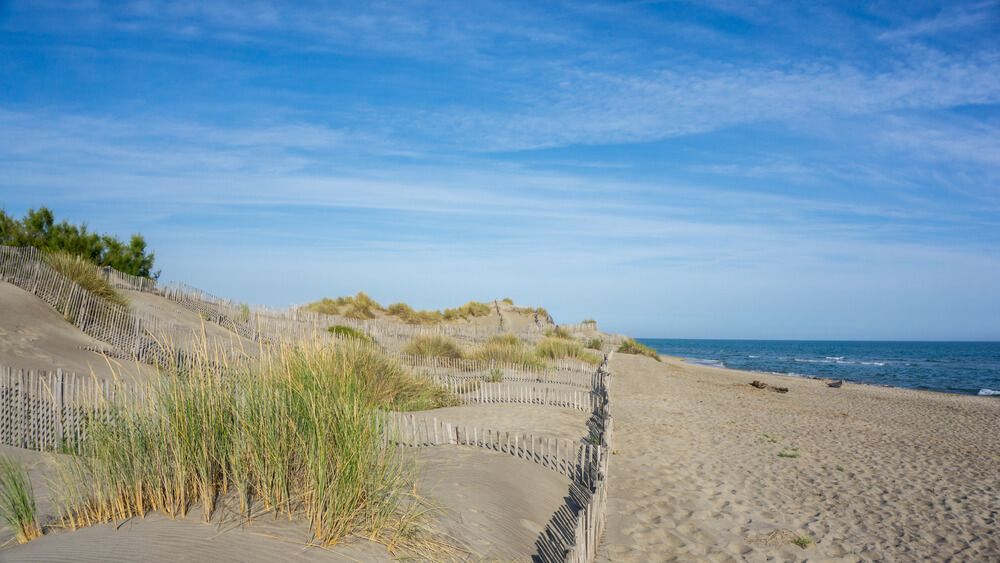
L'Espiguette is in a category of its own. Classified as a protected natural site, integrated into a vast Natura 2000 perimeter between Le Grau-du-Roi and Petite Camargue, it extends over 10 km of high dunes, junipers and russet sand where the only visible horizon from the water is the sea. No buildings, no roads, no shops within sight.

From Montpellier, count 40 km, about 45 minutes via the D979 and D62. It's the most distant beach in this guide, but also the most different. The white dunes of l'Espiguette reach 12 meters in height in places, creating almost desert-like landscapes behind the beach. On weekdays outside July-August, it's possible to walk for long minutes without meeting another bather. This is rare on a French Mediterranean coastline so close to a major city.

A few points to anticipate before going. L'Espiguette is exposed: mistral and tramontane winds blow without obstacle, waves can be strong and currents present in sustained wind. The beach has a delimited and signposted naturist section, accessible a few hundred meters from the parking, a well-established use on this site, neither hidden nor imposed. The official parking, paid in season, is at the site entrance; from there, you must walk between 10 and 30 minutes depending on the targeted section. No shops in immediate proximity: bring water, sunscreen and something to eat.

L'Espiguette belongs to the territory of Le Grau-du-Roi and Petite Camargue, an area of exceptional naturalist richness. Pink flamingos are frequent on neighboring lagoons, lizards cross paths between dunes, and guided naturalist outings are organized from Le Grau-du-Roi. For a stay combining wild beach and regional exploration, it's the ideal anchor point.

If you hesitate between l'Espiguette and a less logistically demanding beach, ask yourself this question: do you want a beach or an experience? L'Espiguette is the second option.

Espiguette dunes
© Shutterstock
Frontignan-Plage
© Shutterstock

Frontignan-Plage and les Aresquiers: the Confidential Ones

Two beaches deserve a separate mention because they remain outside usual circuits, and that's precisely their charm.

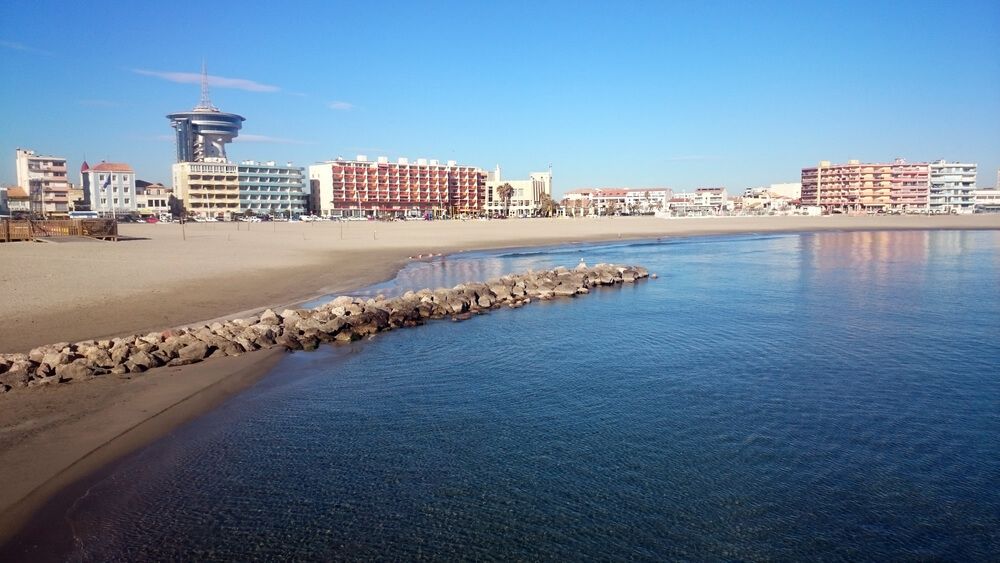
Frontignan-Plage is a seaside resort in its own right, distinct from Frontignan town, at 20 km from Montpellier via the D612. The beach extends over 3 km, fine sand, well equipped, with a lively coastal avenue in summer without reaching the saturation of Palavas or La Grande-Motte. The local originality lies in two things: the proximity of Bassin de Thau, its oyster farming tables are visible from the beach, and Frontignan's cooperative winery that produces the region's most renowned AOC Muscat. Combining bathing and tasting at day's end is a typically Languedocian option.

The Aresquiers beach (Chemin des Aresquiers, 34560 Vic-la-Gardiole, rated 4.6/5 on Google for 372 reviews), accessible from Vic-la-Gardiole, plays an even more discreet card. Its 4 km of coastline extend between Frontignan and Villeneuve-lès-Maguelone, accessible by a few kilometers path through low garrigue. The sand is fine, the beach undeveloped on the west side, but several beach bars and restaurants settle on the east side for the season. The atmosphere is relaxed, the clientele mainly local, and very few tourists outside the region find themselves there compared to Palavas or Carnon.

The water is slightly cooler there than to the east due to currents from Bassin de Thau. Distance from Montpellier: 18 km (D612 then turn at Vic-la-Gardiole). Free parking outside high season.

Wild Beaches vs Developed Beaches: How to Choose

The Montpellier coastline actually offers two very different types of experiences, and confusing the two often generates disappointments.

The developed beaches, Palavas, Carnon, La Grande-Motte, Frontignan, offer showers, restaurants, seasonal supervision and organized parking. These are comfortable beaches, suitable for families with young children and those who want a day without complicated logistics. They are crowded, sometimes very crowded in July-August, but functional.

The natural or semi-natural beaches, Villeneuve-lès-Maguelone, les Aresquiers, l'Espiguette, require more organization: bringing your things, managing sometimes long walks from parking, accepting less comfort. In return, they offer atmospheres that developed beaches cannot reproduce. It's up to you to calibrate your priorities according to the day.

A simple rule: if you're leaving with children or elderly people, stick to developed beaches. If you're traveling light and seeking to get away from crowds, head towards natural beaches.

plages Montpellier
© Shutterstock

How to Reach Beaches Without a Car

Montpellier is one of the rare French cities where it's really possible to go to the beach without a car, at least for certain spots.

Palavas-les-Flots is the simplest beach to reach by public transport from downtown. Tram line 3 to Pérols Étang de l'Or stop, then shuttle or bus towards Palavas-les-Flots. Total journey: 40 to 50 minutes, depending on connections. In July-August, seasonal 'Beaches' shuttles reinforce the service; a combined tram + shuttle ticket is offered by the metropolitan transport authority, check the authority's website for updated schedules.

Carnon is served by the same logic from Pérols, but the bike path via Lattes and Étang de l'Or remains the most pleasant option: count 45 to 55 minutes by bike from the southern suburbs of the city on an essentially flat route of about 12 km. From central Montpellier, add 15 to 20 minutes.

Villeneuve-lès-Maguelone and les Aresquiers are difficult to reach without a vehicle. Cycling from Palavas remains the best option for Maguelone (20 minutes on low road). For les Aresquiers, car or bike from Frontignan are unavoidable.

L'Espiguette and La Grande-Motte are not accessible without a car under reasonable conditions from Montpellier. For La Grande-Motte, some visitors combine cycling to Carnon then taxi or local rideshare.

A practical tip valid for all beaches: avoid the D986 on Friday evening and Saturday morning in July-August. Traffic jams between Montpellier and Palavas can turn 20 minutes into 1 hour.

What Time Slot to Choose to Avoid Crowds

Timing is often more decisive than beach choice. On the entire Montpellier coastline, the busiest time slots in July-August are: Saturday from 10am to 5pm, Sunday the same, and every day from 11am to 3pm on beaches accessible without a car.

Some practical observations. Before 9am, even Palavas is deserted or almost, ideal for a long swim before heat sets in. After 5:30pm, crowds begin to withdraw and temperatures remain pleasant until 8pm on this coastline. On weekdays (Monday to Thursday), beach attendance drops significantly even in midsummer: it's the best time to visit Carnon or Maguelone without looking for your spot on the sand.

L'Espiguette is an exception: due to its size, it absorbs high attendance without ever seeming crowded. The constraint is not the crowd, it's logistics (parking + walk).

FAQ

What is the closest beach to Montpellier?

The beach of les Roquilles in Pérols is located about 10 km from downtown Montpellier, technically the closest. But Palavas-les-Flots, at 12 km, remains the most practical destination: it's the large beach easiest to reach by public transport (tram line 3 to Pérols Étang de l'Or, then shuttle or bus, 40 to 50 minutes). If you don't have a car, Palavas is your best option among Montpellier's beaches.

How to get to Palavas from Montpellier without a car?

Take tram line 3 to Pérols Étang de l'Or stop, then the shuttle or bus towards Palavas-les-Flots. The complete journey takes about 40 to 50 minutes depending on connections. In July-August, seasonal 'Beaches' shuttles reinforce the service, with a combined tram + shuttle ticket; check schedules on the transport authority website. It's also possible to go by bike in about 50 minutes from downtown via a partial bike path.

Which beach to choose for young children?

Carnon (Petit-Travers beach) is the most suitable: calm, shallow water, progressive sandy bottom, supervised beach in season. La Grande-Motte is also suitable thanks to its wide beach, facilities and generally moderate waves. Avoid l'Espiguette with very young children, waves can be strong and the beach is not supervised on most of the coastline.

What is the wildest beach within 45 minutes of Montpellier?

L'Espiguette, 40 km southwest (about 45 minutes by car), is unmatched: 10 km of dunes classified as protected natural site, no visible construction from the water. To stay under 20 km, Villeneuve-lès-Maguelone beach also offers a strong natural character, undeveloped, with views of pink flamingos on Vic lagoon and the medieval cathedral of Maguelone.

Are Montpellier beaches free?

Yes, all Montpellier beaches presented in this guide are free to access. Parking becomes paid in high season (July-August) at most sites, particularly at Palavas, Carnon and La Grande-Motte. Off season, parking access is generally free. Swimming is only supervised from mid-June to mid-September approximately, depending on municipalities.

Are there beaches suitable for snorkeling or diving?

The Montpellier coastline is essentially sandy, which limits interest for snorkeling. The only notable exception is found near Agde (55 km), where basaltic rocky bottoms, inherited from the extinct volcano of Mont Saint-Loup, offer interesting snorkeling areas, particularly near Grande Conque beach. Closer, a few isolated rocks around Frontignan allow observation of rock fish, but potential remains limited.

Conclusion

Montpellier's beaches form a surprisingly diverse coastline for a metropolis of this size. Palavas for entertainment, Carnon for calm waters and families, La Grande-Motte for space, Maguelone for history, l'Espiguette for wild immensity, Frontignan and les Aresquiers for discretion: each spot has its own identity, and no beach day resembles another on this coastline.

If you want to explore Montpellier itself with the same curiosity, the Ryocity of Montpellier on Ryo, 19 audios, 1h30 audio-guided tour in the 'Gifted One', is the most efficient way to understand this city between two days at sea.