
Créé par Emilie, le 7 mai 2026
Votre guide Ryo
© Shutterstock
Paris, the City of Light, reveals all its splendor through its numerous bridges that majestically span the Seine. These architectural works, witnesses to Parisian history, offer walkers unique perspectives on the capital's emblematic monuments. Crossing Paris on foot while discovering its most remarkable bridges is like taking a journey through the centuries, from medieval architecture to contemporary creations. Each bridge tells a story, reveals a panorama, and invites contemplation. Whether you're an architecture enthusiast, history buff, or simply a wanderer seeking beauty, these 10 iconic Paris bridges promise unforgettable moments during your walking tours in the French capital.
1. Pont Neuf: The Dean of Parisian Bridges
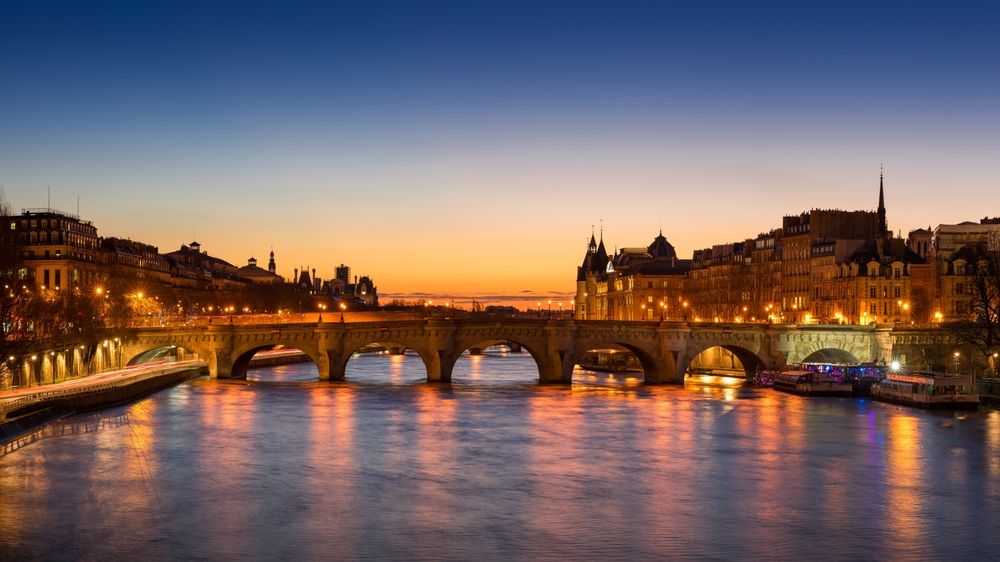
Paradoxically called 'New', this bridge is actually the oldest in Paris still standing today. Built between 1578 and 1607, Pont Neuf crosses the Seine at Île de la Cité and connects the 1st and 6th arrondissements. Commissioned by Henri III and inaugurated by Henri IV, this revolutionary bridge for its time was the first to be built without buildings on its sides and equipped with sidewalks for pedestrians.
238 meters long and 20 meters wide, Pont Neuf is distinguished by its twelve arches and 381 sculpted mascarons, those small grimacing heads that adorn its sides. At the center of the bridge, the equestrian statue of Henri IV pays tribute to the king who saw the completion of this architectural work. Listed as a historic monument since 1889 and inscribed on the UNESCO World Heritage List, this bridge offers a stunning view of the Louvre and Île Saint-Louis. To discover the fascinating history of this emblematic place during your visit to Paris, let yourself be guided by audio guides that will reveal all its secrets.
2. Pont Alexandre III: The Most Beautiful Bridge in Paris
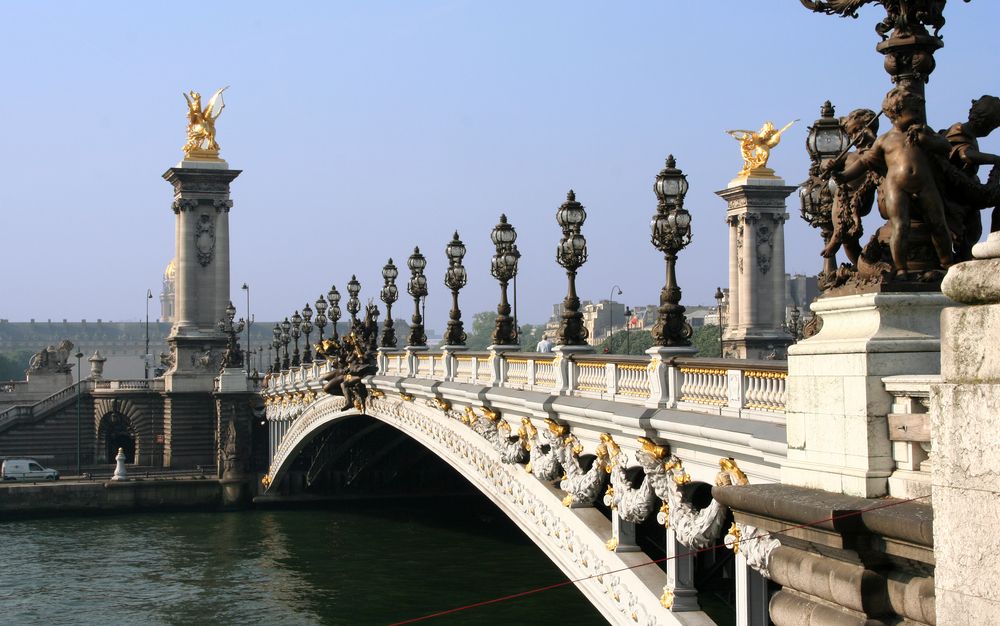
Considered the most elegant bridge in the capital, Pont Alexandre III constitutes a true architectural jewel that connects the 7th and 8th arrondissements. Built between 1896 and 1900 for the Universal Exhibition, this bridge symbolizes the Franco-Russian alliance and bears the name of Tsar Alexander III, father of Nicholas II.
150 meters long and 40 meters wide, Pont Alexandre III is characterized by its unique arch that preserves the perspective between the Champs-Élysées and Les Invalides. Its four pylons adorned with golden sculptures and its 32 bronze candelabras give it unparalleled magnificence. The sculpted groups represent 'The Fame of Sciences' and 'The Fame of Arts' on the right bank side, 'The Fame of Combat' and 'The Fame of Commerce' on the left bank side. This bridge offers one of the most beautiful perspectives of Paris, with views of the Eiffel Tower on one side and the dome of Les Invalides on the other, especially during Seine cruises.
3. Pont des Arts: The Former Lovers' Bridge
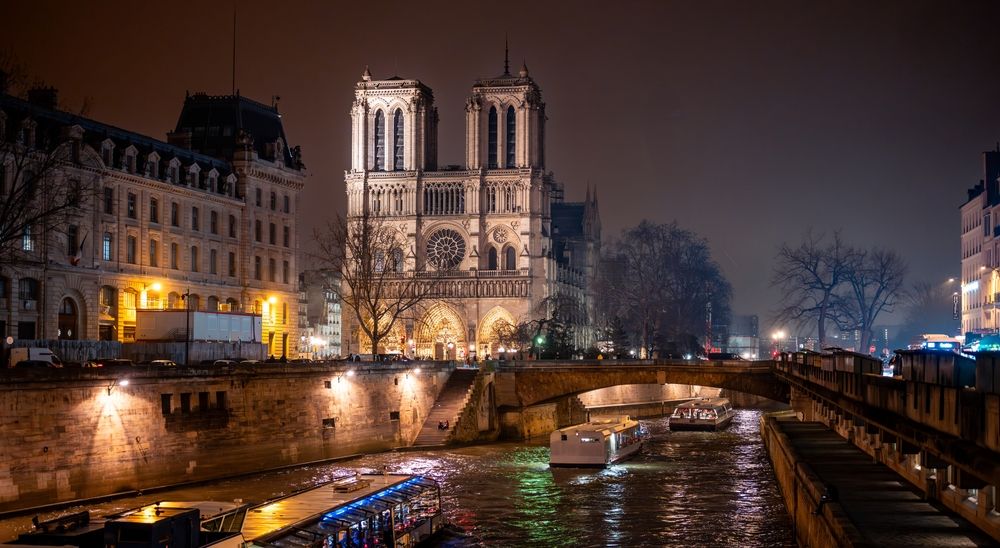
Pont des Arts, a pedestrian footbridge linking the Louvre to the Institut de France, remains one of the most romantic bridges in Paris despite the disappearance of the famous love locks. Inaugurated in 1984 to replace the original 1804 structure, this 155-meter-long metal bridge offers a unique perspective on Île de la Cité and Notre-Dame de Paris.
From 2008 to 2015, Pont des Arts became world famous for the tradition of love locks, those small padlocks that couples would attach to the railings before throwing the key into the Seine. However, the weight of nearly 45 tons of locks forced the city of Paris to remove them and install glass panels to preserve the structure. Today, Pont des Arts remains a prime walking destination, offering one of the most beautiful views of the Louvre and constituting an essential passage to visit Paris on foot. Street artists and musicians continue to animate this place full of history and poetry.
4. Pont de Bir-Hakeim: The Cinema Bridge
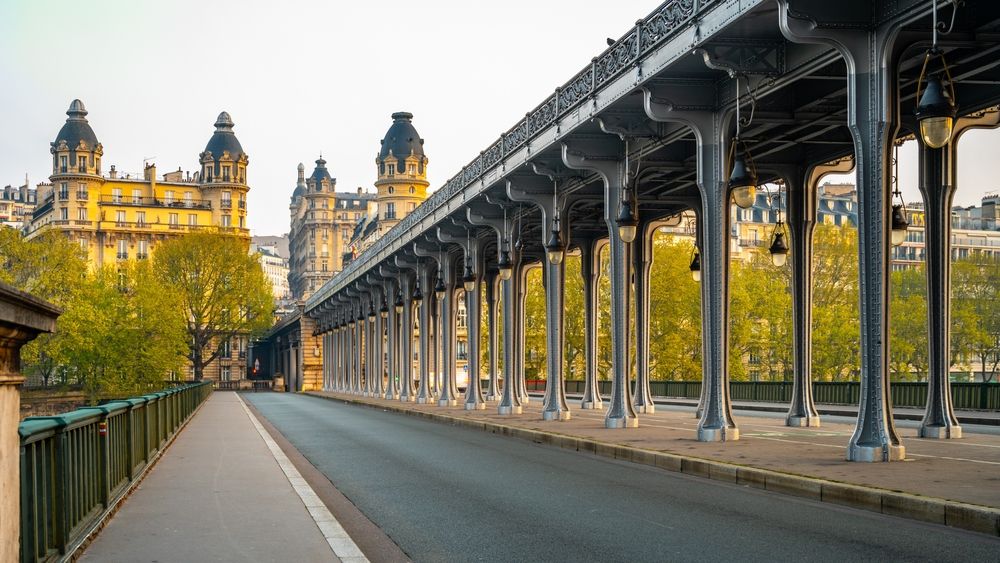
Pont de Bir-Hakeim, which connects the 15th and 16th arrondissements, has become a cinema star thanks to its numerous film appearances. Built between 1903 and 1905, this 237-meter-long metal bridge owes its international fame to Christopher Nolan's film 'Inception', but also to works like 'Last Tango in Paris' or 'Fear Over the City'.
Its two-level architecture makes it unique: the upper level accommodates metro line 6, while the lower level is reserved for cars, bikes, and pedestrians. This configuration offers exceptional photographic perspectives of the Eiffel Tower, particularly appreciated at sunset. The bridge takes its name from the Battle of Bir Hakeim, a Free France victory in Libya in 1942. For photography and cinema enthusiasts, this bridge is a must-see during a discovery of Paris, offering unique framings of the French capital's symbol.
5. Passerelle Simone-de-Beauvoir: Contemporary Boldness
Inaugurated in 2006, the Passerelle Simone-de-Beauvoir represents Parisian architectural modernity with its bold lens-shaped design. This exclusively pedestrian and cycling footbridge connects the 12th and 13th arrondissements over a length of 304 meters.
Designed by Austrian architect Dietmar Feichtinger, this footbridge is distinguished by its unique lenticular structure that seems to defy the laws of gravity. It doesn't rest in the water but on the pathways that border the high banks of the Seine. This technical feat creates a striking visual effect, particularly at night when lighting emphasizes its elegant curves. The footbridge offers an original viewpoint of Paris, notably of the Bibliothèque nationale de France and Parc de Bercy. Its name honors Simone de Beauvoir, an emblematic figure of French feminism, and symbolizes Paris's evolution toward more modern and inclusive architecture.
Download the audio-guided circuit to discover Paris on foot and independently
For optimal exploration of Parisian bridges and their fascinating histories, the Ryo audio-guided itinerary accompanies you in an in-depth discovery of Paris. This 6.2 km route guides you through 18 major points of interest in the capital, including several of these emblematic bridges, with enriching historical commentary and captivating anecdotes that reveal the soul of each place crossed.
6. Pont de la Concorde: Witness to Revolutionary History
Built between 1787 and 1791, Pont de la Concorde connects Place de la Concorde to the 7th arrondissement and constitutes a privileged witness to French revolutionary history. This 153-meter-long and 35-meter-wide stone bridge was built with stones from the Bastille, a strong symbol of the transformation of the Ancien Régime.
Its strategic location offers a remarkable perspective on the National Assembly, Place de la Concorde with its Luxor obelisk, and the Tuileries gardens. The sober and elegant architecture of this bridge, the work of Jean-Rodolphe Perronet, harmonizes perfectly with the surrounding urban landscape. The five arches of Pont de la Concorde magnificently frame the Seine and offer pedestrians a peaceful walk in the heart of Parisian hustle and bustle. This bridge constitutes a privileged passage to reach the Musée d'Orsay and discover French Impressionist art.
7. Pont Saint-Louis: The Artistic Soul of Paris
Pont Saint-Louis, which connects Île de la Cité to Île Saint-Louis, embodies the bohemian and artistic spirit of Paris. With a modest length of 67 meters, this metal bridge rebuilt in 1970 replaces a succession of bridges that have marked this location since 1634.
A true open-air stage, Pont Saint-Louis daily welcomes street musicians, artists, and buskers who create a unique and authentically Parisian atmosphere. The impromptu shows by these street artists transform each crossing into a moment of spontaneous entertainment. The view from this bridge allows you to admire the historic facades of Île Saint-Louis, with its 17th-century private mansions, as well as the chevet of Notre-Dame de Paris. This unique perspective makes Pont Saint-Louis a privileged place for photographers and an essential passage during a complete exploration of Paris.
8. Pont Mirabeau: Apollinaire's Poetry
Made famous by Guillaume Apollinaire's poem 'Le Pont Mirabeau', this bridge connecting the 15th and 16th arrondissements evokes the melancholy and beauty of Paris. Built between 1893 and 1896, this 173-meter-long metal bridge bears the name of Honoré-Gabriel Riquetti, Count of Mirabeau.
Four sculptures by Jean-Antoine Injalbert adorn the bridge's pylons: 'The City of Paris' and 'Abundance' upstream, 'Commerce' and 'Navigation' downstream. A bronze plaque engraved with Apollinaire's verses recalls the poetic attachment to this place: 'Under Pont Mirabeau flows the Seine / And our loves / Must I remember them / Joy always came after pain'. This bridge offers a beautiful perspective on the Seine and constitutes an ideal starting point to discover the chic residential neighborhoods of western Paris, while enjoying the tranquility of the Seine banks.
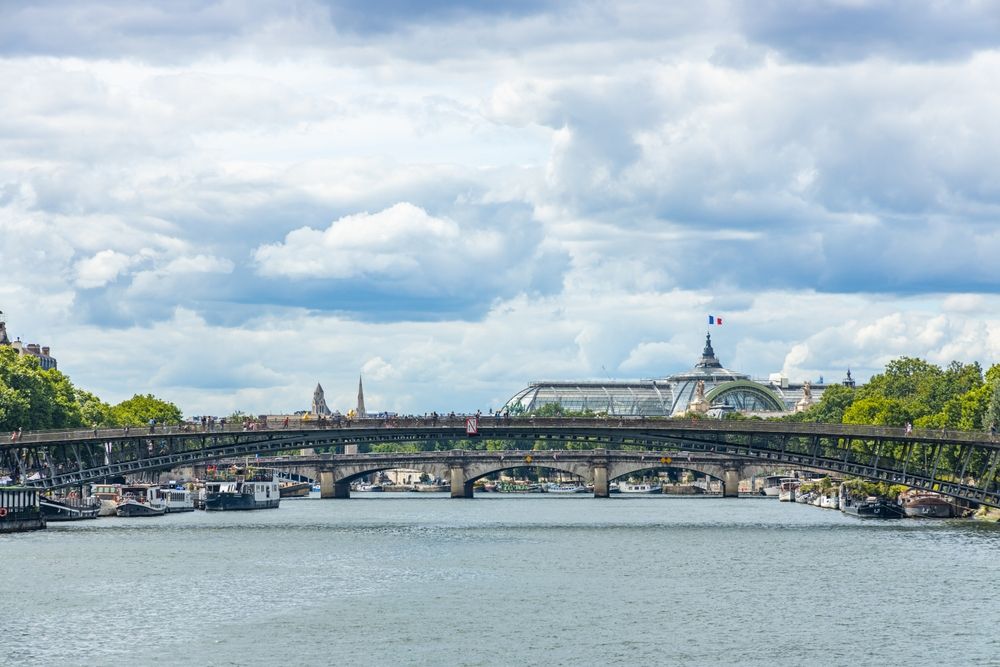
9. Passerelle Léopold-Sédar-Senghor: Discreet Elegance
Linking the Tuileries garden to the Musée d'Orsay, the Passerelle Léopold-Sédar-Senghor, formerly Passerelle Solférino, constitutes an elegant connection between two major Parisian cultural sites. This 106-meter-long metal footbridge, inaugurated in 1999, honors the memory of the Senegalese poet and statesman.
Its contemporary architecture, the work of engineer Marc Mimram, is characterized by its flattened arch structure that integrates harmoniously into the Parisian urban landscape. Exclusively pedestrian, this footbridge offers a peaceful walk with a panoramic view of the Louvre, the Tuileries gardens, and the Musée d'Orsay. Its strategic position makes it a privileged passage for art lovers wishing to move from one museum to another. The nighttime lighting of the footbridge creates a subdued atmosphere particularly appreciated by nocturnal walkers and lovers of the illuminated capital.
10. Pont de l'Alma: Memory and Emotion
Pont de l'Alma, rebuilt between 1970 and 1974, connects the 7th and 8th arrondissements and remains marked by contemporary history. 153 meters long and 42 meters wide, this bridge owes its name to the Battle of Alma (1854) during the Crimean War.
Four statues adorned the original bridge: the Zouave, the Grenadier, the Foot Chasseur, and the Marine Artillery. Only the Zouave was preserved during reconstruction and traditionally serves as a landmark to measure Seine floods. Pont de l'Alma has also become a place of remembrance since the accident that cost Lady Diana her life in 1997 in the nearby tunnel. The Flame of Liberty, a replica of the Statue of Liberty's offered by the Herald Tribune in 1987, has become an unofficial memorial. This bridge offers a beautiful perspective on the Eiffel Tower and constitutes an important passage point to visit Paris and its emblematic monuments.
In conclusion, crossing these 10 iconic bridges of Paris on foot means traveling through the history of the French capital from the Middle Ages to today. Each bridge reveals a unique aspect of Parisian identity: the architectural innovation of Pont Neuf, the elegance of Pont Alexandre III, the romanticism of Pont des Arts, or the bold modernity of Passerelle Simone-de-Beauvoir. These architectural works are not simple means of crossing the Seine, but true invitations to contemplation and discovery. For an in-depth exploration of these architectural marvels and their fascinating histories, let yourself be guided by the Ryo audio-guided itinerary which will reveal all the secrets of the French capital as you walk.
Frequently Asked Questions
What is the oldest bridge in Paris?
Pont Neuf is paradoxically the oldest bridge in Paris still standing today. Built between 1578 and 1607, it was revolutionary for its time as it was the first Parisian bridge without buildings and equipped with sidewalks for pedestrians.
Which Paris bridge offers the best view of the Eiffel Tower?
Pont de Bir-Hakeim offers one of the most beautiful perspectives of the Eiffel Tower, particularly from its pedestrian level. This view has become famous thanks to numerous films shot there, notably Christopher Nolan's 'Inception'.
Can you still attach love locks to Pont des Arts?
No, since 2015, it is no longer possible to attach locks to Pont des Arts. The city of Paris removed the 45 tons of locks that threatened the bridge's structure and installed glass panels to preserve the structure.
How long does it take to cross all these bridges on foot?
Crossing these 10 iconic bridges of Paris on foot requires a full day if you want to take time to admire each structure and enjoy the panoramas. Allow about 6 to 8 hours including photo breaks and moments of contemplation.
What is the most recent bridge in this selection?
Passerelle Simone-de-Beauvoir is the most recent bridge in this selection, inaugurated in 2006. It represents contemporary Parisian architecture with its bold lens-shaped design and unique lenticular structure.