
Créé par Emilie, le 20 juin 2026
Votre guide Ryo
Arc de Triomphe Paris: Complete Guide for a Visit in 2026
© Shutterstock
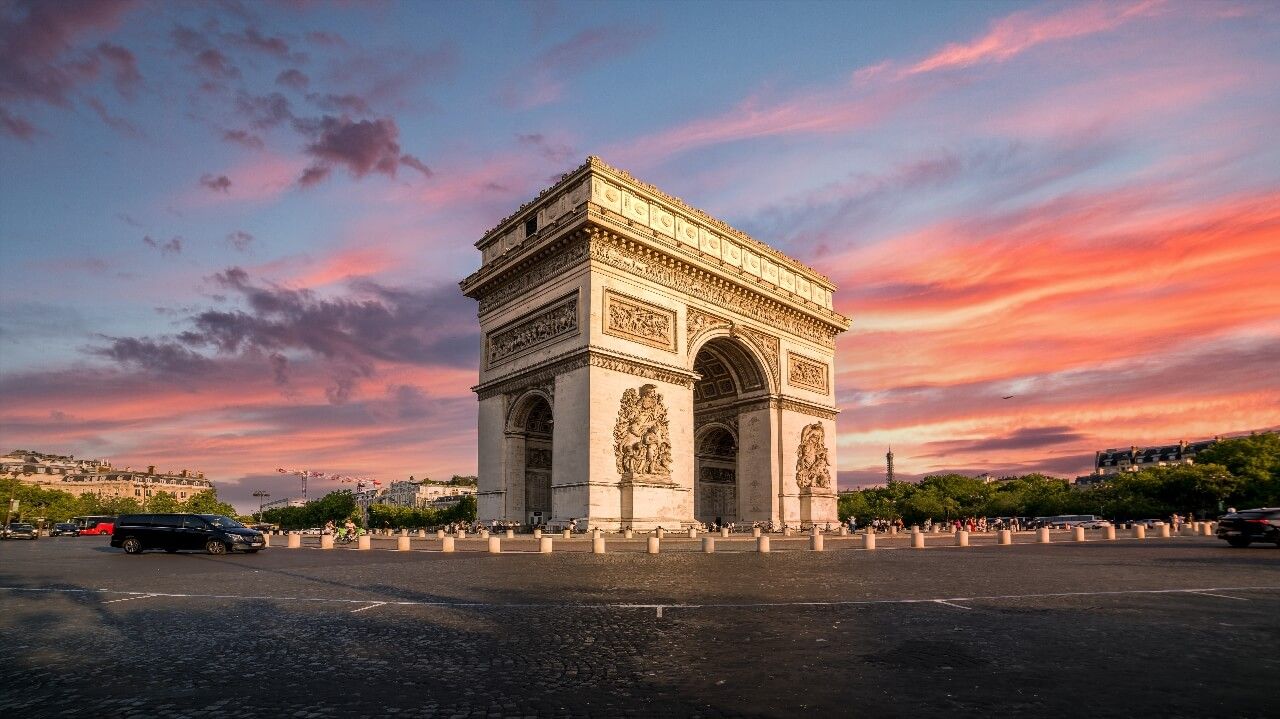
Every year, millions of people circle the Étoile roundabout without ever looking up at the sculpted friezes 50 meters high. The Arc de Triomphe is one of the most photographed monuments in the world, and yet it remains largely unknown: its construction lasted thirty years, its facades bear the names of 558 generals, and Napoleon never passed under it during his lifetime. If you plan to explore the Champs-Élysées and the 8th arrondissement at your own pace, the Ryo audio guide of Paris will give you a reading of the district that information panels don't provide. Before joining the queue for the underground tunnel, here's everything you need to know to transform a souvenir photo into a real visit.
This article covers the history of the monument since 1806, the details of the sculptures you would otherwise have missed, the conditions for climbing to the top, the rates and free admissions in effect in 2026, the best times of the year, and the surroundings not to be overlooked.
A Monument Born from the Victory of Austerlitz
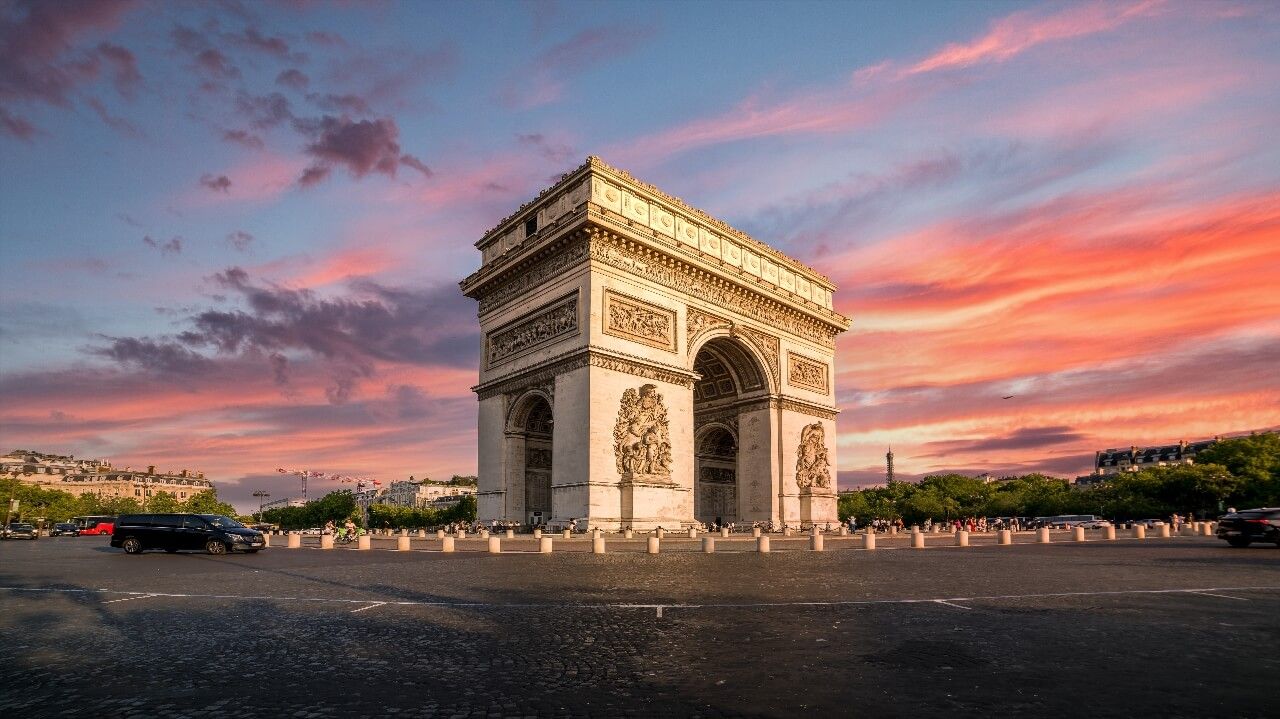
Napoleon Bonaparte orders the construction of the Arc de Triomphe on February 18, 1806, a few weeks after the victory of Austerlitz, his greatest battle. The idea is clear: build an arch that would eclipse all those of Roman Antiquity and serve as a gateway to Paris for his victorious armies. Jean-François-Thérèse Chalgrin wins the architecture competition. He draws inspiration from ancient arches, notably that of Titus in Rome, but multiplies the proportions: 50 meters high, 45 meters wide, 22 meters deep.
Construction stops abruptly with the fall of the Empire in 1814. At the time of Napoleon's marriage to Marie-Louise of Austria in 1810, the arch still existed only on paper, the architect had erected a wooden and painted canvas model to simulate the monument for the duration of the wedding procession. Construction resumes under the Restoration, then under the July Monarchy. Louis-Philippe finally completes the project in 1836, thirty years after the cornerstone.
Irony of history: Napoleon never passes under the completed arch during his lifetime. It is his coffin that passes through the vault in 1840, during the return of his ashes from Saint Helena. Victor Hugo witnesses the scene from one of the arch's windows and describes it in his notebooks. Since then, the monument has accompanied the great pages of French history, the parade of German troops in 1871, the victory march in 1919, the liberation of Paris in August 1944 with General de Gaulle walking up the Champs-Élysées on foot.
Deciphering the Sculptures and Bas-reliefs
The Arc de l'Étoile is not a smooth facade. Its four pillars bear monumental sculptures that deserve several minutes' attention before entering.
The most famous group is La Marseillaise (officially "The Departure of the Volunteers of 1792"), sculpted by François Rude on the right pillar on the Champs-Élysées side. The winged figure dominating the scene is the allegory of the Fatherland, mouth open in a war cry. Facing it, The Triumph of 1810 by Jean-Pierre Cortot celebrates peace with a more serene, almost academic composition. The two other high-reliefs, Resistance and Peace, are the work of Antoine Étex.
On the upper faces run continuous friezes representing the departure and return of the armies. Inside the vault, 558 generals' names are engraved in stone. Those who died in combat have their name underlined. On the interior faces of the arch, 30 shields each bear the name of a French military victory, 128 battles in total are thus commemorated.
Walk completely around the monument before entering. The morning light illuminates the east and west sculptures differently. Many details are visible at human height on the pillar bases, where pollution has less attacked the stone.
The Unknown Soldier and the Flame of Remembrance
Under the central vault rests the Unknown Soldier, buried on November 11, 1920. This unidentified French soldier from World War I was chosen from eight coffins of anonymous soldiers exhumed from the main battlefields, Verdun, the Marne, the Somme, the Chemin des Dames. A young blind soldier, Auguste Thin, designated the coffin by placing his bouquet of flowers on one of them.
The Flame of Remembrance burns above the tomb since November 11, 1923. It has never been extinguished since this date, neither during the German Occupation, nor during restoration work. Every evening at 6:30 PM, a rekindling ceremony is held under the vault, organized by the Flame Committee. Participation is free and the spectacle sober: a representative of veterans' association bellows the flame to revive it, then pays respects. It's one of the rare moments when you can approach the tomb very closely, surrounded by Parisians rather than tourist groups.
The slab is accessible for free, without a ticket. The passage under the vault remains open outside paid visiting hours.
Climbing to the Top: 284 Steps and an Exceptional Panorama
The top of the monument is accessible to the public and offers one of the most unique panoramas of Paris. From the terrace at 50 meters high, you see the twelve avenues converge toward the Étoile roundabout like the spokes of a wheel. The Avenue des Champs-Élysées goes straight to Place de la Concorde, and on clear days, you can distinguish the Louvre pyramid in the historic axis. The Eiffel Tower stands out to the south.
To access it, you climb 284 steps by a spiral staircase. There is no elevator for the public (PMR access is available, inquire at reception). The climb takes about 10 minutes at a moderate pace. Halfway up, an exhibition room presents models and historical documents on the construction; the Ryo audio guide details this room often crossed too quickly.
Sunset is the most sought-after time: the golden light strikes directly the Champs-Élysées axis and lights up the windows of Haussmann buildings. Plan to arrive 45 minutes before sunset to be well positioned. Dress warmly even in summer, the wind at height is constant. Access to the top is included in the standard entrance ticket.
The Four Arches of Paris
Most visitors are unaware that Paris has four distinct triumphal arches. The Arc de l'Étoile is the largest and best known, but its three "cousins" are worth a detour during a stroll through the center.
The Arc du Carrousel, Place du Carrousel in front of the Louvre, was built from 1806 to 1808, before the Arc de l'Étoile. It is smaller, less than 20 meters high, but its proportions are directly inspired by the Arch of Septimius Severus in Rome. Originally, it was topped by the horses of Saint Mark brought from Venice, returned to Italy in 1815 and replaced by copies.
The Porte Saint-Denis (Boulevard Saint-Denis, 75010 Paris, rated 4.5/5 on Google for 322 reviews), Boulevard Saint-Denis in the 10th arrondissement, dates from 1672. It is the oldest of the four. Louis XIV had it erected to celebrate the crossing of the Rhine by his armies. 24 meters high, it is inspired by the Arch of Titus in Rome and can be visited freely, without a ticket.
The Porte Saint-Martin, 200 meters from the Porte Saint-Denis, dates from 1674 and celebrates the capture of Besançon and Limbourg. Slightly less high (17 meters), it is decorated with bas-reliefs representing the victories of Louis XIV. The area around the two gates, between theaters and the Saint-Quentin market, deserves half an hour on foot.
Rates, Tickets and Free Admission in 2026
Access to the interior of the monument (exhibition + top) is paid, managed by the Centre des monuments nationaux. Rates now vary according to season.
- Full price (April 1 to September 30): €22
- Single rate (October 1 to March 31): €16
- Wednesday reduced rate (April 1 to September 30): €16
- Free: under 18, EU and EEA citizens aged 18 to 25, job seekers, people with disabilities and their companion
- Paris Museum Pass: access included, time slot reservation required
Online booking (Centre des monuments nationaux website) is highly recommended from June to September to avoid queues of more than 45 minutes. Advance booking costs no more than at the ticket office. Entry is through the underground tunnel on the Champs-Élysées side, crossing the roundabout on foot is prohibited.
The monument is open every day, with a delayed opening at 11 AM on Tuesdays, except on the mornings of May 1st, May 8th, July 14th and November 11th (official ceremonies). Closing is at 10:30 PM from October to March and at 11 PM from April to September, last admission 45 minutes before.
How to Get to the Arc de Triomphe
The monument occupies Place Charles-de-Gaulle, at the intersection of the 8th, 16th and 17th arrondissements.
Metro: lines 1, 2 and 6, Charles de Gaulle-Étoile station. Direct exit under the square.
RER: line A, same station.
Bus: lines 22, 30, 31, 52, 73, 92.
By bike, Vélib' stations are available on several radiating avenues (Kléber, Friedland, Wagram). The Champs-Élysées bike lane allows comfortable arrival from the east. By car, parking around the square is impractical, prefer underground parking on the Champs-Élysées.
When to Visit: the Year's Highlights
The monument is never closed to view from the street, but the timing of the visit deserves careful consideration.
July 14th is the most spectacular time of the year: the military parade descends the Champs-Élysées from Place de l'Étoile, with fighter jets passing over the monument. The view from the terrace is exceptional, but tickets for this time slot sell out weeks in advance.
November 11th (Armistice) gives rise each year to an official ceremony presided over by the head of state. The monument is closed to the public in the morning. The ceremony takes place at exactly 11 AM.
The winter solstice offers a particular photographic spectacle: the sun sets exactly in the axis of the Champs-Élysées, visible from the arch to La Défense. The phenomenon lasts a few minutes and attracts photographers and onlookers every December 21st.
For a peaceful visit, weekday mornings from September to November are ideal: few groups, beautiful light, short queues.
Surroundings: Champs-Élysées and Étoile District
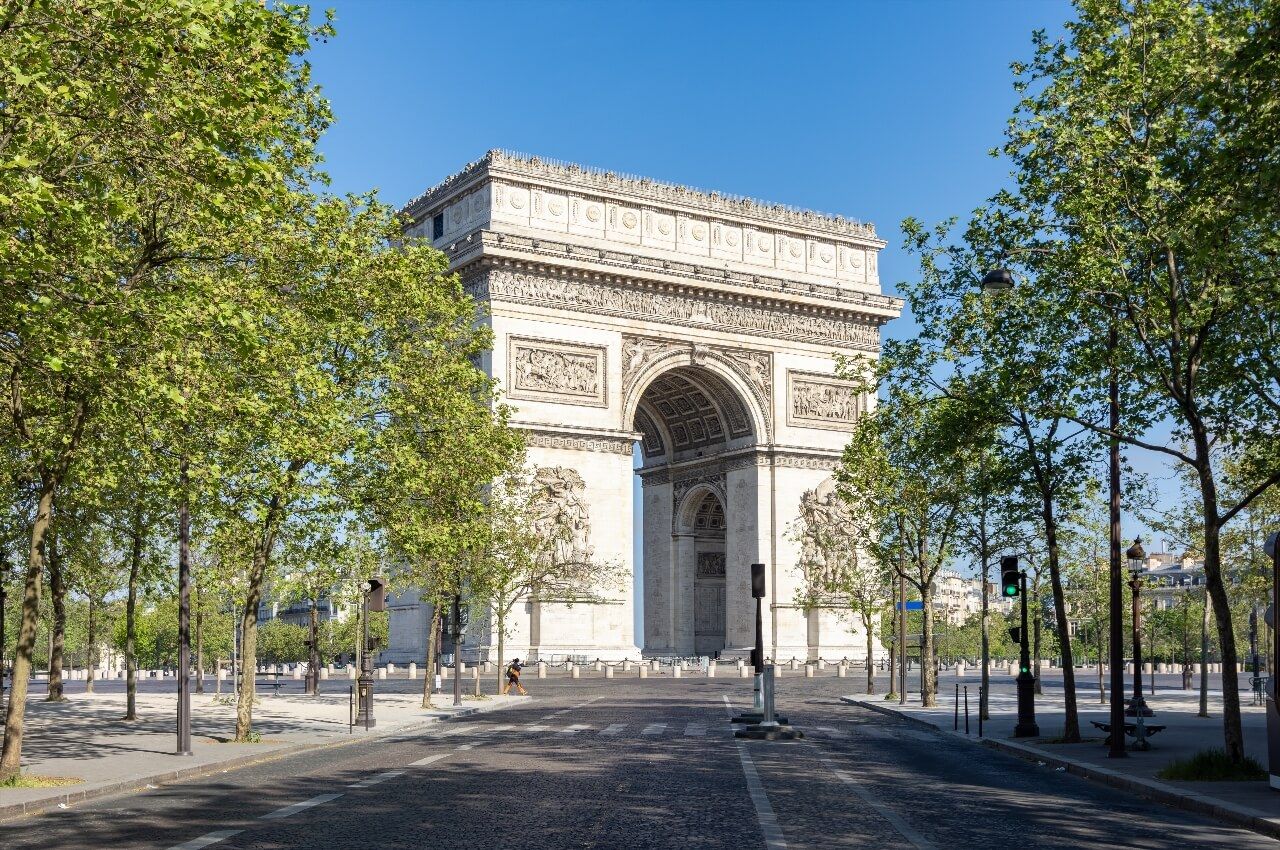
Place Charles-de-Gaulle deserves attention in itself. The twelve avenues radiating from it were carved out under Haussmann between 1854 and 1870, there were only five under Napoleon. Avenue Foch, the widest in Paris at 120 meters, leads to the Bois de Boulogne. Avenue Kléber descends to Trocadéro and offers a remarkable visual axis between the Eiffel Tower and the arch.
The Champs-Élysées stretch for 1.9 km between Place de l'Étoile and Place de la Concorde. The upper part, between the arch and the roundabout, concentrates luxury shops, cinemas and restaurants. The lower part, quieter, borders the Champs-Élysées gardens where, in December, the Christmas market chalets are held.
A five-minute walk south from the arch, the Musée Jacquemart-André (158 Boulevard Haussmann, 75008 Paris, rated 4.5/5 on Google for 9,767 reviews) (158 boulevard Haussmann) houses one of the most beautiful private collections of Italian Renaissance painting in France. Less crowded than the Louvre, it's worth visiting especially for its café-restaurant installed in the mansion's former dining room.
To the north, Place des Ternes and its flower market are one of the few permanent markets in the district. The surrounding streets offer a selection of traditional Parisian brasseries much less touristy than those on the Champs-Élysées. The Ryo audio-guided tour of the district covers these Haussmann streets in detail, with anecdotes about the buildings and the people who lived there.
Practical Tips for Your Visit
Book online. From April to September, queues without reservation regularly exceed 45 minutes. Online booking (Centre des monuments nationaux) gives access to a specific time slot.
Allow 1.5 to 2 hours if you visit the interior exhibition and climb to the top. For a quick visit focused on the panorama: 45 minutes is enough.
Appropriate shoes. The 284-step staircase is spiral and the handrail is narrow. Soft-soled shoes facilitate the descent.
Night photography. The arch is illuminated every evening. The best night photos are taken from the lower end of the Champs-Élysées (Place de la Concorde side) or from Avenue de Wagram. Avoid flash, it doesn't illuminate the monument at this distance.
Combine with other visits. Line 1 directly connects the arch to the Louvre in four stations. The same transport ticket then takes you to the Eiffel Tower via line 6 (Bir-Hakeim). A well-organized day can cover these three monuments without a car.
FAQ
Do you need to book in advance to visit the Arc de Triomphe?
Booking is not mandatory, but highly recommended from April to September and during May bank holidays and school vacations. Outside high season, you can usually buy your ticket directly at the entrance without significant waiting. Booking is done on the Centre des monuments nationaux website, same price as at the ticket office, but priority access at your time slot.
Is the Arc de Triomphe accessible to people with reduced mobility?
The rooftop terrace is not accessible to wheelchair users without specific assistance, as the ascent is entirely by stairs. PMR access is however available, inquire directly at the monument reception. The ground floor and the Unknown Soldier crypt are accessible at ground level from the underground tunnel. Entry is free for people with disabilities and their companion.
What time does the Flame ceremony take place?
The rekindling ceremony of the Flame of Remembrance takes place every evening at 6:30 PM, year-round. It is open to all for free, from the forecourt under the vault. Veterans' associations take turns and there is no advance published program, but the ceremony takes place on time without exception.
What is the difference between the Arc de Triomphe and the Arc du Carrousel?
The Arc du Carrousel (in front of the Louvre) was built first, between 1806 and 1808. It is smaller (19 meters high versus 50 for the Arc de l'Étoile) and celebrates the victories of the 1805 campaign. Both are aligned on the same historic axis, the great Parisian perspective that runs from the Louvre to La Défense, which makes their contemplation from the top of the Arc de l'Étoile a particularly strong experience.
Is the monument open on July 14th?
The monument is closed on the morning of July 14th due to the military parade on the Champs-Élysées. It generally reopens in the early afternoon. Time slots to see the parade from the terrace are released weeks in advance on the official website and are in high demand.
Can you see Paris from the top at night?
Yes. The monument is open until 10:30 PM from October to March and until 11 PM from April to September (last admission 30 to 45 minutes before closing). The night view of the twelve illuminated avenues and the Eiffel Tower that sparkles every hour is one of the most beautiful in Paris. Bring a jacket, the wind at height is striking even in summer.
Conclusion
The Arc de l'Étoile holds a special place in the Parisian landscape: at once historical monument, tomb, belvedere and living national symbol. You can admire it from afar from the Champs-Élysées or Avenue de la Grande Armée, or choose to devote two hours to it, between climbing to the top, reading the sculptures and the evening Flame ceremony. To extend your exploration of the district after your visit, our Ryo app offers an audio guide to the Champs-Élysées and the 8th arrondissement, with commentary on the buildings and places you'll pass through as you walk back down to Concorde.