
Créé par Romane, le 7 mai 2026
Votre guide Ryo
© Shutterstock
Perched at the top of Montmartre hill, the Sacré-Cœur Basilica is one of Paris's most emblematic monuments. With its dazzling white silhouette dominating the capital, it attracts over 10 million visitors from around the world each year. Built between 1875 and 1914, this Romano-Byzantine basilica offers not only a unique spiritual and architectural journey, but also one of the most beautiful panoramic views of Paris. Whether you're a history buff, architecture enthusiast, or simply seeking an authentic experience in the heart of Montmartre's bohemian district, visiting the Sacré-Cœur in Paris is an essential stop on your stay in the City of Light.
1. The fascinating history of the Sacré-Cœur
The history of the Sacré-Cœur Basilica is intimately linked to the tragic events that marked France in the 19th century. After the humiliating defeat of the Franco-Prussian War of 1870 and the dark hours of the Paris Commune, two Catholic businessmen, Alexandre Legentil and Hubert Rohault de Fleury, vowed to build an expiatory monument dedicated to the Sacred Heart of Jesus. This project was to symbolize national redemption and mark a new beginning for wounded France.
A law passed in 1873 declared the construction of public utility, and an architectural competition was launched the following year. It was Paul Abadie, famous French architect who had just restored the Saint-Front Cathedral in Périgueux, who won the competition with a bold Romano-Byzantine inspired project. The first stone was laid on June 16, 1875 by Cardinal Guibert, Archbishop of Paris, marking the beginning of a titanic construction site that would last nearly forty years.
The construction of the basilica represented a considerable technical challenge. Located at the top of Montmartre hill, at 130 meters altitude, the building had to be built on unstable ground consisting of former gypsum quarries. The architects had to dig 83 wells reaching up to 33 meters deep to establish solid foundations. The work was slowed by numerous obstacles: the death of Paul Abadie in 1884, financial difficulties requiring appeals for donations from the faithful, and finally the interruption caused by the First World War.
The basilica was finally completed in 1914, but its consecration only took place in 1919, after the end of the world conflict. Since this date, it has become one of the most recognizable symbols of Paris and an essential pilgrimage site for Catholics from around the world.
2. A unique Romano-Byzantine architecture in Paris
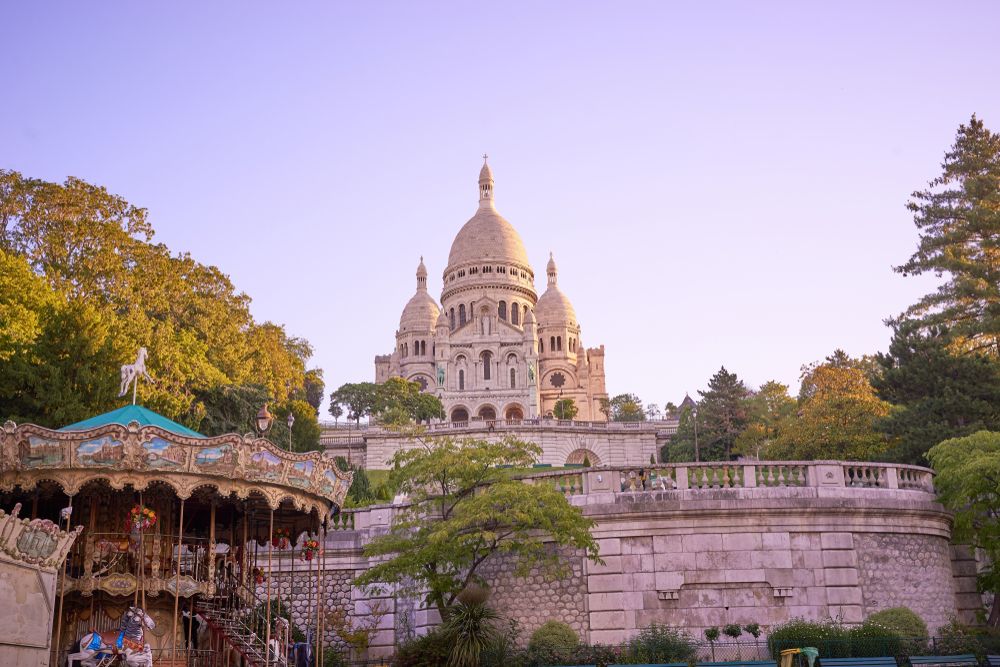
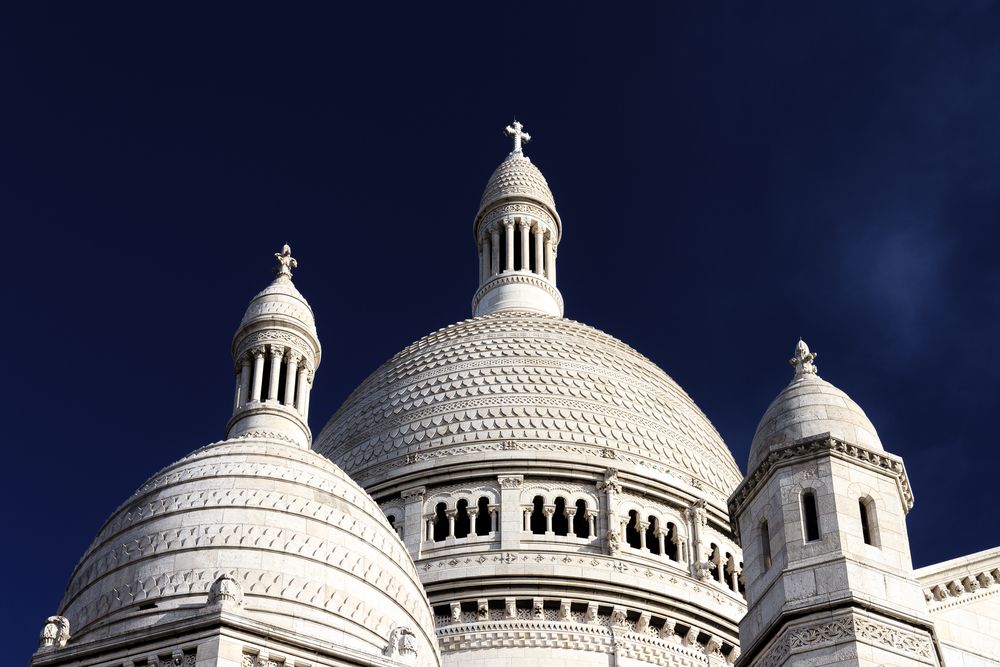
The architecture of the Sacré-Cœur contrasts dramatically with the Haussmann style that dominates Paris. Paul Abadie drew inspiration from Romanesque and Byzantine architecture to create a unique building of its kind in the French capital. The basilica adopts a Greek cross plan with four secondary domes surrounding the central dome that rises to 83 meters high. This configuration recalls that of the Saint-Front Basilica in Périgueux or Saint Mark's Cathedral in Venice.
The choice of construction material is equally remarkable. The basilica is entirely clad in Château-Landon stone, a white limestone extracted from the quarries of Seine-et-Marne. This stone possesses an exceptional property: when in contact with rainwater, it secretes calcite which forms a natural coating. This phenomenon allows the basilica to permanently maintain its dazzling whiteness, even after more than a century of existence. This immaculate color, visible from afar, gives the Sacré-Cœur its recognizable character and makes it a true spiritual lighthouse dominating Paris.
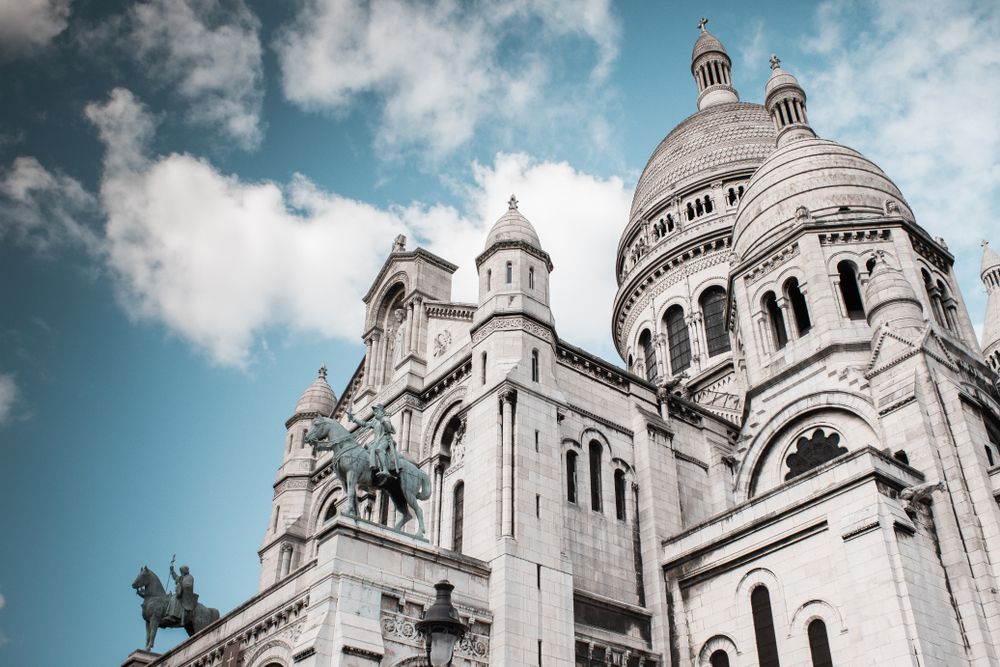
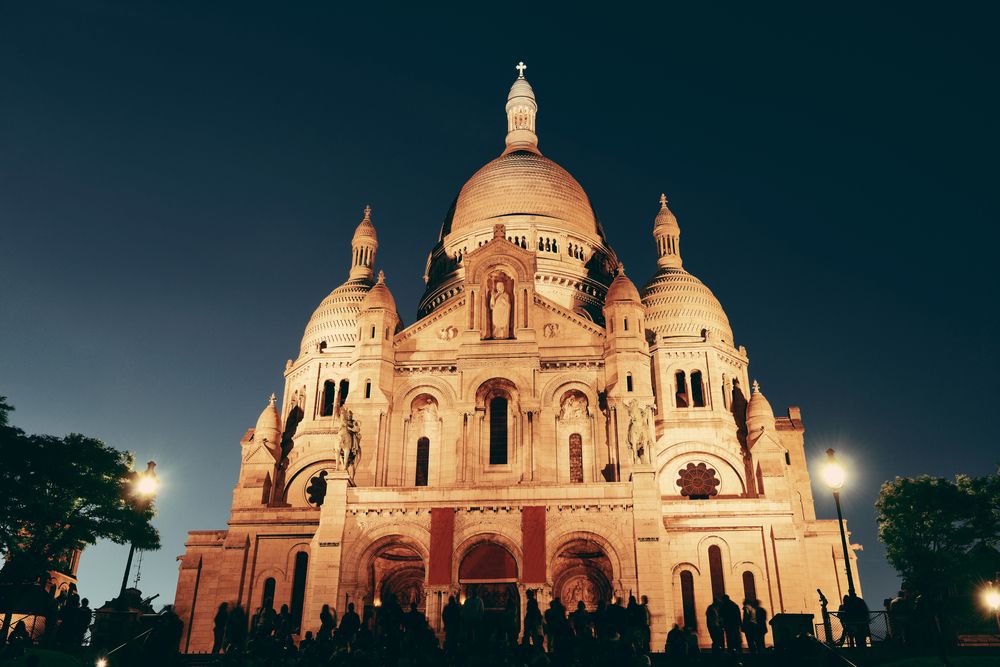
The main facade is adorned with three porches surmounted by two bronze equestrian statues representing Jeanne d'Arc and Saint Louis, two emblematic figures of French history. The pediment of the central portal is crowned with a monumental statue of Christ of the Sacred Heart, arms open in welcome. Inside, the space is organized around a vast nave that can accommodate up to 3,000 faithful, whose gaze is immediately drawn to the splendid mosaic of the choir.
3. What to see inside the Sacré-Cœur Basilica
As soon as you enter the Sacré-Cœur Basilica, you will be struck by the majesty of the place. The atmosphere is both solemn and peaceful, inviting contemplation. Silence is required inside, as this is primarily an active place of worship where perpetual adoration of the Blessed Sacrament has continued without interruption since 1885.
The monumental choir mosaic
The jewel of the basilica is undoubtedly the gigantic mosaic that adorns the apse of the choir. Created between 1912 and 1922 by Luc-Olivier Merson, this colossal 475 m² work is one of the largest mosaics in Europe. It represents Christ in glory, arms outstretched, showing his Sacred Heart surrounded by golden rays. At his sides appear the Virgin Mary, Saint Michael, as well as other historical and religious figures, including Jeanne d'Arc and Pope Leo XIII. At the base of the mosaic, one can read in Latin: "To the most holy Heart of Jesus, France penitent, fervent and grateful." This inscription recalls the origin of the monument as an act of national expiation.
The stained glass windows and side chapels
The side chapels that line the nave also deserve your attention. Each is dedicated to a particular saint and decorated with colored stained glass that diffuses a soft and mystical light. These stained glass windows, although partially destroyed during the Second World War and subsequently replaced, tell the story of the Sacred Heart and the devotion dedicated to it.
The monumental organ
The great organ of the Sacré-Cœur is considered one of the most remarkable instruments in France. Inaugurated in 1898, it has 78 stops and nearly 6000 pipes. Its exceptional sound resonates majestically under the vaults of the basilica, particularly during religious services and concerts that are regularly organized there.
Download the audio-guided circuit to discover Paris on foot and independently
To make the most of your discovery of the Sacré-Cœur and the Montmartre district, nothing beats a guided visit at your own pace. Ryo offers a complete audio-guided itinerary that allows you to explore Paris in complete freedom. Thanks to this application, you benefit from detailed explanations on the history, architecture and anecdotes of the Sacré-Cœur, but also on many other emblematic monuments of the capital. Download the circuit to visit Paris and let yourself be guided through the cobbled streets of Montmartre, from the Moulin Rouge to Place du Tertre, passing by the artists' studios that have made this bohemian district famous.
4. The crypt: a space for contemplation and history
Located under the choir of the basilica, the Sacré-Cœur crypt offers a striking contrast to the luminosity of the main building. This underground space, of the same dimensions as the upper basilica, plunges the visitor into a more intimate and meditative atmosphere. Access to the crypt is paid (about 3 euros) and is through a staircase located on the side of the basilica.
The crypt houses several chapels where various relics and sacred objects rest. It notably contains the tomb of Cardinal Guibert, first promoter of the construction of the Sacré-Cœur, as well as that of several other religious personalities who have marked the history of the basilica. The subdued lighting and coolness of the place create an atmosphere conducive to contemplation and prayer.
The walls of the crypt are adorned with commemorative plaques placed by faithful from around the world, testifying to the international reach of this pilgrimage site. Statues and stained glass complete the decoration of this space charged with history and spirituality.
5. Climb the dome to admire the panorama over Paris
The ascent to the dome of the Sacré-Cœur is an experience not to be missed during your visit. Although the effort is considerable – you have to climb about 300 steps in a narrow spiral staircase with no elevator – the reward is well worth it. The ticket to access the dome costs 8 euros for adults and 5 euros for children aged 4 to 16.
During your ascent, you will discover the architecture of the basilica's roof up close, its buttresses and decorative elements. Once at the top, at 272 meters above sea level, you will enjoy one of the most beautiful 360-degree panoramas of Paris. In clear weather, visibility can reach up to 50 kilometers, allowing you to embrace with your gaze not only the most famous Parisian monuments – the Eiffel Tower (rated 4.6/5 on Google for 459,000 reviews), Notre-Dame de Paris, the Arc de Triomphe – but also the suburbs and, at the horizon's edge, the first hills of Île-de-France.
The dome is open daily from 10:15 AM to 5:30 PM (last admission at 5 PM), but these hours may vary according to seasons and weather conditions. It is recommended to avoid peak hours (generally between 12 PM and 3 PM) to enjoy the view more peacefully.
6. Hours, prices and practical information
The Sacré-Cœur Basilica is open every day of the year, without exception, from 6:30 AM to 10:30 PM. Entry into the basilica itself is completely free, making it an accessible visit for everyone. However, expect a small queue during peak hours, particularly between 10:30 AM and 5 PM when visitor flow can lead to a wait of 10 to 15 minutes before entering the sanctuary.
For paid visits, here are the current rates: access to the dome alone costs 8 euros for adults and 5 euros for children aged 4 to 16. The crypt visit is offered at 3 euros (2 euros for children). If you wish to visit both, a combined dome + crypt ticket is available at the price of 11 euros for adults and 7 euros for children, allowing you to make a small saving.
It is important to note that the Sacré-Cœur is primarily an active place of worship where several masses and religious services take place daily. Out of respect for the faithful, visitors are asked to keep silent inside the basilica, put their phone on silent mode and avoid taking photos during services. Proper dress is also required: avoid tank tops, shorts that are too short and other clothing deemed inappropriate in a sacred place.
7. How to get to the Sacré-Cœur
The Sacré-Cœur is located at 35 rue du Chevalier de la Barre, in the 18th arrondissement of Paris, at the top of Montmartre hill. Several options are available to reach this emblematic monument, each having its advantages according to your physical condition and preferences.
By metro, the closest station is Anvers (line 2), about 10 minutes walk. From there, you will go up rue de Steinkerque, a pedestrian street lined with souvenir shops, before tackling the ascent of the 270 steps of the monumental staircase that leads to the basilica forecourt. Another option: Abbesses station (line 12), which places you in the heart of the Montmartre district. From this station, count about 15 minutes walk through the charming cobbled streets of the district to reach the Sacré-Cœur.
If you prefer to avoid the physical effort of climbing, the Montmartre funicular is the ideal solution. Accessible from Anvers metro station, this small rack railway takes you up to the basilica forecourt in just a few minutes. The funicular operates with a simple standard metro ticket (valid with both ticket+ and Navigo pass), making it a very economical option. It runs every day from 6 AM to 12:45 AM, with departures every 2 to 3 minutes during peak hours.
Several bus lines also serve Montmartre: lines 30, 54 and 80 have stops near the Sacré-Cœur. The Montmartrobus, a special line with small electric buses, also goes around the district and constitutes a pleasant and ecological way to discover Montmartre.
For those who choose to come by car, know that parking is difficult in the district. The closest parking is the Anvers-Montmartre parking, located on rue Seveste, but spaces are limited and expensive. Moreover, a large part of the area is pedestrian, making car circulation complex.
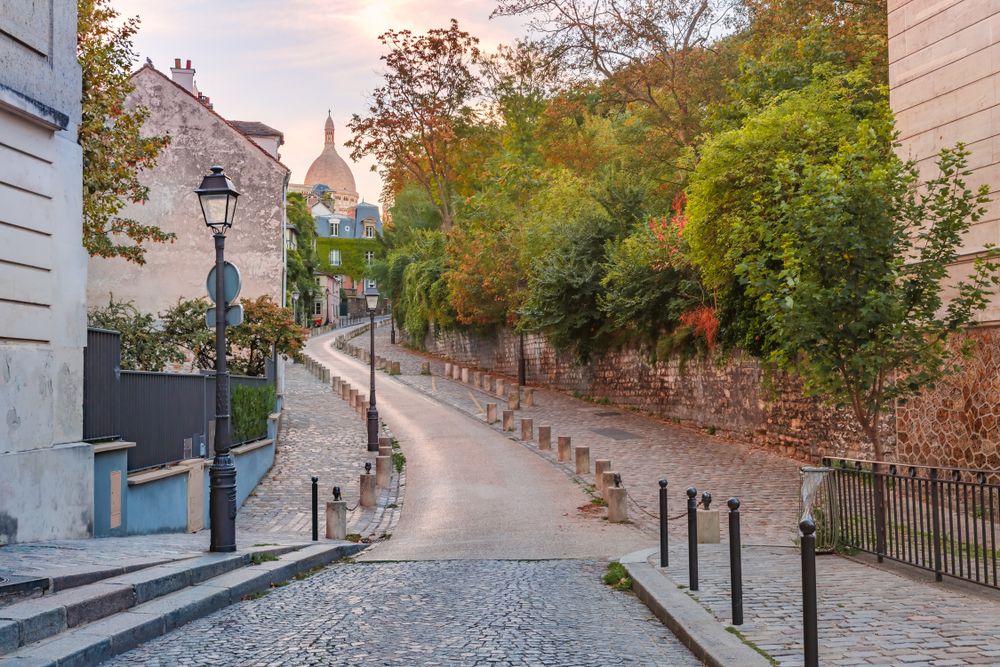
8. Discover the Montmartre district
Visiting the Sacré-Cœur would not be complete without exploring the bohemian Montmartre district that surrounds it. This legendary district, perched on its hill, has preserved a village atmosphere in the heart of Paris. Its cobbled streets, picturesque staircases and shaded squares have inspired countless artists, from Picasso to Van Gogh, from Toulouse-Lautrec to Dalí.
A few steps from the Sacré-Cœur is the famous Place du Tertre, the historic heart of the old village of Montmartre. This small square, bordered by cafes and restaurants with lively terraces, is today the kingdom of portraitists and caricaturists who perpetuate the district's artistic tradition. Although very touristy, it retains undeniable charm, especially early in the morning or late in the day when the crowds disperse.
Don't miss visiting the Saint-Pierre de Montmartre church (rated 4.6/5 on Google for 880 reviews), located just a few meters from the Sacré-Cœur. This church, one of the oldest in Paris, dates from the 12th century and offers a striking contrast with the recent architecture of the basilica. Its small cemetery, often overlooked by visitors, is a haven of peace where several Montmartre personalities rest.
Then go down to the Moulin Rouge (rated 4.4/5 on Google for 76,000 reviews) via rue Lepic, famous for having housed the Café des Deux Moulins from the film "Amélie". This shopping street, which winds along the hill, will show you authentic Montmartre, off the beaten track.
For art lovers, the Musée de Montmartre, housed in the former home of painter Suzanne Valadon, traces the history of the district and its artists. Its Renoir garden, where the painter set up his easel to immortalize the "Bal du Moulin de la Galette", offers a bucolic pause with a view of Montmartre's vineyards.
Going down the steps of rue Foyatier or taking the funicular, take time to stroll through the small adjacent streets. Rue de l'Abreuvoir, often considered one of the most beautiful streets in Paris, rue Cortot lined with artists' studios, or the mysterious passage Cottin are worth the detour. Don't hesitate to get lost in this maze of alleys: it's often there that the most beautiful discoveries are made. To make the most of your exploration, the Ryo itinerary to visit Paris will guide you through the hidden treasures of Montmartre with captivating audio guides that will enrich your experience.
9. Anecdotes and secrets of the Sacré-Cœur
The Sacré-Cœur holds many unknown stories that add to the fascination it exerts. Did you know for example that the construction of the basilica required no less than 40 years of work and mobilized six successive architects after the death of Paul Abadie in 1884? Each left their mark on the building, thus creating a unique collective work.
The basilica's famous bell, nicknamed "La Savoyarde", is one of the biggest bells in France. Cast in Annecy in 1895, it weighs 19 tons and measures more than 3 meters in diameter. Its transport to Paris, then its installation in the bell tower, was a true technical feat for the time. Its clapper alone weighs 850 kilograms. When it rings, its deep chime can be heard several kilometers away.
The perpetual adoration that takes place at the Sacré-Cœur since 1885 constitutes a remarkable record. Day and night, without interruption for nearly 140 years, faithful have taken turns to pray before the exposed Blessed Sacrament. This tradition continued even during the two world wars, making the Sacré-Cœur a symbol of spiritual continuity.
The basilica site is also charged with history well before its construction. In the 3rd century, Saint Denis, first bishop of Paris, would have been beheaded on Montmartre hill (the "Mount of Martyrs"). According to legend, after his ordeal, he would have picked up his head and walked to the site of the current Saint-Denis Basilica, located several kilometers north of Paris. This story contributes to the sacred character of the place since antiquity.
Finally, an architectural anecdote: the Château-Landon stone used for construction has the particularity of whitening in contact with rainwater thanks to a natural chemical process. The more it rains on Paris, the whiter the Sacré-Cœur becomes. Even after more than a century of exposure to weather and Parisian pollution, the basilica maintains its brilliant whiteness.
10. Practical tips for your visit
To make the most of your visit to the Sacré-Cœur, favor the early morning hours (from 6:30 AM) or late in the day to avoid crowds. Weekends and Sunday afternoons are the busiest. Attending a mass can enrich the spiritual experience.
Wear comfortable shoes, as even with the funicular, there are still stairs to access the dome and walk around Montmartre. Access to the dome is not possible for people with reduced mobility, but the basilica itself is accessible via the funicular.
Beware of pickpockets and scams around the Sacré-Cœur and in Montmartre. Be wary of "good luck" bracelet sellers or solicitations for petitions. On Place du Tertre, some caricaturists charge excessive rates.
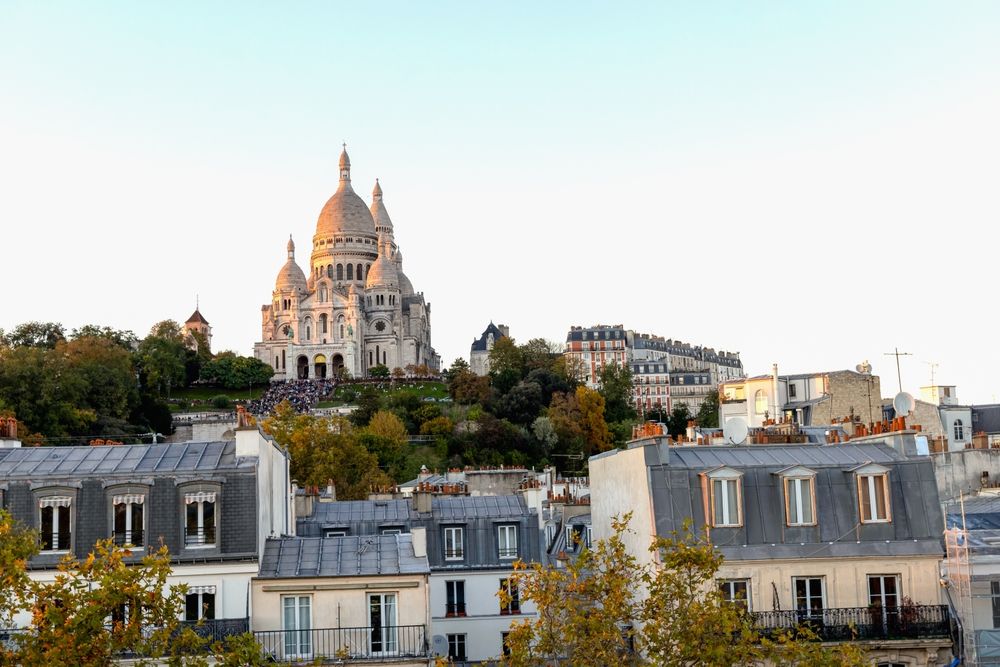
For photographers, the forecourt offers an ideal viewpoint for the facade with Paris in the background. The stairs and surrounding streets allow for beautiful framing. Photography is forbidden inside out of respect for the place.
Combine your visit with other nearby attractions like the Musée Grévin and the Grands Boulevards district. The thematic itineraries of Ryo allow for a complete exploration of Paris.
Visiting the Sacré-Cœur is an immersion in history, art and spirituality. From its immaculate facade to the choir mosaic, through the panorama from the dome and the charm of Montmartre, every aspect deserves attention. To miss nothing, download the Ryo circuit.
FAQ: your questions about visiting the Sacré-Cœur
Is entry to the Sacré-Cœur free?
Yes, entry into the basilica is free. Only visits to the dome (8 euros) and the crypt (3 euros) are paid.
How much time should you allow to visit the Sacré-Cœur?
1h30 to 2h for the basilica and dome. Half a day if you also explore Montmartre.
Can you attend mass at the Sacré-Cœur?
Yes, several masses are celebrated each day. Access is free and open to all.
Is the Sacré-Cœur accessible to people with reduced mobility?
The basilica is accessible via the funicular for wheelchairs. Access to the dome is not possible.
What is the best time to photograph the Sacré-Cœur?
Morning light (8 AM-10 AM) and late afternoon (5 PM to sunset) is ideal. Avoid the interior, where photography is prohibited.
Are there restaurants near the Sacré-Cœur?
Yes, Montmartre offers cafes and brasseries. Place du Tertre is touristy and expensive; rue Lepic or des Abbesses offer more authentic and affordable options.