© Shutterstock
 Votre guide Ryo
The Most Beautiful Villages of Ardèche: Our 2026 Selection (Village by Village)
Ardèche doesn't need to show off. Its villages perched above the gorges, its cobblestone lanes, its medieval towers lit by the southern sun always end up slowing down those who pass through them. This guide covers the most beautiful villages of Ardèche in detail: what you will actually find there, what the usual lists forget to mention, and how to organize your visits without wasting time. From Vogüé to Thines, by way of Balazuc and Antraigues-sur-Volane, each village has its own personality and deserves better than a simple mention in a catalogue. To go further in your planning, Ryo's article Visiting Ardèche: the must-sees complements this guide with the natural and cultural sites not to be missed across the entire department.
Vogüé consistently wins the award for most-shared photos, but Balazuc, clinging to a white limestone cliff above the river, is often cited by locals as the most beautiful. Thines, a hamlet almost lost in the foothills of the Cévennes, has not changed since the 12th century. Antraigues-sur-Volane keeps the memory of Jean Ferrat, who lived there until his death in 2010. Each of these villages is a story in its own right.
Vogüé: the Picture-Postcard of Ardèche
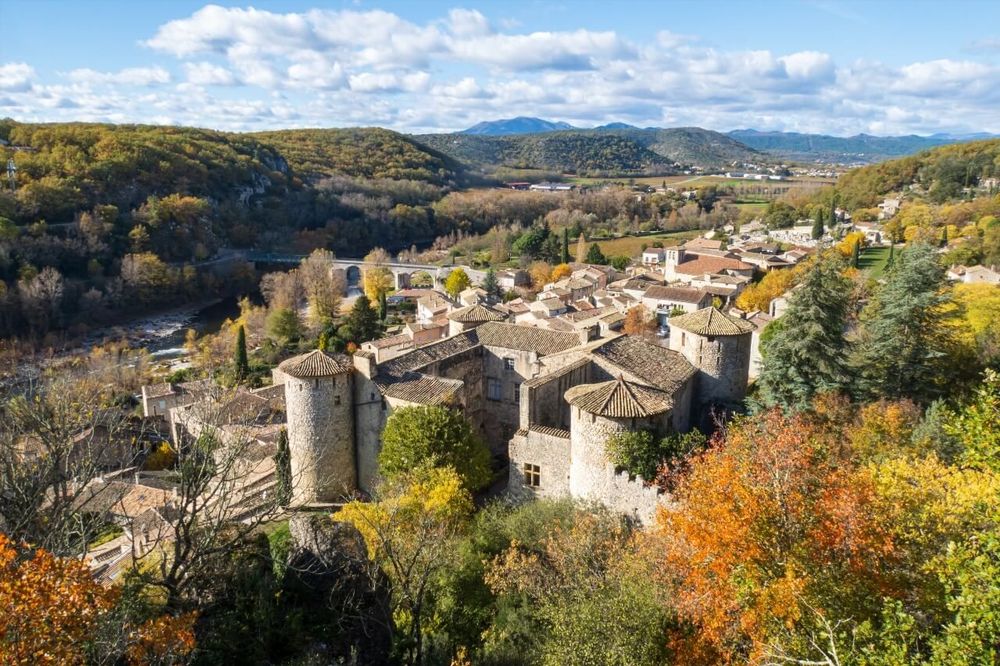
Vogüé stands out as the most photographed village in the department, and for good reason: the golden limestone façade, the arcaded houses descending to the river, and the medieval château that dominates the whole scene form a tableau that is hard to match. Built in the 12th and 17th centuries, the château today hosts temporary exhibitions and a panoramic terrace open to the public — allow around €6 for entry and a view that takes in the meanders of the Ardèche river over several kilometres.
Vogüé is one of only two villages in the department to be listed in the « Les Plus Beaux Villages de France » association, a label awarded to only 184 communes across the entire country. The Rue des Chevaliers, lined with Renaissance houses, leads up to the church of Saint-Symphorien, whose Romanesque bell tower dates from the 11th century. Below, pebble beaches along the riverbanks offer swimming: this is one of the most accessible sections of the gorges, with parking right next to the water.
Vogüé is also the ideal starting point for descending the gorges by canoe. Several rental companies offer routes from 8 to 32 km, with levels suited to both beginners and experienced paddlers. In July and August, the riverbanks come alive with a night market every Wednesday evening — a vibrant, locally rooted event worth stopping for if your visit coincides. To prepare your visit with a quality audio guide, the Ryo audio guide tour accompanies you step by step through the most iconic Ardèche villages.
Best time to visit: May–June or September, before the summer crowds that turn the car parks into traffic jams.
Balazuc: Village Perched on a Limestone Cliff
Balazuc (Village de Balazuc, 07120 Balazuc, rated 4.6/5 on Google from 870 reviews) is one of those villages that stops you in your tracks. Clinging to a white limestone cliff directly above the Ardèche river, its sloping lanes, vaulted passages, and stone houses with lauze roofs give the impression of a scene frozen since the Middle Ages. It is, alongside Vogüé, the other Ardèche village classified as one of « Les Plus Beaux Villages de France », and its raw, almost mineral character sets it apart from the more tourist-oriented sites in the department.
The Tour Sarrasine is one of the village's visual landmarks — a circular medieval tower, remnant of the old defensive wall, which you will spot from the road long before you arrive. From the belvedere at the top of the village, the view plunges directly onto a meander in the river: in summer, the turquoise waters contrast with the white rock in a way that alone justifies the detour.
The calades (pebbles set on edge, typical of Ardèche architecture) cover the central lanes of the village. They make walking slippery in wet weather — opt for sturdy-soled shoes. The village has only around a hundred permanent residents, and parking is limited: a car park is available at the entrance, and everything beyond is done on foot. Allow an hour to explore the whole village at a leisurely pace, longer if you head down to the riverbanks for a swim.
Labeaume: Gorges, Garrigue, and Crystal-Clear Water
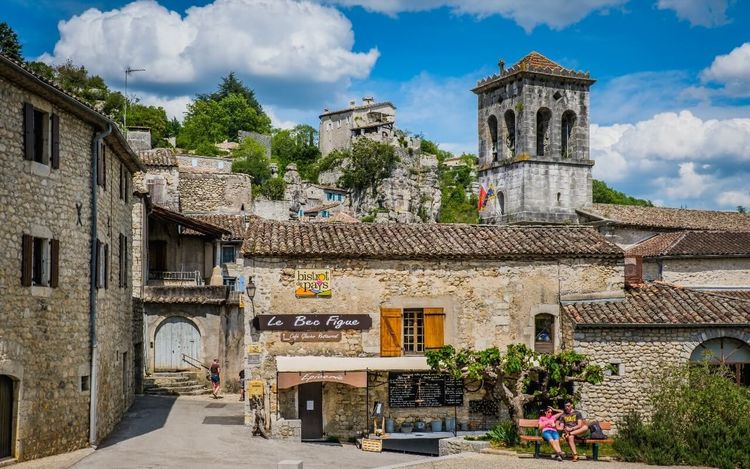
Labeaume is often underestimated compared to its more famous neighbours. Yet its deep gorges through which the Beaume, a tributary of the Ardèche, flows make up one of the most striking landscapes in the southern part of the department. The village itself, built on a rocky spur, combines dry-stone houses, terraced gardens, and vaulted passageways typical of Cévennes architecture. It holds the « Village de Caractère » label from Ardèche, which recognises communes with remarkable built heritage.
The gorges of the Beaume (Labeaume, 07120 Labeaume, rated 4.7/5 on Google from 37 reviews) can be explored on foot along a waymarked trail that follows the river from the village. In summer, the natural rock pools carved into the limestone form natural swimming holes popular with families with children: the water stays cool even in the height of August, and crowds remain lower than at better-known sites. Entry is free and parking is free outside the village.
The moulin de Labeaume, partially restored, bears witness to a milling activity that shaped the entire life of the village for centuries. In the evening, once the hiking groups have left, the terraces of the few restaurants in the village regain the atmosphere of a quiet provincial village — an ambiance that many Ardèche sites have lost to mass tourism. Labeaume is clearly worth the detour, even for just an hour's stroll.
Vallon-Pont-d'Arc: Gateway to the Gorges, Prehistoric Landmark
If you had to choose a single entry point for discovering Ardèche, it would be Vallon-Pont-d'Arc. Not so much for the village itself, which has retained more of a commercial than a medieval character, but for what it opens up: the Ardèche gorges stretching 30 kilometres, and above all, the Grotte Chauvet — or rather its full-scale replica, the Grotte Chauvet 2 — since the original cave is listed as a UNESCO World Heritage Site and has been closed to the public since its discovery in 1994.
The Grotte Chauvet 2 is one of the most ambitious archaeological replication projects ever carried out in France: more than 3,000 m² of cave walls faithfully reproduce the original cave, with its cave paintings dating back around 36,000 years, among the oldest in the world. The experience is breathtaking, and the surrounding museum space is of rare quality. Book well in advance in summer — time slots go fast. Ryo's article on the Grotte Chauvet in Ardèche details everything you need to know to plan your visit.
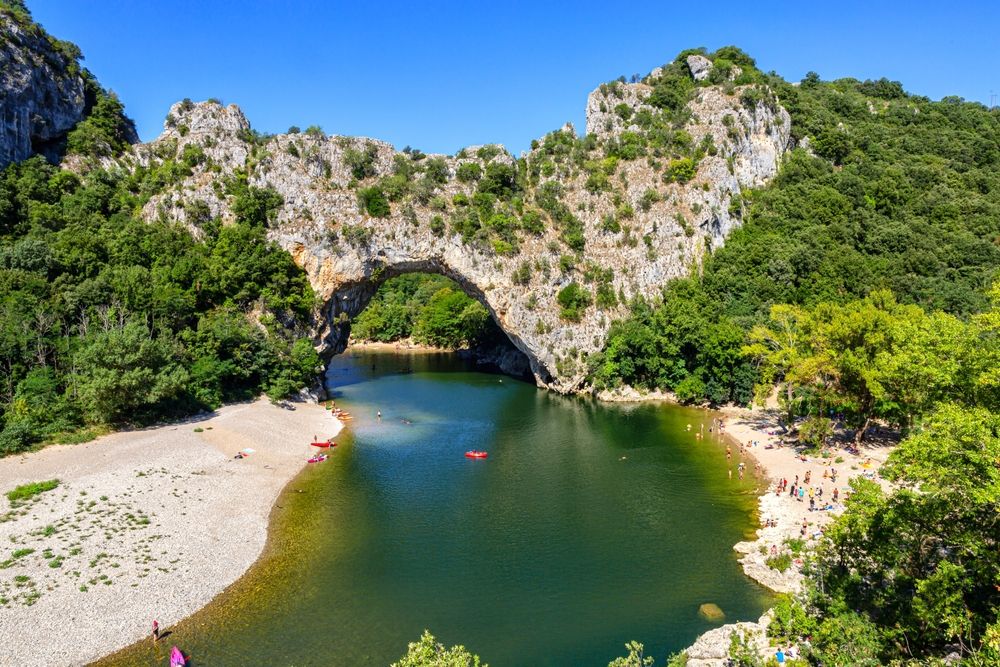
The Pont d'Arc (Gorges de l'Ardèche, 07150 Vallon-Pont-d'Arc, rated 4.7/5 on Google from 17,494 reviews) itself — a natural arch around sixty metres wide carved by the river into the limestone rock — can be admired from a viewing platform accessible on foot from the village in just a few minutes by road. It is one of the most spectacular geological formations in France, and access to the belvedere is completely free. Passing beneath the arch by canoe is one of the most memorable experiences of any stay in Ardèche.
Banne: Fortress on a Volcanic Promontory
Banne (Village de Banne, 07460 Banne, rated 4.4/5 on Google from 280 reviews) is built on a rocky spur that rises out of the garrigue, giving it an immediately recognisable silhouette from the plain below. The village bears the marks of a long military history: its fortified castle, of which only significant ruins remain today (the fort), was one of the region's key strategic control points before its destruction in the 17th century.
From the top of the spur, the panorama stretches broadly across the basin of the southern department and, on a clear day, as far as the first heights of the Cévennes. This natural belvedere is accessible in about ten minutes on foot from the village centre, and it is one of the widest viewpoints in southern Ardèche, far less visited than the riverside sites. The village itself, with its stone houses and narrow lanes, has a remarkable architectural coherence.
The producers' market draws local growers from the surrounding area: goat's cheese, chestnut honey, wines from the Côtes du Vivarais. Banne remains a living village year-round, which is felt in its atmosphere — fewer souvenir shops than in more tourist-oriented villages, and more of that everyday life of a southern French village that gives the south of France its understated charm.
Saint-Montan: Medieval Village Under Ongoing Restoration
Saint-Montan (Village médiéval de Saint-Montan, 07220 Saint-Montan, rated 4.5/5 on Google from 1,859 reviews) is one of the most ambitious restoration projects in Ardèche: since the 1970s, an association has been working on the gradual reconstruction of this medieval village, using period artisan techniques. The result is a restored village where, stone by stone, you can sense the patient work of the volunteers and craftspeople who have brought the old town and its château back to life.
The château de Saint-Montan, perched above the village, commands a view stretching towards the Rhône valley — a striking contrast between the reconstructed Middle Ages and the industrial plain in the distance. Visits are possible in season (generally April to October), and the village regularly organises medieval days with demonstrations and activities. It is a site particularly well suited to families with children who want to make history tangible.
Saint-Montan is located in lower Ardèche, not far from Viviers and Bourg-Saint-Andéol, two towns that are also worth a stop. Allow half a day to make the most of the village and its activities.
Rochecolombe: the Abandoned Village Coming Back to Life
Rochecolombe (Village de Rochecolombe, 07120 Rochecolombe, rated 4.4/5 on Google from 190 reviews) is one of those villages you discover almost by chance, following a small road that branches off the main route. Perched on a rocky pinnacle a few kilometres from Balazuc, the old village was largely abandoned during the 20th century in favour of a more accessible settlement in the valley below. What remains is a collection of ruins of great character, with a square tower still well preserved and houses currently being consolidated.
The walk from the bottom of the village to the top of the spur takes around 30 minutes and offers a direct view over the meanders of the Ardèche. The site is not set up like a conventional tourist attraction: no entrance sign, no ticket office, no shop. That is precisely what makes it one of the most authentic spots in the area. Rochecolombe pairs naturally with Balazuc (4 km away) and Vogüé (7 km away) for a full day of exploration in the valley.
Alba-la-Romaine: Volcanic Village with Gallo-Roman Roots
Alba-la-Romaine owes its name to its past: the town was one of the capitals of the Helvii tribe in the Gallo-Roman era, before being supplanted by Viviers. The remains of that period — a partially excavated ancient theatre, columns, mosaics — stand alongside a medieval village built in black basalt stone, the characteristic colour of the volcanic Coiron plateau on which it sits.
The archaeological site of Alba-la-Romaine, with its MuséAl museum, presents collections from excavations of the ancient site: pottery, coins, jewellery, tools — a comprehensive picture of daily life in the region during the 1st and 2nd centuries AD. Entry is modest (around €5) and the site is open regularly in season. Alba-la-Romaine is also known for its medieval château, whose silhouette dominates the old village: the layering of different eras is particularly easy to read here.
The village hosts a theatre festival every summer within the ancient setting — a backdrop that gives these performances a particular atmosphere that is hard to replicate elsewhere. For lovers of ancient history, Alba-la-Romaine is one of the richest sites in Ardèche.
Thines: Hamlet Lost in the Foothills of the Cévennes
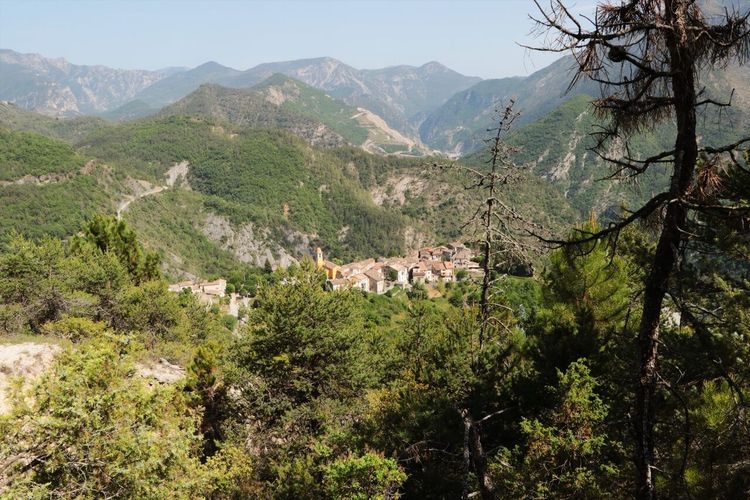
Thines is probably the most isolated village in this selection. Clinging to a mountainside in the foothills of the Cévennes, at over 600 metres altitude, it sits at the end of a narrow, winding road that you only take if you already know it exists. Only a handful of residents live there year-round. The access road itself, winding through chestnut trees and holm oaks, sets the tone: here, the world seems to move a little more slowly.
The Romanesque church of Thines (Thines, 07140 Thines, rated 4.7/5 on Google from 64 reviews) is a listed historic monument and the true jewel of the village: built in the 12th century, it features a portal and a chevet with sculpted decoration of rare elegance for such a modest building. The carvings — fantastical animals, interlacing patterns, geometric figures — testify to exceptional artisanal craftsmanship for the period. The interior, sober and very well preserved, is open to visitors outside of services.
Thines holds the « Village de Caractère » label from Ardèche. Come on a weekday if possible: on July and August weekends, the village can become congested with cars on the access road, creating an improbable queue in the middle of this wild landscape. On weekdays, you stand a good chance of having it almost entirely to yourself — which suits the spirit of the place far better.
Antraigues-sur-Volane: Jean Ferrat's Village
Antraigues-sur-Volane (Place du village, 07530 Antraigues-sur-Volane, rated 4.5/5 on Google from 760 reviews) holds a special place in the Ardèche imagination. This village in the northern part of the department, perched above the Volane in a landscape of extinct volcanoes, is inseparable from the figure of Jean Ferrat, the singer who settled there in the 1960s and lived there until his death in 2010. He composed a large part of his work there and remained deeply attached to the village that had adopted him.
The village itself is built on a rocky spur of basalt, surrounded by deep gorges. Its cobblestone lanes, timber-balconied houses, and terraced gardens form a coherent and appealing ensemble. A dedicated space recalls Ferrat's presence in the village, and the locals retain a sincere attachment to his memory — you will hear them speak of him spontaneously in the shops or at the café.
Antraigues is also a good base for exploring the Parc Naturel Régional des Monts d'Ardèche, which covers a large part of the northern department: the volcanoes of the Vivarais, chestnut forests, and the thermal springs of Vals-les-Bains just a few kilometres away. The village has several quality restaurants and gîtes, making it a good base for touring if you are planning several days in the northern Ardèche.
Ailhon: Ardèche Without the Tourists
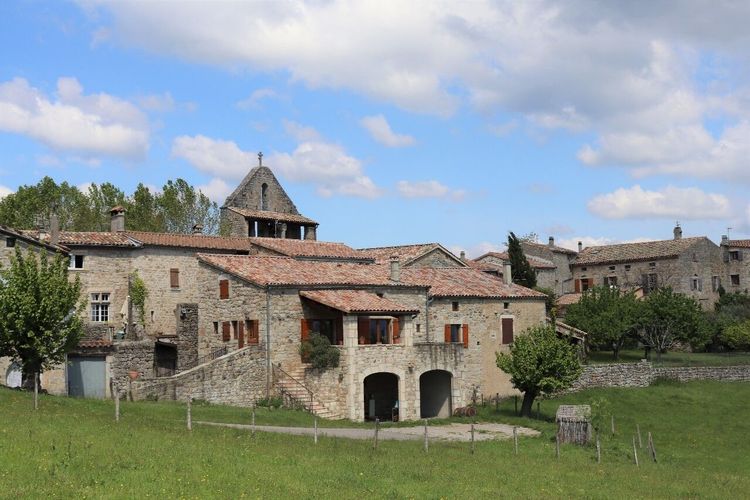
Ailhon (Village d'Ailhon, 07200 Ailhon, rated 4.3/5 on Google from 140 reviews) is a village of character that still escapes the usual tourist circuits. Located between Aubenas and Vals-les-Bains, it stretches across a relief of schist and basalt with a Romanesque bell tower visible from afar. The Romanesque church of Saint-André is worth a stop for the quality of its stonework and the understated elegance of its proportions.
The village is surrounded by chestnut plantations — the chestnut tree is nicknamed the « bread tree » of Ardèche, having long formed the staple of the local diet in the mountainous areas. Ailhon organises a chestnut festival every autumn that brings together producers and craftspeople from across the region. Outside the high season, it is a particularly peaceful spot, perfect for a break away from the bustle of the major sites.
Jaujac: the Village of Three Châteaux and a Volcano
Jaujac (Village de Jaujac, 07380 Jaujac, rated 4.2/5 on Google from 290 reviews) stands out for a rare geological feature: it is surrounded by well-preserved volcanic formations, including the Coupe de Jaujac volcano, a crater that can be explored on foot along a waymarked trail of around 3 km return. The solidified lava flow descending towards the Lignon creates a mineral landscape of great coherence.
The village and its surroundings preserve the remains of several châteaux (including Pourcheyrolles, clinging to the basalt flow, and the Château de Bruget), some of which are accessible on foot from the centre. The Lignon, the river running through the village, offers swimming opportunities in summer in calm, shallow stretches. Jaujac is popular with families who want to combine historical heritage, geology, and outdoor activities in a single stay.
Ruoms: Between Garrigue and Canoe
Ruoms (Village fortifié de Ruoms, 07120 Ruoms, rated 4.8/5 on Google from 36 reviews) is a former fortified town whose defensive towers still encircle the old town in an almost intact manner. The walk along the ramparts gives a sense of the scale of the period's defensive system, and the inner lanes retain a well-preserved medieval character despite heavy summer footfall.
Ruoms is situated near the confluence of the Chassezac and the Ardèche, making it one of the centres of canoe-kayak activity in the department: several rental companies offer routes on both rivers from the village. The town hosts a lively weekly market in season, bringing together local producers, craftspeople, and traders. Pair it with Balazuc (5 km away) for a full day in the valley.
Naves: Cobblestone Lanes and Fossils of Southern Ardèche
Naves (Village de Naves, 07330 Naves, rated 4.2/5 on Google from 120 reviews) is a village of the Ardèche garrigue built largely of calades — pebbles set on edge that cover the lanes, steps, and squares. It has the distinctive feature of sitting on terrain rich in marine fossils: ammonites have been found here, evidence of an ancient time when this entire region lay beneath the sea.
The village is quiet and well preserved, with a simple Romanesque church and a few well-restored townhouses. Naves lends itself to a short stop on a circuit through southern Ardèche rather than a full-day visit — allow an hour to walk around and appreciate the architecture of its lanes.
Saint-Laurent-sous-Coiron: at the Foot of the Volcanic Plateau
Saint-Laurent-sous-Coiron (Village de Saint-Laurent-sous-Coiron, 07170 Saint-Laurent-sous-Coiron, rated 4.7/5 on Google from 9 reviews) lives up to its name: it is literally built beneath the basalt plateau of the Coiron, the volcanic flow that crosses the department and gives the entire area its black-stone houses. The village itself is modest, but the Château de Boulogne, a medieval fortress whose ruins stand in the surrounding countryside, is worth exploring.
The village is primarily interesting as an access point to the cliffs and flows of the Coiron, explored on foot along lightly marked but passable trails. The contrast between the black basalt rock and the pale boxwoods of the garrigue creates landscapes of great originality in this little-visited corner of Ardèche.
Chalencon: Medieval Village of Upper Ardèche
Chalencon (Village médiéval de Chalencon, 07240 Chalencon, rated 4.7/5 on Google from 520 reviews) is located in upper Ardèche, in the northern part of the department, in a landscape of gorges carved by the Eyrieux. The medieval village, perched on a rocky ridge above the river, preserves the remains of its château and fortifications, whose silhouette stands out clearly against the sky. It holds the « Village de Caractère » label.
The Romanesque church, well preserved, and the old houses flanking it form a medieval ensemble of great architectural quality. The gorges of the Eyrieux below offer hiking and trout fishing in an unspoilt setting. Chalencon is often included in discovery circuits of upper Ardèche alongside Saint-Pierreville and Albon-d'Ardèche.
When to Visit and How to Organise Your Trip
The best time to explore these villages is May–June or September–October. In July and August, the country roads turn into traffic jams, the car parks at the most popular sites fill up by 10 a.m., and the heat (often 35 °C and above in the gorges) makes walking exhausting. Out of season, the villages regain their authentic character, restaurant owners have time to chat, and you can photograph the lanes without crowds.
Ardèche has no railway network in its interior. A car is essential for getting between villages: the distances are short as the crow flies, but the winding roads considerably lengthen journey times. Allow 30 to 45 minutes to travel between Vogüé and Banne, despite a distance of around 25 km.
A 3-day loop itinerary allows you to cover the main stages starting from Aubenas:
- Day 1: Vogüé, Balazuc, Rochecolombe, Labeaume
- Day 2: Vallon-Pont-d'Arc (Grotte Chauvet 2), Ruoms, Banne
- Day 3: Alba-la-Romaine, Saint-Montan, then heading north to Antraigues-sur-Volane
For the northern villages (Chalencon, Ailhon, Jaujac, Antraigues), a base in Aubenas or Vals-les-Bains is recommended. Book your accommodation well in advance if you are travelling in July or August: gîtes and bed-and-breakfasts in the region fill up months before the season. Our Ryo guide on the most beautiful villages of France can help you complete your travel notes beyond Ardèche.
FAQ
Which is the most beautiful village in Ardèche?
The question comes up often, but there is no single answer. Vogüé is the most photographed and most recognisable, with its château and cliff-side houses. Balazuc is often preferred by those looking for a rawer, less frequented village. Thines, in the Ardèche Cévennes, is the most isolated and best preserved. The choice depends on the type of experience you are looking for: panoramic views and photogenic appeal, rustic authenticity, or isolation and silence.
How many villages in Ardèche hold the « Les Plus Beaux Villages de France » label?
Ardèche has 2 villages officially classified as « Les Plus Beaux Villages de France »: Balazuc and Vogüé. This demanding label is awarded to communes with fewer than 2,000 inhabitants that feature exceptional architectural heritage, following evaluation by an independent national committee. Many other Ardèche villages (Labeaume, Thines, Alba-la-Romaine, Saint-Montan, Chalencon…) fall under a different departmental label, « Village de Caractère », which includes around twenty communes in Ardèche.
Are the villages of Ardèche accessible without a car?
With difficulty. Ardèche is one of the departments least well served by public transport in France. Coach lines do exist between Aubenas, Ruoms, and Vallon-Pont-d'Arc during the summer season, but the timetables are poorly suited to visiting several villages in one day. Car rental (from Aubenas or Montélimar, connected by train) is the most practical solution. Some travellers plan their stay by electric bike on the roads of lower Ardèche, which are flatter.
Can you swim at the villages in the Ardèche gorges?
Yes, and it is one of the region's main attractions. Vogüé, Balazuc, Ruoms and Labeaume all have pebble or sandy beaches directly below the village, accessible on foot. The waters of the Ardèche river and its tributaries (Beaume, Chassezac) are generally clean and shallow in the calm sections. Some areas are supervised in July and August; others are freely accessible. Check local information signs before swimming, as water levels can rise quickly after heavy rain.
Which Ardèche villages are suitable for families with children?
Vallon-Pont-d'Arc (Grotte Chauvet 2, swimming, canoeing) is the quintessential family destination. Labeaume and its natural rock pools are well suited to children. Saint-Montan with its restored medieval village captivates young visitors from around age 6–7. Ruoms and the canoe descent on the Chassezac are suitable for families with children aged around 8 and up. The Ryo app offers audio-guided tours to make discovering historical sites more lively and engaging for younger visitors.
Can you visit all these villages in a single weekend?
A weekend allows you to cover 5 to 6 villages while staying within a coherent geographical area. The Vogüé–Balazuc–Labeaume–Ruoms area (Ardèche valley, lower part of the department) is the most densely packed with remarkable villages and the best suited to a 2-day express visit. To include the northern villages (Antraigues, Chalencon) or the more remote ones (Thines), allow a minimum of 4 days. It is better to visit 4 villages at a leisurely pace than to rush through 10.
What Ardèche Keeps for Those Who Take Their Time
Ardèche is a department that rewards slowness. Its most remarkable villages — whether Vogüé with its reflections in the river, Thines lost among the chestnut trees, or Balazuc clinging to its white cliff — reveal themselves best on foot, by taking the time to stop in a lane, to push open the door of a Romanesque church, to listen to the sound of the water at the foot of the village. These are places you understand by spending a few hours in them, not by driving past.
To prepare your next stay in the region, the Ryo audio guide accompanies you through the most remarkable Ardèche villages, with explanations of each place and its history. And if you feel like exploring other regions, find our complete selection on the most beautiful villages of France to continue the adventure.