© Shutterstock
 Votre guide Ryo
Roussillon, the Ochre Village: Complete Guide for a Successful Visit in 2026
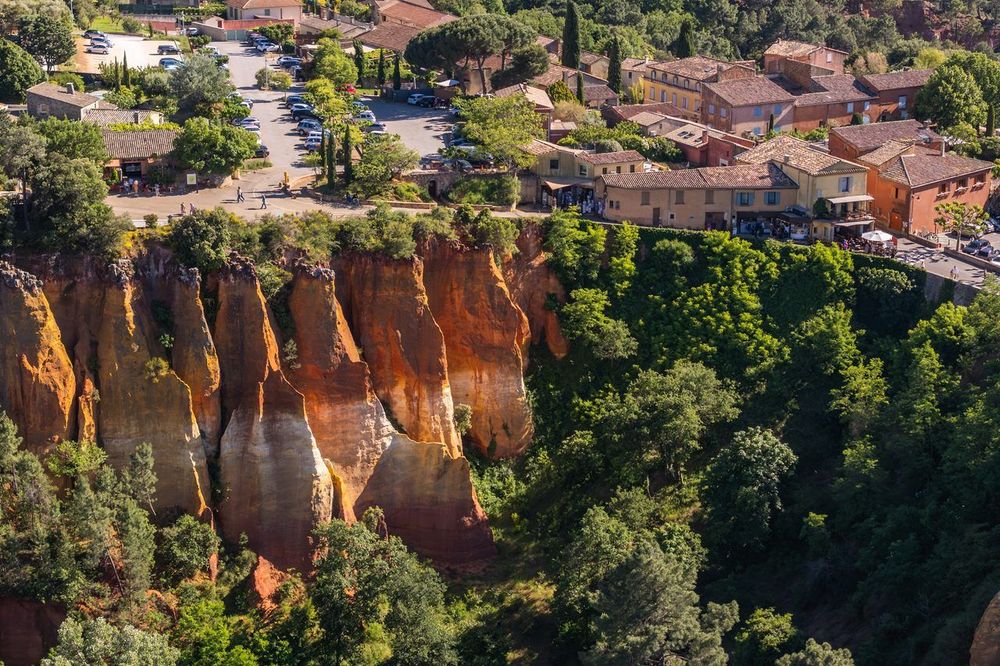
At seven in the morning, Roussillon's facades shift from deep red to burnt orange depending on the sun's angle. The raking light of the Luberon has been doing this work for centuries: turning a village of 1,300 inhabitants into a living painting that is hard to forget. To help you plan your stay in the best possible conditions, this Roussillon travel guide covers everything you need: the two circuits of the Sentier des Ocres and their exact prices, viewpoints that few visitors know about, an honest answer to the "Roussillon or Gordes" question, the best times to avoid the crowds, and the best day trips within a 30 km radius.
This guide also reveals details that most sites never mention: 30-metre spires sculpted by water in the old quarries, free parking throughout the winter, an informal path that bypasses the ticket office to see the cliffs from below, and the fact that Samuel Beckett wrote his novel Watt in this village during the Second World War. Before you go, note that the Ryo app offers audio-guided tours in several cities in the South of France, useful for planning an itinerary that goes beyond the Luberon.
Why Roussillon Is a Must-See Stop in Provence
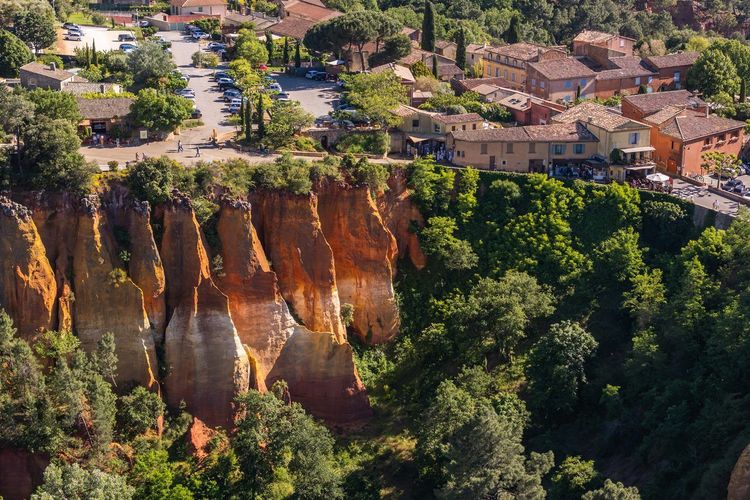
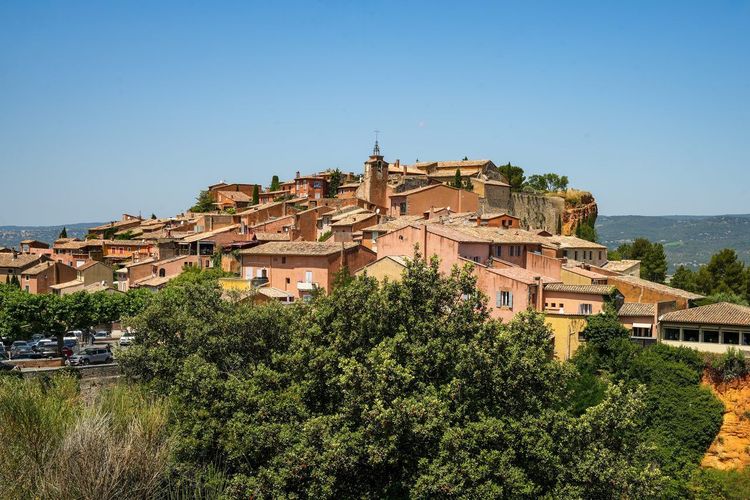
Before exploring Roussillon in detail, it helps to understand where its colour comes from. Roussillon owes its unique character to a rare geology: the subsoil of the area is one of the most significant ochre deposits in Europe, with more than 17 different shades ranging from straw yellow to ox-blood red, passing through chocolate brown and burnt orange. This is not a coat of paint applied for decoration: the village buildings are plastered directly with local earth, a tradition rooted here since the 17th century.
Industrial ochre extraction shaped the local economy until the Second World War, when synthetic pigments caused the market to collapse. The old quarries, processing plants, and landscapes carved out by mining have since become, by a curious twist of history, the village's main tourist attractions today.
Roussillon holds the "Plus Beaux Villages de France" label and welcomes around 700,000 visitors each year, making it one of the most visited villages in Provence after Gordes. This figure explains why the time you choose to arrive can radically change the experience: getting your visit to Roussillon right often comes down to that single detail — arriving at 9:30 a.m. or at 11:30 a.m. makes for two almost entirely different visits.
For lovers of literary history, here is a detail that often flies under the radar: the writer Samuel Beckett stayed in Roussillon during the Occupation and wrote his novel Watt here, while working as a farm labourer to escape the Gestapo. The village and its ochre quarries are also evoked in Waiting for Godot, which he would write a few years later: the character Vladimir mentions the grape harvest done "chez Bonnelly", the name of the family that sheltered him here.
The Heart of the Village: Ochre Lanes and the Place de la Mairie
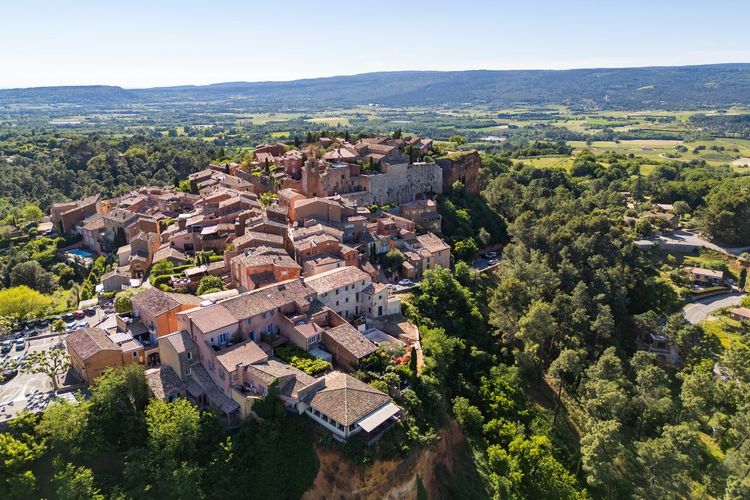
Start your visit to Roussillon from the top: park at the upper village car park (paid in season, see the practical section) and walk into the historic village. The first surprise is sensory: ochre colours not only the facades but also the lane surfaces, the flower pots on windowsills, and sometimes the concrete of the steps. This is not a tourist set-piece — residents do genuinely paint their homes in traditional shades, and local planning rules govern which colours are permitted.
The place de la Mairie is the living heart of the village.
Most of the picturesque lanes branch off from this square. Take the lane to the left of the town hall to reach the rue des Bourgades, one of the most photographed streets in the village with its two-tone facades. Craftsmen's shop fronts alternate with character houses, some of which date back to the 16th century.
Heading north through the village, you emerge onto the Rue de l'Arcade, which frames a natural view of the ochre cliffs beyond the rooftops. Photographers set up here in the late afternoon when the light strikes the rock faces at an oblique angle. The composition is simple but hard to miss: the stone arches naturally frame the red hues.
A walking tour of the historic village takes between 45 minutes and 1.5 hours depending on your pace. With children, allow around 2 hours: the nooks, staircases, and passages under archways fascinate the under-10s. The lanes have no official signposted route, which is precisely the point — getting a little lost.
Most shops and galleries open between 10 a.m. and 6:30 p.m. in the summer season, with a frequent closure between 12:30 p.m. and 2 p.m. in July–August. Painting galleries and ceramics workshops are concentrated in the upper part of the village, around rue Auguste Bastide. Some craftspeople offer studio visits by appointment.
The Sentier des Ocres: Two Circuits, Prices, and Practical Tips
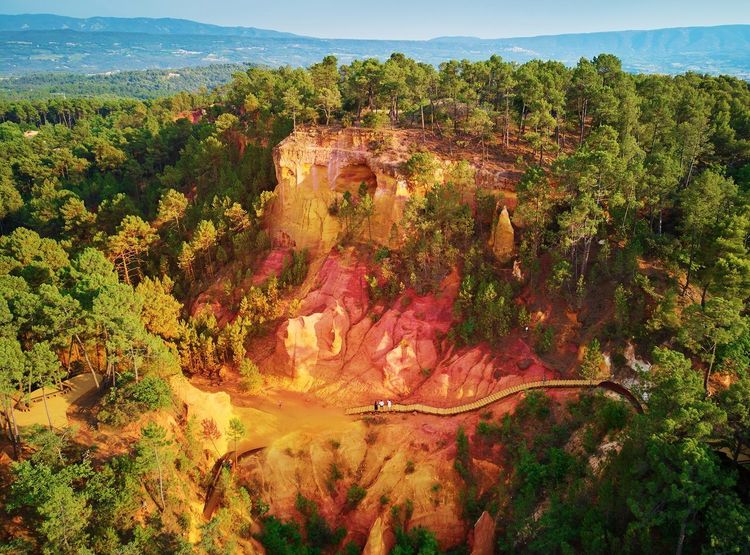
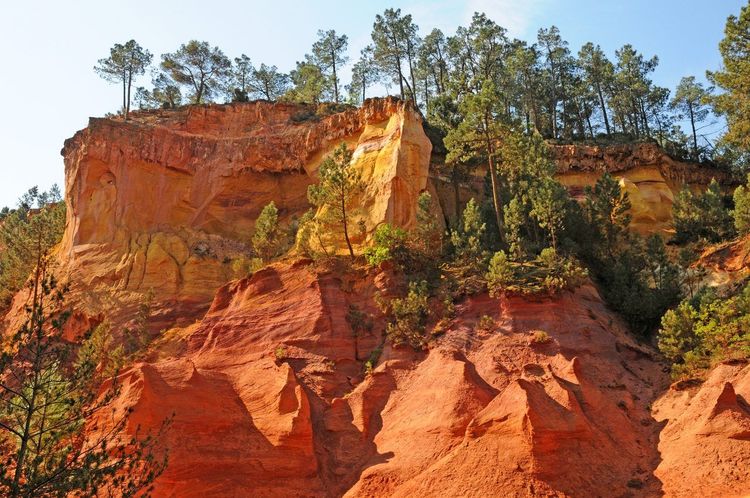
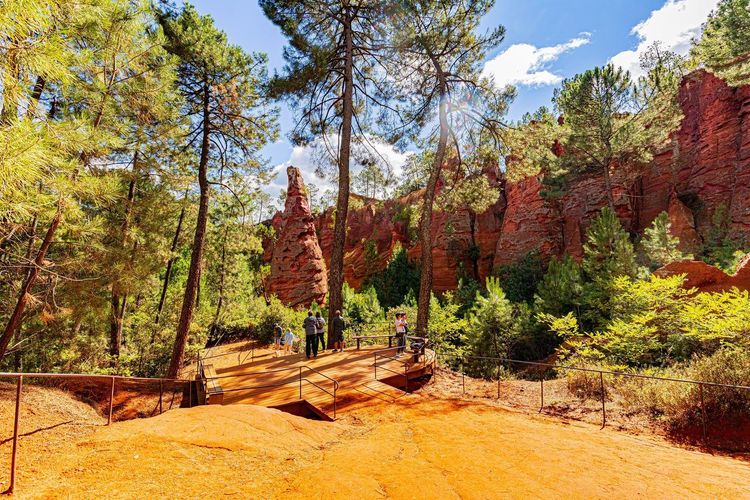
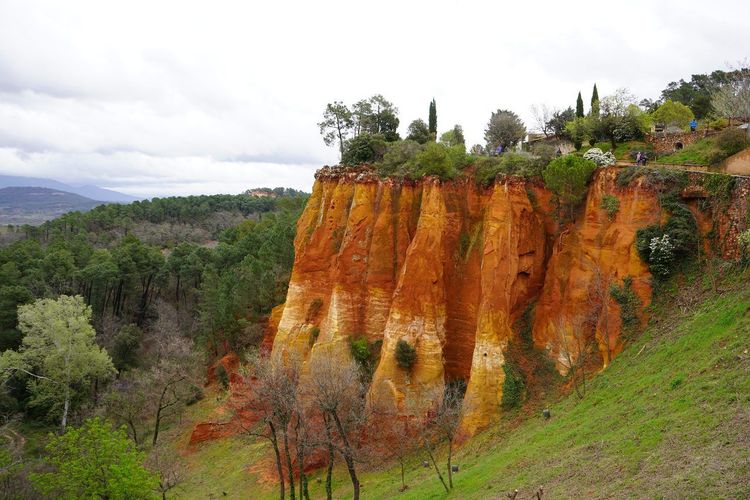
For many, visiting Roussillon means first and foremost this trail. It is the highlight of the visit. The Sentier des Ocres winds through the old ochre quarries amid spectacular formations: rock needles, fairy chimneys, and 30-metre-high coloured cliffs sculpted by water over millennia. Access is from the Castellas car park, to the north-east of the village.
Two circuits to choose from:
- Short circuit (loop A): approximately 1.2 km, allow 30 to 45 minutes. Ideal with young children or if you are short on time. The elevation gain is low and the trail remains accessible without any special equipment.
- Long circuit (loop B): approximately 2.2 km, allow 1 hour to 1 hour 15 minutes, with a few steeper sections. This is the circuit that gives access to the most spectacular formations, including the "ochre needles" and the red cliff overlooking the Luberon valley.
2026 prices:
- Adult (individual ticket): €3.50
- Group rate (15 people or more): €2.50
- Free for children under 10 and people with disabilities
Contrary to a widespread belief, the trail remains paid year-round: there is no free entry in winter. However, all of Roussillon's car parks are free from mid-November to the end of February, making an off-season visit more affordable.
The trail closes in strong winds (mistral) or after heavy rain. On summer days, it can also close temporarily when its visitor capacity is reached, which happens regularly between 11 a.m. and 2 p.m. in July–August. Arriving before 9:30 a.m. or after 4 p.m. avoids this issue and gives you far more flattering light on the ochre.
A few essential precautions before you go: wear closed-toe shoes, as ochre dust is slippery on some damp sections. Avoid white or light-coloured clothing — the pigment works its way into fabric fibres and often resists washing, even at 60°C. Bring water, as there are no refreshment points on the route. In summer, a hat and sunscreen are essential: the ochre ground reflects both heat and light.
The trail opens at 9 a.m. in July–August and closes at 8 p.m. (last entry at 7:30 p.m.). Hours then narrow: 9:30 a.m.–7 p.m. in September, 10 a.m.–6 p.m. in October, then 11 a.m.–4 p.m. from mid-November to December. The last entry is always accepted 30 minutes before closing.
For visitors with reduced mobility: both circuits are difficult to navigate in a wheelchair due to the loose terrain and uneven slopes. A paved path provides partial access from the entrance, but it does not reach the most spectacular rock formations. Check directly with the ticket office for the alternatives available to suit your situation.
Ôkhra: the Ochre Conservatory, between Science and Craftsmanship
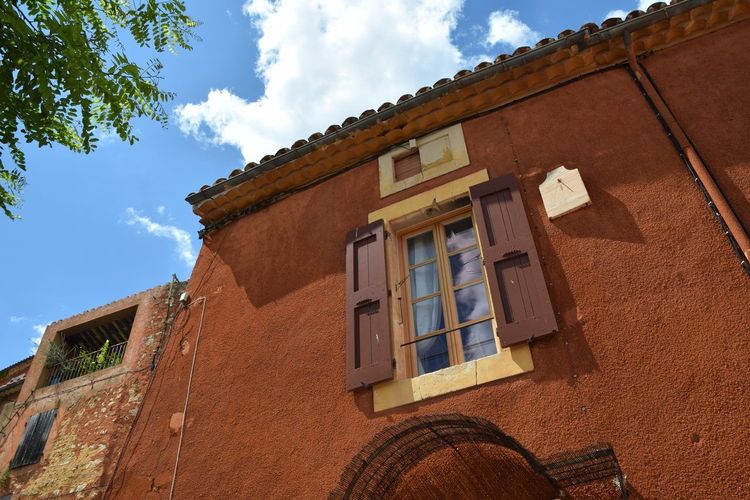
About 2 km from the centre of Roussillon in the direction of Apt (on the D104), Ôkhra occupies the buildings of the former Mathieu factory, one of the last ochre manufacturing plants to have operated in France. This conservatory traces the history of ochre extraction and processing from the artisanal methods of the 17th century to the industrialisation of the 19th.
The visit combines permanent exhibitions on local geology with hands-on workshops: pigment making, natural dyeing techniques, exploration of ochre's chemical properties. The workshops are particularly well suited to children from age 6, and several families spend a full half-day here.
Indicative prices: museum entry around €7.50 (adult), workshops between €15 and €35 depending on the option. Open April to November; closed in winter. Workshop slots should be booked in advance online during high season — do not leave it until the day in July–August.
If you are short on time, the Ôkhra is a lower priority than the Sentier des Ocres. But if you are travelling with curious children or have a passion for craftsmanship and natural materials, this detour is well worth the trip.
The Église Saint-Michel and the Belvedere
At the top of the village stands the église Saint-Michel, a 12th-century Romanesque building with 15th-century Gothic additions. The interior is plain and retains a few original furnishings as well as an 18th-century altarpiece. Entry is free outside of services.
What draws most visitors is not so much the church interior as the belvedere beside it. From this terrace, the panorama takes in the ochre cliffs in the foreground, the scattered hamlets across the Luberon plain, and on a clear day, Mont Ventoux to the north-east. This is the most photographed viewpoint in the village: the natural composition between the red tones of the rock and the green of the pine trees is striking at any hour, but particularly at golden hour.
The belvedere is accessible from the place de la Mairie in under 10 minutes on foot. Head there between 5 p.m. and 7 p.m. in summer to catch the warm light of the setting sun on the cliffs.
Viewpoints from the Immediate Surroundings
The Castrum, the hill on which the village perches, lends itself to several external angles that conventional guides overlook. The road descending towards Apt (D227) offers an interesting low-angle view about 500 metres from the centre: an informal lay-by has formed there where photographers regularly stop to frame the village silhouette from below.
For an even less-frequented angle, follow the path that runs along the base of the cliffs from the Castellas car park. This trail is not officially signposted, but it is easy to find and not subject to the ticketing of the official trail. From here you see the ochre walls from below, which gives a sense of scale radically different from walking along the paid path above.
The colline de la Croix de Provence, about ten minutes on foot from the centre, gives a bird's-eye view over the village rooftops. This path is rarely mentioned in guides, which makes it pleasantly quiet even in the height of August.
The Thursday Market and Local Life
Every Thursday morning, the place de la Mairie and the surrounding streets host the Roussillon market, from around 8 a.m. to 1 p.m. It is a typically Provençal and genuinely local market: seasonal fruit and vegetables, cheeses (fresh goat's cheese from the area, brousse), lavender, garrigue honey, artisan soaps. Not a market of souvenirs made elsewhere, but a real village market where locals do their shopping.
If you are passing through on a Thursday, arrive before 9 a.m.: the best items go quickly and parking becomes difficult after 9:30 a.m. Outside market days, a few delicatessens and wine shops in the village stock local produce, with côtes-du-luberon and luberon as the main appellations.
Roussillon or Gordes: Which One Should You Choose?
Many travellers hesitate when planning their visit to Roussillon: should they choose its neighbour Gordes instead? Gordes (about 11 km away) is larger, more monumental, with a generally more upscale clientele: boutique hotels, gastronomic restaurants, and the Cistercian abbaye de Sénanque 3 km away with its famous lavender fields. Roussillon is more intimate, more colourful, and its ochre trail has no equivalent anywhere else in France.
If you only have one day in the Luberon, do both: morning in Roussillon (Sentier des Ocres from opening, village before 11 a.m.), afternoon in Gordes. The road between the two (D2) passes through landscapes of lavender and holm oaks that deserve a stop in their own right.
If you really must choose one, Roussillon has a more distinctive identity. The ochre cliffs are unique in Europe. Gordes is superb seen from the road; Roussillon rewards a longer stay, and that is all the difference.
Day Trips from Roussillon: Colorado Provençal, Apt, and the Luberon
The Colorado Provençal de Rustrel
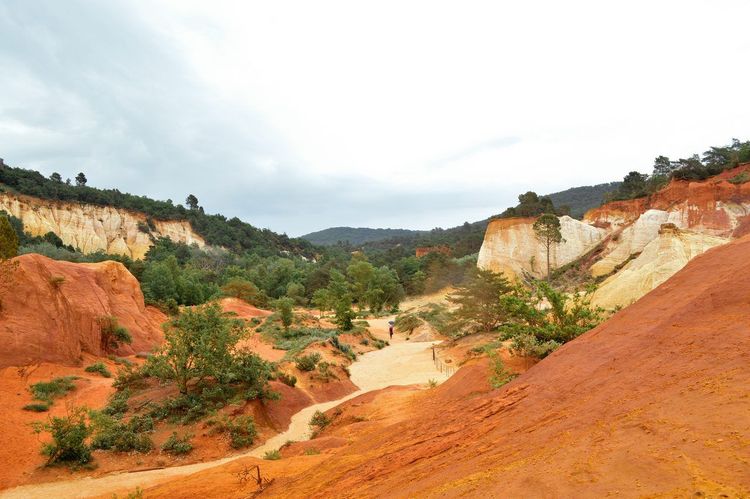
At 15 km from Roussillon (north-east via the D22), the Colorado Provençal is an ochre area even more extensive than the Sentier des Ocres at Roussillon. Far less well known and far less crowded, it offers spectacular scenery with rock formations several dozen metres high: fairy chimneys, walls streaked with red and white, miniature canyons.
Several waymarked trails of 2 to 6 km cross the site. Access is free, with a paid car park at the entrance (around €5). Allow 2 to 3 hours for a comfortable circuit. The site covers several hundred hectares and the scale of the formations exceeds what you see at Roussillon. If you have already done the Sentier des Ocres in the morning, the Colorado Provençal makes an excellent afternoon excursion.
Apt, the Capital of the Luberon
At 11 km from Roussillon, Apt is the main town in the area. Two reasons to make a detour: its Saturday morning market (one of the largest in Provence, with an organic section and local producers who have been there for decades) and its Musée de l'Aventure Industrielle, which traces the regional history of ochre, crystallised fruit, and lavender with collections of vintage machinery.
Apt is also the right place to fill up with petrol before a day of hiking, withdraw cash (Roussillon has no ATM), and find a supermarket if you are preparing a picnic.
Gordes and the Abbaye de Sénanque
At 11 km to the west, Gordes draws visitors for its Renaissance château, its museums, and above all the Cistercian abbaye de Sénanque (3 km away, with its lavender fields that bloom in June–July). Allow 3 to 4 hours to visit both sites comfortably.
If you would like to extend your exploration to other destinations in the South of France, the Ryo audio guides cover many destinations in Provence and the Mediterranean, such as Notre-Dame de la Garde in Marseille or the île de Porquerolles. A way to keep travelling at your own pace, without a guide or a group, after leaving the Luberon.
When to Visit Roussillon and How to Plan Your Day
The best period runs from April to June and from September to October. The weather is pleasant, the light magnificent, and tourist numbers are manageable. July and August are theoretically the most beautiful months (intense blue sky, golden light), but also the busiest: queues at the Sentier des Ocres by 10 a.m., crowded lanes, and car parks that sometimes fill up by 9:30 a.m.
In November and March, the colours of the cliffs are less vibrant but the atmosphere is incomparable: the village regains its authentic character, parking is free, and you will often be alone in front of the rock formations. The mornings can be brisk, but afternoons generally remain mild in this corner of Provence.
Sample itinerary for a full day: this Roussillon visit plan distils the ideal itinerary.
- 8:45 a.m.: arrive at the Castellas car park before the crowds
- 9:00 a.m.: Sentier des Ocres from opening time; choose the long circuit if you have the energy
- 10:30 a.m.: stroll through the lanes of the historic village
- 11:30 a.m.: climb to the belvedere of the église Saint-Michel
- 12:30 p.m.: lunch on a terrace or a picnic in the green spaces at the foot of the village
- 2:30 p.m.: visit the Ôkhra or head towards Gordes / Colorado Provençal
- 5:00 p.m.: return to the belvedere for the late-afternoon light
Allow at least 3 hours for an express visit including the trail and a tour of the village. A full day (6 to 7 hours) allows you to add the Ôkhra and an excursion in the surrounding area.
How to Get to Roussillon
Planning your visit to Roussillon starts with choosing your mode of transport.
By car: Roussillon is accessible from Apt (11 km, D227) or from Gordes (11 km, D2). From Avignon, allow 1 hour 15 minutes. From Aix-en-Provence, 1 hour 30 minutes. From Marseille, around 1 hour 45 minutes.
Two paid car parks serve the village:
- Castellas car park (north-east, direct access to the Sentier des Ocres): around €5 per day
- Lower car park (southern entrance to the village): around €4 per day
In July–August, both car parks are often full before 10 a.m. Arrive early or use the informal parking areas on secondary roads within a 500 m radius of the village.
By public transport: the Zou! line no. 15 coach service connects Apt to Roussillon Monday to Saturday, with a few return journeys per day. From Avignon, you need to change at Apt. Practical for travellers without a car, but timetables are limited outside the summer season. Check the Zou Mobilités website before you go for up-to-date schedules.
By bike: the roads between Roussillon and Apt (D227) or Gordes (D2) are suitable for road cycling, but the gradients are steep. An electric bike, available to hire in Apt from several providers, is an excellent option for this terrain.
Where to Eat and Where to Stay in Roussillon
After a day visiting Roussillon's ochre cliffs and winding lanes, it is time for the pleasures of the table and some well-earned rest.
Restaurants
The village has a handful of establishments; quality varies and prices reflect the tourist clientele in high season.
Le Bistrot de Roussillon, on the place de la Mairie, offers Provençal brasserie cuisine — fresh salads, spelt soup, dishes slow-cooked with thyme and lavender — at reasonable prices for the area (lunch menu around €18–22). The terrace overlooking the square is one of the most pleasant spots in the village for lunch.
Le David is slightly off the most touristy lanes, making it a quieter option. Refined Provençal cuisine, a fine selection of local wines (côtes-du-luberon, luberon), menu around €28–35. Reservations recommended in July–August.
For a quick and affordable meal, several delis and artisan shops around the place de la Mairie offer sandwiches, cheeses, and Provençal specialities to take away.
Accommodation
The village's hotel offering is limited in number but high in quality.
The Mas de Garrigon (Route de Saint-Saturnin-lès-Apt, 84220 Roussillon, rated 4.8/5 on Google from 151 reviews) (2 km from the centre) is the most highly regarded in the area: a charming Provençal farmhouse with a pool, a flower-filled garden, and bistronomic cuisine inspired by local produce. Expect €180–280 per night in high season.
For tighter budgets, there are numerous guesthouses in the area, generally excellent (€60–100 per night). Apt has a wider choice of 2–3 star hotels at more accessible prices. In summer, book at least 6 weeks in advance for the whole Luberon area — accommodation goes very quickly in July.
FAQ
How Long Does It Take to Visit Roussillon?
Allow at least 3 hours for an express visit including the Sentier des Ocres and a quick tour of the historic village. A full day (6 to 7 hours) will let you walk both trail circuits, stroll through the lanes, climb to the viewpoint, and visit the Ôkhra. If you want to combine Roussillon with Gordes and the Colorado Provençal de Rustrel, plan two days in the area.
Is There an Entrance Fee for Roussillon Village?
No, strolling through the historic village is entirely free. However, access to the Sentier des Ocres is paid (€3.50 per adult, free for children under 10). Entry to the Ôkhra is also paid (around €7.50). Parking is paid in high season (€4–5 per vehicle), but free from mid-November to the end of February. The Sentier des Ocres, however, remains paid year-round.
What Is the Best Time to Visit Roussillon?
April–June and September–October offer the best balance of weather and crowd levels. In July–August, the village is very busy and car parks sometimes fill up by 9:30 a.m. From November to March, the village car parks are free and Roussillon regains a more authentic atmosphere, though some restaurants and the Ôkhra may be closed. Check opening hours before you go.
Can You Do the Sentier des Ocres with Young Children?
Yes. The short circuit (1.2 km, 35–45 min) is suitable from age 3–4 with good closed-toe shoes. It has little elevation change and the tricky sections are limited. The long circuit is not recommended for children under 6 due to some steep passages. In both cases, dress children in clothes you do not mind getting stained with ochre — the pigments work their way into fabric fibres.
Do You Need to Book in Advance to Visit Roussillon?
Visiting the village and the Sentier des Ocres requires no reservation — you pay at the entrance. However, in July–August, the Sentier des Ocres can temporarily close when its visitor capacity is reached: arrive before 9:30 a.m. to be sure of entering without a wait. Ôkhra workshops should be booked in advance online via their official website.
Where Can You Park in Roussillon?
Two paid car parks serve the village: the Castellas car park to the north-east (direct access to the trail, ~€5/day) and the lower car park to the south (~€4/day). In high season, arrive before 9:30 a.m. or after 4 p.m. to find a space without waiting. Informal parking exists on secondary roads within a 500 m radius. Avoid parking on the verges of main roads: fines are regularly issued in season.
Conclusion
Roussillon is not a village you can rush through. Its ochre cliffs, two-tone lanes, and trail carved into coloured rock demand time, and a little goodwill to arrive early in the morning while the crowds are still asleep. Getting your visit to Roussillon right means first accepting this slow pace. That very demand is also what sets it apart from most "picturesque villages" in Provence: here, the beauty is mineral, physical, almost raw. It is well worth lingering over.
To explore other destinations in the South of France after your stay in the Luberon, our Ryo app offers audio-guided tours in many cities across the region. Ryo tours let you discover the history and secrets of each place at your own pace, without a guide or a group, with audio commentary crafted by people passionate about the places they cover.