
Créé par Emilie, le 7 mai 2026
Votre guide Ryo
© Shutterstock
This district built during the time when the German Empire had taken over Alsace, became an extension of the city of Strasbourg just before the beginning of the 20th century.
The imperial quarter is a must-see of the city, it presents a dense heritage that will delight history and architecture enthusiasts, or simply, the curious. The Prussians saw in this district a way to show their power and their capacity to modernize spaces.
By visiting this typical district of the city of Strasbourg, you will discover vast avenues, immense squares, an environment that wanted to be airy and gigantic. But also buildings in neo-Renaissance and neo-baroque style, but also in Art Nouveau style, among others.
Listed as a UNESCO World Heritage Site, the Neustadt will surprise you with its extravagances and remains among the last illustrations of what German architecture could represent at the end of the 19th century.
The Neustadt, which means the new town, should be planned in your travel diary when you visit Strasbourg.
Why was the Neustadt built?
Following the war between France and Prussia which ended in 1870, 3 of the 4 suburbs were destroyed within the city itself. Everything had to be rebuilt, and at the same time, take care of the extension of the city of Strasbourg which had been in project for many years and which came back to the forefront at the request of companies that needed adapted infrastructures (station, port, large avenues facilitating circulation...).
As for the Prussian Empire, it sees in this project the means to make Strasbourg an object of propaganda to the glory of German power. A political showcase that Alsatians and French could discover by visiting the "little Berlin" which was already the regional capital of economic and political affairs. It would take 40 years to build all the buildings and infrastructures of the new city according to the urban architecture of the German Empire.
A style that has strictly nothing to do with the Alsatian style of the historic heart of Strasbourg with its very colorful half-timbered facades. However, there is a little Haussmannian air in its wide avenues.
- The official buildings were built first from 1880 to 1900.
- Housing would take more time to emerge and would still be under construction after 1920.
What to visit in the Neustadt?
The Neustadt district was built on a total surface of more than 300 hectares and includes nearly 12,000 buildings with economic, administrative, university and residential functions.
There are 48 sites to visit, between buildings and gardens, military and religious monuments. Here is a non-exhaustive list of places to visit in the Neustadt:
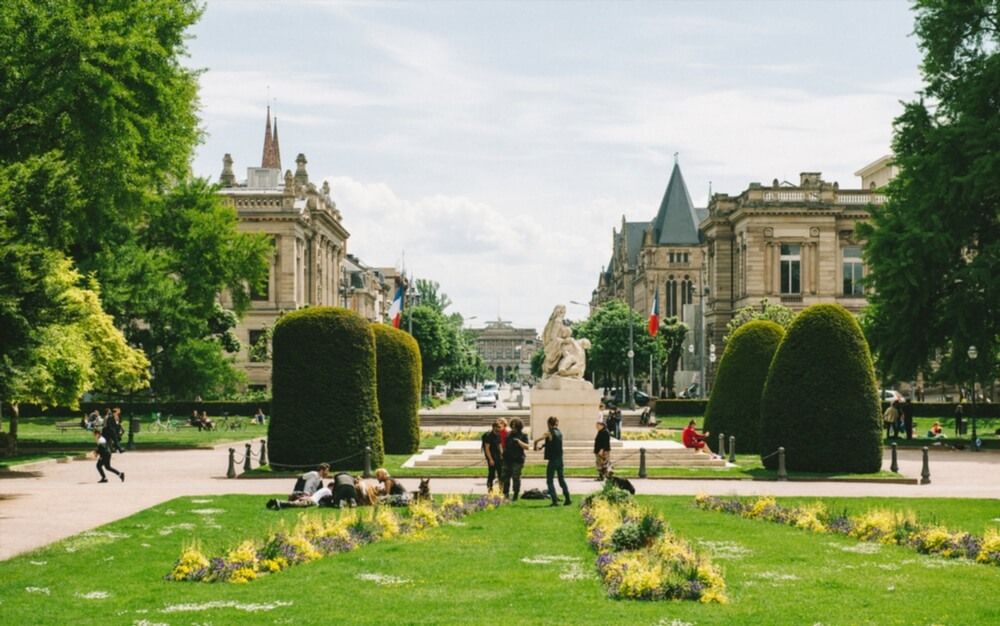
1 – Place de la République
Built to represent the new power in place, it brings together all the official buildings. The French garden in slight gradient highlights the scenography aimed at enhancing the neighboring buildings: the Palais du Rhin, the Théâtre National de Strasbourg...
In 1918, the emperor's statue was replaced by a war memorial that pays tribute to soldiers who fell during the war without indicating their nationality.
2 – The Palais du Rhin
Dominating the Place de République in Strasbourg, it is easily recognizable by its dome covered with tiles and its gigantic porch.
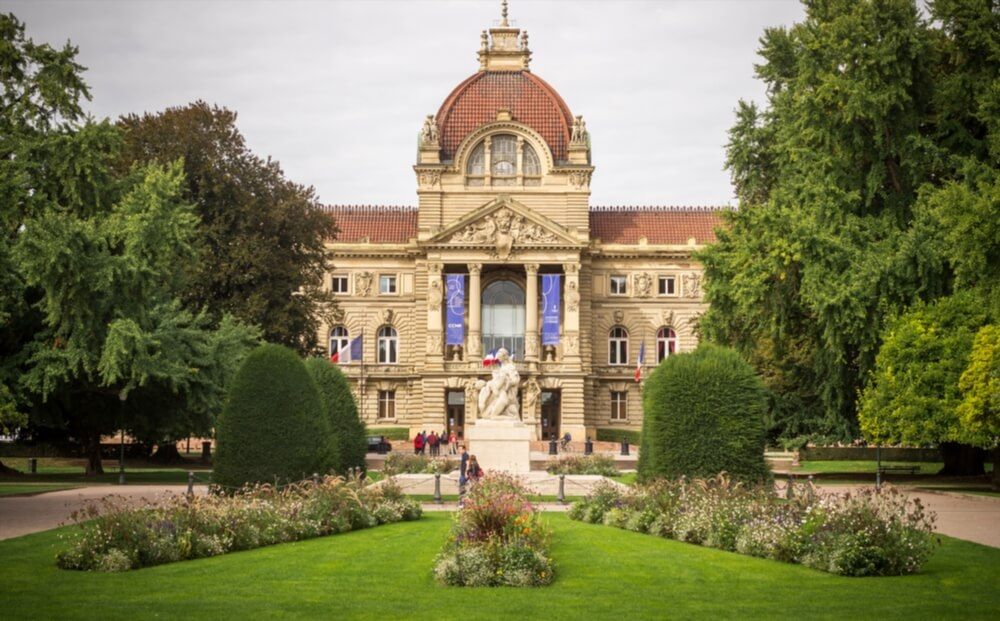
High place of residence of the imperial family, many receptions were given there in the past, today, it is the headquarters of the Regional Directorate of Cultural Affairs of Grand Est and the Central Commission for Navigation on the Rhine.
Several styles are recognizable on this building: Florentine Renaissance and Baroque, notably. As an annex, there are the former imperial stables which could accommodate up to 18 horses.
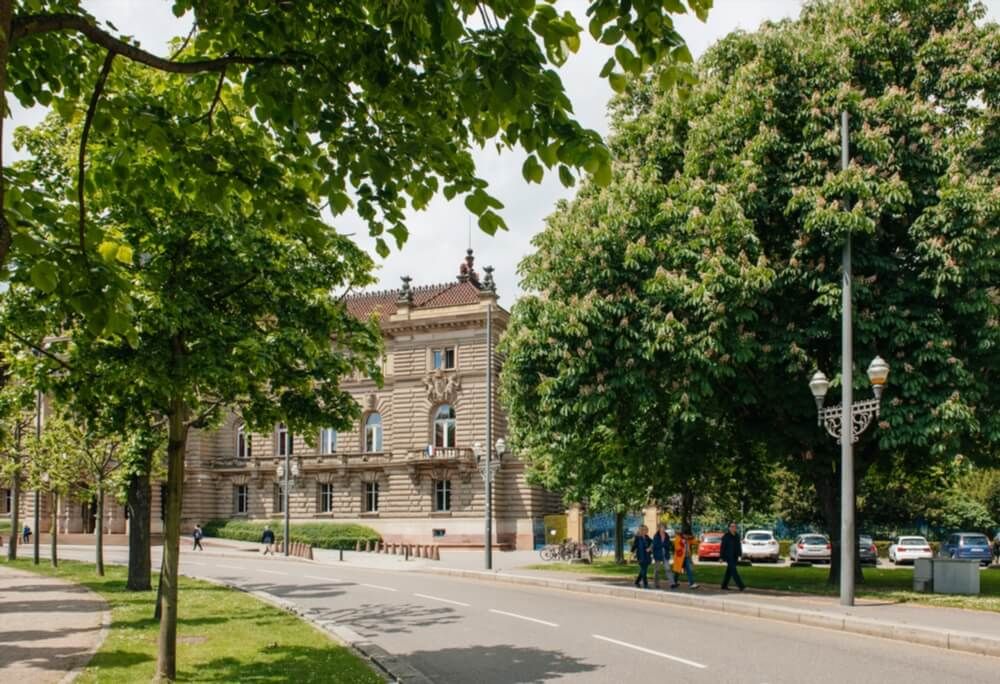
3 – The National and University Library
A massive glass dome is located above the reading room, this neo-classical style dome, like the rest of the building, has been completely modernized inside, which creates a quite stunning contrast.
It is ranked the 2nd university library in France in terms of quantity of books.
4 – The Théâtre National de Strasbourg
Previously occupied by the various administrative services of the Land, it is the Music Conservatory that will take possession of the premises after the 1st world conflict.
The 1957 extension will give the possibility for the Centre Dramatique de l'Est to settle there before becoming, in 1968, the Théâtre National de Strasbourg.
5 – Avenue de la Liberté
This avenue is reminiscent of the Champs Élysées with its wide axis, its 300 m length, its private mansions, and the monuments that border it.
To see on the avenue:
- The customs directorate: a pink sandstone building from the Vosges in Florentine style uncommon in the city of Strasbourg.
- The Post Office Hotel: neo-gothic style, it contrasts with the renaissance style already very present in the surroundings.
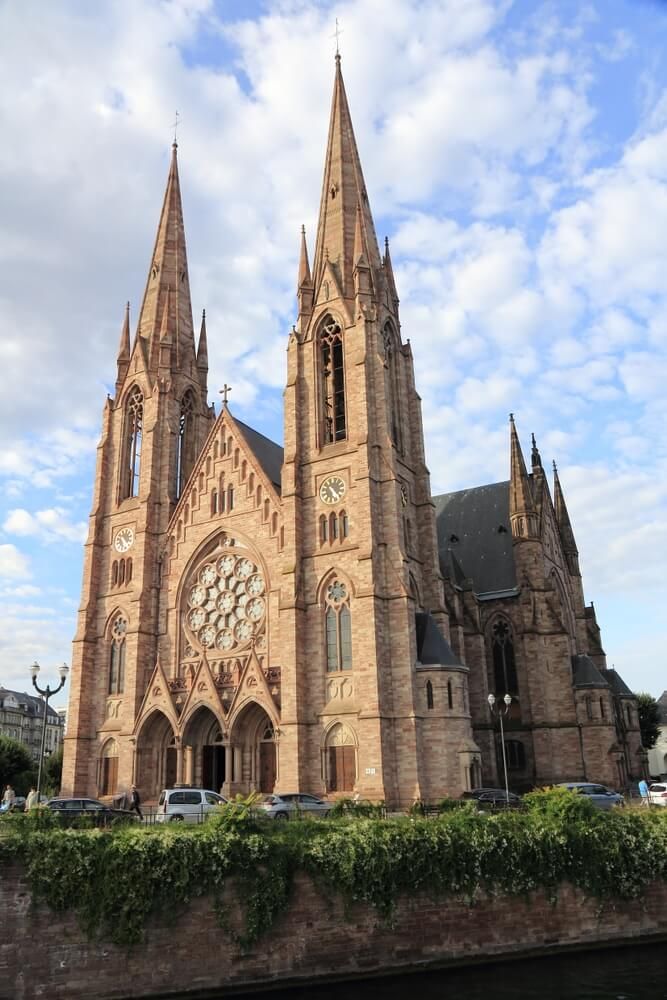
6 – Saint-Paul Protestant Church
Surrounded by the Ill and the Aar, it intrigues with its 15 doors and the fact that it was once a German garrison church, to discover...
7 – Saint-Maurice Catholic Church
Visible from afar, it was the Catholic garrison church of the city, the stained glass windows are magnificent, as well as the paintings and the 2 remarkably sculpted altarpieces.
8 – The University Palace
In Italian Renaissance style, 36 statues of scholars and scientists mainly German dominate the summits of the pavilions, an inner courtyard is surrounded by galleries on which rests an imposing glass roof.
9 – The Botanical Garden
3.5 hectares of experiments conducted by the botanical institute on no less than 6,000 plants, the Bary greenhouse has been classified as a historical monument.
10 – The Observatory
Its immense dome houses a 7-meter telescope, and since 1982, a planetarium with hemispherical screen reproducing the starry sky, a fun way to discover all the secrets of the cosmos.
11 – The Municipal Baths
2 swimming pools, showers and Roman baths in an absolutely magnificent neo-classical and neo-baroque style building: marble, stained glass, copper and antique decorations that you will only find very rarely in municipal swimming pools! Wellness and care space for guaranteed moments of relaxation.
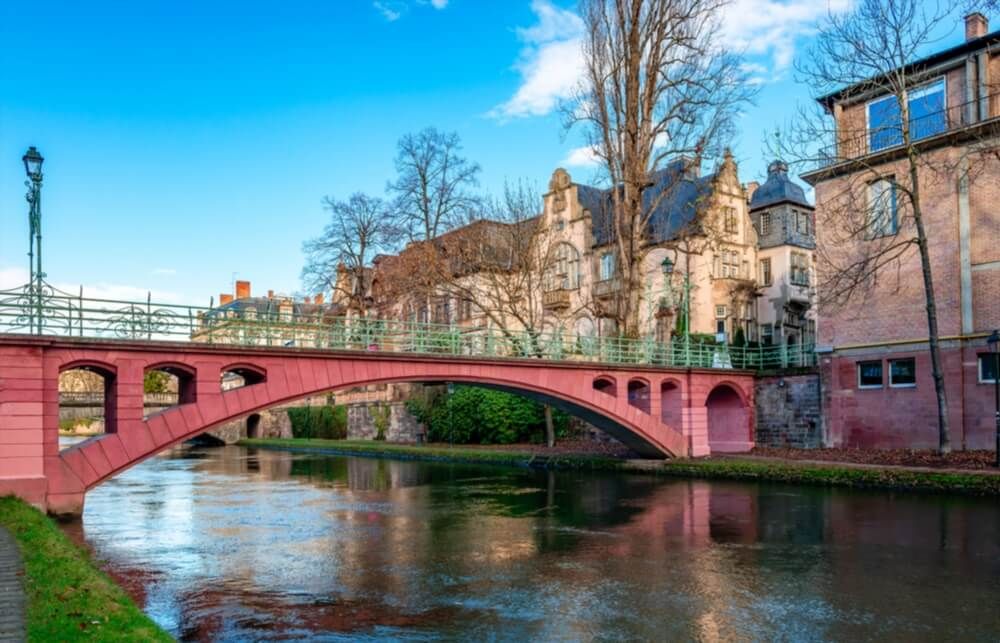
12 – The Bridges
- The theater bridge,
- The Jews' footbridge,
- The foundry bridge and its surroundings...
13 – The Tomi Ungerer Museum
Children's, political, advertising, satirical drawings and mechanical toys, board games, lead soldiers... 14,000 drawings and 1,500 toys exhibited for the pleasure of young and old.