
Créé par Romane, le 7 mai 2026
Votre guide Ryo
© Shutterstock
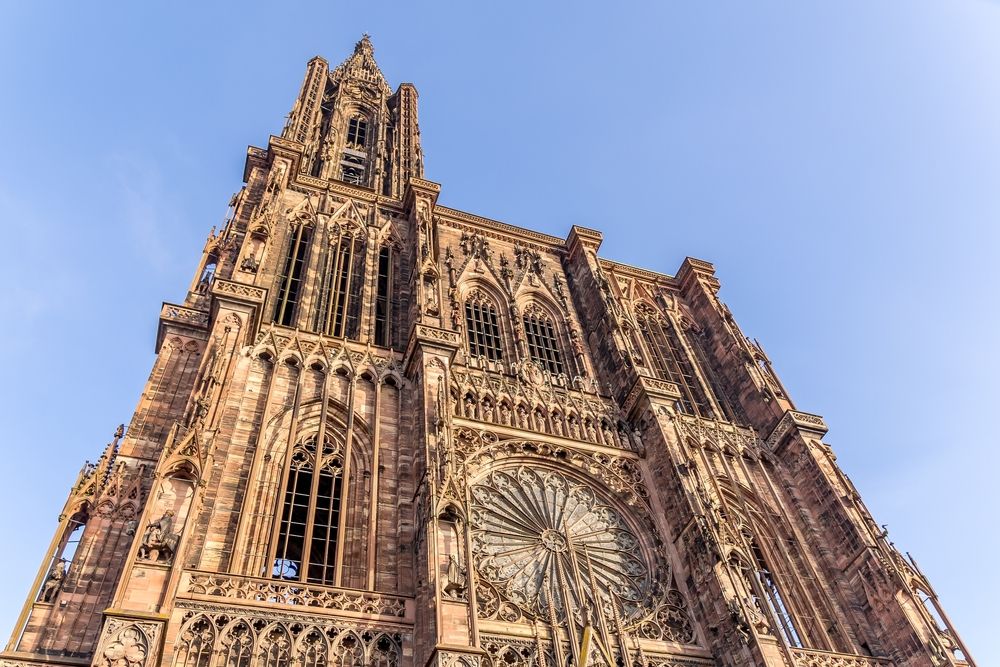
Absolute symbol of Visit Strasbourg, Notre-Dame de Strasbourg Cathedral stands as one of the most striking masterpieces of medieval Gothic architecture. Built in pink sandstone from the Vosges over more than four centuries, it reaches 142 meters high and remains one of Europe's most slender spires. Each year, it welcomes nearly 4 million visitors, captivated by its sculpted portals, flamboyant stained glass windows, legendary astronomical clock and panoramic platform offering breathtaking views over the Alsace plain. Visiting Strasbourg Cathedral means diving into the heart of a thousand-year history, between faith, art and architectural prowess, all in the heart of one of France's best-preserved historic districts.
1. History and construction of Strasbourg Cathedral
The history of Strasbourg Cathedral is that of a monumental construction site that spanned more than four centuries, making this monument a unique witness to the architectural transformations of the Middle Ages. It all began in 1015, under the initiative of Bishop Werner de Habsbourg, who laid the foundations of a first Romanesque cathedral on the banks of the Ill. From this initial Romanesque period, little more than the crypt and the ground plan survive today, true buried memory of the original building.
From the middle of the 12th century, builders resumed work in an emerging Gothic style. The nave and choir still testify to this transition between the two styles, with their slender proportions and search for light characteristic of Gothic art. It was in the 13th century that the construction truly took off under the impetus of master builder Erwin de Steinbach, whose mysterious statue on the southern façade seems still to watch over his work. The western façade, considered one of the summits of flamboyant Gothic art, was completed in the early 15th century.
The building gets its characteristic pink hue from Vosges sandstone, extracted from local quarries for centuries. This stone, which varies from pinkish brown to orange red depending on the light, gives the cathedral a unique atmosphere, intensifying its nuances at sunrise and sunset to offer a magical spectacle to visitors. In 1439, the spire was finally completed at 142 meters high, making Strasbourg Cathedral the highest construction in the Christian world, a record it would hold until 1647. The cathedral would subsequently be the theater of European history, surviving wars, reforms and revolutions, to establish itself today as an inseparable symbol of Alsatian identity.
2. The western façade: sculpted portals and rose window
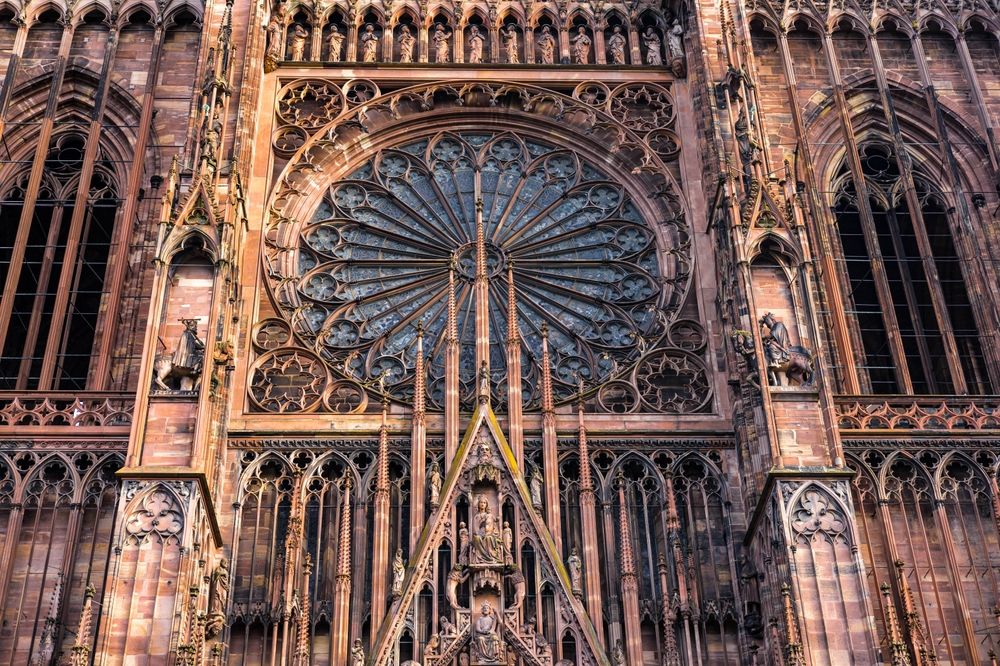
The first impression produced by Notre-Dame de Strasbourg Cathedral (Place de la Cathédrale, 67000 Strasbourg, rated 4.8/5 on Google for over 75,900 reviews) is that of stone lacework of almost unreal finesse. The western façade, considered one of the most beautiful in the Gothic world, impresses with the richness and minuteness of its sculptures. It is organized around three monumental portals, each dedicated to a specific biblical theme. The central portal is dedicated to Christ and the Last Judgment, while the lateral portals illustrate scenes from the Old Testament and the life of the Virgin Mary. The hundreds of statues and bas-reliefs that adorn these portals constitute a true catechism in stone, testimony to the ingenuity of medieval sculptors.
At the center of this façade stands the western rose window, absolute masterpiece of rayonnant Gothic art dating from the 13th century. With its sixteen large petals and its brightly colored stained glass, it filters light from the west to project inside the cathedral a kaleidoscope of tints that changes throughout the hours. Symbolizing divine perfection by its circular form and radiating motifs, this rose window is one of the largest and best preserved in France. Simply stand on the square opposite to understand why Victor Hugo called this building a "marvel of the gigantic and the delicate."
Don't miss either the Gothic spire that soars 142 meters above the ground. Completed in 1439 after several decades of work, it is the result of an unprecedented architectural feat. Its flying buttresses and openwork galleries give the impression that the stone itself defies gravity. From certain points in the historic center — notably from the terraces of Barrage Vauban — the cathedral's summit stands out against the sky like gigantic lacework.
3. The cathedral interior: treasures not to be missed
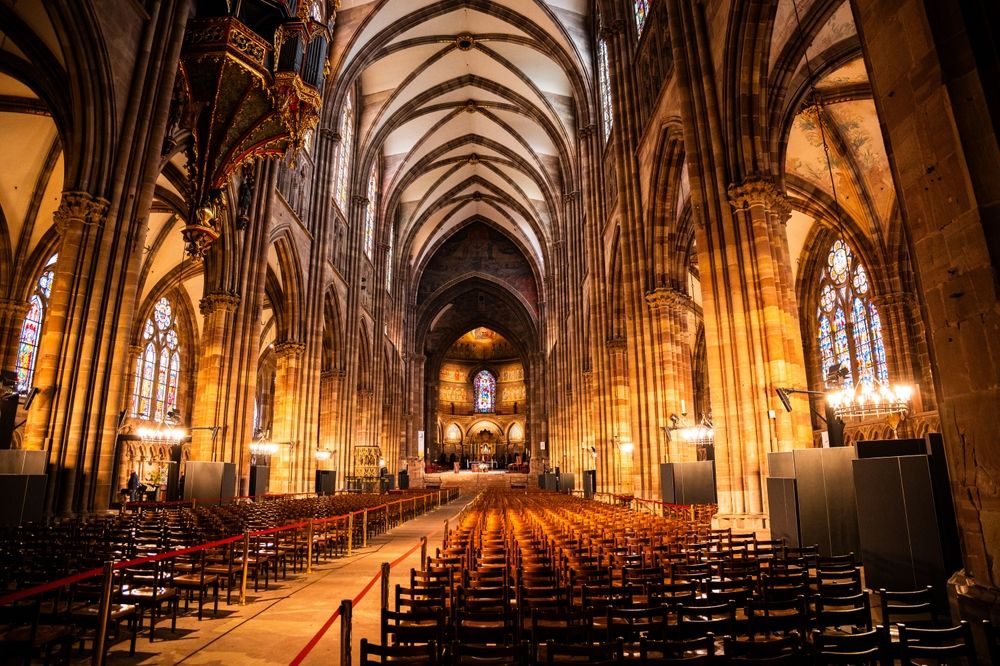
Crossing the threshold of Strasbourg Cathedral means entering another world. The interior of the building, with its soaring nave of 62 meters long, exudes a striking solemnity. The Gothic vaults rise to a dizzying height, while light filtered through hundreds of stained glass windows bathes the whole in an unreal atmosphere. Here are the highlights of this interior visit.
3.1. The Pillar of Angels
Located in the south transept, the Pillar of Angels is undoubtedly the cathedral's most famous sculptural masterpiece. Dating from the middle of the 13th century and rising to 18 meters, it represents on four superimposed levels the scene of the Last Judgment, with twelve figures of angels sounding trumpets and four evangelists bearing the symbols of their gospels. The elegance of proportions, fineness of drapery and expressiveness of faces make this column one of the summits of world Gothic sculpture. A popular legend claims that if this pillar is moved, the entire cathedral would collapse — testimony to its symbolic as well as structural importance within the building.
3.2. Stained glass windows and nave
The central nave and its side aisles house an exceptional collection of stained glass covering more than 600 m² of glazed surfaces. Some date back to the 12th century, making this glazing panorama one of the oldest and best preserved in France. During World War II, several of these stained glass windows had been carefully dismantled and secured to protect them from bombing — a decision that saved priceless treasures. Today reinstalled in their original setting, they spread floods of colored light throughout the cathedral that vary according to hours and seasons, offering each visit a unique spectacle.
3.3. Geiler's pulpit
Near the north pillar of the nave, Geiler's pulpit, completed in 1485, is another jewel of late Gothic style. It was designed to honor Jean Geiler de Kaysersberg, famous Strasbourg preacher of the late Middle Ages whose sermons attracted considerable crowds. Its delicate sculptures and minute reliefs testify to the concern for excellence of Alsatian craftsmen of the time. The pulpit is adorned with a dog sculpted at its base — animal symbol of fidelity, companion of the preacher — a delightful detail that delights attentive visitors.
3.4. The Virgin at the Pillar statue
In the south side aisle, the statue of the Virgin at the Pillar, dating from the 13th century, constitutes one of the cathedral's most venerated elements. Sculpted in pink sandstone from the Vosges, it represents Mary carrying the infant Jesus in a posture full of tenderness and serenity. Her gentle expression and delicate posture are characteristic of the Gothic sensibility of this era. Long an object of popular devotion, it continues to occupy a central place in local piety and constitutes one of the essential stops during the visit.
3.5. The suspended organ
Perched on a tribune fixed high on the nave wall, the suspended organ is a unique architectural and musical curiosity. Installed in the 15th century, this ingenious device frees floor space while guaranteeing remarkable acoustics. Its richly sculpted buffet, with its polychrome figures and finely worked vegetal motifs, makes it a work of art in its own right. During concerts and liturgical ceremonies, its powerful sounds spread throughout the nave with striking amplitude — an acoustic experience that music lovers would not miss for anything in the world.
Let yourself be guided through all these treasures thanks to the Ryo audio-guided circuit to visit Strasbourg, which will allow you to discover the cathedral and the riches of the historic center in complete autonomy, at your own pace.
4. The astronomical clock of Strasbourg Cathedral
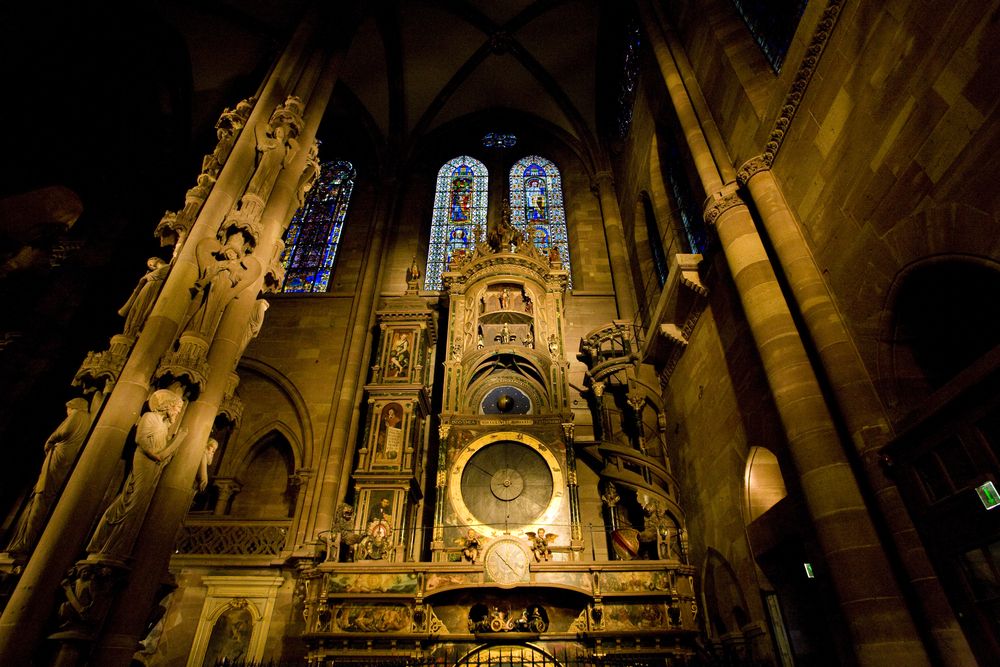
Undoubtedly the most famous attraction of Strasbourg Cathedral, the astronomical clock (17 Pl. de la Cathédrale CEDEX, 67082 Strasbourg, rated 4.5/5 on Google for 323 reviews) is a true masterpiece of mechanical and artistic ingenuity. Third astronomical clock to occupy this location in the south transept, the current clock was completed in 1843 under the direction of Alsatian clockmaker Jean-Baptiste Schwilgué. It contains more than 30,000 mechanical parts — gears, automata, astronomical dials — for a result of breathtaking precision and iconographic richness.
Its multiple dials simultaneously indicate legal and solar time, the day of the week represented by Roman gods from Antiquity, the day of the month, month, year, mobile and fixed feasts of the liturgical calendar, as well as the position of planets, phases of the Moon and even eclipses. Every quarter hour, the four periods of life — childhood, adolescence, adulthood and old age — advance to strike the chimes. The great anticipated moment takes place at 12:30 PM: the twelve apostles parade before Christ who blesses them, while the rooster crows three times — a mechanical spectacle of remarkable precision that brings together a crowd of amazed visitors each day.
Access to the apostles' parade is paid (about €4) and places are limited to 50 people per session. It is strongly recommended to arrive early in the morning to buy your ticket at the cathedral entrance, Place du Château side.
5. The panoramic platform: climbing to the top of the cathedral
For those seeking a unique perspective on Strasbourg and the Alsace plain, climbing to the cathedral's panoramic platform is an unforgettable experience. After climbing 330 steps through the galleries and walkways of the north tower, you emerge 66 meters high onto a terrace that embraces a 360° panorama of Alsatian rooftops, the meanders of the Ill, the Black Forest to the east and the crests of the Vosges to the west. In clear weather, the gaze can even reach the Alps. The cathedral's unique spire rises just meters from you, in all its stone lacework, offering an unprecedented perspective on the mastery of medieval builders.
The ascent is not effortless: the stairs are narrow and steep, and good physical condition is required. Access is limited to 50 people simultaneously. The platform ticket (about €8) is purchased at the separate entrance, Place du Château side. In summer (April to September), the platform is accessible from 9:30 AM to 8 PM (last ascent at 7:30 PM); in winter (October to March), from 10 AM to 6 PM (last ascent at 5:30 PM). To avoid queues, prefer a weekday visit, in the morning from opening.
To complete your discovery of Strasbourg from above, know that the panoramic terraces of Barrage Vauban also offer a beautiful view of the cathedral and Petite France — an ideal complement to your visit, which you will find on the Ryo audio-guided circuit of Strasbourg.
6. The cathedral crypt and treasury
Beneath the cathedral choir lies a Romanesque crypt dating back to the 11th-century foundations. Its low vaults and muffled atmosphere plunge visitors into an atmosphere of contemplation and ancient history. This is where the oldest heart of the building beats, where it all began in 1015 under Bishop Werner. The crypt also houses the cathedral treasury, a collection of liturgical pieces of inestimable value: medieval reliquaries, priestly vestments embroidered with gold and silk, carved ivories, illuminated manuscripts and other testimonies to the devotion and wealth of the Strasbourg Church over the centuries. The crypt visit takes place during specific visits organized by the pastoral team — check the cathedral's official website for dates and times.
7. Opening hours, prices and practical access
Visiting Strasbourg Cathedral is widely accessible, as entry to the nave is completely free. Here is the practical information to know before your visit.
7.1. Opening hours
The cathedral is open year-round, Monday to Saturday from 8:30 AM to 11:15 AM and from 12:45 PM to 5:45 PM; Sundays and holidays from 2:00 PM to 5:15 PM. During the Christmas market period, extended hours are in effect on the Place du Château side (Monday to Saturday from 8:30 AM to 5:45 PM without interruption). The panoramic platform is accessible daily from April to September from 9:30 AM to 8 PM, and from October to March from 10 AM to 6 PM. Remember to check the hours on the cathedral's official website before your visit, as they may change during particular liturgical events.
7.2. Prices
Access to the nave is free. Access to the astronomical clock's apostles parade is paid (about €4, tickets to be purchased on site). Climbing to the panoramic platform is paid (about €8). Guided tours of the cathedral are offered from €9 per person, and audioguides are available from €5.
7.3. How to access the cathedral?
The cathedral is located in the heart of Strasbourg, at Place de la Cathédrale, 67000 Strasbourg. From Strasbourg station, allow about 15 minutes on foot via Place Kléber. Tram lines A and D serve the Langstross/Grand'Rue stop, 5 minutes walk from the cathedral. By car, Gutenberg and Austerlitz parking lots are closest. Place Gutenberg, one of the city's oldest, is just minutes' walk away.
7.4. Practical tips for your visit
Arrive preferably on weekdays, in the morning from opening, to enjoy the cathedral in relative tranquility — Saturday afternoon is the busiest period. Plan an outfit respectful of the religious character of the place (shoulders and legs covered). Bags are subject to security check at the entrance: travel light to save time. Photography is allowed inside, but without flash and with respect for religious services. For the astronomical clock, anticipate buying tickets from the cathedral's opening.
Download the audio-guided circuit to discover Strasbourg on foot and independently
To miss nothing of Strasbourg during your visit, the Ryo app offers you a complete audio-guided itinerary of 6.6 km for about 2h40 of walking discovery, which takes you from Petite France to Grande Europe via Notre-Dame Cathedral, Maison Kammerzell, Place Gutenberg and many other jewels of the Alsatian capital. Thanks to its 32 playful audio guides and interactive GPS navigation, you let yourself be guided in complete freedom, without worrying about getting lost. Download the circuit before your departure and set off to discover Strasbourg at your own pace!
8. Cathedral surroundings not to be missed
Strasbourg Cathedral is surrounded by an exceptional district that well deserves lingering. In the immediate vicinity of the building, several unmissable places offer themselves to the visitor.
8.1. Maison Kammerzell
Almost attached to the cathedral on Place de la Cathédrale, Maison Kammerzell is one of the most beautiful medieval Alsatian houses still standing in France. Built in 1427 and remodeled in the 16th century, it owes its name to grocer Kammerzell who lived there in the 19th century. Its five-story wooden façade, richly sculpted with characters, animals and vegetal motifs, is a marvel in itself. It today houses a gastronomic restaurant offering the most emblematic Alsatian specialties — an ideal address for a gourmet break after visiting the cathedral.
8.2. Palais Rohan and Musée de l'Œuvre Notre-Dame
Facing the south side of the cathedral, Palais Rohan and Musée de l'Œuvre Notre-Dame form a first-rate museum complex. Palais Rohan (2 Place du Château, 67000 Strasbourg), former residence of the prince-bishops of Strasbourg built between 1732 and 1742 by Robert de Cotte, houses three museums: the Museum of Decorative Arts, the Fine Arts Museum and the Archaeological Museum. The Musée de l'Œuvre Notre-Dame preserves the original sculptures from the cathedral replaced by copies in situ, notably pieces of striking beauty dating from the 13th century. An essential complementary visit to understand the history and secrets of the cathedral.
8.3. Petite France and Barrage Vauban
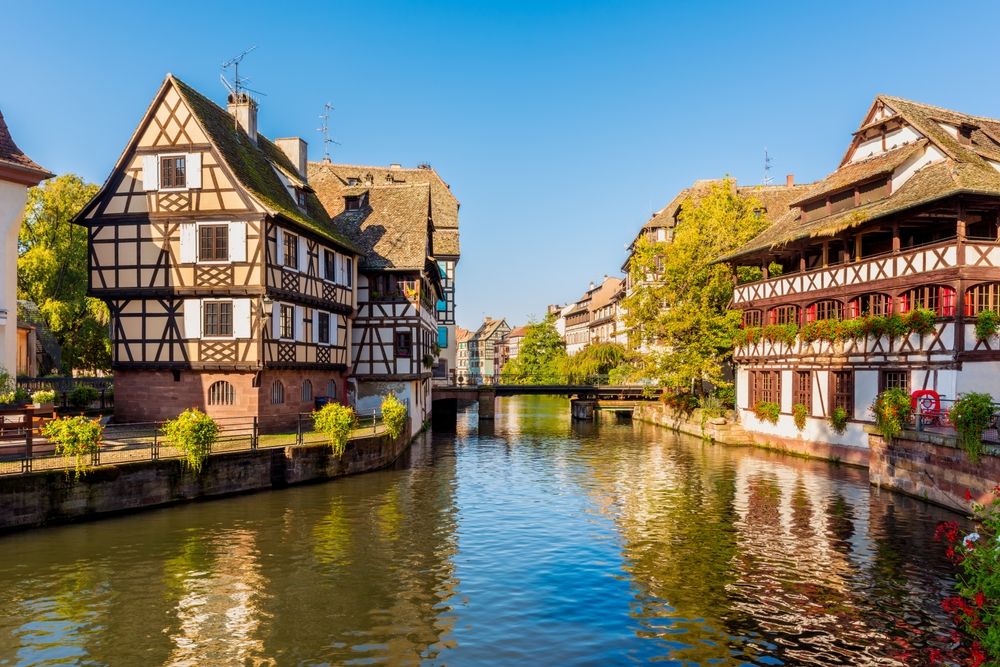
A few minutes' walk from the cathedral, Petite France is Strasbourg's most picturesque district, with its half-timbered houses reflected in the arms of the Ill and its cobbled streets traveled by tourists from around the world. Further on, Barrage Vauban and its panoramic terraces offer breathtaking views of the Covered Bridges and the cathedral silhouette standing out on the horizon. These two sites are an integral part of the walking tour proposed by Ryo to discover the best of Strasbourg in one day — an ideal way to extend your discovery after the cathedral.
9. Anecdotes and secrets of Strasbourg Cathedral
Beyond its impressive dimensions and artistic masterpieces, Strasbourg Cathedral is full of anecdotes and secrets that fascinate visitors. Here are some to enrich your visit.
9.1. The highest construction in the Christian world
Upon its completion in 1439, the cathedral spire reached 142 meters, making Strasbourg the city that possessed the highest human construction on Earth — a title it held for more than two centuries, from 1647 to 1874. Even today, the spire dominates Alsatian rooftops and remains visible from far away in the Rhine plain, like a lighthouse for passing travelers.
9.2. A cathedral that has resisted all trials
Despite the wars, revolutions and bombings that marked Strasbourg's turbulent history, the cathedral has survived the centuries without ever being destroyed. During the French Revolution, it was briefly transformed into a temple of Reason, then into a hay warehouse. Its salvation came from the inventiveness of a Strasbourg citizen who proposed crowning the spire with a large Phrygian cap, thus avoiding its demolition. During World War II, precious stained glass and sculptures were dismantled and secured, which allowed them to be preserved intact to this day.
9.3. The mysterious statue of Erwin de Steinbach
On the cathedral's southern façade, an enigmatic statue supposedly represents Erwin de Steinbach, the principal master builder of the western façade. According to local tradition, this genius architect would symbolically watch over his masterpiece for centuries, an eye eternally fixed on the stone lacework he helped rise from Strasbourg's soil.
To discover these anecdotes and many others during your visit, don't hesitate to follow the Ryo audio-guided circuit to visit Strasbourg, which reveals the city's secrets at each step of your walk.
10. Frequently asked questions about visiting Strasbourg Cathedral
Is visiting Strasbourg Cathedral free?
Access to the nave is completely free. However, climbing to the panoramic platform (about €8), access to the astronomical clock parade (about €4) and guided tours (from €9) are paid.
How much time should you plan to visit the cathedral?
Allow about 1 hour for a free interior visit, 1.5 to 2 hours if you climb to the platform or attend the clock parade. Half a day is ideal to discover everything at your own pace.
What time should you arrive to avoid crowds?
It's best to arrive at opening (8:30 AM on weekdays). Saturday afternoon is the busiest period, especially from 2 PM to 5 PM. For the platform, also prefer mornings, as the number of visitors is limited to 50 people simultaneously.
Can you take photos inside the cathedral?
Yes, photography is allowed inside the cathedral, without flash and with respect for liturgical services. Some areas or periods may be subject to temporary restrictions.
When does the apostles parade of the astronomical clock take place?
The famous parade of the twelve apostles takes place daily at 12:30 PM. Tickets (about €4) must be purchased the same morning at the cathedral entrance, Place du Château side. Places are limited, so it's advisable to arrive early.
Is Strasbourg Cathedral accessible to people with reduced mobility?
Access to the nave is possible for people with reduced mobility via an adapted entrance. However, the panoramic platform is not accessible to people with reduced mobility due to the many steps to climb.
In conclusion, visiting Notre-Dame de Strasbourg Cathedral is an experience that leaves a lasting impression. Whether to admire its Gothic façade covered with sculptures, be enchanted by the light of its stained glass, discover the ingenious mechanism of the astronomical clock or climb to the panoramic platform, each angle of view reserves its share of wonder. Strasbourg Cathedral is not just a monument: it is a book of stone open to ten centuries of history, art and faith at the crossroads of Europe. To extend this discovery and explore all the riches of the historic center at your own pace, find the Ryo audio-guided circuit to visit Strasbourg on foot and independently, your best travel companion for an unforgettable day in the Alsatian capital.