
Créé par Emilie, le 7 mai 2026
Votre guide Ryo
© Shutterstock
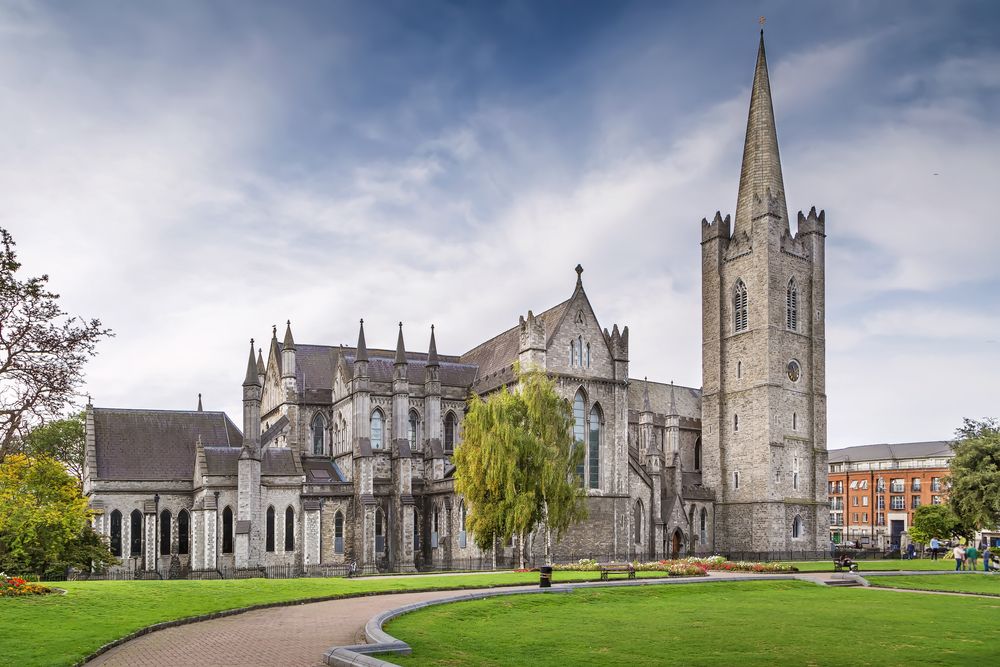
Standing proudly in the heart of the Irish capital for over 800 years, Saint Patrick's Cathedral in Dublin is much more than a simple religious building: it's a life-size history book, a living testament to Irish culture and soul. As Ireland's largest cathedral, it welcomes hundreds of thousands of visitors each year who come to admire its majestic Gothic architecture, pay their respects at the tomb of Jonathan Swift — author of the famous Gulliver's Travels — or simply soak up the unique atmosphere that reigns within its history-laden walls. If you're planning to Visit Dublin, this cathedral undoubtedly ranks among the must-sees of the Irish capital. In this comprehensive guide, you'll find everything you need to know to organize your visit to Saint Patrick's Cathedral: entrance fees, opening hours, what to see inside, history, practical advice and ideas for walks in the neighborhood.
1. Saint Patrick's Cathedral Dublin entrance fees
Visiting Saint Patrick's Cathedral in Dublin is paid, which directly contributes to the maintenance and restoration of this exceptional heritage. The prices are reasonable and several formulas allow adapting to all visitor profiles. For individuals, entry is set at €11.50 for an adult, €10.00 for a student or senior (60 years and over), and €5.50 for a child between 6 and 12 years old. Children under 5 enter free. For families, a group ticket at €31.00 covers two adults and up to three children.
An original formula also allows you to combine entry to the cathedral with a visit to Marsh's Library, Ireland's oldest public library, immediate neighbor of the cathedral, for €17.00. If you're visiting Dublin intensively, the Go City Dublin Pass includes entry to more than 40 city attractions, including Saint Patrick's Cathedral, from €69. For groups of 10 or more, online booking is mandatory, and prices are reduced (€10.00 per adult, €9.00 per student or senior).
2. What to see inside Saint Patrick's Cathedral?
Saint Patrick's Cathedral is full of architectural, historical and artistic treasures. Allow a good hour and a half, or even two hours, to enjoy it fully. Here are the major points of interest not to miss during your visit.
The Gothic nave and stained glass windows
As soon as you cross the main portal, the height and sobriety of the Gothic nave strike you. Built in English Gothic style, Saint Patrick's Cathedral in Dublin extends over more than 91 meters in length, making it the longest church in Ireland. The great pointed arcades, slender pillars and ribbed vaulting create a remarkable atmosphere of contemplation and grandeur. Throughout the nave and choir, a series of colorful stained glass windows filters natural light with elegance, some dating from the 19th century and others much older, illustrating biblical scenes and figures of saints.
Jonathan Swift's tomb
This is undoubtedly one of the most visited monuments inside the cathedral: the tomb of Jonathan Swift, immortal author of Gulliver's Travels and dean of the cathedral from 1713 to 1745. Located to the right of the main entrance, the funeral slab is simple but charged with emotion. Swift himself wrote his epitaph in Latin, of which we can read a translation made by Irish writer W. B. Yeats: "He lies here, where savage indignation can no longer tear his heart." Just beside lies Esther Johnson, the mysterious "Stella" whom he addressed in his writings and whom he had known from his youth. This proximity in death still fuels historians' speculations about the nature of their relationship.
The Order of Saint Patrick banners
One of the most striking visual spectacles of the cathedral is undoubtedly the row of heraldic banners that adorn the choir, remnants from the time when the cathedral served as chapel to the Most Illustrious Order of Saint Patrick, an order of chivalry founded in 1783. These colorful standards, suspended above the carved wooden choir stalls, testify to the splendor of this now-extinct order. Each banner corresponds to a knight, with his personal coat of arms. The brass plates fixed to the stalls, engraved with the names and titles of former members, complete this impressive heraldic decor that gives this part of the cathedral a unique character.
The Boyle memorial and pulpit
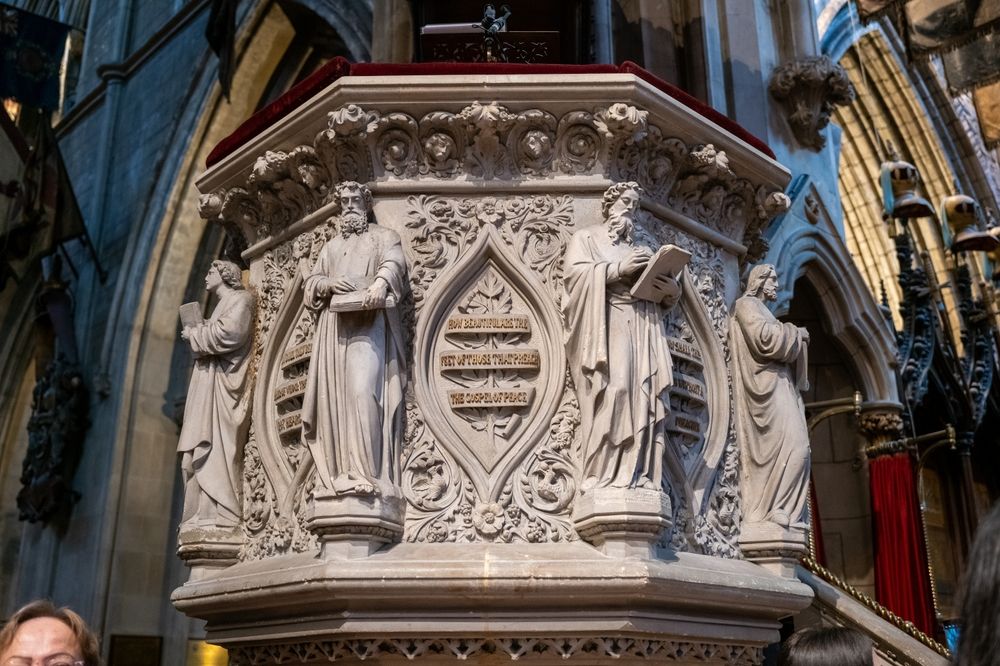
On the north side of the cathedral, the Boyle memorial is one of the most elaborate funeral monuments in all of Dublin. Built in 1632 in memory of Richard Boyle, first Earl of Cork, this painted and gilded altarpiece represents the members of his family arranged in niches. It is indeed in this memorial that young Robert Boyle — future father of modern chemistry — would have been represented as a child, making it an object of scientific curiosity in addition to its artistic interest. Nearby, the carved wooden pulpit from the 17th century also deserves your attention for the fineness of its ornamentation.
The choir school and choir
Saint Patrick's Cathedral houses one of the oldest choir schools in Europe, founded in 1432. For nearly six centuries, the students of this school have provided twelve sung liturgical services per week during the school period. If you are fortunate to visit the cathedral during one of these services, the musical experience is truly unforgettable: voices rise in the Gothic nave with exceptional resonance. The schedules of sung services are posted at the cathedral entrance.
Download the audio-guided circuit to discover Dublin on foot and independently
To extend your immersion and not miss any of the wonders of the Irish capital, remember to download the Ryo audio-guided itinerary to visit Dublin. This circuit takes you through 20 essential places of interest, including Saint Patrick's Cathedral, along a commented and interactive walk. Ideal for exploring the city at your own pace, without guide and without time constraints.
3. Saint Patrick's Cathedral opening hours
Saint Patrick's Cathedral is open all year round, but its hours vary according to the days of the week, due to religious services that continue to be celebrated there regularly. It is therefore important to plan your visit well in advance to avoid disappointment.
From Monday to Friday, the cathedral is accessible from 9:30 AM to 5:00 PM (last entry at 5:00 PM). On Saturday, it opens a little earlier, from 9:00 AM, with last entry at 6:00 PM. On Sunday, the hours are divided into three slots to make room for services: from 9:00 AM to 10:30 AM, then from 1:00 PM to 2:30 PM, and finally from 4:30 PM to 6:00 PM. Outside these slots, the cathedral is closed to tourists to allow religious ceremonies to take place.
Free guided tours are offered Monday to Saturday, at 10:30 AM and 2:30 PM. These tours are provided by volunteer guides and allow you to deepen your knowledge of the cathedral's history in about 45 minutes. Please note, they are not available for organized groups, and may sometimes be canceled without notice: inquire at reception upon arrival.
4. History of Saint Patrick's Cathedral in Dublin
To understand Saint Patrick's Cathedral, we must go back to the very origins of Christianity in Ireland. Its history is intimately linked to that of the country, reflecting its glories, its divisions and its resilience.
From Celtic origins to the Middle Ages
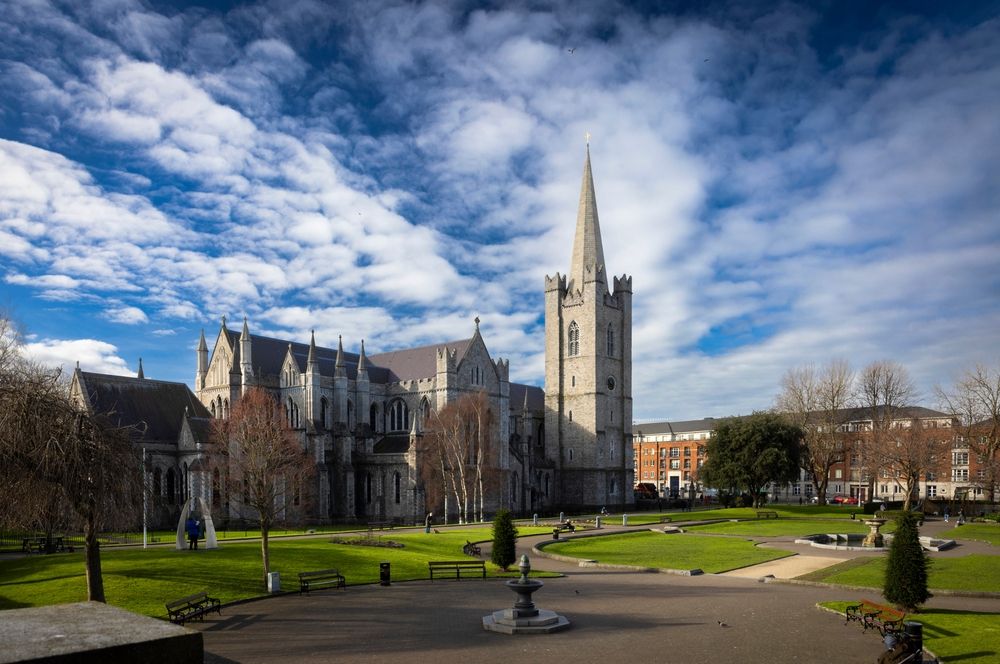
According to tradition, it was around 450 AD that Saint Patrick himself would have used a well located at the current site of the cathedral to baptize converts to Christianity. This well, considered sacred, gave birth to a first modest place of worship. A small wooden church was erected on this site, gradually rebuilt in stone from the 11th century. In 1191, under the impulse of Archbishop John Comyn, the church was elevated to the rank of collegiate church, before being promoted to cathedral status in 1213. The construction of the Gothic building we know today began in 1220 and extended over several decades, to be completed around 1260, in an English Gothic style characterized by its pointed arches, buttresses and slender silhouette.
The Protestant Reformation and its consequences
The 16th century marks a radical turning point in the cathedral's history. During the Protestant Reformation, under the reign of Henry VIII, Saint Patrick's Cathedral passes under the authority of the Church of Ireland — an Anglican church — in 1537. This change of regime causes decades of religious and political tensions. Later, Oliver Cromwell installs his soldiers and horses there during the English occupation in the 17th century, causing significant damage to the building. Paradoxically, it is also during this troubled period that the cathedral experiences one of its moments of artistic glory: in 1742, composer George Frideric Handel conducts in Dublin the world premiere of his oratorio Messiah, in which sang the choristers of Saint Patrick and the neighboring cathedral Christ Church Cathedral.
Restoration by the Guinness family in the 19th century
At the beginning of the 19th century, the cathedral is in an advanced state of disrepair. It is Sir Benjamin Lee Guinness, millionaire brewer and member of the famous Irish family, who saves it. Between 1860 and 1869, he personally finances a vast restoration campaign that restores the building's medieval appearance, while consolidating its structures. His son, Lord Ardilaun, completes the work and finances the landscaping of the gardens that surround the cathedral today. This restoration, spectacular for its time, is commemorated by a statue of Sir Benjamin Lee Guinness visible outside the building. Thanks to this decisive intervention, Saint Patrick's Cathedral has been able to survive through the centuries to us.
5. Anecdotes and curiosities about Saint Patrick's Cathedral
Saint Patrick's Cathedral would not be quite itself without its legends and savory anecdotes. Here are some that pleasantly spice up the visit.
The best known is certainly the origin of the English expression "to chance your arm", which means "to try your luck" or "to take a risk". In 1492, during a bloody quarrel between two great Irish families — the Kildare and the Ormond — the Ormond had barricaded themselves in the cathedral's chapter house. To end the conflict, Gerald Fitzgerald, Earl of Kildare, had a hole cut in the door and slipped his arm through it, thus risking having his hand cut off by his enemies, as a sign of peace. The gesture was accepted, and reconciliation took place. This holed door is still visible in the cathedral today.
The cathedral also houses more than 500 burials, including those of many archbishops, military personnel and personalities from Irish history. Among the most visited tombs, we find of course that of Jonathan Swift, but also that of his companion Stella, two inseparable figures from the cathedral's history. Finally, the choir school, founded in 1432, is one of the oldest musical education institutions in Europe, and its pupils still sing today in weekly services — a living link with the Middle Ages that never fails to strike visitors.
6. How to get to Saint Patrick's Cathedral?
The Saint Patrick's Cathedral is ideally located in Dublin's historic center, just minutes on foot from many other major city attractions (St Patrick's Close, Dublin, D08 H6X3, Ireland, rated 4.5/5 on Google for numerous reviews). It is about 10 to 15 minutes' walk from the heart of the city center, along Patrick Street.
If you prefer public transport, several bus lines serve the area from Dublin city center: lines 49, 54a and 77a stop nearby. Walking remains however the most pleasant and practical option: from Trinity College, allow about 15 minutes crossing the old town streets. From Dublin Castle, less than 5 minutes will suffice. No private parking is associated with the cathedral, but limited spaces for coaches are available on Saint Patrick's Close. Motorized visitors should preferably park in one of the city center public car parks.
The cathedral is accessible to people with reduced mobility thanks to adapted access, and also has toilets on site.
7. Practical tips for visiting Saint Patrick's Cathedral
To make the most of your visit to Saint Patrick's Cathedral in Dublin, here are some practical tips that will make the difference.
Book your ticket online. While the cathedral can be very busy during tourist peaks — especially in summer and during Irish holidays — booking online in advance guarantees you access without waiting and often allows you to benefit from the same rates as at the box office. Groups of 10 or more are required to book in advance, with a specific time slot.
Take advantage of free guided tours. Offered Monday to Saturday at 10:30 AM and 2:30 PM, they are the best way to access anecdotes and details that you don't notice during an independent visit. The volunteer guides, passionate, share their intimate knowledge of the building with great enthusiasm.
Plan your visit outside of services. The cathedral is closed to tourists during religious services, particularly on Sundays. If you wish to attend one of these services, know that they are generally open to all: an exceptional musical and spiritual experience, with the choristers from Saint Patrick's school.
Adopt respectful attire. Although dress codes are not strict, the cathedral is an active place of worship. Proper and discreet attire is appropriate, especially during services. Photography is allowed, without flash, so as not to disturb ceremonies or other visitors.
Finally, to optimize your day in Dublin, we recommend combining the cathedral visit with other sites in the historic quarter. Our audio-guided circuit to visit Dublin on foot allows you to connect these places smoothly and with commentary, in complete independence.
8. What to see around Saint Patrick's Cathedral?
Saint Patrick's Cathedral is surrounded by a particularly rich historic quarter, ideal for a half-day stroll. Here are the unmissable sites to discover nearby, several of which feature in our Dublin guided tour itinerary.
Christ Church Cathedral
Just a few hundred meters to the north, Christ Church Cathedral is the other great historic cathedral of Dublin. Founded in the 11th century, it is slightly older than Saint Patrick's and notably houses remarkably well-preserved medieval crypts. The two cathedrals complement each other perfectly during the same day of visiting.
Dublinia Museum
Adjacent to Christ Church Cathedral, Dublinia Museum offers an immersive dive into Viking and medieval Dublin. Thanks to life-size reconstructions and interactive exhibitions, it allows you to contextualize the history of Saint Patrick's Cathedral and the city in a fun and accessible way for the whole family.
Dublin Castle
A few minutes on foot, Dublin Castle is one of the country's most important historic sites. Former residence of the British viceroys, this complex mixes medieval, Georgian and Victorian architectures. Its state apartments and royal chapel are well worth the detour.
Temple Bar district
After a studious morning between cathedrals and museums, head to Temple Bar district for lunch or a drink in one of its many traditional pubs. This lively district, with its cobbled streets and colorful facades, is the beating heart of Dublin's cultural and nightlife, just 10 minutes' walk from Saint Patrick's Cathedral.