© Shutterstock
 Votre guide Ryo
Discovering Selinunte, major archaeological site in Sicily
Nestled on the southwest coast of Sicily, the archaeological site of Selinunte represents one of the most impressive testimonies of ancient Greek civilization in the Mediterranean. Founded in the 7th century BC by colonists from Megara Hyblaea, this former prosperous city now reveals majestic temples, an imposing acropolis and remains that continue to fascinate archaeologists and visitors from around the world. With its ruins stretching across nearly 270 hectares facing the Mediterranean Sea, Selinunte offers a captivating journey through the history of Magna Graecia.
The fascinating history of Selinunte
The history of Selinunte begins in the 7th century BC, when Greek colonists from Megara Hyblaea decided to settle on this strategic Sicilian coast. According to the Athenian historian Thucydides, the city would have been founded around 628-627 BC, although some sources mention the year 651 BC. The name of the city comes from the Greek word "selinon", designating a variety of parsley or wild celery that grew abundantly in the region. This emblematic plant was also engraved on the city's coins, testifying to its cultural and economic importance.
Thanks to its privileged position and flourishing agriculture, Selinunte quickly experienced remarkable prosperity. The city became one of the richest Greek colonies in Sicily, rivaling the great metropolises of the time. The inhabitants erected monumental temples that are among the largest in ancient Greek architecture. However, this period of glory came to a brutal end in 409 BC, when the Carthaginians led by Hannibal Mago destroyed the city after a bloody siege. According to ancient historians, more than 16,000 inhabitants were killed and 5,000 others reduced to slavery. Although partially rebuilt, Selinunte never regained its past splendor and was definitively abandoned in the 3rd century BC.
The temples of Selinunte: jewels of Greek architecture
The archaeological park of Selinunte (Piazzale Bovio Marconi, 91022 Marinella TP, rated 4.6/5 on Google for 17,950 reviews) houses some of the most imposing temples of ancient Greece, all built in the Doric style. Although the exact identity of the deities to which they were dedicated sometimes remains uncertain, these buildings provide spectacular testimony to Greek architectural genius and the power of this ancient city.
1. Temple E: the best restored building
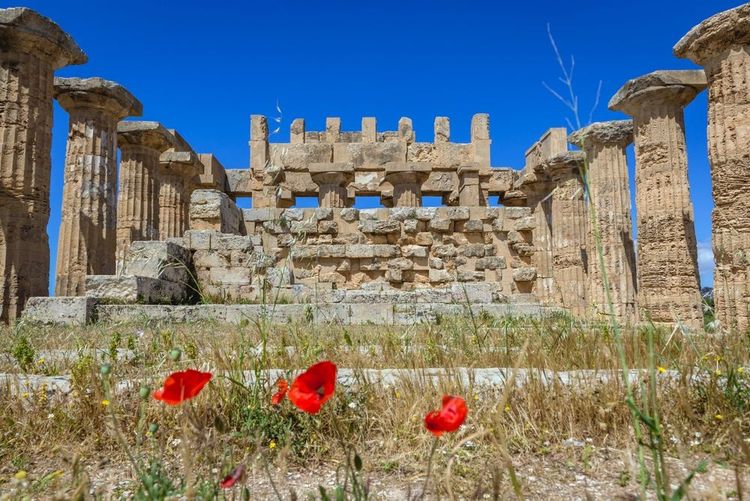
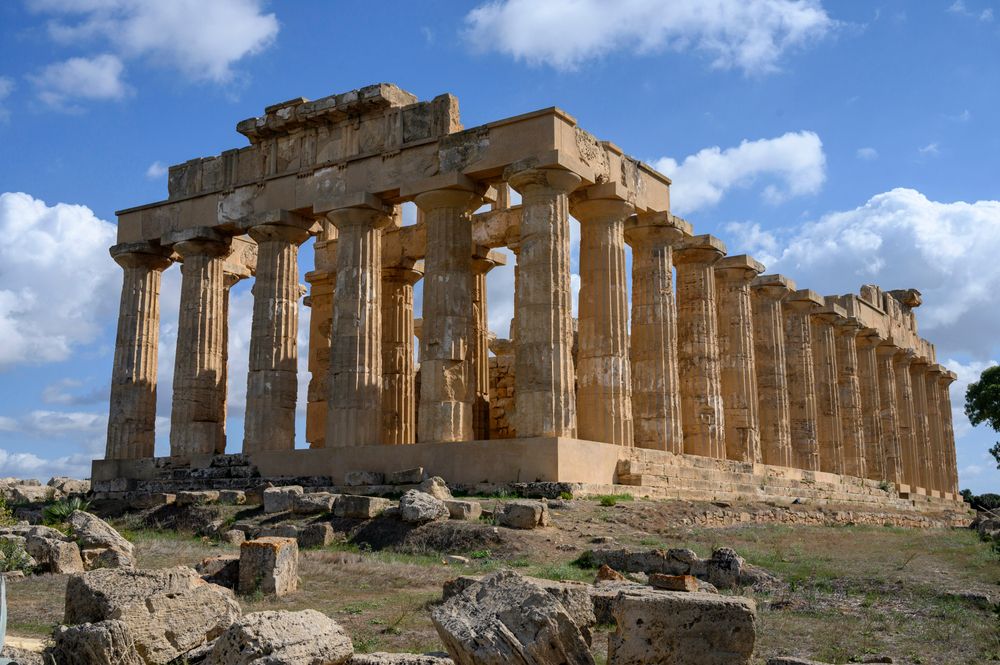
Located on the eastern hill, Temple E is undoubtedly the most impressive monument of Selinunte. Built around 460-450 BC, it is generally attributed to Hera, although this attribution is still debated among archaeologists. This temple is part of the most recent buildings of the complex and testifies to the architectural refinement achieved by the builders of Selinunte. Partially reconstructed in the 1950s, it stands majestically with its massive columns and harmonious proportions, offering a brilliant example of classical Greek architecture. Its imposing dimensions (67 meters long by 25 meters wide) and its excellent state of preservation make it one of the most photographed sites in Sicily.
2. Temple G: the unfinished giant
Temple G represents one of the most ambitious constructions ever undertaken by the Greeks. With its 110 meters in length and 50 meters in width, it would have been one of the largest temples in the Greek world if it had been completed. It is thought that it could have been dedicated to Zeus or Apollo, but the absence of definitive evidence maintains the mystery about its true attribution. Now in ruins, its collapsed columns and monumental fragments scattered on the ground offer a striking vision of the magnitude of this titanic project. A 16-meter-high column still lies on the ground, allowing us to imagine the majesty of the completed building. Construction work, begun in the 6th century BC, was interrupted by the Carthaginian destruction of 409 BC.
3. Temple C: the oldest on the acropolis
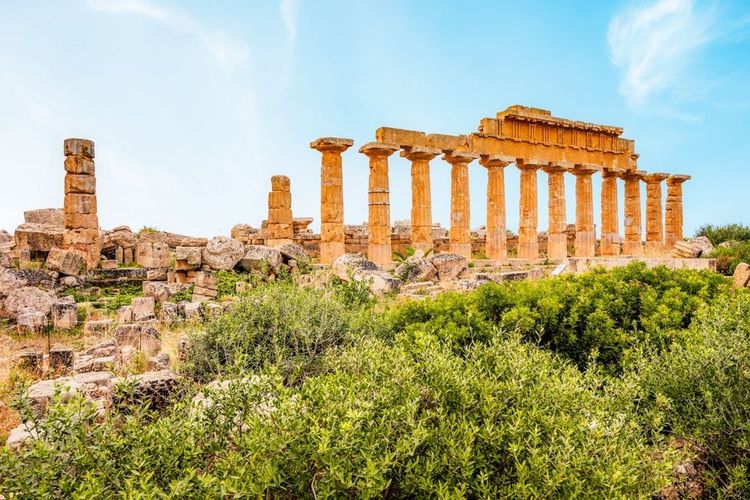
Built around 580-550 BC on the acropolis, Temple C is the oldest and largest peripteral temple of Selinunte (24 meters by 64 meters). Perhaps built on the foundations of a small pre-archaic temple, it was probably dedicated to Apollo or Athena. This temple is distinguished by its remarkable sculpted metopes, now preserved in the archaeological museum of Palermo, which represent mythological scenes of great artistic finesse. Although partially in ruins, its remains still allow us to appreciate the sophistication of ancient Greek architecture.
4. Temple F: shrouded in mystery
Located near Temple E on the eastern hill, Temple F remains one of the most enigmatic buildings of Selinunte. Hypotheses suggest that it could be dedicated to Athena or Dionysus, but archaeologists cannot agree on a precise deity. Built in the 6th century BC, this more modest temple is now partially destroyed. Its ruins nevertheless retain a mysterious charm that invites visitors to imagine its past splendor and meditate on the secrets it still holds.
Beyond these major temples, the site also includes temples A, B, D and O located on the acropolis, as well as temple M at the Malophoros sanctuary, each adding its stone to the understanding of this extraordinary civilization.
The acropolis: political and religious heart of the city
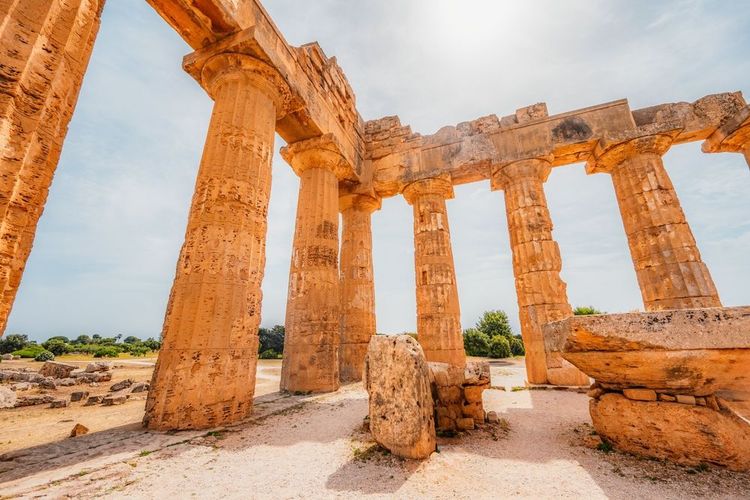
Perched on a hill overlooking the Mediterranean Sea, the acropolis of Selinunte was the nerve center of the ancient city. It was here that the main political, religious and commercial activities of the city were concentrated. By exploring this archaeological zone, we discover the vestiges of the ramparts that once protected the city, the foundations of ancient public buildings, narrow streets testifying to Greek urbanism, and sophisticated fortifications designed to defend the city against invaders.
The acropolis also housed five temples (A, B, C, D and O) whose ruins testify to the intense religious activity that animated this sacred quarter. The agora, central place of public life where assemblies and commercial exchanges took place, was also located on the acropolis. The site is now dotted with olive trees and Mediterranean plants that create a peaceful and poetic atmosphere, contrasting with the tumultuous history of the city. A walk on the acropolis invites us to imagine the daily life of yesteryear, when the Greeks dominated these lands and Selinunte shone throughout the western Mediterranean.
The Malophoros sanctuary: devotion to Demeter
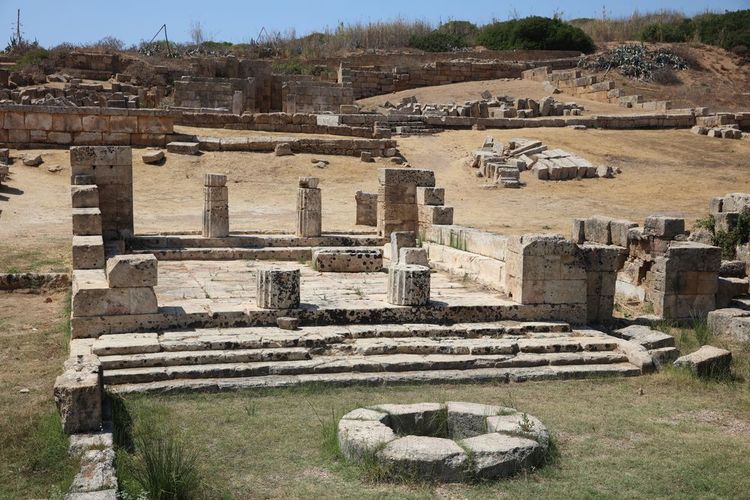
A few kilometers west of the acropolis stands the Malophoros sanctuary, dedicated to Demeter, the goddess of fertility and agriculture. This sanctuary was one of the most important places of worship in Selinunte, and the ruins of its altars, columns and walls testify to the deep devotion of the inhabitants to this essential deity. The name "Malophoros" literally means "apple bearer" or "fruit bearer", emphasizing the close link between this goddess and abundant harvests.
The rituals dedicated to Demeter played a central role in a region as agricultural as Selinunte, where prosperity depended largely on harvests. The sanctuary also included a temenos (sacred enclosure) dedicated to Zeus Meilichios and Hecate, testifying to the complexity of the Selinuntine religious pantheon. Archaeological excavations have revealed numerous votive offerings, terracotta figurines and inscriptions that inform us about the religious practices of the time. This spiritual site reflects the importance given by the Greeks to divine protection of their lands and their crops.
The quarries of Cusa: witnesses to the work of builders
About 13 kilometers northwest of Selinunte are the extraordinary quarries of Cusa (Cave di Cusa), which were an integral part of the archaeological park. These ancient quarries constitute a unique archaeological site in the world, offering fascinating testimony on the extraction and stone cutting techniques used by the Greeks to build their monumental temples. It was here that the enormous limestone blocks used to build the temples of Selinunte were extracted.
Stone extraction began in the 6th century BC and stopped abruptly in 409 BC, during the destruction of Selinunte by the Carthaginians. This sudden interruption froze the quarries in time, like an instant photograph of the work of stone cutters. We can still observe half-carved columns, column drums ready to be transported, and even blocks still attached to the mother rock. These remains allow us to understand in detail the extraction process: workers first traced a circle of the desired diameter, then chiseled downward to clear the block, before detaching it from its base. The transport of these colossal masses (some weighing more than 40 tons) to the construction site, 13 kilometers away, was a remarkable technical feat.
The visit to the quarries of Cusa admirably complements that of the archaeological site of Selinunte, offering a unique perspective on work organization and the ingenuity of Greek builders. The site, surrounded by centuries-old olive trees, exudes a particular atmosphere where time seems to have stopped more than 2,400 years ago.
Practical information for visiting Selinunte
Download the audio-guided circuit to discover Sicily on foot and independently
To explore Sicily thoroughly and discover the wonders of the island beyond Selinunte, Ryo offers a complete audio-guided circuit of Sicily. This itinerary accompanies you in your discovery of major Sicilian sites through fun and informative audio guides available directly on your smartphone. You can thus explore the island's treasures at your own pace, with enriching historical and cultural explanations at each stage of your journey. The circuit naturally includes Selinunte, but also other unmissable archaeological sites such as the Valley of the Temples of Agrigento, Syracuse or even Segesta.
Opening hours and entrance fees
The archaeological park of Selinunte is open every day with variable hours depending on the season. From October 29 to March 15, the site is accessible from 9am to 5pm (ticket office closes at 4pm). From March 16 to September 15, the hours are extended from 9am to 6pm (ticket office closes at 5pm). From September 16 to October 28, opening hours are 9am to 6pm. During the high summer season, the park may remain open until 8pm. It is recommended to check the current hours on the official website before your visit.
The standard entrance fee is €12 per adult (some sources mention €10, it should be verified). Entry is free for under 18s and European citizens over 65. Reduced rates are also offered to young people aged 18 to 25 (around €2) and groups. A family ticket at €25 may be available for families. A shuttle in a small electric train runs between the different areas of the park for an additional cost of around €5-6 per person, which is highly recommended given the extent of the site (about 10 km on foot to visit everything).
How to get to Selinunte
Selinunte is located near the town of Castelvetrano, in the province of Trapani, on the southwest coast of Sicily. By car, from Palermo, allow about 1h30 journey (95 km) taking the A29 motorway then the SS115. From Trapani, the journey takes about 1h (72 km). From Agrigento, allow about 1h15 drive westward. Parking on site is free and included in the entrance price, with a good capacity parking lot near the park entrance.
If you are traveling by public transport, buses regularly connect Palermo and Trapani to Castelvetrano. From Castelvetrano, local buses serve Marinella di Selinunte (where the archaeological site is located). The journey from Palermo by bus takes about 2h30 to 3h. It is also possible to take the train to Castelvetrano (Palermo-Trapani line), then a bus or taxi to the site (about 10 km). Be careful, bus schedules may be limited, especially in low season, so it is preferable to plan your return in advance.
Visit duration and practical advice
For a complete exploration of the two main areas of the park (the eastern hill with temples E, F and G, and the acropolis), allow a minimum of 3 to 4 hours. If you also wish to visit the Malophoros sanctuary and take your time to photograph each ruin while enjoying the Mediterranean landscapes, a half-day (5-6 hours) is recommended. Archaeology and photography enthusiasts can easily spend a full day there, especially if you plan to include the quarries of Cusa in your visit.
As the site is vast and largely unpaved, it is essential to wear comfortable walking shoes suitable for uneven terrain. In summer, Sicily can be particularly hot: bring plenty of water (there are a few refreshment points but it's better to be prepared), a hat, sunglasses and sunscreen. Shade is rare on the site, especially on the eastern hill. On the other hand, spring (April-May) and autumn (September-October) offer ideal conditions with pleasant temperatures and lush vegetation that further magnifies the ruins. Several small cafes and refreshment points are present at the main areas of the site, offering refreshing drinks and snacks.
Don't hesitate to let yourself be guided in your exploration of the park thanks to Ryo audio-guided circuits, which will considerably enrich your understanding of this exceptional site and allow you to miss no important detail of the fascinating history of Selinunte.
What to see around Selinunte
The region around Selinunte is full of interesting sites that deserve a visit. Just 12 kilometers to the north is Castelvetrano, a charming Sicilian town known for its baroque historic center and its Madre church with spectacular golden ceiling. The town also houses the civic museum where the Ephebe of Selinunte is exhibited, a magnificent bronze statue from the 5th century BC discovered on the archaeological site in 1882.
About 60 kilometers to the east is Agrigento and its famous Valley of the Temples, another exceptional Greek archaeological site classified as a UNESCO World Heritage Site. The comparison between these two major sites is fascinating and allows us to appreciate the diversity of Greek architecture in Sicily. To the northwest, about 50 kilometers away, the archaeological site of Segesta impresses with its magnificently preserved Doric temple and its Greek theater offering an exceptional panoramic view.
For beach relaxation enthusiasts, the beach of Marinella di Selinunte, located in the immediate vicinity of the archaeological park, offers beautiful stretches of fine sand and crystal-clear waters. It's the ideal place to cool off after a day of visiting under the Sicilian sun. Finally, for a complete immersion in Sicilian culture, visiting Palermo, the regional capital located about 100 kilometers to the northeast, allows you to discover an exceptional architectural heritage mixing Arab, Norman and Baroque influences.
In conclusion, the archaeological site of Selinunte constitutes an essential stop during a trip to Sicily. Between majestic temples, acropolis steeped in history and ancient quarries frozen in time, this exceptional archaeological park offers a fascinating journey into ancient Greece. Whether you are passionate about archaeology, history enthusiast or simply curious seeking Mediterranean beauties, Selinunte will amaze you with the grandeur of its remains and the beauty of its natural setting. Don't hesitate to extend your discovery of Sicily by following the Ryo audio-guided itineraries, which will accompany you in exploring the treasures of this extraordinary island where every stone tells a thousand-year-old story.
FAQ – Frequently asked questions about Selinunte
What is the best time to visit Selinunte?
The best time to visit Selinunte extends from April to June and from September to October. Temperatures are pleasant (20-25°C), vegetation is lush in spring, and you'll avoid summer crowds as well as the oppressive heat of July-August where temperatures can exceed 35°C with little shade on the site.
How long does it take to visit Selinunte?
Allow a minimum of 3 to 4 hours to visit the two main areas of the park (eastern hill and acropolis). For a complete visit including the Malophoros sanctuary and the quarries of Cusa, plan a half-day to a full day. The site extends over nearly 270 hectares, and about 10 km of walking is necessary to explore everything on foot.
Should you take the internal shuttle or walk?
The shuttle in a small electric train (around €5-6 per person) is highly recommended, especially in summer. The distances between the different areas are significant (about 1.5 km between the eastern hill and the acropolis), and the sun can be intense. The shuttle allows you to save your energy to explore the temples themselves and makes the visit much more comfortable.
Can you visit Selinunte with children?
Yes, Selinunte is family-friendly. Entry is free for under 18s. The site is large and offers plenty of space for children to stretch their legs. However, bring water, snacks and sun protection. The internal shuttle is particularly appreciated by children and avoids tiring long walks. The impressive ruins generally capture the imagination of young visitors.
Selinunte or Agrigento: which site to choose?
Both sites are worth the detour and offer different experiences. Selinunte is larger, less crowded and offers a wilder atmosphere with sea views. Agrigento (Valley of the Temples) presents better preserved temples, notably the Temple of Concordia, and enjoys international renown. If you have to choose, Agrigento is more accessible and concentrated, while Selinunte will appeal more to archaeology enthusiasts seeking a less touristy atmosphere. The ideal is to visit both if your schedule allows.
Are there restaurants near Selinunte?
Yes, several restaurants and trattorias are located in Marinella di Selinunte, the seaside village adjacent to the archaeological site. You will find establishments offering authentic Sicilian cuisine, pizzerias and fish restaurants. Inside the park, small cafes offer refreshing drinks, ice cream and snacks. For a complete meal, it is preferable to leave the site and go to Marinella.
Can you swim near Selinunte?
Absolutely! The beach of Marinella di Selinunte, located a few hundred meters from the archaeological site, offers beautiful stretches of fine sand and crystal-clear waters. It's the ideal place to cool off after a visit to the park under the Sicilian sun. Several lidos (equipped beaches with deck chairs and umbrellas) are available, as well as free public beach areas.