
Créé par Emilie, le 7 mai 2026
Votre guide Ryo
© Shutterstock
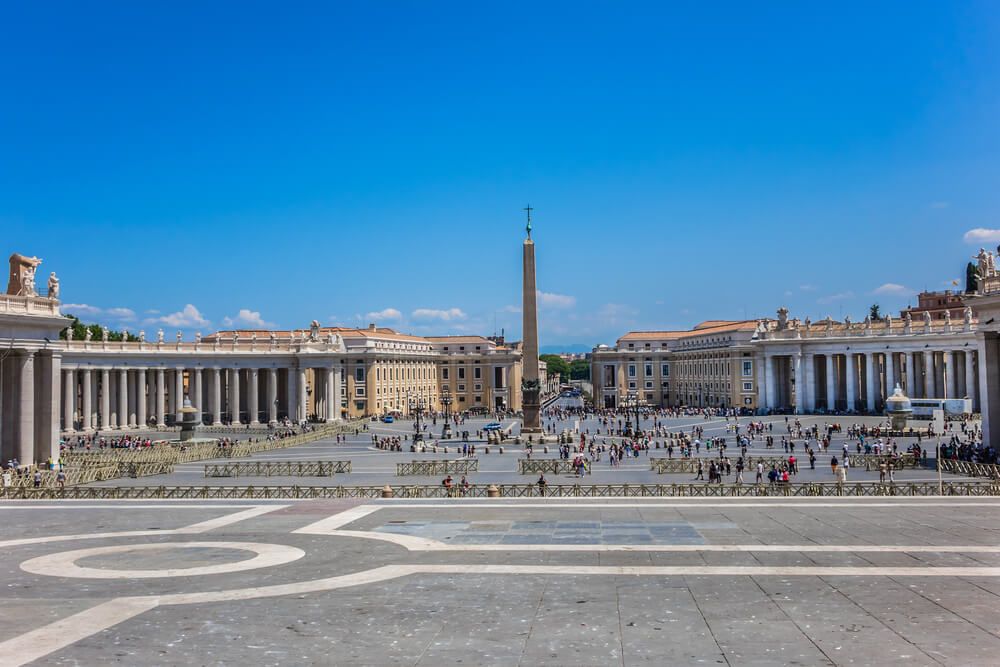
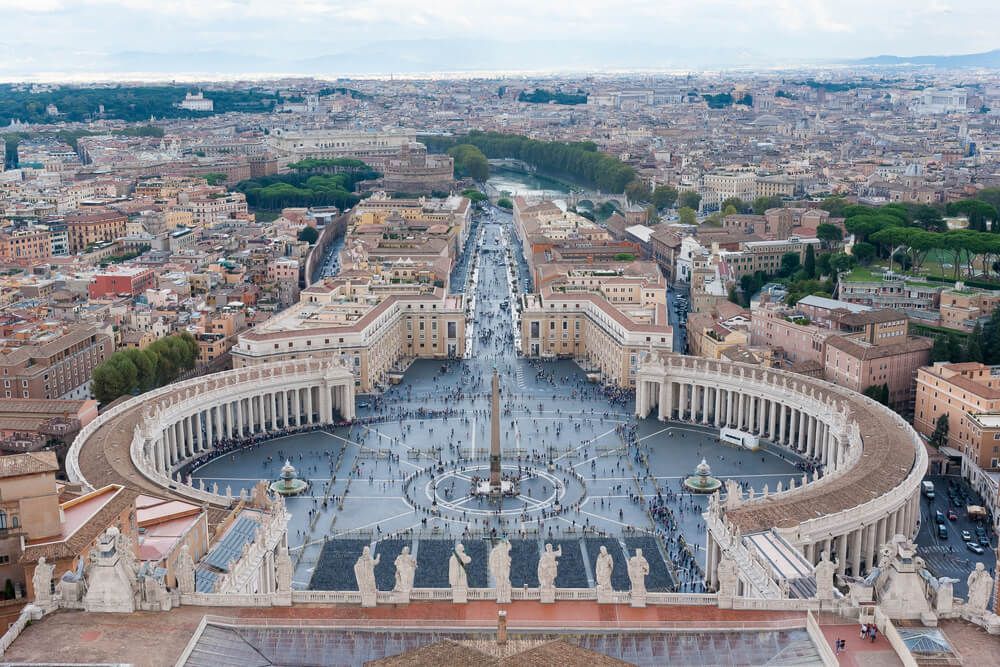
St. Peter's Square in Rome is undoubtedly the most famous square in Italy and certainly one of the most famous squares in the entire world.
Symbolic, magnificent and particularly vast, this square is one of the must-see places during your visit to Rome. Day or night, with family or friends, you can only marvel at this grandiose baroque architecture that has impressed visitors since the 17th century.
Located in Vatican City in front of St. Peter's Basilica, this esplanade is a unique place in the world, you can reach it via the via della conciliazione or rue de la réconciliation before arriving at Place Pie XII. The passetto di borgo or the little passage is a fortified and elevated place that connects St. Peter's Square in Vatican City and Castel Sant'Angelo, you won't be able to miss it if you pass by!
Who built St. Peter's Square in the Vatican?
This gathering place and centerpiece of great Catholic religious festivals was built in the 17th century to welcome Catholic faithful. The square was commissioned by Pope Alexander VII.
The choice of site was highly symbolic, as it is the location of Saint Peter's tomb. It was the architect Bernini who carried out the construction work, he was considered as talented as Michelangelo. Its construction lasted 11 years from 1656 until 1667 AD. You will certainly be impressed by the 284 columns and 88 pillars, among others, that compose it...
What to see at St. Peter's Square in Rome or Vatican Square?
Here are some figures that will give you an idea of the grandeur of the square and the richness of the architectural elements you will find there:
- 320 meters long,
- 240 meters wide,
- 300,000 people can be accommodated on this square,
- 284 columns 17 m high,
- 88 pilasters (columns embedded in a wall) 20 meters high,
- 140 statues of Saints 3.10 meters high,
- 1 Egyptian obelisk 25 meters high...
The square is composed of 2 arcs, each arc is composed of 4 rows of Doric columns, which allowed the creation of 3 circulation routes.
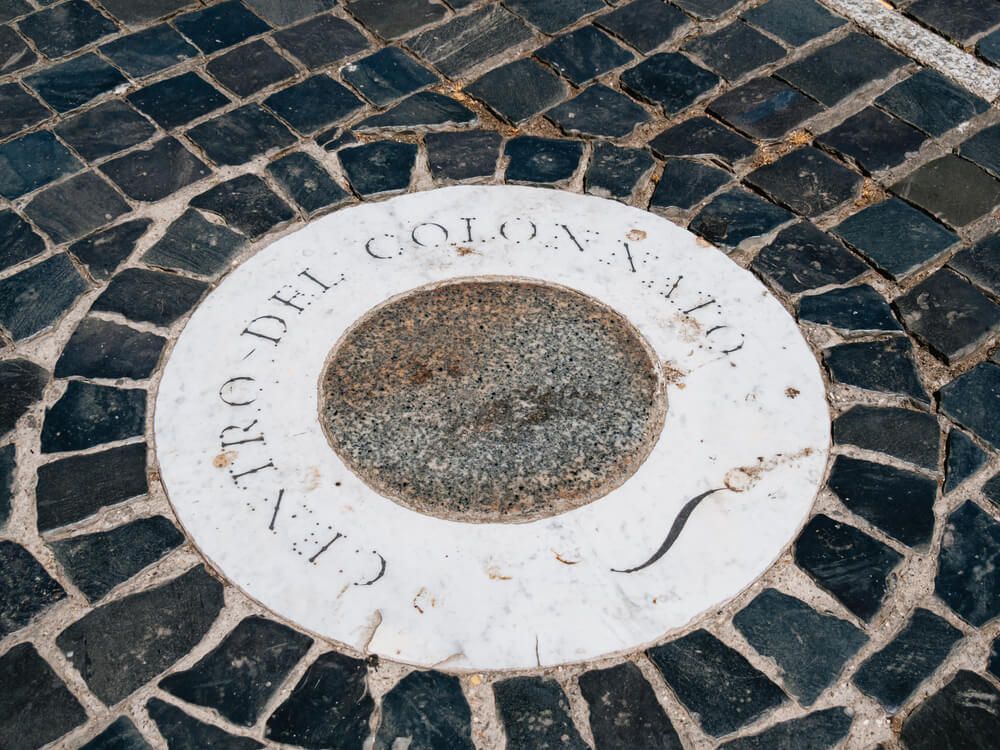
A small particularity: by positioning yourself on one of the 2 marble discs bearing the inscription "centro del colonnato" located between the obelisk and the two fountains, you will notice that the 4 columns merge into 1 single column. The optical illusion is perfect and really worth seeing.
The first space, located in front of St. Peter's Basilica, has the shape of a trapezoid representing two closed arms. The 2nd has an elliptical shape of two half circles composed of a quadruple colonnade representing arms that welcome the faithful. Moreover, Bernini (Gian Lorenzo Bernini) said on this subject: "Since the church of St. Peter is the mother of all others, it should have a portico that shows precisely wanting to receive with open arms, maternally, the Catholics" but also the "heretics, to guide them towards the Church and the infidels to enlighten them on the path of true faith". The construction of St. Peter's Square between 1656 and 1667 lasted no less than 11 years. The square can accommodate 150,000 people or more during major religious events.
In front of the steps of the basilica, you will see two large statues of 5.55 m in height each placed on a pedestal of almost 5 meters: the statue of Saint Peter to the south and the statue of Saint Paul to the north.
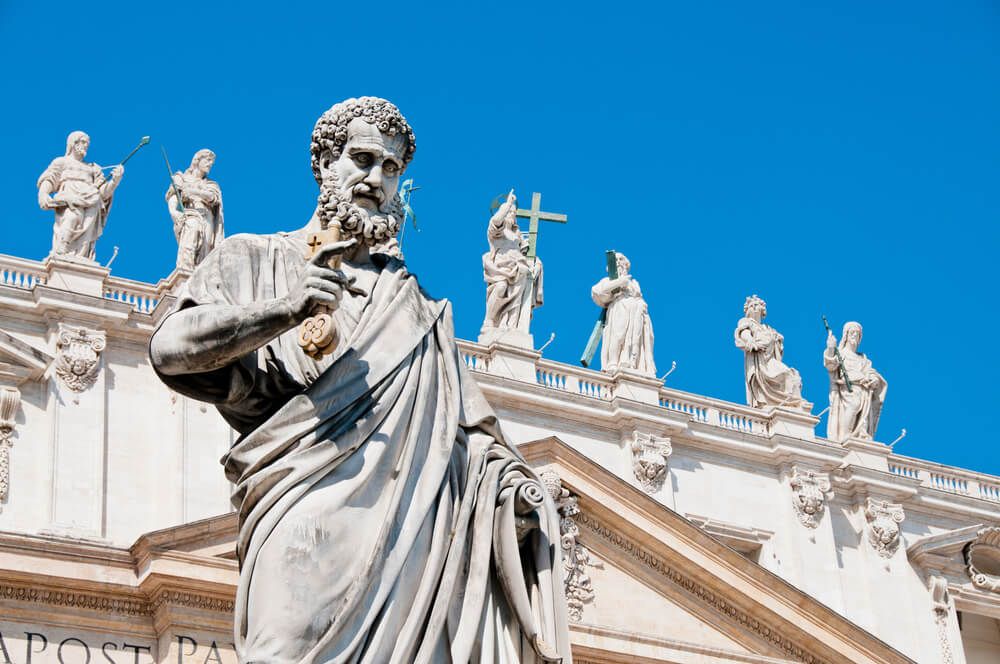
Statue of Saint Peter located in front of Saint Peter's Basilica
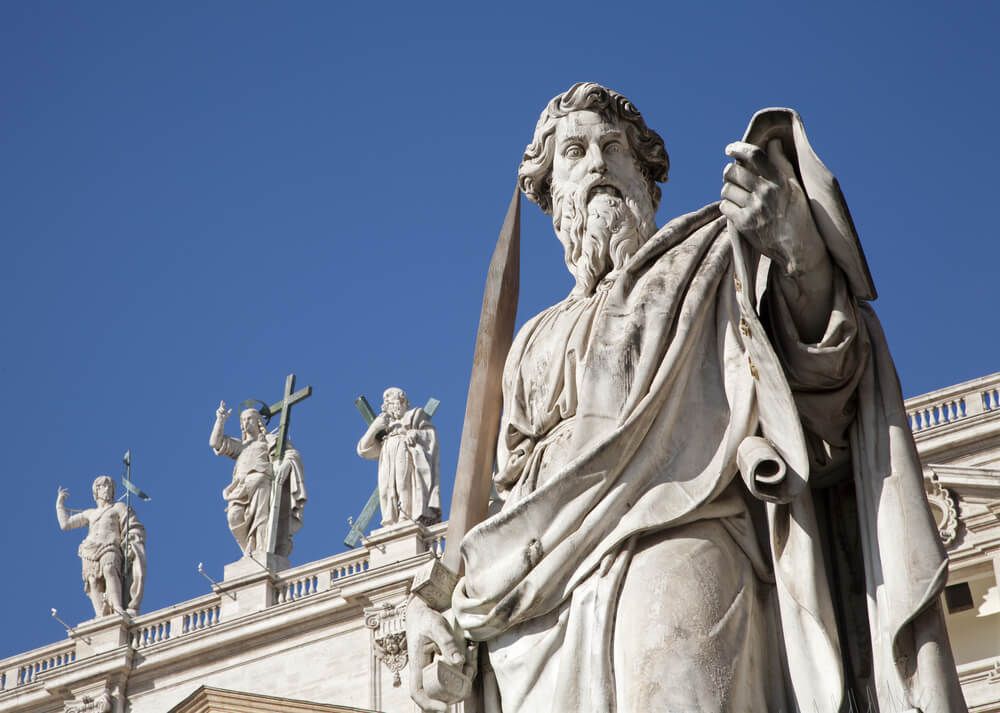
Statue of Saint Paul
The Vatican obelisk comes from Egypt, it was Emperor Caligula who brought it back from a campaign. Its location is not by chance, it is the precise place where the apostle Peter was crucified. It was the architect Domenico Fontana who took care of its displacement and restoration according to the order of Pope Sixtus V.
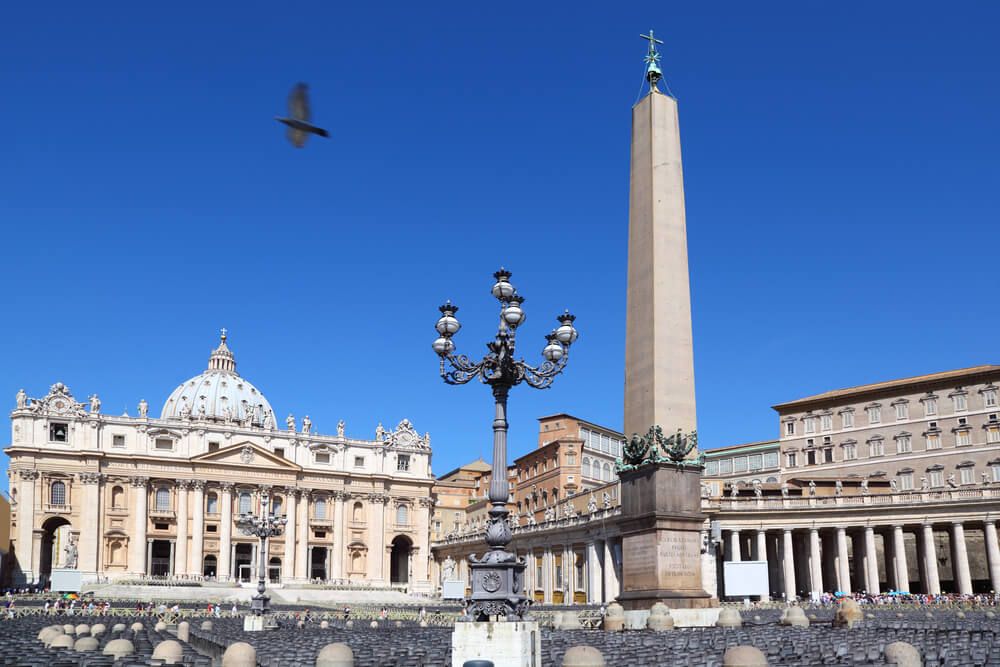
The twin fountains are arranged on each side of the obelisk: to the north (Gregoriana) and to the south (Clementina), papal coats of arms and dolphins adorn the fountains, in the center of St. Peter's Square. The upper basin is decorated with small reliefs that produce an effect of fine droplets spreading like a very fine veil of water. The authorship of these fountains is associated with Carlo Fontana who himself claims them as a work of Bernini (Gian Lorenzo Bernini)... Mystery. Maybe you will know more during a guided tour.
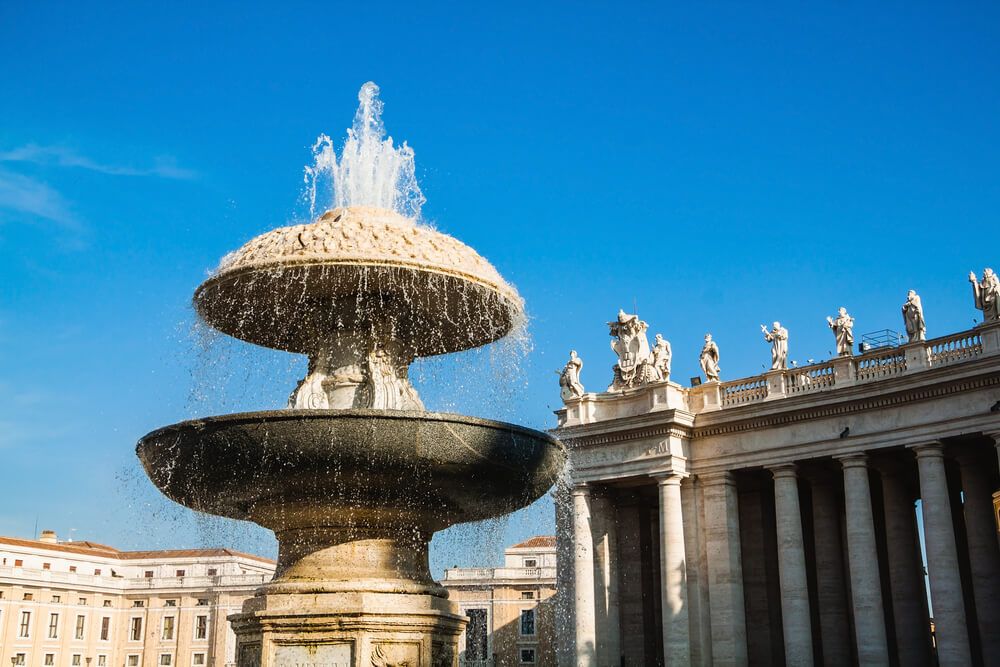
The wind rose, created by Filippo gigli in 1817, gives information about the 8 winds that cross the city of Rome, the sundial has the obelisk as its needle.
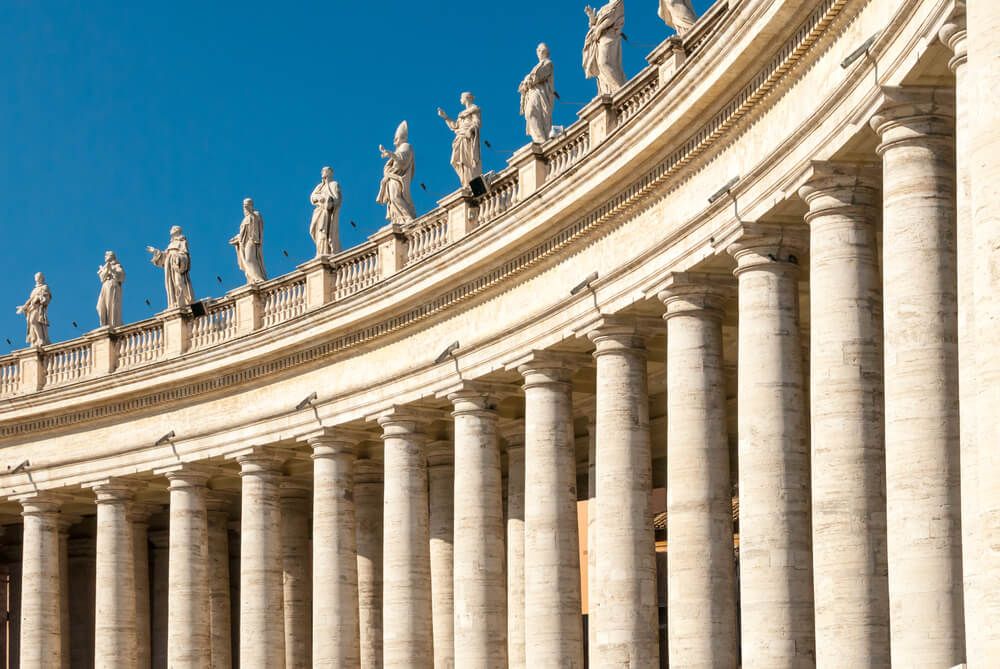
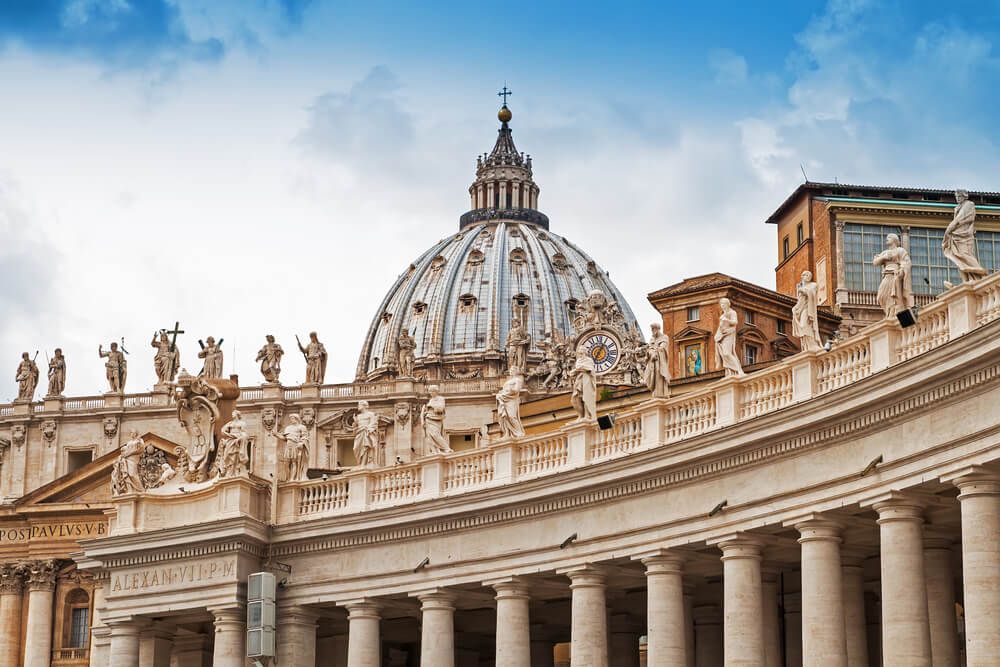
St. Peter's Square in Rome and its 140 Statues of Saints and Martyrs
Many Italian and French sculptors of the 17th century participated in the elaboration of these statues: Lazzaro Morelli, Giacomo Antonio Fancelli, Pierre-Étienne Monnot, Jean-Baptiste Théodon, Bartolommeo Cennini, Giuseppe De Fabris...
They mainly represent men, but also some women (38 in total), martyr saints, popes and bishops, nobles, church reformers... These people are mainly from Italy, France, and Spain.
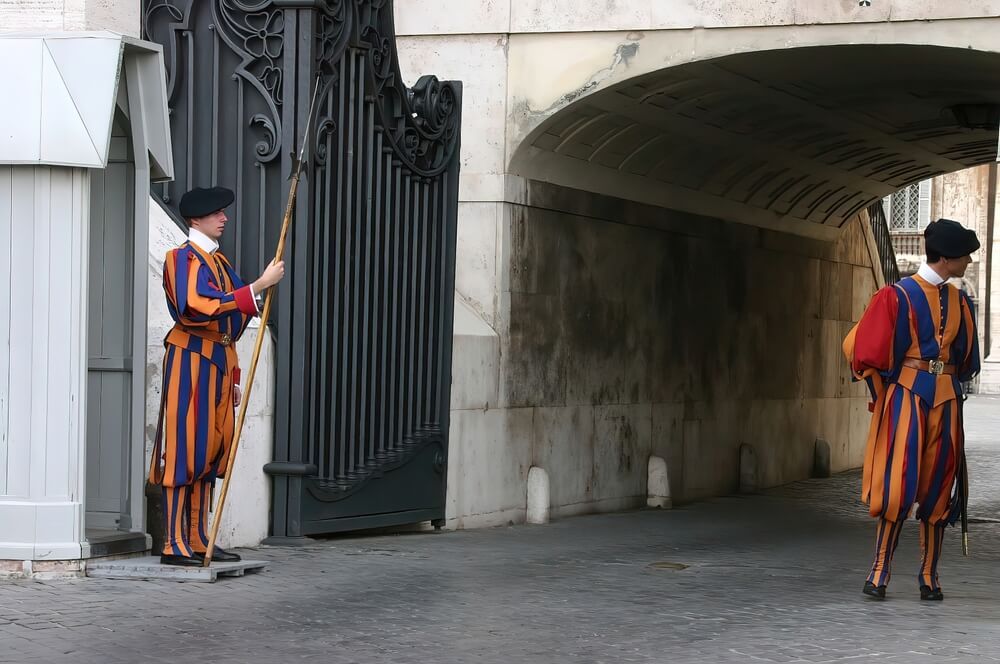
The Swiss Guards
It is the Swiss Guards who are responsible for protecting the Vatican City State or Holy See. Since 1506, they have been protecting the Pope and his residence. You will find them at the Bronze Door with their colorful uniform.
Contrary to popular belief, the uniform is indeed Renaissance style, but was not created at that time, its history is quite different: it was a commander of the Swiss Guard who had this idea much later in the 20th century. However, he was inspired by a model by Michelangelo who lived during this Renaissance period. The Vatican army is the smallest in the world with only 110 soldiers.
Warning: these are real military personnel, they are not there to parade and take selfies with tourists! If you want to photograph them, be sure to keep a certain distance.
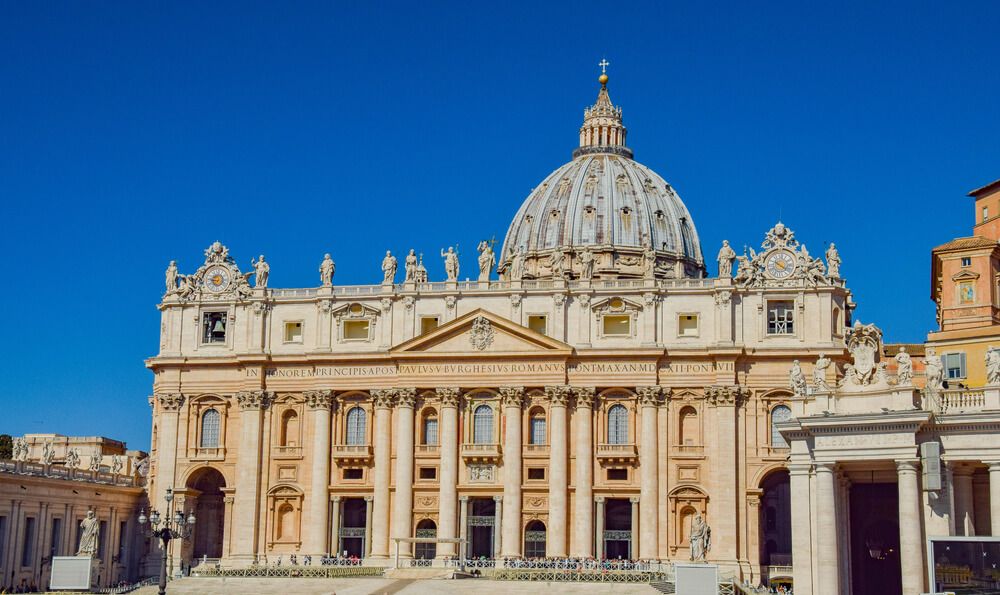
St. Peter's Basilica
Built in the 4th century, it was, from the early Middle Ages, the most important pilgrimage site in the West. It underwent major modifications in the 16th century under the impetus of Pope Julius II: what had been only a church for 1,200 years was at risk of falling into ruin and was replaced by the current basilica starting from 1506, the beginning of construction. This work lasted a century, thousands of workers participated in this titanic construction project in downtown Rome. The facade and nave were designed by architect Carlo Maderno.
Grandiose, monumental, superb... Superlatives are usually not lacking in visitors' comments as the exterior and interior views are simply fabulous. A legendary monument. Richness of decoration, fineness of details, monumental pillars, polychrome marbles, the dome designed by Michelangelo, the funeral monument of Pope Alexander VII Chigi... To finish the visit beautifully, thanks to an access that will take you to the top of the dome, you will have an exceptional 360-degree view of the city of Rome, the colonnades, the fountain, and its crowd of visitors, regardless of the schedule.
Where is St. Peter's Square located?
St. Peter's Square is located at Piazza San Pietro, Vatican City in Rome.
How to get to St. Peter's Square?
By Metro to St. Peter's Square
Ottaviano station, line A (red).
By bus to St. Peter's Square
Buses 40, 62, 64, 81.
By tram to St. Peter's Square
Stop at Piazza del Risorgimento.
By car to St. Peter's Square
It is impossible to enter Vatican City by car, the nearest parking lots are:
- Prati Parking, on Piazza Unità, 62 – 193
- Garage San Pietro, on Via di Santa Maria alle Fornaci, 26 – 165 (5 min walk).
- Garage Vespasian.
Website: https://www.parkingroma.it/ online reservation of your nearby parking with your email address.
To do:
The Sistine Chapel: one of the rooms of the pontifical palaces of the Vatican, this chapel is part of the Vatican Museums. The Circus Maximus or Circo Massimo, this monument was the largest stadium in Rome in the tradition of chariot races with its 600 meters in length, we can still see today the remains of this building with immense dimensions. If you are looking for a souvenir, a religious item, the many shops around St. Peter's Square or piazza san pietro should satisfy your curiosity.