
Créé par Emilie, le 7 mai 2026
Votre guide Ryo
© Shutterstock
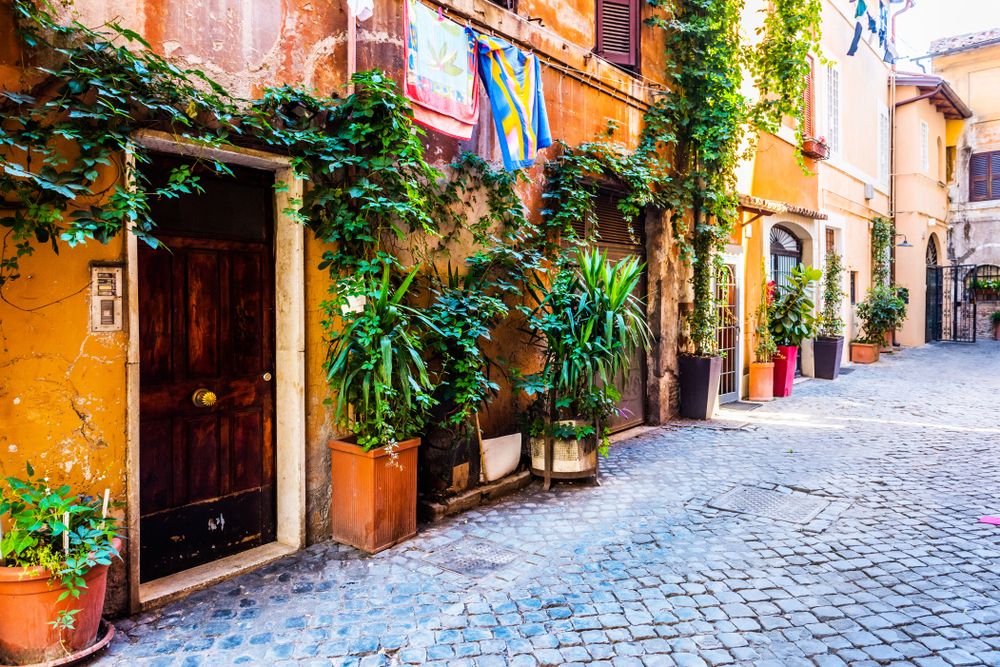
Nestled on the right bank of the Tiber, the district of Trastevere in Rome is one of the most charming and authentic neighborhoods of the Eternal City. Its name, which literally means "beyond the Tiber" in Latin (Trans Tiberim), sums up the identity of this unique territory, long remaining on the margins of imperial Rome's heart. Today, its cobbled alleys, ochre and golden facades, lively small squares and fragrant trattorias make it one of the most appreciated neighborhoods by travelers who wish to Visit Rome differently, away from the main tourist arteries.
Visiting the Trastevere quarter means immersing yourself in popular and warm Rome, that of inhabitants who settle on terraces in the evening, children playing in the squares, lively morning markets and musicians improvising at the corner of an alley. Between exceptional religious heritage, Renaissance masterpieces, secret gardens and authentic Roman gastronomy, Trastevere has everything to seduce. This comprehensive guide takes you to discover everything this legendary quarter has to offer.
1. The history of the Trastevere quarter: Rome beyond the Tiber
Crossing the Tiber to reach Trastevere means crossing a symbolic frontier that separates imperial Rome from popular Rome. Since Antiquity, this territory located on the right bank of the river did not officially belong to the city of Rome. It was under Augustus's reign, between 31 BC and 14 AD, that Trastevere was officially incorporated into the city as the 14th region. The quarter then welcomed sailors, fishermen, merchants and immigrants from all over the Mediterranean basin — notably an important Jewish community, among the oldest in the West, and numerous Orientals from Syria and Egypt.
It was precisely in this cosmopolitan and popular environment that Christianity was established very early in Rome. Archaeological excavations attest to the presence of Christian places of worship in the quarter from the 3rd century, making it one of the cradles of Christian faith in the capital. In the Middle Ages, Trastevere affirmed itself as an autonomous quarter, proud of its traditions, with its own craftsmen, corporations and distinctive popular culture. Its inhabitants, the trasteverini, are renowned for their strong character and visceral attachment to their quarter — a reputation that has not entirely disappeared today. If you're preparing your trip, don't miss the Ryo audio-guided tour to visit Rome: it will help you understand how Trastevere connects with the other great stops of the eternal city.
2. Piazza Santa Maria in Trastevere, the living heart of the quarter
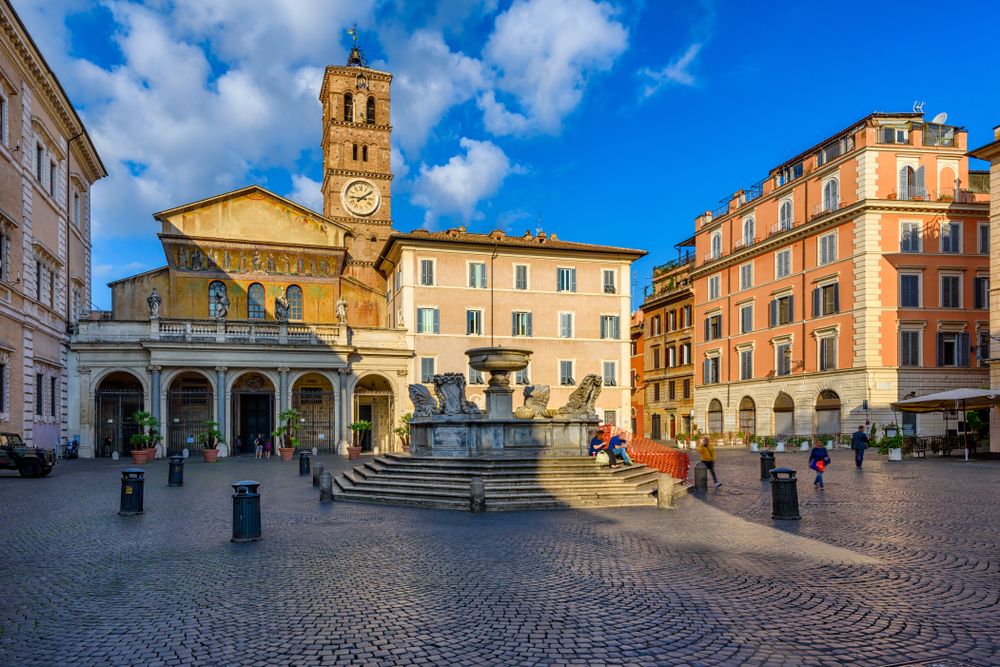
Any visit to the Trastevere quarter naturally begins on the piazza Santa Maria in Trastevere, the main square of the quarter and one of the liveliest places in Rome at any hour of the day. Surrounded by terrace cafes, restaurants and small shops, this shaded square is a true open-air salon where Romans and travelers mingle with disconcerting ease.
At its center stands a Roman fountain considered one of the oldest in Rome. Its first mention dates back to the 8th century, although its current form results from successive restorations, notably those of Bernini in 1659 and Carlo Fontana in 1692. Around the fountain, from morning onwards, the quarter awakens slowly: inhabitants have their coffee, vendors set up their stalls, and the peaceful atmosphere contrasts with the agitation of the rest of Rome. In the evening, this is where street musicians, groups of friends and lingering tourists converge, transforming the square into a permanent and spontaneous stage. Piazza Santa Maria in Trastevere is also the ideal starting point to explore the surrounding alleys and discover the best of Rome on foot with the Ryo tour.
3. The basilica Santa Maria in Trastevere, jewel of Roman medieval art
Dominating the square with its imposing gold-lit facade, the basilica Santa Maria in Trastevere is the absolute must-see of the quarter. This edifice is considered one of the very first Christian places of worship officially established in Rome. According to tradition, it was here that a spring of oil miraculously gushed at the precise moment of Jesus's birth — which would have led to the construction of a first oratory from the 3rd century. The basilica as we know it today dates back to the 12th century, under Pope Innocent II's pontificate.
What strikes first is the splendor of its Byzantine mosaics: the facade itself is adorned with a 12th-century mosaic representing the Virgin and ten holy women carrying lamps. Inside, the apse is entirely covered with golden mosaics of rare beauty, including the famous panels attributed to Pietro Cavallini (13th century) depicting six scenes from the life of the Virgin Mary with a realism that foreshadowed the Renaissance. The cosmatelque mosaic floor, ancient granite columns and nave bathed in golden light give the whole a rare atmosphere of contemplation and wonder. Entry is free, and the visit is essential for anyone interested in early Christian and Roman medieval art.
Download the audio-guided tour to discover Rome on foot and independently
To explore Trastevere and its treasures beyond this guide, the Ryo app offers a complete audio-guided tour to visit Rome including 23 commented stops, including one dedicated to the basilica Santa Maria in Trastevere. Interactive navigation, historical commentary and savory anecdotes: let yourself be guided through the streets of Rome at your own pace, without a human guide, directly from your smartphone. An ideal tool to prepare or extend your visit to the quarter.
4. Villa Farnesina, Renaissance masterpiece in Trastevere
A stone's throw from the basilica, going up Via della Lungara, hides one of Rome's unknown gems: Villa Farnesina (Via della Lungara 230, 00165 Rome). This Renaissance villa, built between 1508 and 1511 for Agostino Chigi, a Sienese banker among the richest of his time, is a remarkable example of High Renaissance architecture and painted decoration. Its sober and elegant architecture, work of Baldassarre Peruzzi, contrasts with the decorative profusion of its interior.
It's inside that the true magic of Villa Farnesina is revealed. The Loggia of Galatea, on the ground floor, houses a fresco by Raphael representing the Triumph of Galatea, considered one of his most accomplished works. The Loggia of Cupid and Psyche, whose vault is entirely covered with frescoes commissioned from Raphael and executed in part by his pupils, resembles a pergola invaded by the gods of mythology. Upstairs, the Hall of Perspectives painted in trompe-l'oeil by Peruzzi offers a striking visual spectacle. The visit to Villa Farnesina is a must for Renaissance art enthusiasts and can easily be combined with discovering Rome's other unmissable museums.
5. Palazzo Corsini and its National Gallery of Ancient Art
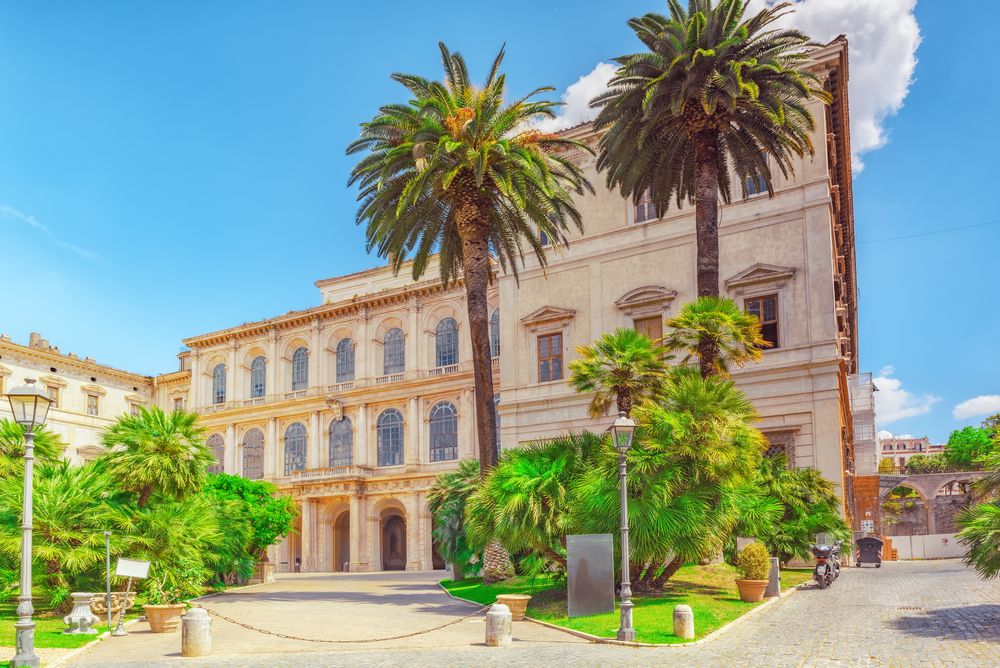
Just across from Villa Farnesina, on the same Via della Lungara, stands the imposing Palazzo Corsini (Via della Lungara 10, 00165 Rome). This late Baroque palace, built between 1730 and 1740 for the Corsini family — from which Pope Clement XII came — is today the seat of one of the two components of the National Gallery of Ancient Art. It has the particularity of being the only museum in Rome to have preserved its original 18th-century arrangement.
The Palazzo Corsini collections bring together several hundred paintings from the 14th to 18th centuries, with a fine representation of Flemish art and the Roman Baroque school. One can admire works by Guido Reni, Nicolas Poussin, Bartolomé Esteban Murillo, Fra Angelico and Rubens, hung in rooms with ornate ceilings of great elegance. The museum's modest size compared to the giants of the Capitoline or Vatican makes it a restful and intimate visit, appreciated by art lovers who flee large crowds. Palazzo Corsini also adjoins the splendid Botanical Garden of Rome, allowing one to combine two visits in the same walk.
6. Orto Botanico di Roma, a green parenthesis in the heart of Trastevere
Leaning against the Janiculum Hill and adjoining Palazzo Corsini, the Orto Botanico di Roma (Largo Cristina di Svezia 24, 00165 Rome) is one of the most beautiful botanical gardens in Italy. Officially founded in the 19th century on lands that belonged to Queen Christina of Sweden — whose palace, the current Palazzo Corsini, is neighboring — it spreads its twelve hectares of lush vegetation on the slopes of Gianicolo.
Visiting this garden is a real breath of fresh air in a city as mineral as Rome. One discovers an impressive bamboo forest, a serene Japanese garden, a fragrant rose garden, an orangery, and thematic sections dedicated to medicinal plants or rare essences. Families particularly appreciate the shaded paths and cascading fountains. In summer, the botanical garden is a very welcome oasis of freshness during the visit to the Trastevere quarter. Entry is paid, but the rates remain very reasonable.
7. The Janiculum Hill, unique panorama over the Eternal City
Dominating Trastevere from its heights, the Janiculum Hill (or Gianicolo) offers one of the most spectacular panoramas of all Rome. Although it's not part of the city's seven historic hills, the Janiculum is the highest hill visible from central Rome, and its terraces allow one to embrace with a single glance the entire eternal city, from the Pantheon to Saint Peter's Basilica passing through the Colosseum. The sunset from the Janiculum terraces is an unforgettable experience, not to be missed under any circumstances.
Climbing towards the summit, one passes the Fontana dell'Acqua Paola (Via Garibaldi, 00153 Rome), nicknamed er Fontanone (the "big fountain") by Romans. Built in 1612 by architect Giovanni Fontana on Pope Paul V's orders, this monumental Baroque fountain marks the terminus of the restored Trajan aqueduct. Its five-arch facade in white marble, inspired by a triumphal arch, is of striking majesty. Higher up, at the summit of the hill, a majestic equestrian statue of Garibaldi overlooks the city — a strong symbol of the Italian Risorgimento. Know that a cannon shot is fired every day at noon from the Janiculum to remind Rome's inhabitants of the time, a tradition dating back to 1847.
The Ryo audio-guided tour also passes by the surroundings of this emblematic quarter: let yourself be guided through authentic Rome to miss nothing of the hidden treasures of the Tiber's right bank.
8. Ponte Sisto and piazza Trilussa, gateway to Trastevere
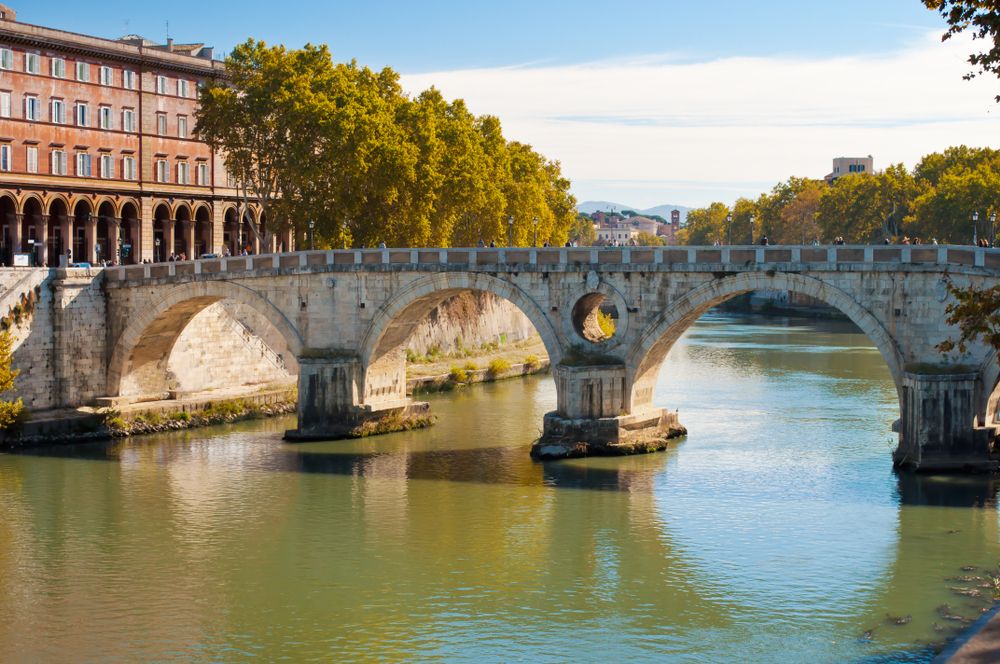
One of the most pleasant ways to reach Trastevere from Rome's historic center is to cross Ponte Sisto, the elegant pedestrian bridge spanning the Tiber. Rebuilt in the 15th century on Pope Sixtus IV's orders (hence its name), it replaced an ancient bridge probably swept away by a Tiber flood in 791. Its sober and robust stone silhouette, four arches and oculi pierced to let floods pass — a remarkable technical innovation for the time — make it one of Rome's most charming bridges.
Crossing Ponte Sisto on the Trastevere side, one emerges onto piazza Trilussa (Piazza Trilussa, 00153 Rome), a true living square of the quarter and an unmissable meeting place for Romans at aperitif time. The square takes its name from the pseudonym of Roman dialectal poet Carlo Alberto Salustri, whose statue stands in the center. Its Baroque fountain, with water flowing from lion masks, is an almost obligatory photo stop. From late afternoon, the fountain steps and surrounding stairs are covered with young Romans meeting for spritz hour. The atmosphere is relaxed, convivial, and very far from the mass tourism that reigns in other parts of the city.
9. The Museum of Rome in Trastevere, dive into Roman popular life
Installed in the former 17th-century Carmelite convent located on piazza di Sant'Egidio (Piazza di Sant'Egidio 1B, 00153 Rome), the Museo di Roma in Trastevere is an intimate and endearing museum, often ignored by classic tourist guides but nevertheless precious for those who want to understand the soul of the quarter. Founded in 1977 after the convent's restoration, it was initially dedicated to Roman folklore and popular traditions.
Today, the Museum of Rome in Trastevere offers permanent and temporary exhibitions centered on Roman daily life in the 18th and 19th centuries: watercolors representing popular costumes and customs, reconstructions of life scenes, old photographs and everyday objects. The piazza Sant'Egidio on which it faces is itself one of the calmest and most photogenic squares in Trastevere, ideal for a break away from the hustle and bustle. A small art bookstore is installed on the museum's ground floor.
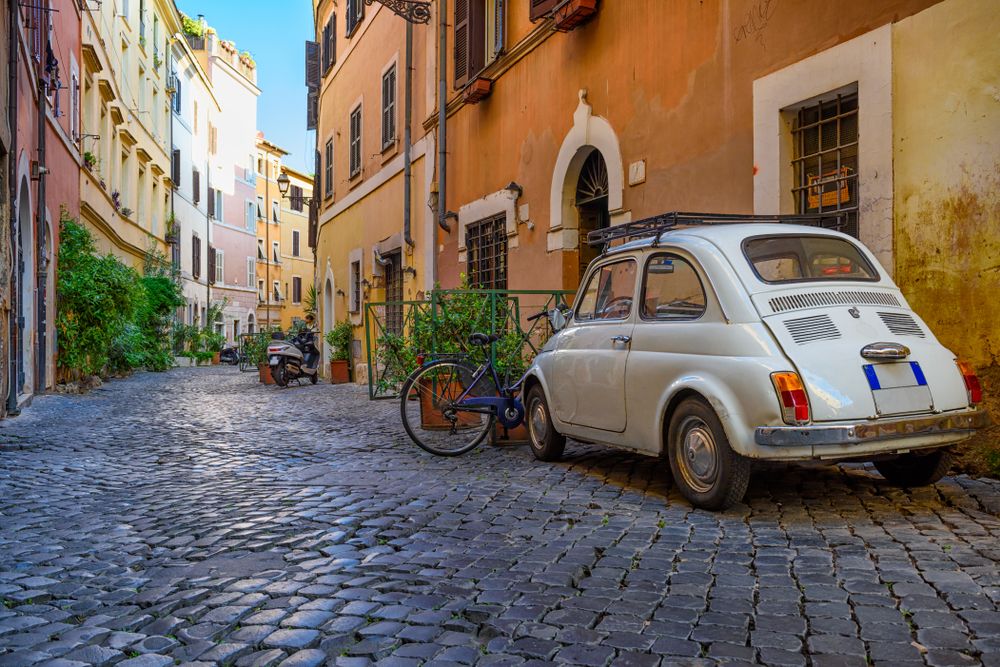
10. Getting lost in Trastevere's alleys, the true magic of the quarter
Beyond its monuments, it's the aimless wandering through Trastevere's alleys that constitutes the quarter's most memorable experience. The network of cobbled lanes, flowery interior courtyards, vaulted passages and secret small squares is a labyrinth that one takes pleasure in not deciphering too quickly. Every street corner holds a surprise: an ivy-covered facade, a Madonna in her niche lit by a candle, a craftsman's workshop open to the street, a cat sleeping on a tufa wall.
Among the places not to miss during this stroll, the Porta di Settimiana deserves a stop: this remnant of the ramparts built by Emperor Aurelian in the 3rd century symbolically delimits the entrance to Trastevere from Via della Lungara. Further south, piazza Mastai is a square less known to tourists, named after Pope Pius IX (Giovanni Mastai), who had the pontifical tobacco factory built there in 1860. These places constitute some of the stops on the Ryo audio-guided visit tour of Rome, which takes you to the most unusual corners of the city. Take time to stop in the small craft shops, art galleries and independent bookstores that dot the alleys: they're an integral part of Trastevere's unique charm.
11. Gastronomy in Trastevere: eating like a Roman
Trastevere is, along with Testaccio, one of Rome's quarters where Roman popular gastronomy is best represented. Its alleys are full of trattorias and osterias offering characterful cuisine, generous and unsophisticated, faithful to recipes passed down from generation to generation. To get into the atmosphere, start with antipasti: supplì al telefono (fried rice croquettes with stringy mozzarella), carciofi alla romana (artichokes simmered in olive oil, garlic and mint) or fiori di zucca fritti (stuffed and fried zucchini flowers). To learn more about specialties to taste absolutely, check our article What to eat in Rome? Our selection of 14 Roman specialties.
In terms of main courses, the must-haves are rigatoni alla carbonara, bucatini all'amatriciana, cacio e pepe or coda alla vaccinara (braised oxtail in tomato sauce with herbs). Among the quarter's renowned addresses, Il Tonnarello (Via della Paglia 1-3, 00153 Rome) is one of the most emblematic trattorias, known for its generous portions and authentic atmosphere. L'Antica Pesa (Via Garibaldi 18, 00153 Rome), founded in 1922, offers refined Roman cuisine in an elegant historic setting. For a sweet break, Trastevere's bignè and maritozzi are savored on the go, standing in front of a bar, like a true Roman.
12. Trastevere in the evening: Rome's most festive quarter
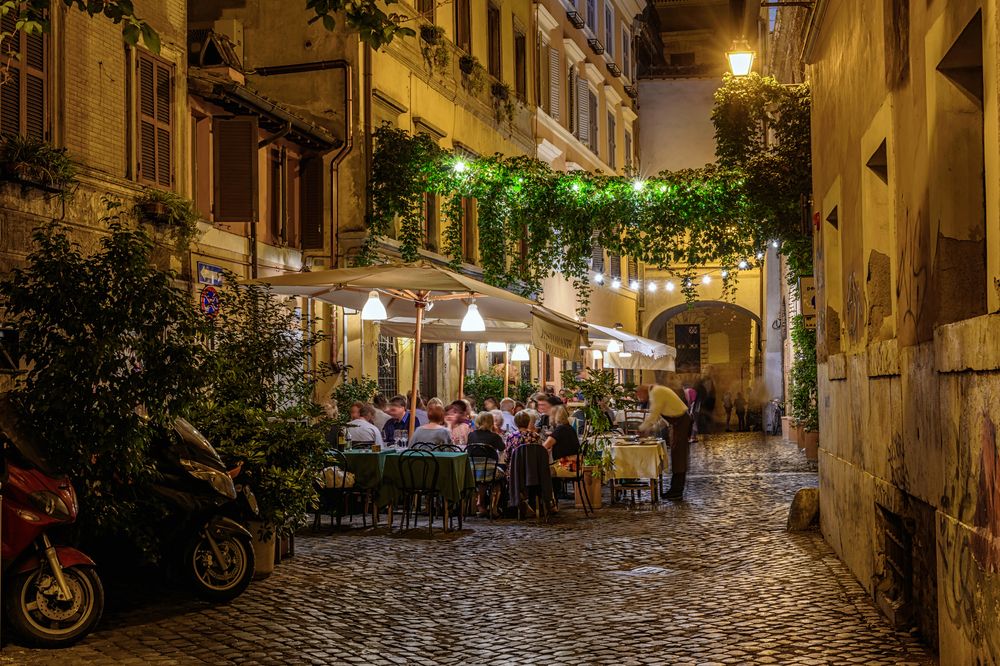
When the sun begins to decline over Rome's rooftops, Trastevere is transformed. The quarter, already charming by day, reveals a festive and warm soul that makes it one of the liveliest places in the Italian capital after nightfall. The ochre facades are illuminated by the soft lights of restaurants and bars, terraces fill up, and music from bars escapes into the cobbled alleys.
The Trastevere quarter attracts both young Romans and foreign travelers to its bars and intimate clubs. Via del Moro, Via della Scala and the alleys adjacent to piazza Trilussa concentrate most of the quarter's nightlife. Unlike downtown nightclubs, the atmosphere here is that of convivial wine bars, restaurant-concerts where one dines under brick vaults, and small improvised stages where jazz or folk musicians set up at the corner of a square. To best prepare your evening in the quarter after a beautiful day of visiting, check our selection of best activities in Rome and surroundings.
13. Practical tips for visiting the Trastevere quarter
How to get to Trastevere?
Trastevere is accessible from Rome's historic center on foot, by bike or by public transport. On foot from the Pantheon or piazza Navona, count about 20 to 25 minutes. By tram, lines 8 and H serve the quarter directly. From Termini station, bus 8 is the most convenient solution. The quarter is also easily accessible from the Vatican by walking along the Tiber.
What's the best time to visit Trastevere?
Trastevere is ideally visited in the morning to enjoy the calm of the alleys before the tourist influx, or late afternoon for the aperitif atmosphere and golden light that adorns its facades. At night, the quarter reveals its festive life. To avoid in midsummer between 12pm and 4pm, when heat and crowds are at their peak. If you're planning a multi-day visit to Rome, check our guide to free activities and visits in Rome to optimize your stay.
Where to park to visit Trastevere?
The Trastevere quarter is located in Rome's ZTL (Limited Traffic Zone), which means car access is very restricted for non-residents. It's strongly advised to park outside the quarter — the Gianicolo parking (Via Urbano VIII 16/C) is a good option — and reach the quarter on foot or by public transport.
How much time is needed to visit Trastevere?
Half a day is enough for a quick visit covering the basilica Santa Maria in Trastevere, the main square and a few alleys. For a complete discovery including Villa Farnesina, Palazzo Corsini, the botanical garden and a climb to the Janiculum, plan a full day. Coupled with an evening in the quarter's restaurants and bars, Trastevere can easily occupy a day and a half of your Rome stay.
In conclusion, visiting the Trastevere quarter in Rome is a unique experience that blends art, millennial history, popular gastronomy and the Italian art of living in a setting of golden alleys and lively squares. Whether you're passionate about medieval art, an epicurean seeking Rome's best trattorias or simply in love with authentic atmospheres, Trastevere will touch you. To extend the adventure and discover Rome in all its depth, don't hesitate to use the Ryo audio-guided tour to visit Rome on foot and independently: 23 commented stages for a complete immersion in the immortal city, including several dedicated to the heart of Trastevere.
FAQ – Visiting the Trastevere quarter in Rome
Is the Trastevere quarter dangerous?
No, Trastevere is a safe and well-frequented quarter, including at night. As in any heavily visited tourist area, however, beware of pickpockets in very crowded areas (around piazza Santa Maria in Trastevere and piazza Trilussa notably) and keep your belongings in sight. Overall, it's one of the quarters where it's pleasant to walk in the evening in Rome.
Is Trastevere far from Rome's other tourist sites?
No, Trastevere is well situated relative to Rome's main attractions. The quarter is about 20-25 minutes walk from the Pantheon and piazza Navona, 30 minutes from the Colosseum, and 15 minutes walk from the Vatican along the Tiber. Many tourists therefore combine visiting Trastevere with the Vatican in the same day.
Is there a market in Trastevere?
Yes, the piazza San Cosimato market is held Monday to Saturday mornings and offers local fruits, vegetables, cheeses and cold cuts in a very Roman atmosphere. It's a nice stop for travelers who want to soak up the quarter's daily life. A flea market is also held Sunday mornings on the same square.
Is the basilica Santa Maria in Trastevere open every day?
Yes, the basilica Santa Maria in Trastevere is generally open every day from 7:30 AM to 9:00 PM, with possible closure at midday during religious services. Entry is free. It's advised to go early morning or early evening to avoid crowds and fully enjoy the luminous atmosphere of its golden mosaics.
Can you visit Trastevere with children?
Absolutely! Trastevere is a very family-friendly quarter, with its open squares, gardens (notably the botanical garden), gelaterias and welcoming restaurants. The cobbled alleys can however be a bit difficult for strollers. The Janiculum, with its panorama and traditional small carousels installed in summer, is particularly appreciated by families with young children. The quarter offers a nice diversity of experiences for all generations.