
Créé par Romane, le 20 juin 2026
Votre guide Ryo
Visit Hadrian's Villa near Rome
© Shutterstock
A few kilometers from Rome, in the town of Tivoli, stands one of the most spectacular testimonies of the Roman Empire's grandeur: Hadrian's Villa. Spanning over 120 hectares, this imperial residence built in the 2nd century fascinates with its innovative architecture and remarkable state of conservation. Listed as a UNESCO World Heritage site since 1999, it offers a unique dive into the refinement of ancient Rome and helps better understand the personality of one of the most cultivated emperors in Roman history. Follow this complete guide to prepare your visit to this exceptional archaeological site.
What is Hadrian's Villa?
Hadrian's Villa, or Villa Adriana in Italian, is a vast imperial residence built in the 2nd century AD by Emperor Hadrian (117-138). Located in Tivoli, about 30 kilometers east of Rome, it extends over a domain of more than 120 hectares, making it one of the largest villas of Roman Antiquity. Much more than a simple residence, it was a true small town comprising palaces, thermal baths, libraries, theaters, temples and sumptuous gardens.
Hadrian, a scholarly emperor and great traveler, conceived this villa as a place of retreat and reflection. Passionate about architecture and foreign cultures, he reproduced the monuments and landscapes that had impressed him during his travels throughout the Empire, from Greece to Egypt. The result is a unique architectural ensemble harmoniously blending Roman, Greek and Egyptian influences, testifying to the open-mindedness of this cultivated emperor.
How to get to Hadrian's Villa from Rome?
Located in Tivoli, Hadrian's Villa is easily accessible from Rome by different means of transport. Here are the main options to reach this exceptional site.
By bus from Rome
The most economical option is the Cotral bus. Go to Ponte Mammolo metro station (line B) in Rome, then take a Cotral bus heading to Tivoli. Get off at the "Bivio Villa Adriana" stop which is about 300 meters from the site entrance. The journey takes about 50 minutes and costs around €2.60. Buses run regularly throughout the day.
By train from Rome
From Roma Termini or Roma Tiburtina station, take a regional train heading to Tivoli. Once you arrive at Tivoli station, you'll need to take a local CAT bus number 4 which will drop you off near Hadrian's Villa. The train journey takes about 30 minutes, but the entire trip with the local bus can take 1 to 1h15.
By car
If you have a vehicle, take the A24 highway towards L'Aquila and exit at "Tivoli". Then follow the signs indicating "Villa Adriana". Free parking is available near the site entrance. The journey from Rome's center takes about 40 minutes depending on traffic.
By taxi or ride-hailing
For more comfort, you can book a taxi or ride-hailing service from Rome. Count about €50 to €70 for a one-way trip. This option is particularly interesting if you're traveling in a group.
With an organized guided tour
Many agencies offer day excursions from Rome including transport, entrance and an English-speaking guide. It's a practical solution that often allows you to combine the visit of Hadrian's Villa with that of Villa d'Este, another jewel of Tivoli.
Opening hours and prices for Hadrian's Villa
1. Opening hours
Hadrian's Villa is open every day of the year, except January 1st, May 1st and December 25th. Opening hours vary according to seasons:
- October 26 to November 30: 9:00 AM – 5:15 PM (last entry at 4:15 PM)
- January 2 to March 25: 9:00 AM – 5:00 PM (last entry at 4:00 PM)
- March 26 to June 30: 9:00 AM – 7:00 PM (last entry at 6:00 PM)
- July 1 to August 31: 9:00 AM – 7:00 PM (last entry at 6:00 PM)
- September 1 to last Sunday of October: 9:00 AM – 7:00 PM (last entry at 6:00 PM)
It is recommended to arrive at least two hours before closing to fully enjoy your visit.
2. Entrance fees
The rates to visit Hadrian's Villa are as follows:
- Standard adult ticket: €10
- Youth ticket (13-17 years): €8
- Children's ticket (6-12 years): €5
- Free for under 6 years old
- Skip-the-line ticket: €15
Entry is free on the first Sunday of each month, as well as during certain Italian national holidays (April 25, June 2, November 4). Combined tickets with Villa d'Este are also available at reduced rates.
3. Online booking
It is strongly recommended to book your tickets online via the CoopCulture website or other specialized platforms. Booking allows you to avoid queues, which are particularly long in high season, and guarantees you access to the site during peak hours. Booking fees of €2 generally apply.
Download the audio-guided circuit to discover Rome on foot and independently
To make the most of your stay in the Rome region, don't hesitate to download our audio-guided itinerary to visit Rome. Our circuit takes you through the emblematic monuments of the Eternal City, from the Colosseum to the Roman Forum via Trastevere. With 24 fun audio guides and interactive navigation, explore Rome like never before. The circuit also includes recommendations for organizing an excursion to Tivoli and discovering Hadrian's Villa in the best conditions.
What to see at Hadrian's Villa?
The archaeological site of Hadrian's Villa is filled with exceptional monuments. Here are the must-sees not to miss during your visit.
1. The Pecile
The Pecile is an immense rectangular portico inspired by the Painted Portico of Athens that Emperor Hadrian had admired during his travels. 232 meters long and 97 meters wide, this space was bordered by columns and surrounded a vast central basin. It was a place for philosophical strolling where the emperor liked to meditate. The monumental dimensions of the Pecile testify to Hadrian's desire to recreate the atmosphere of great Greek public spaces within his private residence.
2. The Maritime Theater
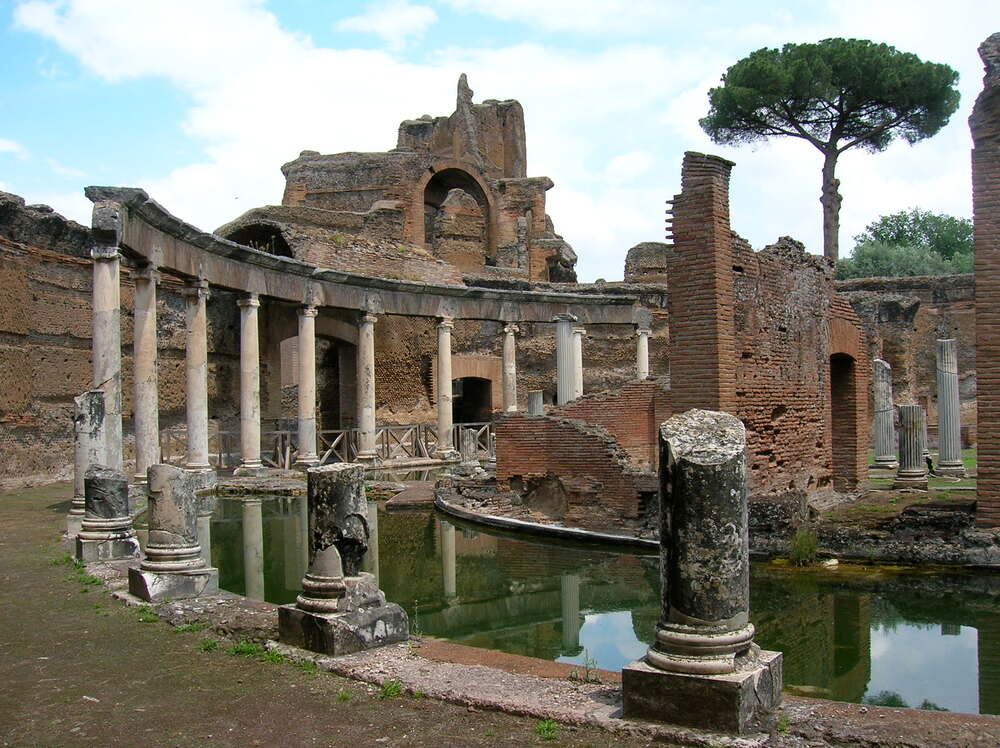
The Maritime Theater, also called the "Enchanted Island", is one of the most original monuments of the villa. It is a small circular residence built on an artificial island, surrounded by a canal and a columned portico. Accessible by a movable bridge, this pavilion housed a library, rest rooms and a miniature garden. It was Hadrian's most intimate refuge, where the emperor retired to read, meditate and isolate himself from his court. The circular architecture and ingenious arrangement of spaces reveal Hadrian's taste for architectural innovation and his need for solitude.
3. The Canopus and Serapeum
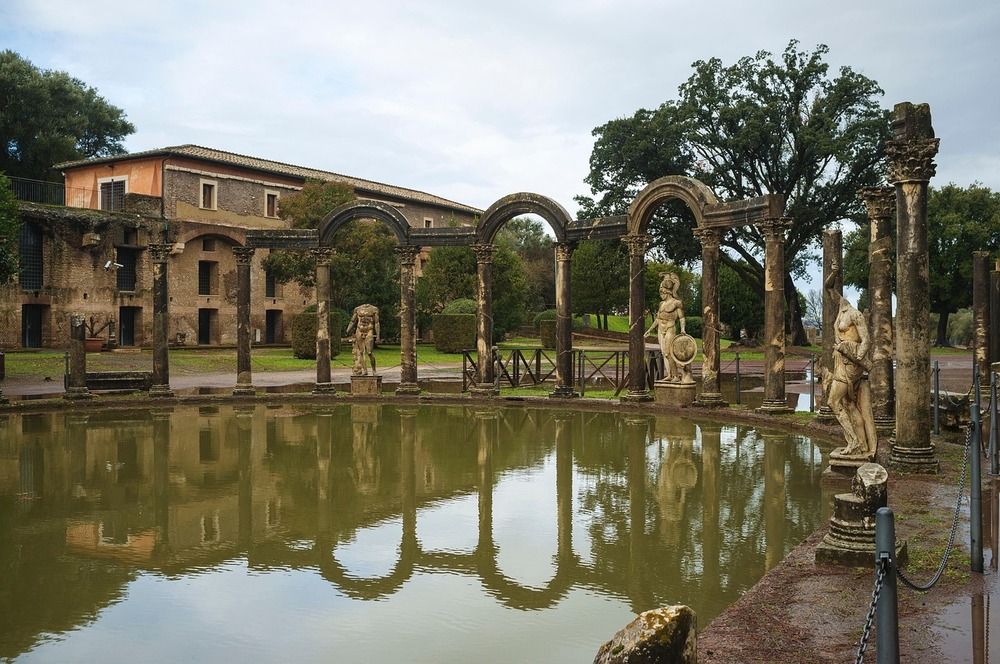
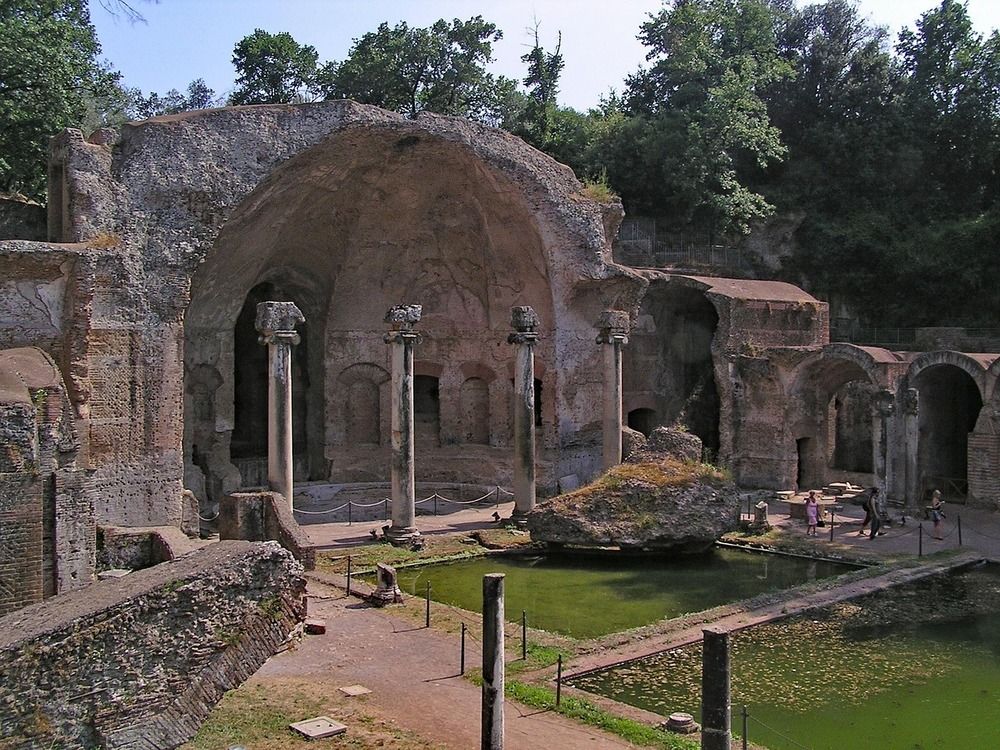
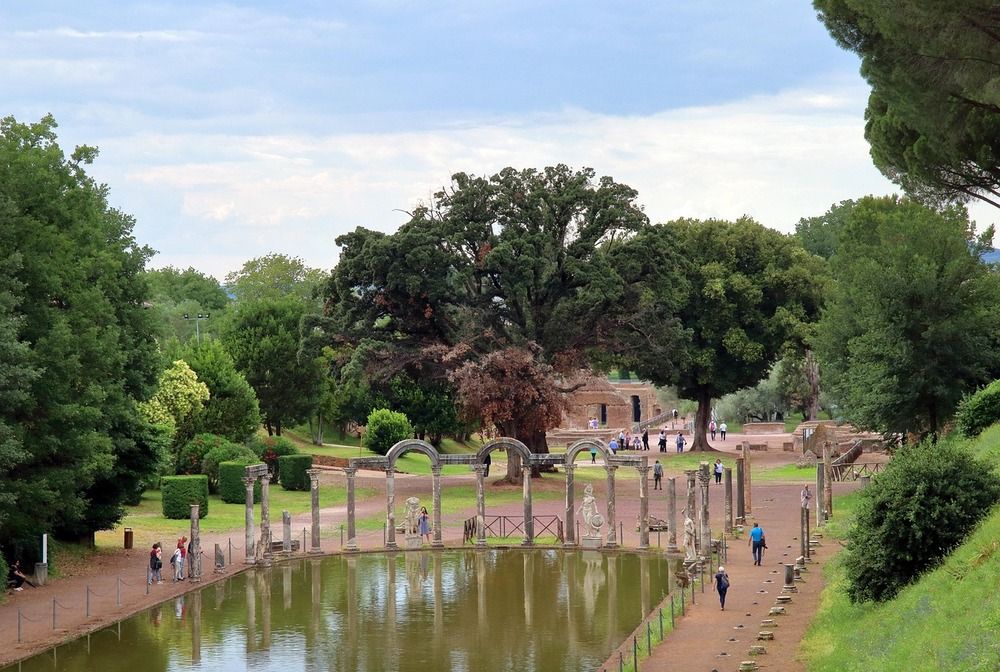
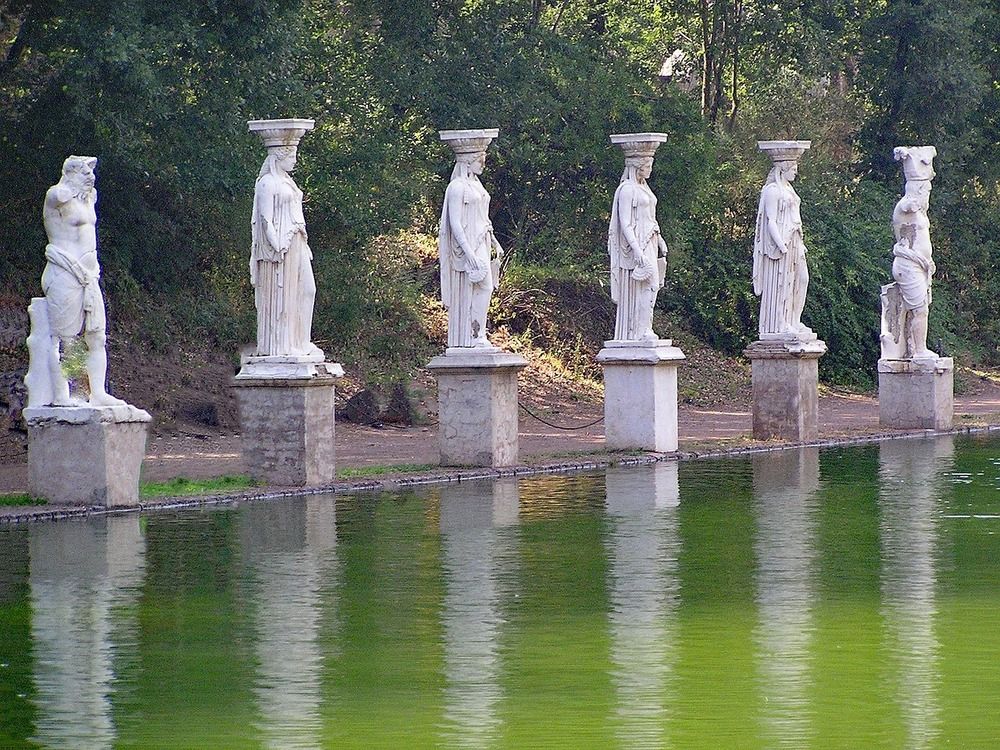
The Canopus is undoubtedly the most spectacular ensemble of Hadrian's Villa. It is a long 119-meter basin bordered by columns, statues and sculptures, reproducing the canal that connected Alexandria to the city of Canope in Egypt. At the end of the basin is the Serapeum, a monumental nymphaeum where Hadrian organized summer banquets sheltered from the heat. The half-dome vault and sophisticated water features created a refreshing and majestic atmosphere. This ensemble testifies to Hadrian's fascination with Egyptian culture and the ingenuity of Roman engineers in hydraulic matters.
4. The Thermal Baths (Large and Small)
The villa included two thermal complexes: the Large Baths and the Small Baths. These facilities reflect the importance of bathing in Roman society. The Large Baths, intended for the court and guests, included a frigidarium (cold bath), a tepidarium (warm bath) and a caldarium (hot bath), as well as gymnasiums and massage rooms. The Small Baths, more intimate, were probably reserved for the emperor and his close family. You can still admire the remains of underfloor heating systems (hypocausts) and the magnificent mosaics that adorned these relaxation spaces.
5. The Piazza d'Oro
The "Golden Square" owes its name to the richness of its ornamentation. This vast reception space included a peristyle surrounding a courtyard enhanced with basins and fountains. The walls were covered with precious marbles, the columns were in Carrara marble, and the floors were adorned with refined mosaics. The remains of gilded stucco that still survive testify to the extraordinary luxury of this space. The Piazza d'Oro was probably used for official receptions and imperial ceremonies, where Hadrian received dignitaries and ambassadors from throughout the Empire.
6. The Imperial Palace
The Imperial Palace was the residential heart of the villa. It housed Hadrian's private apartments, reception halls and the famous Triclinium, an immense banquet hall where the emperor organized his feasts. The palace also included a double library, divided into Greek and Latin sections, testifying to Hadrian's encyclopedic culture. The frescoes and marbles that decorated these spaces have unfortunately disappeared, but the magnitude of the ruins still allows us to imagine the splendor of these places. It was here that the daily life of the emperor and his court took place.
7. The gardens and esplanades
Beyond the buildings, Hadrian's Villa had vast landscaped gardens with groves of olive trees, cypresses and umbrella pines. The gardens were enhanced with fountains, statues and panoramic viewpoints over the surrounding countryside. These green spaces were not only decorative: they also served the agricultural production of the villa. Fruits, vegetables and aromatic plants were cultivated there. The tree-lined avenues and shaded spaces invited walking and contemplation, in the spirit of Greek philosophical gardens.
8. The Didactic Museum
Before starting your visit to the archaeological site, don't miss the Didactic Museum located at the entrance. It presents a model reconstructing the villa in its original state, which will greatly help you visualize the architectural ensemble. You will also find copies of statues discovered during excavations, as well as explanations about the site's history and Roman construction techniques. This introduction is valuable for better understanding what you will discover while exploring the ruins.
Practical advice for visiting Hadrian's Villa
1. How much time to plan for the visit?
Plan a minimum of 2 to 3 hours to visit Hadrian's Villa. The site is vast and requires a lot of walking. History and archaeology enthusiasts could easily spend half a day there. If you also want to visit Rome on the same day, plan a full day with an early departure.
2. What is the best time to visit?
Spring (April-May) and autumn (September-October) are the ideal periods to visit Hadrian's Villa. Temperatures are pleasant and attendance is lower than in summer. If possible, avoid July and August, when the heat can be overwhelming and the site is very crowded. For a more peaceful atmosphere, prefer opening hours (9 AM) or late afternoon.
3. How to dress?
Wear comfortable walking shoes as the site is extensive and has dirt and gravel paths. In summer, plan a hat, sunscreen and plenty of water, as much of the route is not shaded. In winter, bring a jacket as temperatures can be cool. Casual attire is perfectly appropriate for the visit.
4. Is there an audioguide?
Audioguides in several languages, including English, are available for rent at the entrance for about €5. They provide detailed explanations about the site's history and its main monuments. You can also download free mobile applications before your visit. If you prefer, group guided tours with an English-speaking guide are offered by different agencies.
5. Can you bring food?
It is permitted to bring water and small snacks. However, picnics are not allowed inside the archaeological site. A bar-cafeteria is located at the entrance where you can buy drinks and snacks. If you want to have lunch, it's better to plan to do so before or after the visit, in one of Tivoli's restaurants.
6. Is the site accessible to people with reduced mobility?
Part of the site is wheelchair accessible, notably the most emblematic areas like the Canopus and the Pecile. However, some sections have stairs and dirt paths that may be difficult to access. It is recommended to contact the site in advance for precise accessibility information and possibly benefit from assistance.
7. Can you combine it with a visit to Villa d'Este?
Absolutely! Villa d'Este, famous for its Italian gardens and spectacular fountains, is also located in Tivoli. If you have a full day, you can visit both sites. Combined tickets at reduced rates are available. Plan about 1h30 to 2h for Villa d'Este. A local bus connects the two sites in a few minutes.
To organize your stay in Rome and discover all the treasures of the Italian capital, don't forget to download our audio-guided circuit to visit Rome. Our itinerary guides you through the must-see sites of the Eternal City and gives you all the keys to succeed in your trip.
History of Hadrian's Villa
1. Construction under Emperor Hadrian
The construction of Hadrian's Villa began around 118 AD, shortly after Hadrian's accession to the throne. Unlike most Roman emperors who preferred to reside in the heart of Rome, Hadrian chose to move away from the capital to have a residence built in Tivoli, in a green and hilly region. The project lasted nearly twenty years and mobilized hundreds of architects, engineers and workers.
Hadrian was an atypical emperor: cultured, art lover, passionate about architecture and a great traveler. He spent much of his reign traveling through the provinces of the Roman Empire, from Britain to Egypt. During these travels, he was impressed by the monuments and landscapes he discovered. Hadrian's Villa then became the place where he could recreate these wonders: the Canopus evokes Egypt, the Pecile recalls Athens, and the Maritime Theater is inspired by Greek architecture. More than a simple residence, it was an architectural manifesto reflecting the emperor's cosmopolitan vision.
2. Abandonment and pillaging after Hadrian's death
After Hadrian's death in 138 AD, the villa was used by his immediate successors, but it gradually fell into disuse. Later emperors preferred other residences, and the villa lost its importance. Over the centuries, it suffered from the ravages of time, earthquakes and especially pillaging. From the Renaissance, nobles and popes had statues, columns and marbles dismantled to adorn their own palaces. Many works of art discovered in the villa are now found in museums around the world, notably in the Vatican Museums and the Capitoline Museums.
3. Rediscovery and archaeological excavations
It was in the 16th century that Hadrian's Villa regained interest among Renaissance artists and scholars. The site became a major source of inspiration for architects like Andrea Palladio, who studied Roman proportions and construction techniques there. The first systematic excavations began in the 18th century, notably under the impetus of Cardinal Giuseppe Alessandro Furietti, who discovered the famous Furietti Centaurs, now displayed in the Capitoline Museums.
Excavations continued in the 19th and 20th centuries, gradually revealing the extent and richness of the site. In 1999, UNESCO inscribed Hadrian's Villa on the World Heritage List, recognizing its exceptional historical and architectural importance. Today, excavation and restoration campaigns continue, allowing us to better understand this monumental complex.
4. Historical anecdotes about Hadrian's Villa
Hadrian's Villa contains many fascinating stories. It is said that Hadrian spent hours there designing certain buildings himself, not hesitating to correct his architects' plans. His love for his companion Antinoüs, a young Greek who died tragically in the Nile, permeates the site: numerous statues in his effigy have been found in the villa.
Under the villa lies a vast network of underground corridors that served the staff to circulate discreetly and transport food and goods without disturbing the emperor. These galleries testify to the impressive logistical organization necessary for the operation of such a complex.
Finally, it is amusing to note that the villa was so large that Hadrian could spend several days there without taking the same path twice. It was truly a small city all to himself, with its residential quarters, leisure spaces, administrative areas and gardens.
In conclusion, visiting Hadrian's Villa is an unforgettable experience that transports you 2000 years back, to the heart of imperial Rome. This exceptional site testifies to Roman architectural genius and the fascinating personality of Emperor Hadrian. Easily accessible from Rome, this day trip to Tivoli perfectly complements the discovery of the Eternal City. Don't forget to download our audio-guided itinerary to visit Rome to make the most of your stay and discover all the secrets of the Italian capital. Whether you are passionate about history, architecture or simply seeking beauty, Hadrian's Villa will amaze you with its grandeur and unique atmosphere.
Frequently asked questions about Hadrian's Villa
Can you buy tickets on site?
Yes, it is possible to buy tickets directly at the entrance of Hadrian's Villa. However, in high season, queues can be long. We strongly recommend booking your tickets online in advance via the CoopCulture website or other specialized platforms to save time and guarantee your access.
Is there a restaurant on site?
A bar-cafeteria is located at the site entrance where you can buy cold drinks, snacks and sandwiches. For a real meal, it is better to go to Tivoli center, a few minutes by bus, where you will find many restaurants and trattorias offering authentic Italian cuisine.
Can you take photos at Hadrian's Villa?
Yes, photography is allowed throughout the site for personal use. Visitors can take photos and videos without flash. For professional shots or the use of tripods, prior authorization may be necessary. It is forbidden to use drones without special authorization.
Is the visit suitable for children?
Hadrian's Villa can be visited as a family, but keep in mind that the site is vast and requires a lot of walking. Children over 8 will generally appreciate the visit, especially if they are aware of Roman history. For younger ones, plan breaks and make the visit fun by telling them stories about Roman emperors. Entry is free for under 6 years old and reduced for 6-12 years old.
Can you visit both villas of Tivoli on the same day?
Yes, it is quite possible to visit Hadrian's Villa and Villa d'Este on the same day. Plan about 2h30-3h for Hadrian's Villa in the morning, then 1h30-2h for Villa d'Este in the afternoon. The two sites are about 3 kilometers apart and connected by a local bus. Combined tickets at reduced rates are available. To succeed in this double visit, leave Rome early and plan a full day.
Are there guided tours in English?
Guided tours in English are regularly organized by different specialized agencies. You can book these tours online before your departure. They generally last 2 to 3 hours and often include transport from Rome. An English audioguide is also available for rent on site for those who prefer to visit at their own pace.