
Créé par Emilie, le 7 mai 2026
Votre guide Ryo
© Shutterstock
Venice is a city like no other in the world. Set on a lagoon, divided into about a hundred islets connected by some 400 bridges, the City of Doges owes its unique identity to this intimate relationship between architecture and water. Crossing the historic bridges of Venice is much more than passing from one bank to another: it's diving into several centuries of Venetian history, popular rivalries, romantic legends and architectural prowess. Whether you're visiting Venice for the first time or returning with the desire to explore differently, this itinerary through the 8 most remarkable historic bridges offers you a new reading of La Serenissima.
From the famous Rialto Bridge, one of the city's unmissable symbols, to the discreet Chiodo Bridge whose singularity lies in the absence of railings, each bridge in Venice has its character, history and secrets. To not miss any of these treasures and discover them with all the details that make them fascinating, let yourself be guided by Ryo's audio-guided itinerary in Venice, designed to explore the city on foot, at your own pace and in complete autonomy.
1. Rialto Bridge (Ponte di Rialto)
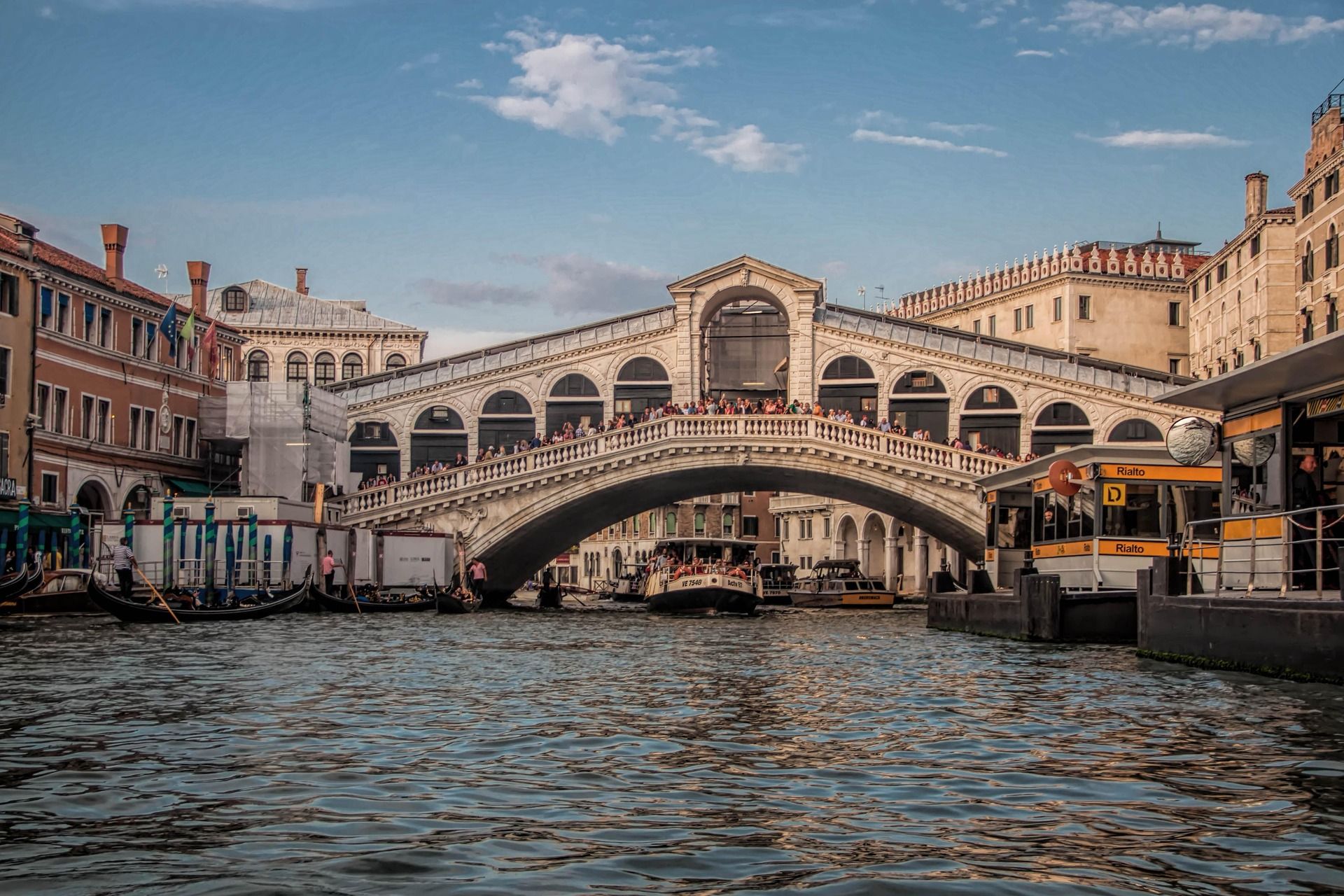
Impossible to mention Venice's historic bridges without starting with the most famous of them all. The Rialto Bridge is not only the oldest of the four bridges spanning the Grand Canal, but also one of the most photographed monuments in Italy. Its single-arch silhouette has become the architectural symbol of an entire city.
The history of the Rialto begins well before its current form. A first pontoon bridge was established as early as the 12th century to connect the two banks of the Grand Canal. Rebuilt in wood in 1265, this bridge was damaged by fires and floods several times over the following centuries. The decision to build a stone bridge was made in 1525, after long deliberations in the Venetian Senate. Great architects of the era, including Michelangelo and Palladio, submitted their projects, but it was finally Antonio da Ponte who won the contract. Work began in 1588 and was completed in 1591, giving birth to the structure we know today.
With its 48-meter span and 22-meter width, the Rialto Bridge rests on some 6,000 wooden piles of elm, alder and oak driven into the lagoon floor. Its design is unique: three parallel pedestrian passages, with the central passage still housing a double row of shops under six arches today. For centuries, it was the only way to cross the Grand Canal on foot, and it constituted Venice's economic heart, connecting the San Polo district and its famous Rialto market to the rest of the city. The Rialto Bridge is an essential passage in any tour of Venice's bridges.
2. Accademia Bridge (Ponte dell'Accademia)
Second of the four bridges spanning the Grand Canal, the Accademia Bridge is appreciated as much for its panoramic view over the Grand Canal as for its turbulent history. Unlike the Rialto whose construction extended over several generations, this bridge was born from a quick and pragmatic decision, not without controversy.
It was British engineer Alfred Neville who built the first metal version of the bridge in 1854, in an industrial style that strongly displeased the Venetians. The cast iron structure was deemed incompatible with the city's aesthetics. In the early 1930s, a decision was made to replace this bridge with a structure more in keeping with Venetian architecture. Architect Eugenio Miozzi was entrusted with the project. But with tight deadlines, he first built a temporary wooden walkway in just 37 days, opened to the public in 1933. The saying goes that 'the temporary lasts,' and indeed this temporary structure, reinforced many times, is still in place today — although it has undergone major renovation work.
This bridge takes its name from the famous Gallerie dell'Accademia, one of Venice's most important art museums, located in the immediate vicinity of its southern end, in the Dorsoduro district. From its height of 6.5 meters above the Grand Canal, it offers one of the most beautiful perspectives on the canal and the palaces that line it. Lovers traditionally attach padlocks to the railings, perpetuating a well-known romantic tradition. To visit Venice and enjoy these exceptional views of the Grand Canal, this bridge remains one of the must-sees of the walking circuit in La Serenissima.
3. Bridge of Sighs (Ponte dei Sospiri)
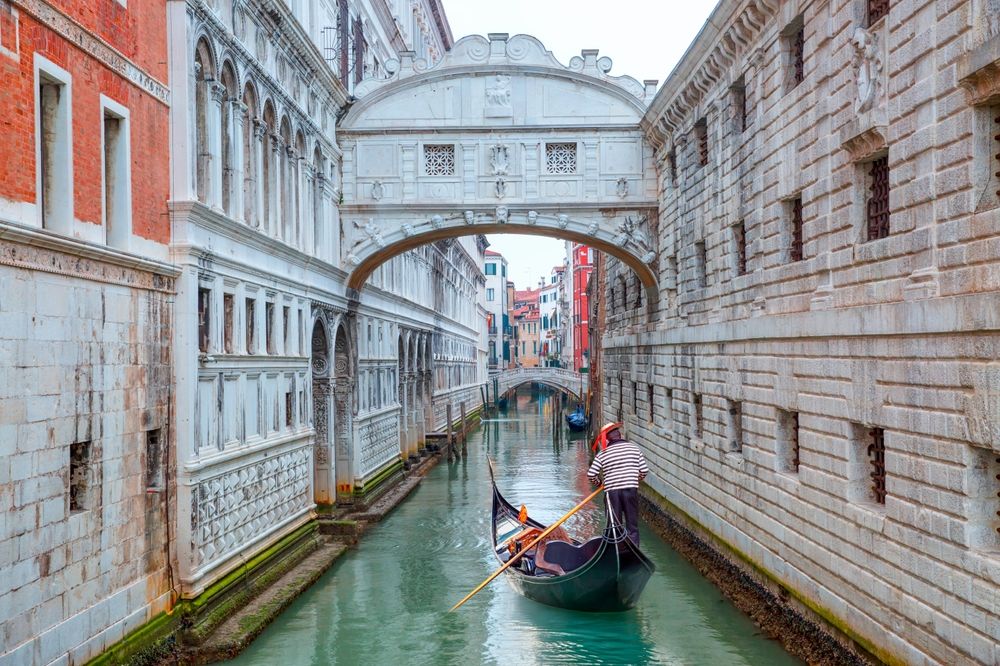
Few bridges in the world can boast of concentrating as much dramatic history, romantic legends and architectural beauty as the Bridge of Sighs. Recognizable among all thanks to its grilled windows and baroque ornaments in white Istrian stone, this covered bridge is the only one of its kind in Venice and one of the most photographed in the world.
Built around 1602 by architect Antonio Contin, the Bridge of Sighs connected the Doge's Palace to the new prison, built in 1614 on the other side of Rio di Palazzo. Its role was purely functional: to allow the transfer of condemned prisoners from the ducal palace court directly to their cell, without them being able to escape. Its interior architecture is designed accordingly: a double corridor, separated by a central wall, so that prisoners could not communicate with each other. Access to the Bridge of Sighs is possible with an entrance ticket to the Doge's Palace, which also gives access to the prison called the 'Wells.'
Its poetic name — 'Sospiri' means 'sighs' in Italian — evokes the laments of the condemned who crossed this passage and cast a last glance at the lagoon and the campanile of San Giorgio Maggiore through the small grilled windows, before being incarcerated for long years, sometimes for life. Among the most famous prisoners to have crossed this bridge is Giacomo Casanova, who managed to escape from it in 1756. The romantic legend, meanwhile, claims that couples who kiss under the Bridge of Sighs at sunset, aboard a gondola, will be granted eternal love. This bridge is part of the must-see places mentioned in Ryo's audio guide tour to visit Venice.
4. Scalzi Bridge (Ponte degli Scalzi)
The Scalzi Bridge (30100 Venezia VE, Italy, rated 4.6/5 on Google for over 3,100 reviews) is the first bridge discovered by most travelers arriving in Venice by train or bus, as it is located right in front of Santa Lucia station. Its name comes from the 'scalzi' monks, meaning barefoot or Discalced Carmelites, whose church and convent are located in the immediate vicinity on the left bank.
The history of this bridge is directly linked to the modernization of Venice in the 19th century. It was again Alfred Neville, the British engineer already behind the first Accademia Bridge, who built the first cast iron version in 1846 to meet the growing circulation needs with the brand new railway station. But, as with the Accademia Bridge, the industrial aesthetics of this metal structure did not satisfy the Venetians. In the 1930s, during a major city infrastructure modernization program, architect Eugenio Miozzi was entrusted with designing a new bridge in Istrian stone, more in harmony with Venetian architecture. The work was completed in 1934, and this is the version we can admire today.
With its 40-meter span and 6.75-meter height above the Grand Canal, the Scalzi Bridge offers a beautiful view of the canal from its summit. It's also an excellent starting point for exploring Venice on foot. Starting from there, one can walk along the Grand Canal towards St. Mark's Square, gradually crossing all the historic districts of the city. To miss nothing of this crossing, don't hesitate to use Ryo's audio-guided itinerary, which guides you independently to the most beautiful points of interest in La Serenissima.
5. Fists Bridge (Ponte dei Pugni)
The Fists Bridge (Campo San Barnaba, 30123 Venezia VE, Italy, rated 4.6/5 on Google for 1,038 reviews) is undoubtedly the most unusual bridge in our selection. Nestled in the picturesque Dorsoduro district, near Campo San Barnaba, this small brick arch bridge crosses Rio de San Barnaba and doesn't look like much at first glance. It's its history that makes it an absolutely essential stop for anyone interested in Venice's historic bridges.
Its evocative name — 'Pugni' means 'fists' in Italian — comes from a popular tradition now disappeared: the 'War of Fists.' Venice was formerly divided into two rival factions, the Castellani (from the eastern districts of the city, around Castello) and the Nicolotti (from the western districts, including Dorsoduro). These rivalries were regularly settled during organized fights on the city's bridges, and the Ponte dei Pugni was one of the preferred theaters for these confrontations. The rules were simple: the group that managed to maintain its position on the bridge and throw opponents into the canal below won the event. These battles could gather hundreds of spectators and sometimes degenerated into real riots. They were finally banned by the authorities in 1705, deemed too violent.
Today, the memory of these picturesque jousts is perpetuated by four white marble footprints embedded in the corners of the bridge, indicating the starting positions of the fighters from both factions. A charming detail that makes visitors smile and reminds them of a popular and combative Venice, far from the usual romantic image. Note that right next to the bridge is a famous grocery boat permanently moored on the canal, one of the city's best-known floating markets.
6. Chiodo Bridge (Ponte Chiodo)
Lost in the quiet alleyways of the Cannaregio district, far from the tourist bustle of the center, the Chiodo Bridge (Rio di san Felice, 30121 Venezia VE, Italy, rated 4.6/5 on Google for 2,009 reviews) is a unique architectural curiosity in the Venetian landscape. Its particularity? It's the only bridge in Venice's historic center to have preserved its original appearance, without any railings or guardrails on the sides.
In the past, almost all Venice's bridges were without parapets — this is how they originally looked. Over the centuries, authorities gradually imposed the installation of guardrails on all the city's bridges for safety reasons, notably to avoid accidental falls into the canals. But the Chiodo Bridge escaped this, partly because it's a private bridge. Its construction dates back to the 15th century, and it belonged to the noble Chiodo family, from whom it takes its name — 'chiodo' meaning 'nail' in Italian. It served as a direct entrance to their patrician residence, which gave it a particular status in the city's legal organization.
Crossing the Chiodo Bridge is a strange and delightful experience: one instantly understands how Venetians of the past had to move with assurance and balance on these narrow and unprotected structures, whether it rained or was windy. The place is appreciated by photographers, who find an authentic framing on Rio di San Felice, with the colorful facades of palaces reflected in the water. To discover Venice in its most authentic corners, consult Ryo's audio-guided circuit, which takes you to meet the hidden treasures of La Serenissima.
7. Straw Bridge (Ponte della Paglia)
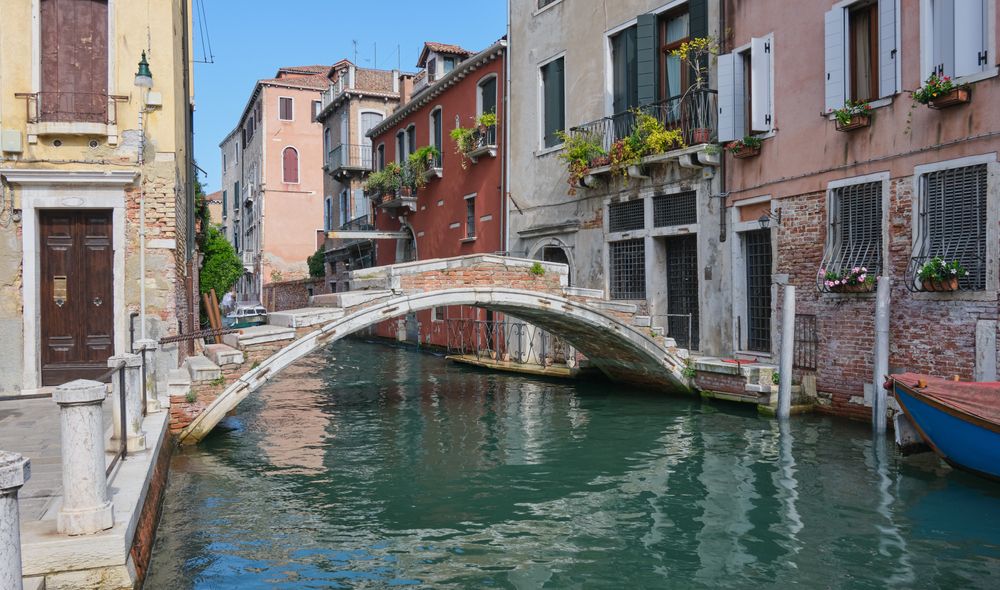
Located on Riva degli Schiavoni, steps away from St. Mark's Square and the Doge's Palace, the Straw Bridge (30124 Venezia VE, Italy, rated 4.7/5 on Google for 783 reviews) is one of Venice's oldest bridges. Its first stone version dates back to 1360, making it one of the oldest structures of this type in all of La Serenissima. The current structure dates from 1847, when the bridge was widened and rebuilt to meet growing pedestrian traffic.
Its enigmatic name — 'Paglia' means 'straw' in Italian — comes from a medieval practice: boats loaded with straw once docked near this bridge to supply the city with this essential material of the time. A small sculpture of the Madonna of the Gondoliers, dating from 1583, is embedded in its side wall, recalling the devotion of Venetian boatmen.
But it's mainly for the view it offers that the Straw Bridge is today one of Venice's most frequented sites. From its summit, one enjoys a perfect viewing angle of the Bridge of Sighs, nestled in Rio di Palazzo. It's one of the most photographed places in the city, especially at sunset when golden light comes to illuminate the white stone facades and canal waters. The Straw Bridge-Bridge of Sighs ensemble thus forms a living tableau, a symbol image of Venice that visitors from around the world seek. It's one of the stops you absolutely must not miss during your exploration of Venice's historic bridges.
8. Constitution Bridge (Ponte della Costituzione)
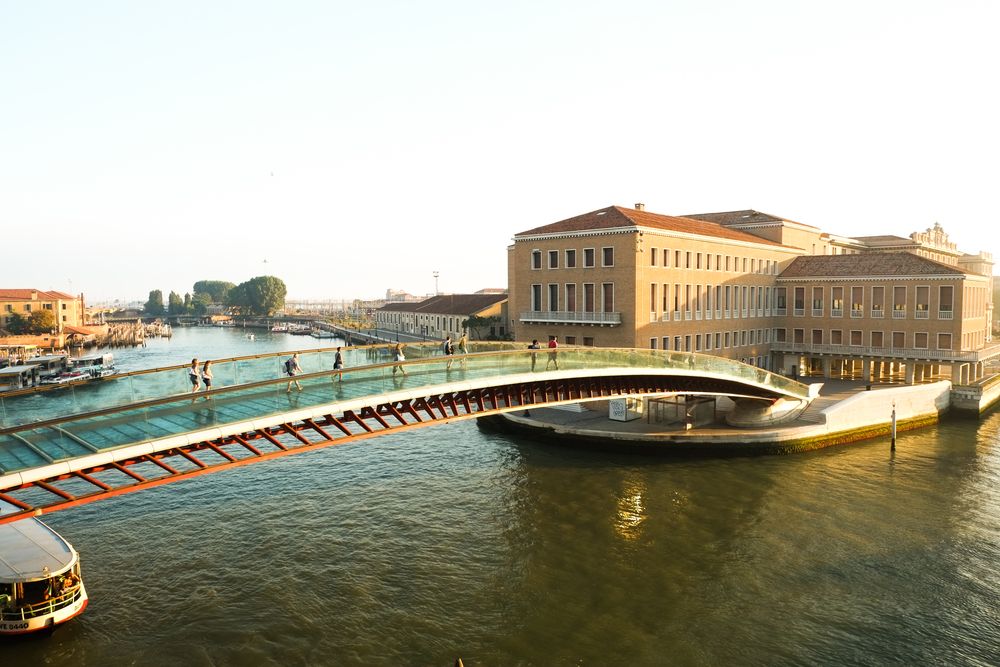
The Constitution Bridge (Ponte de la Constituzione, 30135 Venezia VE, Italy, rated 4.2/5 on Google for 13,506 reviews), also known as Ponte di Calatrava after its architect, is the fourth and most recent bridge spanning the Grand Canal. Inaugurated in 2008, it sharply contrasts with the three other historic bridges through its deliberately contemporary aesthetic, making it both the subject of all controversies and an essential attraction for modern architecture lovers.
Designed by Spanish architect Santiago Calatrava, a leading figure in high-tech architecture worldwide, the Constitution Bridge measures 94 meters long and 9 meters wide at its center. Its main steel structure is supported by a single arch, while the deck is composed of glass slabs and Istrian stone panels for the guardrails. In total, 156 Istrian stone blocks and a 420-ton metal framework were needed for its construction. The bridge is elevated 9.28 meters above the Grand Canal, offering a remarkable panorama of surrounding palaces. It is also equipped with an elevator for people with reduced mobility.
Its geographical position is strategic: it connects Venice's Santa-Lucia railway station to Piazzale Roma, the bus terminus, thus constituting the true pedestrian gateway to the city for the vast majority of visitors. While its glass slabs can prove slippery in rainy weather — a flaw often pointed out — and while the controversy over its final cost (well above the initial budget) hasn't completely subsided, the Constitution Bridge has gradually established itself as an integral part of the Venetian landscape. It offers at first glance a striking contrast with the medieval and baroque setting that surrounds it: exactly what a city like Venice, always alive and always in dialogue with its time, knows how to do best.
Download the audio-guided circuit to discover Venice on foot and independently
Do you want to explore the bridges and treasures of Venice at your own pace, without an imposed guide or time constraints? The Ryo app offers you a complete audio-guided circuit to visit Venice, entitled 'Meeting with La Serenissima.' In 7.6 km and 3h30, this walking route takes you through 26 unmissable places of interest in the city, with enriched audio commentary, historical anecdotes and practical information. Interactive navigation, playful audio guides, adaptive departure from the closest point to you: everything is designed to make your Venice visit as memorable as it is enriching. Download the itinerary on navaway.fr before your departure!
In conclusion, Venice's 8 historic bridges form an architectural and human journey through the centuries of La Serenissima. From the majestic Rialto to the discreet Chiodo Bridge, passing through the poetic Bridge of Sighs and the daring Constitution Bridge, each structure tells of an era, a society and a way of inhabiting the lagoon. Crossing these bridges means understanding Venice in its depth, well beyond the clichés. To fully live this experience and miss none of the city's secrets, let yourself be guided by Ryo's Venice itinerary and set off to discover the City of Doges like you've never done before. Visiting Venice is also this: a stroll from one bridge to another, with ears wide open to history.
FAQ – Historic Bridges of Venice
How many bridges are there in Venice in total?
Venice has approximately 400 bridges in total, connecting the roughly 100 to 120 islets that make up the city. These bridges cross the numerous canals — the 'rii' — that grid the city. Among them, only four span the Grand Canal, the city's main canal: Rialto Bridge, Accademia Bridge, Scalzi Bridge and Constitution Bridge.
What is Venice's oldest bridge?
Rialto Bridge is considered the oldest of Venice's major bridges on the Grand Canal. Its first version dates back to the 12th century, even though the stone structure we see today dates from 1591. Concerning stone bridges outside the Grand Canal, the Straw Bridge is one of the oldest, with a first construction dated 1360.
What is the name of Venice's covered bridge?
The Bridge of Sighs (Ponte dei Sospiri) is the only covered bridge in Venice's historic center. Built around 1602 in baroque style, it connects the Doge's Palace to the prison by crossing Rio di Palazzo. It's one of the most photographed and best-known monuments of La Serenissima.
Which Venice bridge has no railing?
The Chiodo Bridge, located in the Cannaregio district, is the only bridge in Venice's historic center not to have guardrails or railings. It thus preserves its original appearance, as most Venetian bridges appeared before authorities imposed the installation of side protections. It's a private bridge that historically belonged to the noble Chiodo family.
When was the Constitution Bridge in Venice built?
The Constitution Bridge, designed by Spanish architect Santiago Calatrava, was inaugurated in 2008. It's the fourth bridge over the Grand Canal and the most recent in Venice. Its construction was the subject of numerous controversies, notably due to its resolutely modern style and its final cost well above initial forecasts.
Can one visit Venice independently and on foot?
Yes, absolutely! Venice is an entirely pedestrian city in its historic center. It's very pleasant to walk through it on foot, from bridge to bridge and from district to district. For an enriching experience, the Ryo app offers a complete audio-guided itinerary to visit Venice independently, covering 26 points of interest in 7.6 km over about 3h30. It's the ideal solution to discover Venice's historic bridges and all other treasures of the City of Doges without depending on a guide or group.