© Shutterstock
 Votre guide Ryo
What to Do in Malta: 15 Must-Sees to Discover the Archipelago in 2026
What to do in Malta when three islands, 7,000 years of continuous history and less than 316 square kilometers concentrate so many listed monuments? Hard to decide: Malta is probably the densest country in heritage per square kilometer on earth. This is not a tourist brochure formula, it's a verifiable archaeological fact. Its megalithic temples predate Stonehenge by a thousand years, its underground hypogeum dates from before the pyramids, and its baroque capital was built in less than two decades by monk-soldiers who controlled the maritime routes of the Mediterranean. To prepare each stage with an in-depth historical narrative, the Ryo audio guide dedicated to La Valette is the ideal starting point before setting foot on the island.
What few travelers anticipate when wondering what to do in Malta: St. John's Co-cathedral hides two Caravaggios, one of which is the only canvas signed by the painter during his lifetime, the 300 permanent inhabitants of Mdina live in baroque palaces in the middle of a medieval city almost deserted after 6pm, the Blue Lagoon of Comino displays underwater visibility of 30 meters on certain spring mornings, and the Hypogeum of Ħal Saflieni resonates at a precise frequency of 111 Hz which affects brain waves, either a construction coincidence 5,000 years old. Here are the 15 places and experiences that define the archipelago.
1. La Valette: The Smallest Capital in Europe
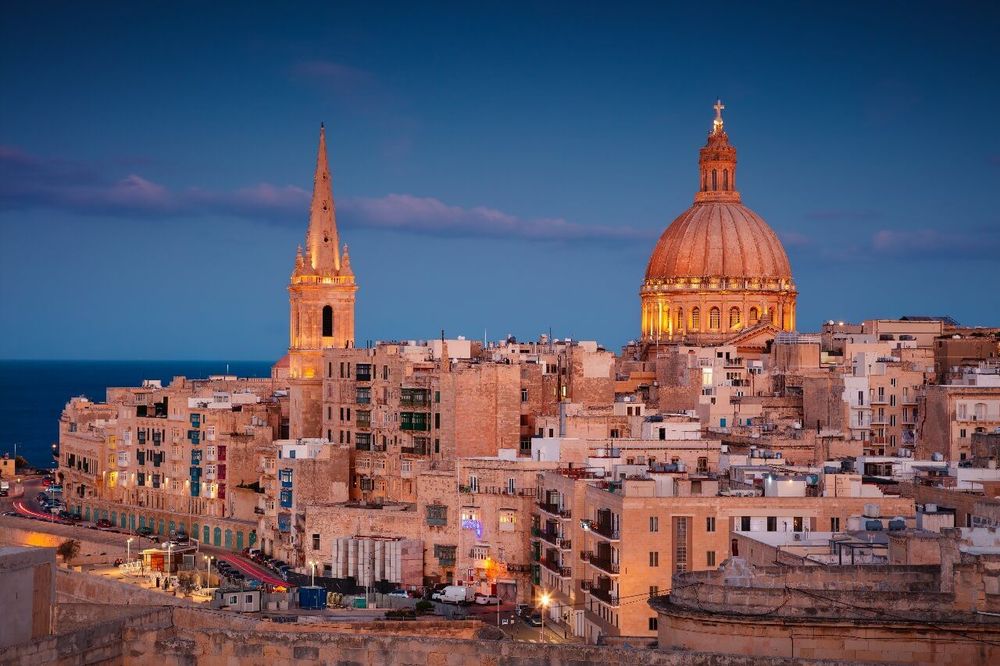
La Valette occupies a rocky peninsula of 0.8 km² wedged between two natural harbors that shaped the military history of the Mediterranean for four centuries. What the numbers don't convey is the sensation of the city on the first morning: stepped streets descend toward a sea of almost unbelievable blue, ochre and honey facades alternate with painted wooden balconies, the gallariji, characteristic of Maltese architecture, and the air simultaneously carries salt, heated stone and coffee from the bars on Republic Street.
Founded in 1566 by Jean de La Valette in the aftermath of the Great Ottoman Siege, the city was laid out according to a perfect grid plan on a peninsula that was then just a steep rock. UNESCO inscribed it on the World Heritage list in 1980. Every street, every square responded to a dual logic: military control of port access and demonstration of the Order's power before European courts. The result, 450 years later, is a still-inhabited museum city, where Maltese families live in apartments whose facades date from the 17th century and where foreign ambassadors cross paths in the same streets as schoolchildren.
The Upper Barrakka Gardens are the island's most famous terraced gardens. Developed in 1661 by a Knight of the Order as a private recreation space, they overlook the Grand Harbour with a frontal view of the Three Cities and the port. Every day at noon and 4pm, the Saluting Battery fires a salvo from the lower terrace: a British-era military tradition that startles unprepared visitors and delights all others. Access is free and the gardens are open daily.
The Grandmaster's Palace occupies the geometric center of the city according to the original plan. Designed by Girolamo Cassar, the Knights' reference architect, it was for two centuries the seat of the Order's power. Today partially occupied by the Maltese Parliament, one wing is open to the public: the state rooms are decorated with Brussels tapestries commissioned to replace those that Napoleon had taken during his six-day passage in 1798. The adjoining Armoury houses 5,700 pieces of armor from the 16th to 18th centuries, including Grandmaster Alof de Wignacourt's armor considered one of Europe's finest.
For contemporary history, the Lascaris War Rooms (Lascaris Ditch, Valletta VLT 1000, Malta, rated 4.6/5 on Google for 1,636 reviews) deserve an hour: this underground command room, carved into the rock beneath the Grandmaster's Palace, coordinated Allied operations in the Mediterranean during World War II. It was from here that Eisenhower supervised the invasion of Sicily in July 1943. The sound reconstructions and uniformed mannequins achieve a museographic quality rare in Malta.
Practical advice: the city is entirely walkable. In high season, avoid Friday and Saturday mornings: cruise groups disembark from 9:30am and the Co-cathedral is saturated before 10am. Pedestrian access from Sliema via the jetty ferry is more pleasant than the bus. Allow a full day or two half-days to not miss the essentials. Our audio-guided tour of La Valette follows that same tempo, 20 stops in 1h45, from Republic Street to the Grandmaster's Palace.
2. St. John's Co-Cathedral and the Caravaggios
The austere exterior of St. John's Co-Cathedral (Triq San Gwann, Valletta VLT 1216, Malta, rated 4.8/5 on Google for 25,669 reviews) in no way prepares you for what awaits inside. From the alley on St. John Street, the facade is that of a sober, almost military building, this is intentional, the Knights did not want the wealth of their main church to be readable from the street. Cross the door: the contrast is total and immediate.
The floor is entirely covered with 400 funeral slabs in polychrome marble, each dedicated to a knight of the Order who died in service of Christianity. No space is left empty between the slabs: you literally walk on the dead, a dizzying effect that visitors take a few moments to realize. The walls and ceiling of the central nave are covered with frescoes by Mattia Preti, a Calabrian painter who worked in Malta from 1661 to 1699 and is buried there. Each side chapel corresponds to a langue (tongue) of the Order, one for French knights, one for Spanish, one for German, and each was decorated in a slightly different style according to the tastes of the nation concerned.
The Oratory, accessible from the right nave, houses two paintings by Caravaggio. The Beheading of Saint John the Baptist (1608) is the largest canvas ever painted by the artist: 3.6 meters by 5.2 meters of oil painting on canvas, representing the saint's execution with a violence and realism that baroque painting had not yet achieved. It is also the only work that Caravaggio signed with his name, in red on the blood flowing from John the Baptist's severed neck. The second canvas, Saint Jerome Writing, is less known but of equivalent technical quality.
Caravaggio had joined the Order in Malta in 1607 after killing a man in Rome during a brawl. The Knights had granted him this refuge in exchange for his services as a painter. He was made a knight in 1608, then expelled a few months later after another altercation, and left the island by night. The two paintings have remained in La Valette since then, making it one of the most significant concentrations of baroque art in the Mediterranean.
Practical: the Co-cathedral is open Monday to Saturday from 9am to 5pm (last entry 4:30pm), closed Sunday morning until the end of services. Entry costs 15 EUR including audio guide. Arrive at opening to see the Oratory without waiting: groups accumulate there from 10:30am. Allow 1h30 to 2h for a complete visit. Photography is allowed in the nave, forbidden in the Oratory.
3. Mdina, the Silent City
Mdina resembles no other Mediterranean city. Former capital of Malta until the arrival of the Knights of St. John in the 16th century, it has preserved its intact medieval plan over less than one square kilometer of limestone hill in the center of the island. Its 300 permanent residents live in baroque and Norman palaces whose interior courtyards and hidden gardens remain closed to visitors, narrow alleys wind between carved facades, and the silence, locals call it Il-Belt Skiet, the Silent City, is real rather than metaphorical. Cars are forbidden except for residents.
The Main Gate of Mdina, baroque arch of 1724, is the only official road access. Cross it after 6pm, when the last tourist buses have left: the alleys light up with yellow lamplight, the palaces close their shutters, and you can traverse the entire city in less than thirty minutes practically alone. This is an experience that few visitors plan because they organize their day according to mass tourism schedules, and this is precisely what makes it one of Malta's most memorable.
Mdina's Cathedral of St. Paul, attributed to architect Lorenzo Gafà, dates from 1693: it replaces a medieval cathedral destroyed by the earthquake of that same year. Its adjoining museum preserves a collection of original engravings by Albrecht Dürer as well as medieval manuscripts that trace the island's Christianization. Maltese tradition traces this Christianization back to the Apostle Paul's shipwreck on the island's coasts in 60 AD, an event mentioned in the Acts of the Apostles and of which the Maltese are collectively very proud.
From the bastions of Mdina, the view embraces the entire island in clear weather: the Grand Harbour of La Valette to the east, Dingli Cliffs to the west, and in very clear weather, the silhouette of Gozo to the north. This is one of the most complete panoramas of the archipelago, particularly at sunset when the limestone takes on a hue between orange and honey.
Just at the entrance, the town of Rabat is often neglected although it deserves half an hour. The Catacombs of St. Paul (Triq Sant'Agata, Rabat RBT 1043, Malta, rated 4.3/5 on Google for 12,006 reviews) (3rd-5th century), carved into soft limestone, form a network of more than 2,000 m² of galleries with dozens of tombs and agape tables, these circular rock tables where early Christians gathered for commemorative funeral meals. Access is poorly signposted from Rabat's main square but easy to find.
Practical: Mdina is visited in 1h30 to 2h on foot. From La Valette, bus line 201 connects the two cities in about 35 minutes.
4. The Three Cities: Vittoriosa, Senglea and Cospicua
Facing La Valette, on the other side of the Grand Harbour, three fortified cities form a historical ensemble that should feature at the top of every Maltese itinerary and yet remains less visited than the capital. Vittoriosa (Birgu), Senglea (L-Isla) and Cospicua (Bormla) were the bastions of the Knights of St. John even before the foundation of La Valette, and their network of alleys, bastions and palaces is almost as rich, but with a fraction of tourist crowds. The difference is striking: the same blonde stones, the same baroque architecture, but inhabitants living their daily lives without organized group flows.
Access from La Valette is ideally by Dghajsa ferry, a traditional Maltese flat-bottomed boat that crosses the Grand Harbour in 5 minutes (about 1.50 EUR per person). The crossing is an experience in itself: the two fortified shores face each other, the palace facades of La Valette on one shore, the bastions of Vittoriosa on the other, and the harbor water reflects the ochres and grays of the stone. Don't take the bus for this route.
Vittoriosa is the most visited and richest of the three. The Malta Maritime Museum traces the archipelago's naval history from antiquity to World War II, with models of Ottoman and Knights' galleys, uniforms, and photographic archives of the 1942 bombings. The visit takes 1h30 and considerably illuminates understanding of Malta's strategic role. The medieval Inquisition Court, next to the museum, is also worth a quick visit: its basement dungeons have preserved graffiti carved by prisoners in the 17th century.
From Senglea, the Gardjola Terrace (Senglea Point, Senglea SGN 1000, Malta, rated 4.4/5 on Google for 52 reviews) offers the most photographed viewpoint of the Three Cities: a sculpted watchtower adorned with an eye and an ear, symbols of maritime vigilance, behind which unfolds the Grand Harbour with La Valette in the background. This panorama is as known to photographers as it is little visited outside a few insiders. Allow ten minutes to reach it from the ferry.
Cospicua is the least touristy of the three and the most authentically Maltese. The morning market, pastizzi bars, alleys where children play after school: this is daily Malta, almost intact. The Cottonera Lines, the outer fortifications protecting the entire Three Cities, also constitute a 4-kilometer walk with harbor views.
To discover this fortifications district and the Grand Harbour in depth, the Ryo audio-guided tour of La Valette includes narratives about all the fortified shores and their common history.
Plan a complete half-day for the Three Cities, ideally in the morning. Vittoriosa is livelier in late morning; Senglea and Cospicua are almost deserted of tourists and give a glimpse of contemporary Maltese life.
5. The Ħal Saflieni Hypogeum
If Malta offered only one archaeological site, it would be the Ħal Saflieni Hypogeum (Burial Street, Paola PLA 1043, Malta, rated 4.4/5 on Google for 4,168 reviews). Discovered in 1902 by workers digging foundations in the Paola district, it is a network of underground chambers and corridors carved entirely by hand in soft limestone, on three levels descending to 11 meters deep. Carbon-14 dating places its construction between 3600 and 2400 BC, contemporary with the archipelago's surface temples.
What distinguishes the Hypogeum from all other Mediterranean prehistoric sites is the deliberate sophistication of its interior design. The lower level chambers were sculpted to imitate surface architecture: false lintels, rhythmic niches, spirals carved in the rock that reproduce those carved on open-air temples. The Holy of Holies Chamber presents acoustics that owe nothing to chance: a male bass voice resonates throughout the complex with striking natural amplification. Researchers have established that this resonance occurs precisely at 111 Hz, a frequency that influences brain waves in EEG recordings. Deliberate design or genius coincidence? The question remains open.
The bones of 7,000 individuals were found in the Hypogeum during initial excavations of the early 20th century: it was a collective ossuary used over several centuries. Among the artifacts uncovered is the famous Sleeping Lady, a terracotta figurine representing a character lying in a state resembling trance or deep sleep, now displayed at La Valette's National Museum of Archaeology. Archaeologists still debate its significance: ritual representation, divine figure, or simple everyday life scene?
The visit is among the most strictly regulated in the Mediterranean: 80 visitors maximum per day, divided into small guided groups of 10 people. The reason is conservatory: condensation produced by human breathing progressively degrades the sculpted rock. Online booking on the Heritage Malta site is mandatory, and slots fill up weeks in advance in high season. If your trip is planned for July or August, book as soon as your dates are set, ideally 6 to 8 weeks before departure. In November, December or January, one to two weeks is sufficient.
The surface museum, accessible without a ticket for the Hypogeum, presents a cutaway model of the entire complex and reproductions of major artifacts. Useful for understanding the three-level organization before descending. The guided tour lasts exactly 50 minutes. Flash-free photography is allowed in certain sections; the guide indicates where.
Practical: the Hypogeum is in Paola, about 25 minutes by bus from La Valette (lines 82 or 85). By taxi or VTC, allow 15 minutes. No shop or cafe on site, plan to arrive rested.
6. The Temples of Ħaġar Qim and Mnajdra
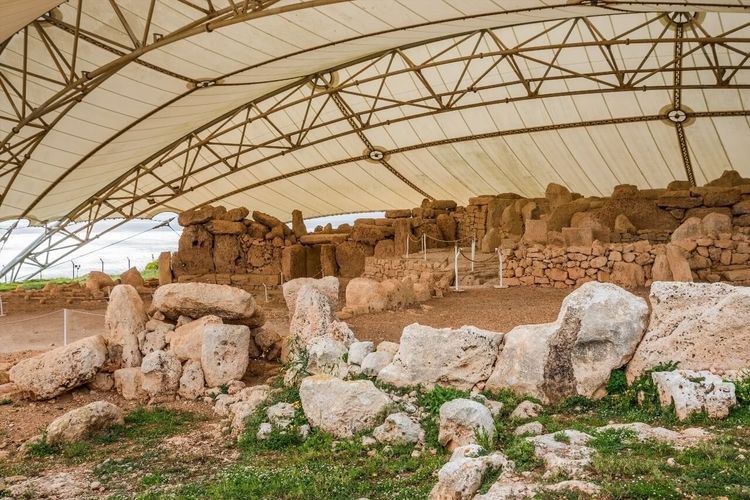
A minute to grasp the figures: the temples of Ħaġar Qim (Triq Hagar Qim, Qrendi QRD 2502, Malta, rated 4.6/5 on Google for 8,277 reviews) and Mnajdra were built between 3600 and 2500 BC, about 1,000 years before the first stones of Stonehenge and 500 years before the great pyramids of Egypt. They are, along with other Maltese prehistoric temples, the oldest known free-standing religious structures on earth. And no one knows for certain which civilization erected them, nor why it disappeared so suddenly around 2300 BC, without leaving traces of exodus or conflict.
Ħaġar Qim ('standing stones' in Maltese) is the more imposing of the two sites. Its megaliths reach 5.2 meters high and some of the largest stones weigh up to 20 tons: they were extracted from quarries located several kilometers from the site, then moved without wheels or draft animals, at least without evidence of these tools being found. The outer enclosure is among the best preserved in the archipelago. Inside, semi-circular niches, the apses, testify to ritual practice whose contours are reconstructed through objects found on site: Mother Goddess figurines, sacrificial animal bones, ceremonial vases.
At 500 meters on a cliff edge, Mnajdra is perhaps the more striking of the two. Three temples built at successive periods form a complex oriented according to precise astronomy: at spring and autumn equinoxes, the first rays of the rising sun pass exactly through the central corridor of the middle temple and illuminate the back of the apse. At solstices, the sun grazes the edges of lateral lintels. This architectural precision, achieved without known measuring instruments, without writing, without documented calendar, remains an active research subject for archaeoastronomers.
Since 2009, both sites have been protected by stretched canvas structures to slow erosion due to spray and weather. These tents, aesthetically controversial at their installation, have shown their effectiveness on rock conservation. A modern visitor center presents archaeological discoveries in context.
Practical: the temples are open daily from 9am to 5pm. In summer, arrive before 9:30am, heat becomes intense from 10am and cruise groups arrive mid-morning. Allow 2 hours for both sites and the museum. Combine this visit with the Blue Grotto 2 kilometers northwest. Bus 201 from La Valette stops at Ħaġar Qim on weekdays.
7. The Blue Grotto
The Blue Grotto (Wied iż-Żurrieq, Żurrieq ZRQ 2000, Malta, rated 4.7/5 on Google for 12,570 reviews) is not a grotto in the speleological sense: it is a set of six natural arches carved by marine erosion in the limestone cliffs of the island's southwest. Between the walls, water reaches depths of 12 to 15 meters and takes on electric blue hues due to light refraction on phosphorescent algae lining the bottom. The visual effect exceeds all the photographs seen online, especially in calm weather and high light.
The visit is done by traditional boat from the small dock of Wied iż-Żurrieq. Boatmen offer 25 to 30 minute circuits that pass under several arches and allow observing the walls from the water, the arches sometimes reach 12 meters high, and you pass underneath just centimeters from the rock. The best time for light is between 10am and 1pm, when the sun is high enough to penetrate under the vaults. Rates are around 8 to 10 EUR per person.
In strong wind or rough sea, trips are cancelled, check before making the journey from La Valette. In July and August, boats leave every 20 minutes from 9am. From the road viewpoint above the dock, a bird's-eye view of the arches gives a complementary perspective even without going down.
Combine Blue Grotto with Ħaġar Qim (2 km), Dingli Cliffs (15 km) and Marsaxlokk (12 km) for a complete day in the south of the island.
8. Marsaxlokk, Colorful Boats and Sunday Market
Marsaxlokk is an anomaly in the Maltese landscape: where the rest of the island densifies and modernizes, this fishing village in the southeast has preserved its seafront intact, its traditional luzzijiet boats painted in red, yellow and blue, and its Sunday morning market that attracts both locals and travelers. The hook-shaped natural bay is one of the most sheltered in the archipelago, this is where Dragut's Ottoman fleet anchored in 1565 before the Great Siege, and it is still here that the trawlers that supply the island's restaurants with lampuki and freġa anchor today.
The luzzijiet are Malta's visual symbol as much as La Valette's wooden balconies. These flat-bottomed wooden boats, painted in bright colors according to an unbroken tradition, bear on their prow two Eyes of Osiris inherited from Phoenician navigation, a legacy of more than 3,000 years still living. They are still actively used by the village fishermen, not just displayed for tourists.
The Sunday morning market extends along the entire promenade and mixes stalls of fresh fish taken from the water that morning, artisanal souvenirs, local honey, capers and bigilla, a herb bean paste that Maltese spread on ftira, their traditional ring-shaped bread. Fishermen unload their catches at dawn; the most sought-after fish (lampuki, sea bream, red mullet) are often sold within a few hours. If you visit on another weekday, the village is quieter but the luzzijiet are still moored and photographable at leisure.
Two restaurants on the promenade serve grilled fish of the day at reasonable prices for the quality. Arrive before 1pm for a table with a view of the boats. 2 kilometers to the east, Saint Peter's Pool is a natural pool carved in limestone rocks, accessible on foot by a coastal path: the water is remarkably clear and deep, protected from waves.
From La Valette, bus line 81 serves Marsaxlokk in about 45 minutes. By car, allow 30 minutes.
9. Dingli Cliffs
253 meters above the Mediterranean: Dingli Cliffs (Triq il-Kosta, Dingli DGL 2010, Malta, rated 4.5/5 on Google for 9,173 reviews) constitute Malta's highest point and offer the island's most open panorama. From the panoramic road that runs along the plateau edge, the view carries to Filfla, an uninhabited islet and strict nature reserve visible in clear weather a dozen kilometers away.
The site is particularly beautiful at sunset, when raking light reveals limestone rock texture and tints the sea orange that slowly turns purple. It is also one of the few places in Malta where natural vegetation truly subsists: thyme, rosemary and wild caper scrubland covers the plateau, contrasting with the blue sea below.
A 5 kilometer coastal path links Dingli to Rabat along the cliff edge. No protective barrier on most of the route, keep your distance from the edge, especially with children. The small chapel of St. Mary Magdalene, perched on the cliff edge, is the usual starting point for the hike. Allow 1h30 to 2h for the round trip.
10. Gozo: The Sister Island with a Different Rhythm
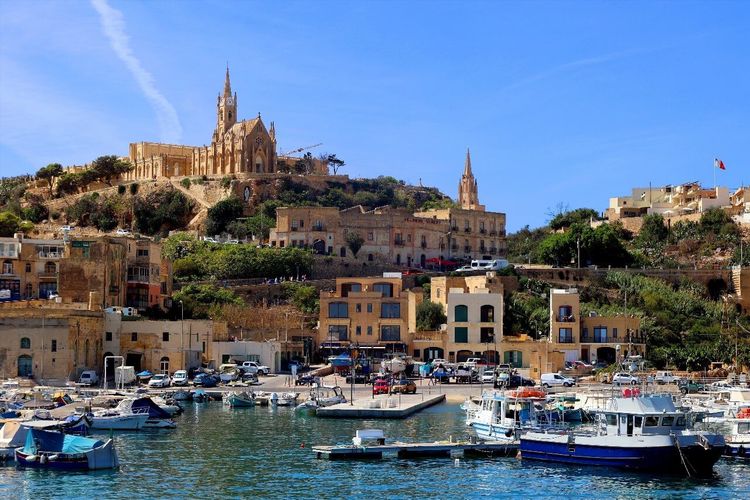
What to do in Malta when you want to escape the tourist flow of the main island? The ferry to Gozo is 25 minutes crossing from the port of Cirkewwa, and the atmosphere changes radically on the other side of the channel. Where Malta is dense, fortified and focused on its military history, Gozo is agricultural, greener by Mediterranean standards, and marked by a popular culture that modernization has preserved better than on the main island. Gozitans claim this difference: many refer to Malta as 'the continent' and speak of their island as a world apart.
Gozo measures 67 km² and has about 32,000 inhabitants. Its relief is more rugged, with hills dominating the coast and valleys shaped by seasonal runoff. The stone used in constructions is slightly darker than Maltese limestone, a detail that contributes to the different ambiance many travelers perceive upon arriving at Mġarr port.
Ramla Bay is Gozo's largest and most beautiful beach, with its characteristic red sand due to iron oxide contained in local limestone. Water remains transparent to several meters deep in good weather, and the beach remains accessible by bus from Victoria even without a car. San Blas Bay, smaller and accessible only on foot via a steep descent, offers in return almost solitude even in mid-July.
For divers, Gozo is recognized as one of the best diving destinations in the entire Mediterranean. Dwejra's Blue Hole, Reqqa Point Canyon, Xlendi's underwater Cathedral and Gebla tal-General cave feature in all specialized guides. Visibility often exceeds 30 meters in good weather, fauna is diverse, morays, octopuses, groupers, barracudas, and underwater reliefs (arches, vertical walls, caves) are exceptionally varied for such a small island.
Victoria (also called Rabat in Maltese), the island's capital, is visited from its medieval citadel that dominates the entire Gozitan territory. The covered market at the bottom of the hill, fruits, vegetables, ġbejna (fresh goat cheeses) and fresh ftira, gives a precise idea of local food economy. Victoria's parish church, with its facade visible from the entire island, is a late example of Maltese baroque worth a stop.
The Ryo audio guide covering La Valette also gives reference points on the archipelago as a whole, useful for contextualizing Gozo before the crossing.
The ferry between Malta and Gozo departs from Cirkewwa (north Malta) and arrives at Mġarr in 25 minutes. Crossings every 45 minutes approximately from 6am to 11pm, every hour at night. Crossing is free for pedestrians in the Malta to Gozo direction (paid in the other direction, 4.65 EUR). One day suffices for Gozo's main points; two days allow unhurried exploration.
11. Victoria Citadel and Ġgantija Temples
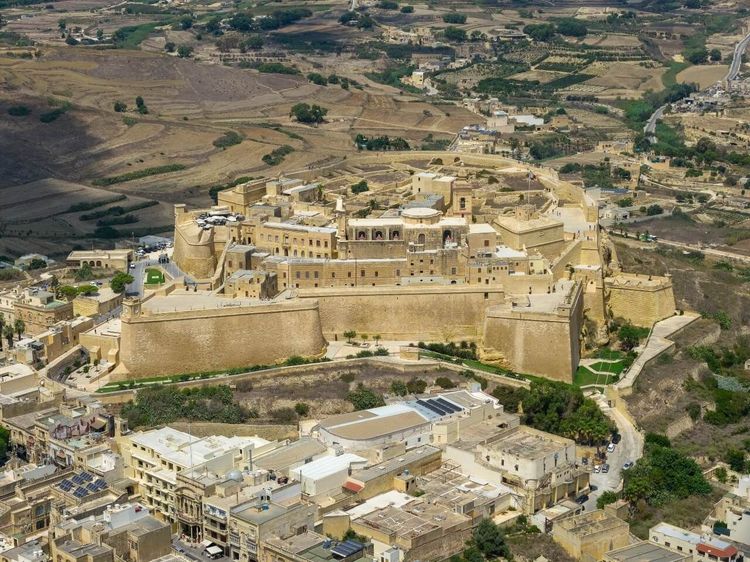
Victoria Citadel is one of the best-preserved medieval fortifications in the island Mediterranean. Built on the foundations of a Roman acropolis itself built on a Phoenician site, it served as refuge for Gozo's entire population during Ottoman raids. In 1551, Dragut took into slavery almost all the island's inhabitants, about 6,000 people, from this same port of Mġarr. The citadel was supposed to protect them; it was empty at the time of attack.
Inside the ramparts, the Cathedral of the Assumption presents an architectural curiosity that many visitors take several minutes to detect: its dome is entirely painted in trompe-l'oeil on a flat surface. The cathedral did not have funds to build a real cupola after the 1693 earthquake; artist Antoine Manuel Borg painted such a convincing illusion that even when looking for the trick, the eye resists. Natural zenithal lighting reinforces the effect.
From the ramparts, the 360° view over the entire island is exceptional in clear weather. In very good weather, Malta's coasts and Sicily's contours are visible on the northern horizon.
At 5 kilometers east of Victoria, the Ġgantija temples (Triq Ix-Xagħra, Xagħra XRA 1011, Gozo, Malta, rated 4.4/5 on Google for 9,558 reviews) constitute the archipelago's second major megalithic site after Ħaġar Qim and Mnajdra. Dated 3600 to 3000 BC, these two temples side by side are even older than the main island temples, and their name means 'giantess' in Maltese, medieval Gozo inhabitants, not understanding who could have moved such heavy stones, attributed construction to giants. Megaliths reach 6 meters high for some blocks. Ġgantija was the first Maltese megalithic temple inscribed on UNESCO World Heritage in 1980, before the list was extended in 1992 to other archipelago temples (Ħaġar Qim, Mnajdra, Ta' Ħaġrat, Skorba and Tarxien).
Practical: the citadel is accessible on foot from Victoria center. Entry to ramparts is free; interior museums are individually paid or with combined pass. Allow 2 to 3 hours for the citadel and its museums. For Ġgantija, add 45 minutes visit and travel from Victoria.
12. Dwejra: Gozo's Wild Coast after the Azure Window
Dwejra is a coastal area in western Gozo whose spectacular geology made it one of the archipelago's most photographed landscapes, and one of the most transformed by a recent event. The Azure Window (Tieqa tad-Dwejra), this limestone arch that advanced into the sea and featured on all Malta postcards, collapsed during a storm in March 2017. It had notably served as decor for the Game of Thrones wedding scene in 2011. Its absence radically changes the landscape, but Dwejra remains one of the archipelago's most remarkable coastal sites.
The Blue Hole is a natural circular well of about 10 meters diameter open to air, plunging to 60 meters deep and connecting to the sea via an underwater tunnel at 8 meters. It is one of the Mediterranean's most renowned diving sites: fauna is dense at all depths, morays in crevices, octopuses on the bottom, brown groupers and fish schools along the walls. For non-divers, the Blue Hole surface is snorkelable and surrounding rock is accessible on foot from the sea edge.
The Inland Sea (Il-Qawra), lagoon connected to the open sea by a 50 meter tunnel carved in the cliff, is crossed by boat to emerge on Gozo's west coast. It is Dwejra's main attraction for non-diving visitors since the Azure Window's disappearance, and boatmen offer regular crossings in season.
Dwejra is accessible by car or bus from Victoria (line 91). Avoid July and August weekends when crowds are maximum. Early morning or late afternoon are the best times.
13. Comino and the Blue Lagoon
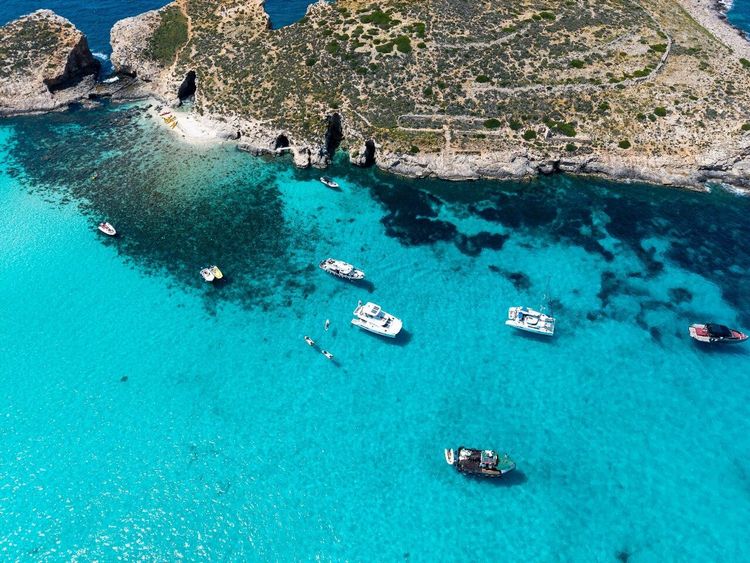
Comino is the smallest of the archipelago's three inhabited islands: 3.5 km², a handful of permanent inhabitants (less than ten year-round), one seasonal hotel and no cars. Its name comes from wild cumin (kemmuna in Maltese) that grows between rocks. From November to March, Comino is almost deserted: hikers who make the crossing can traverse the entire island in a few hours in complete tranquility, and Blue Lagoon water quality without summer crowds is even more spectacular.
The Blue Lagoon has become one of the Mediterranean's most viral images. The enclosed bay between Comino and the islet of Cominotto reaches turquoise to cyan hues of extreme photographic intensity, with underwater visibility of 20 to 35 meters depending on light and weather. Water clarity is due to limited depth (maximum 3 to 4 meters in the inner bay) combined with white sand bottom and near-total absence of pollution in this part of the channel.
In July and August, dozens of boats anchor simultaneously in the bay and the white sand beach is saturated from 10am. Two strategies to enjoy the Blue Lagoon without masses: arrive before 9am by first ferry from Cirkewwa or Mġarr, when the lagoon is still calm and water has maximum morning clarity; or visit in May, June or September-October, when temperatures remain very pleasant (24-28°C) and crowds reduced by two-thirds.
For divers, the Crystal Cave (Kristal Cave) east of the island offers cave diving whose walls are lined with limestone crystallizations. The Santa Marija tower (Comino, CMN 1000, Malta, rated 4.6/5 on Google for 615 reviews) from the 17th century, one of twelve watch towers built by the Knights to monitor Maltese coasts, is discovered from the coastal path that circles the island.
Ferries from Cirkewwa (north Malta) and Mġarr (Gozo) every 30 to 45 minutes in season (crossing: 20 to 30 minutes). Bring water, food and sun protection, especially outside high tourist season when island services are almost non-existent.
14. Mellieħa and Għadira Beach
Mellieħa is Malta island's northernmost town, perched on a rocky ridge overlooking both the bay and the road to Cirkewwa. The historic village on the hilltop has preserved its narrow alleys and Maltese town rhythm, quite far from the intensive urbanization of the island's northeast. The Grotto of the Virgin, carved into rock under the parish church, is one of Malta's oldest Marian sanctuaries: pilgrims have deposited ex-votos there since the Middle Ages, crutches abandoned by supposed healed to photographs of sick children.
At the bottom of the hill, Għadira Beach (Mellieħa Bay, Mellieħa MLH 1000, Malta, rated 4.5/5 on Google for 2,096 reviews) is Malta's largest natural sand beach: 700 meters of fine sand border a shallow bay whose waters remain calm even in moderate wind. It is also one of the most accessible beaches by public transport from La Valette (direct bus 41, 45 minutes). The sea is particularly suitable for young children thanks to shallow depth over a great distance. In high season, it is lively but never as saturated as Saint Julian's or Sliema beaches.
Mellieħa is also the most practical starting point for the ferry to Gozo: Cirkewwa port is 5 minutes by car.
15. Popeye Village and Diving in Malta
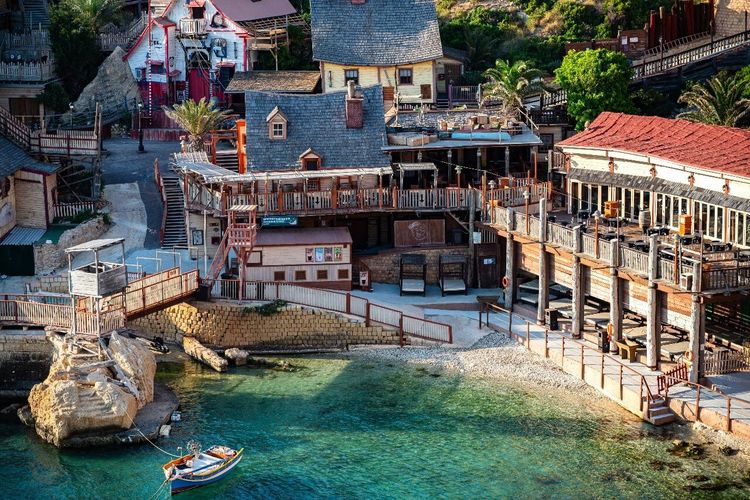
If the island has one disconcerting place, it is Popeye Village (Anchor Bay, Mellieħa MLH 1111, Malta, rated 4.4/5 on Google for 35,937 reviews) at Anchor Bay: this film set built in 1980 for the Popeye musical adaptation with Robin Williams remained on site after filming and was converted into a miniature theme park. The brightly painted wooden houses, built directly in a rocky creek, resemble a full-size cartoon scene. The result is improbable, vaguely kitsch and totally unique in the Mediterranean.
For a completely different register: Malta is one of Europe's most accessible diving destinations. Clear waters, visibility often above 20 meters, and site diversity (wrecks, arches, caves, vertical walls) have attracted divers of all levels since the 1980s. Among the most cited sites: the P29 wreck at Cirkewwa (accessible to beginners), Coral Cave arch in Gozo, and Marsalforn tombs. Diving schools are numerous in La Valette, St Julian's and on Gozo coasts.
FAQ
What is the best time to visit Malta?
May, June and September-October are the optimal months: temperatures between 22 and 28°C, warm sea (24-26°C), moderate tourist crowds and more reasonable hotel prices than in high season. July and August are hot (32-36°C), very crowded and more expensive. Winter (December-February) is mild (15-18°C) and less touristy: ideal for visiting La Valette and interior sites without crowds.
How many days are needed to visit Malta?
Four days allow covering Malta's main sites and one day in Gozo. A week leaves time to discover Comino, less crowded beaches and explore La Valette and Mdina in depth. Two days suffice for a weekend focused on La Valette, the Three Cities and Mdina, but Gozo and the prehistoric temples require a second trip.
How to get around Malta without a car?
The public bus network (Malta Public Transport) covers the entire island from La Valette. Most sites are accessible in 30 to 60 minutes from the capital. VTCs (Bolt, eCabs) offer more predictable rates than traditional taxis. Car rental remains the most flexible solution for linking several sites in a day, especially to reach Dingli Cliffs or Marsaxlokk.
Do you need to book the Hypogeum well in advance?
Yes, absolutely. The Ħal Saflieni Hypogeum only welcomes 80 visitors per day and slots fill up several weeks in advance during high season (June to September). Book on the Heritage Malta site as soon as your dates are set. In low season, one to two weeks' notice is generally sufficient.
Are Malta's prehistoric temples really older than Stonehenge?
Yes. The Maltese temples (Ħaġar Qim, Mnajdra, Ġgantija in Gozo) were built between 3600 and 2500 BC, about 1,000 years before Stonehenge (2500-2000 BC) and 500 years before the Giza pyramids. They are the oldest known free-standing religious structures, which earned the Maltese temples UNESCO World Heritage inscription (Ġgantija from 1980, other temples added in 1992).
Can you visit Malta on a limited budget?
Yes. Buses cost 1.50 to 2 EUR per trip (daily pass available). Pastizzi (about 0.50 EUR each) and ftira sandwiches (3-5 EUR) allow low-cost lunching. Several sites are free or inexpensive: Three Cities ramparts, Dingli Cliffs, Marsaxlokk, Victoria citadel (ramparts). The main expense remains accommodation, whose prices rise significantly in July-August.
What to do in Malta in a week? The archipelago compresses into less than 316 km² temples older than Stonehenge, a baroque capital built in less than thirty years, a sister island with rural rhythm, and water whose clarity rivals the best Mediterranean destinations. Few places in the world offer this density of content in such a reduced area.
To prepare each stage with structured historical narrative, the Ryo audio guide dedicated to La Valette and the Order of St. John is a useful companion before leaving or on site, to understand the context of what you see. Good discovery of Malta.