
Créé par Romane, le 20 juin 2026
Votre guide Ryo
10 Emblematic Sites of the Maya Empire in Mexico
© Shutterstock
Mexico harbors among the most fascinating vestiges of the Maya civilization, this millenary culture that marked the history of Mesoamerica. From majestic pyramids emerging from the dense jungle to coastal cities perched on the edge of the Caribbean Sea, the emblematic sites of the Maya empire in Mexico offer travelers an unforgettable immersion into one of the world's richest archaeological heritages. From the Yucatan Peninsula to Chiapas through the highlands of central Mexico, these ten essential Maya sites testify to the greatness of a civilization that prospered for more than two thousand years before leaving behind architectural masterpieces that continue to amaze.
Whether you are passionate about pre-Columbian archaeology or simply seeking adventure and cultural discoveries, exploring the Maya sites of Mexico is an experience in itself. Each site has its unique atmosphere, particular history and architectural treasures, from temples adorned with Chac masks to stepped pyramids dominating the canopy. Before exploring these treasures scattered across the country, it might be useful to start your Mexican adventure with the capital: Visit Mexico will allow you to dive into the culture and history of this fascinating country, thanks to the Ryo audio-guided circuit that guides you in the footsteps of the Aztecs in 24 narrated stages.
1. Explore the ancient city of Chichen Itza, wonder of the Maya world
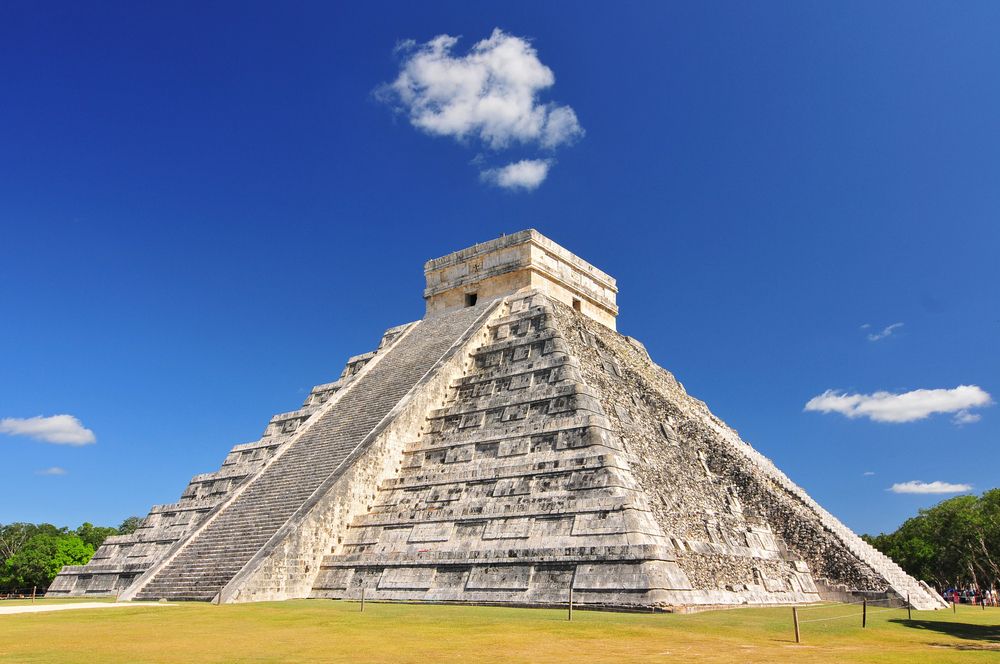
Impossible to mention the emblematic sites of the Maya Empire in Mexico without starting with Chichen Itza (97751 Yucatan, Mexico, rated 4.8/5 on Google for over 135,000 reviews). Ranked among the seven new wonders of the world in 2007 and inscribed on UNESCO's World Heritage list, this Maya archaeological site is the most visited in the entire Yucatan Peninsula, welcoming nearly 2 million visitors each year. Founded around the 2nd century, the city reached its peak between the 6th and 10th centuries and was a powerful political, economic and religious center of Maya civilization.
The absolute symbol of Chichen Itza is undoubtedly El Castillo, also called the Temple of Kukulcán. This stepped pyramid of 30 meters in height, composed of 365 steps in total — one for each day of the year — testifies to the extraordinary astronomical knowledge of the Maya. At each spring and autumn equinox, a phenomenon of light and shadow creates the illusion of a feathered serpent descending the flanks of the pyramid, in homage to the god Kukulcán. This exceptional spectacle attracts thousands of spectators every year and illustrates by itself the Maya architectural and astronomical genius.
Beyond El Castillo, the site harbors other jewels not to be missed: the great ball court, the largest in all of Mesoamerica with its 168 meters long, where the losers — or perhaps the winners according to interpretations — could be sacrificed; El Caracol, the circular astronomical observatory whose openings were calculated to observe the stars; and the Sacred Cenote, natural well of 60 meters in diameter in which the Maya practiced ritual offerings. To best prepare your visit, favor an arrival at opening (8:00 AM) to avoid the heat and crowds that increase significantly in the middle of the day.
2. Discover the preserved city of Uxmal, jewel of the Puuc style
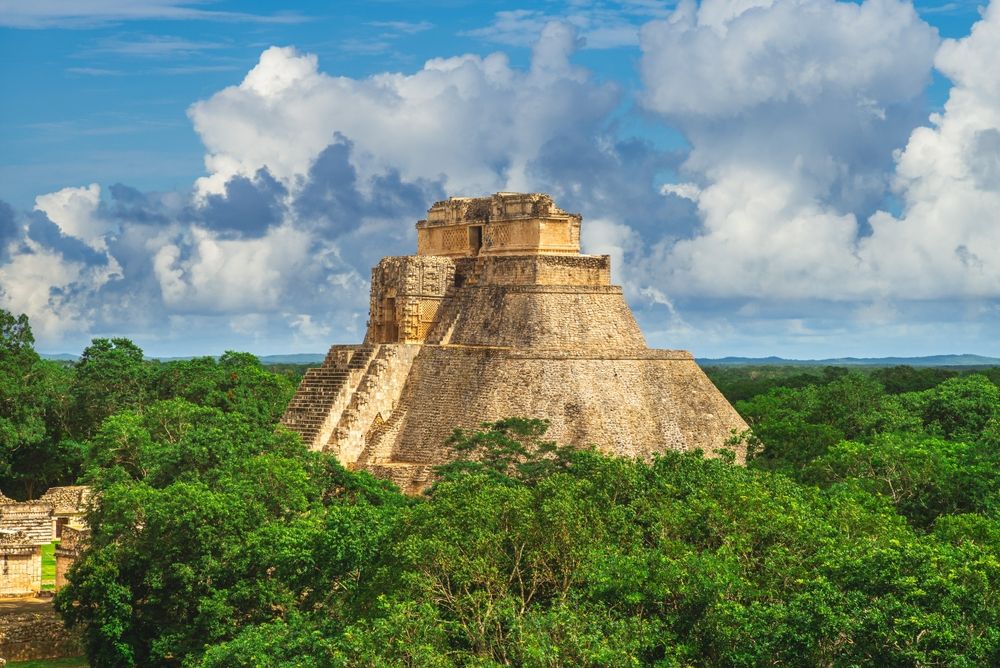
Located about 62 kilometers south of Mérida, in the state of Yucatán, the archaeological site of Uxmal is one of the most beautiful examples of Maya architecture called "Puuc style". Founded around 700 AD, this ancient city counted up to 25,000 inhabitants at its peak, between the 8th and 10th centuries. Inscribed on UNESCO's World Heritage list, Uxmal is considered by many archaeologists as one of the best preserved Maya cities, with its facades richly decorated with geometric motifs and masks of the rain god Chaac, whose repeated representation testifies to the crucial importance of water in this arid region.
The masterpiece of the site is undoubtedly the Pyramid of the Soothsayer (Pirámide del Adivino), whose elliptical and rounded silhouette is unique in all Maya architecture. According to legend, this pyramid would have been built in a single night by a magic dwarf — hence its nickname "Pyramid of the Magician". In reality, it was erected in five successive phases between the 6th and 10th centuries, each new construction enveloping the previous one. 38 meters high, it dominates the entire site and offers from its summit a spectacular panoramic view over the surrounding jungle.
The site visit cannot be complete without exploring the Nunnery Quadrangle, a set of four buildings arranged around a central courtyard, whose upper facades are entirely covered with elaborate sculptures representing serpents, Chaac masks and geometric motifs. The Governor's Palace, 100 meters long and considered one of the most beautiful buildings in all of pre-Columbian Mesoamerica, completes the visit with its continuous frieze of 300 Chaac masks. Plan good sun protection as shade is rare at Uxmal: the site extends openly over several hectares of arid vegetation.
3. Dive into the heart of the jungle and admire Palenque, the city of King Pakal
Nestled in the heart of the lush jungle of the state of Chiapas, the Maya city of Palenque is one of the most mysterious and enchanting among all the sites of the Maya empire in Mexico. Founded around 100 BC, it experienced its golden age under the reign of the legendary king Pakal the Great, who ruled from 615 to 683 AD and made this city one of the most important political and cultural centers of the Classic Maya period. Inscribed on UNESCO's World Heritage list, Palenque is considered one of the most beautiful archaeological sites in all of Latin America.
The most emblematic monument of Palenque is the Temple of the Inscriptions, a nine-level pyramid that houses in its depths the tomb of Pakal himself, discovered in 1952 by Mexican archaeologist Alberto Ruz Lhuillier. Inside the temple, three panels covered with hieroglyphs — 617 in total — recount the dynastic history of the city over several centuries. Pakal's jade sarcophagus, decorated with cosmic representations of extraordinary finesse, is now displayed at the National Museum of Anthropology in Mexico. The Palace, with its observation tower unique in all Maya architecture and its interior courtyards adorned with bas-reliefs, is equally captivating.
The atmosphere of Palenque is decidedly different from other Maya sites: the ruins literally emerge from tropical vegetation, the sound of howler monkeys resonates in the canopy, and streams run through the entire site. It is estimated that only 10% of the buildings have been cleared from the jungle, which leaves one to imagine the extent of what remains to be discovered. A few kilometers away, the waterfalls of Agua Azul and Misol-Ha constitute magnificent natural stops to complete the visit. If you plan a stay in Mexico including the great Maya sites, don't hesitate to consult our guide to the most beautiful places to visit in Mexico to compose your itinerary.
4. Tulum, Maya sentinel facing the Caribbean Sea
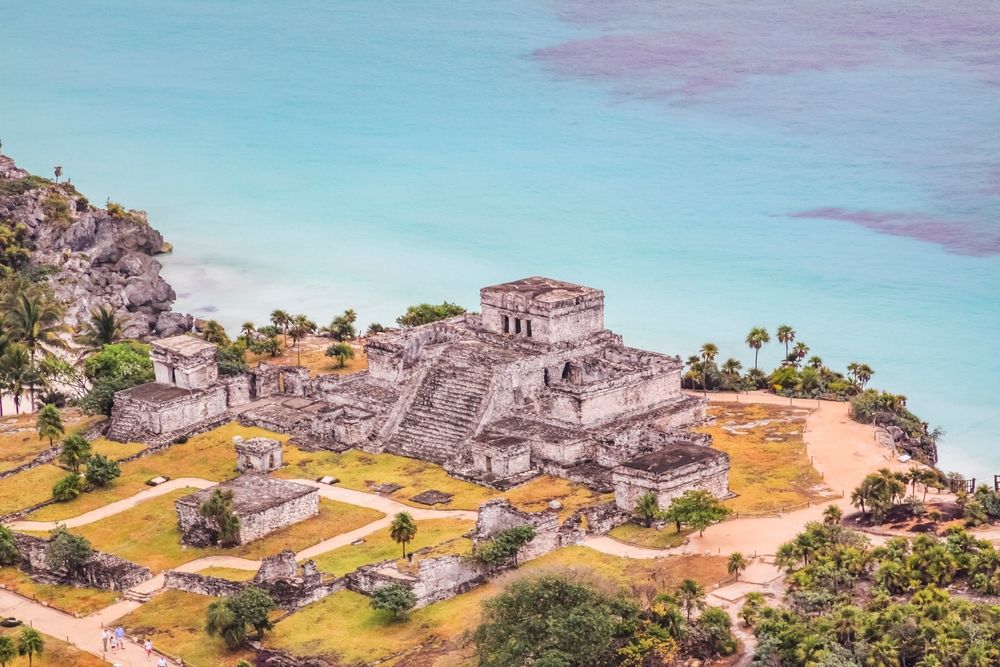
Tulum occupies a special place among the sites of the Maya empire in Mexico: it is indeed the only major Maya archaeological site built directly on the seashore. Perched on a 12-meter cliff overlooking the turquoise waters of the Caribbean Sea, in the Yucatan Peninsula, this ancient fortified city offers a breathtaking panorama that combines archaeological splendor and natural beauty. Founded around 564 AD, Tulum played an essential strategic role as a trading port on Maya maritime routes, notably exporting obsidian, jade and cocoa.
The city was surrounded by a stone wall on three sides — the fourth being delimited by the cliff and the sea — which earned it the name Tulum, which means "wall" or "fortress" in Maya. Its main monument, El Castillo (the Castle), dominating the sea from its rocky promontory, also served as a lighthouse guiding Maya boats along the coast. The temples of the Descending God and of the Frescoes complete the ensemble with their remarkable murals that testify to the religious and daily life of the inhabitants. Tulum was one of the last great Maya cities to survive when Spanish conquistadors arrived in the 16th century.
Today, Tulum is one of the most frequented archaeological sites in the world, combining the attraction of its ruins with the paradisiacal beaches of the Riviera Maya. To fully enjoy the visit, it is strongly advised to arrive at opening at 7:00 AM, before the influx of tourist buses from Cancún. The numerous cenotes in the surroundings — notably the Gran Cenote and the Cenote Dos Ojos — constitute superb complements to the ruins visit for an unforgettable day in the region. Tulum is also an excellent base to explore other Maya sites in the peninsula, starting with Cobá, about forty kilometers away.
5. Cobá, in the heart of the Quintana Roo jungle
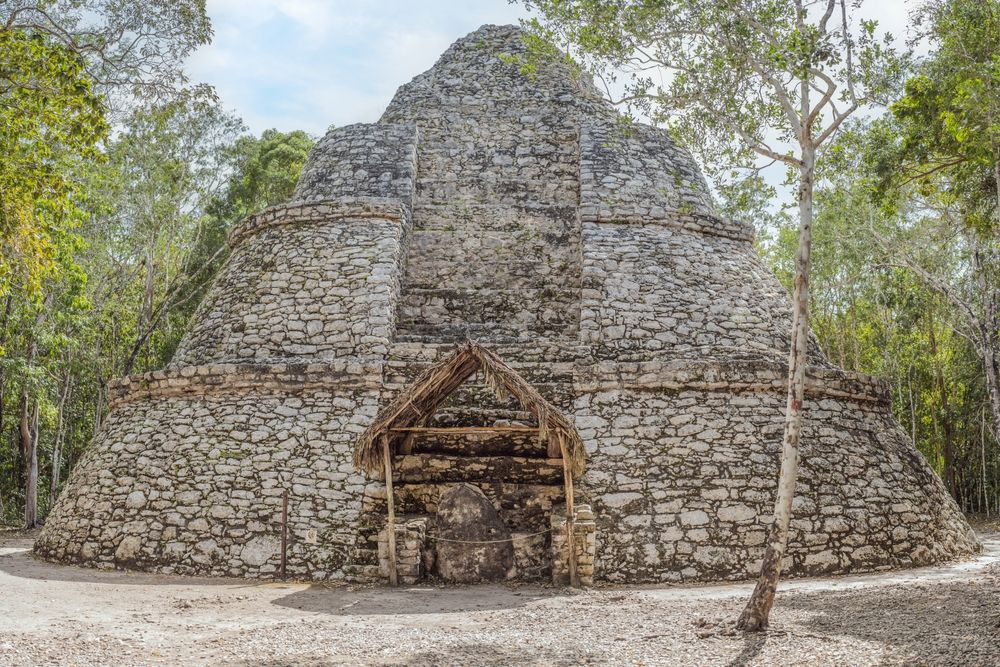
About 42 kilometers northwest of Tulum, lost in the jungle of Quintana Roo, the archaeological site of Cobá is one of the most extensive and fascinating Maya sites in Mexico. This powerful city-state, which prospered between the 8th and 10th centuries, had an estimated population of 50,000 inhabitants at its peak and extended its influence over a vast region through a network of paved roads called sacbés (white roads), some of which reached 100 kilometers long. Gradually abandoned after the 13th century, Cobá was swallowed by the jungle for centuries before being rediscovered in the early 20th century.
The highlight of the visit is undoubtedly the pyramid Nohoch Mul, which rises to 42 meters in height and remains one of the highest Maya pyramids in the entire Yucatan Peninsula. Unlike Chichen Itza where climbing has been prohibited, it is possible (since late 2025) to use the new wooden staircase to reach the summit, rewarded by an extraordinary panoramic view over the infinite expanse of jungle. It is one of the rare Maya pyramids still accessible for climbing, making it a unique experience. The oval temple, the sacbés that connect the different architectural groups and the numerous finely sculpted stelae complete the richness of the site.
The particularity of Cobá also lies in its mode of visit: the site extends over about 70 km² in the middle of the jungle, making it impossible to explore entirely on foot. Renting bicycles or tricycle taxis on site is a popular and fun solution to connect the different groups of monuments separated by sometimes several kilometers of forest track. The site is accessible from 8:00 AM and it is recommended to devote at least half a day to it. Wildlife enthusiasts will also be satisfied: spider monkeys, toucans and colorful butterflies populate the forest that surrounds the ruins.
6. The classified site of Calakmul, lost in the tropical forest of Campeche
Located in the heart of the Calakmul biosphere reserve, in the state of Campeche, just kilometers from the Guatemalan border, the archaeological site of Calakmul is undoubtedly the most isolated and wildest among all the emblematic Maya sites of Mexico. Less known than Chichen Itza or Tulum, this site is nevertheless one of the most important of all Maya civilization: with more than 6,500 structures spread over 70 km² and an estimated population of 50,000 inhabitants at its peak, Calakmul was one of the two great Maya metropolises of the Classic period — the other being Tikal, in Guatemala — and the two cities disputed supremacy for centuries.
Double inscribed on UNESCO's World Heritage list — for both its natural and cultural heritage — Calakmul houses two colossal pyramids. Structure II, 55 meters high, is one of the largest Maya pyramids ever built and contains in its entrails no less than nine richly decorated royal tombs. Its summit offers a breathtaking view over the canopy of the tropical forest that extends infinitely, and on clear days, one can see the pyramids of Tikal profiled on the Guatemalan horizon. More than 117 stelae have been recorded at the site, representing rulers and their wives, the largest number of stelae discovered at a Maya site.
Visiting Calakmul is an experience in itself that requires good logistical organization. The site is more than two hours of track from the main road and generally requires at least one night on site. But the effort is largely rewarded: the isolation of the site, the richness of the fauna (jaguars, tapirs, peccaries, quetzals and an infinity of tropical birds inhabit the reserve), and especially the impression of being alone facing colossal ruins in virgin jungle constitute an unforgettable experience. For travelers wishing to discover the Maya heritage of Mexico in its most authentic and least touristic dimension, Calakmul is a must.
7. The impressive temple of Muyil, gateway to the Sian Ka'an reserve
Much less known than its neighbors Tulum or Cobá, the archaeological site of Muyil (also called Chunyaxché) is a true hidden jewel of the Yucatan Peninsula, nestled inside the biosphere reserve of Sian Ka'an, classified as UNESCO World Heritage. Located only 25 kilometers south of Tulum, this site is one of the oldest on the Caribbean coast of Mexico, with traces of human occupation dating back to the 3rd century BC. Its strategic position on the edge of Muyil lagoon made it a crucial passage point on the commercial maritime routes of the Maya empire.
The main monument of the site is El Castillo of Muyil, a 17-meter high pyramid dating from the 8th century, whose summit once bore a temple-tower unique in Maya architecture. The frescoes and stuccos still partially visible inside testify to the artistic talent of the ancient Maya. The entire site is remarkably well preserved despite the centuries, with several structures still covered by vegetation that gives them a mysterious and romantic aspect. The striking contrast between the gray stone structures and the lush tropical vegetation creates a very particular atmosphere.
Beyond the ruins, Muyil offers an exceptional natural experience: from the site, a wooden trail crosses the mangrove to the Muyil lagoon, where boats offer excursions by boat to the Sian Ka'an reserve. This aquatic stroll through natural channels dug by the Maya, among flamingos, crocodiles and extraordinary bird fauna, is one of the most beautiful natural experiences in Mexico. Muyil thus constitutes a double discovery: archaeological and natural, away from the crowds that invade the more famous sites of the region.
8. Admire the Chac masks on the Ruta Puuc, route of the forgotten cities of Yucatán
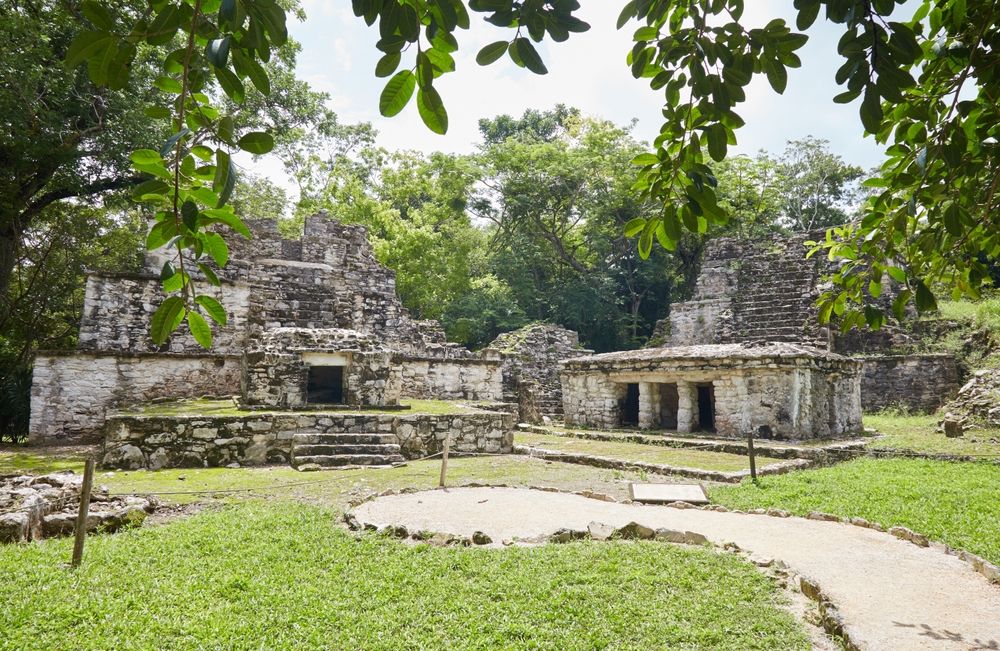
South of Mérida, in the gentle hills of Yucatán, the Ruta Puuc is an exceptional archaeological circuit that groups several first-class Maya cities, including Kabah, Sayil, Xlapak and Labná. Less frequented than Chichen Itza or Uxmal — which constitutes the ideal entry point of this itinerary — the Ruta Puuc offers an authentic and immersive experience in classic Maya architecture of Puuc style, characterized by its stone mosaic facades, round columns and geometric friezes of remarkable precision and elegance. These cities all prospered between 750 and 950 AD, before being abandoned during the collapse of Classic Maya civilization.
The masterpiece of the Ruta Puuc is the Codz Poop of Kabah, also called the Palace of Masks, whose facade is entirely covered with more than 250 masks of the rain god Chaac, stacked one on top of the other from the ground to the top of the building. Each mask, with its characteristic long hooked nose, represents a prayer in stone to obtain the rain essential for survival in this semi-arid region. It is one of the most spectacular and haunting examples of all Maya architecture. At Kabah, an isolated triumphal arch marks the entrance of a sacbé that once led directly to Uxmal, 18 kilometers away.
At Sayil, the great three-level Palace and its 90 rooms illustrate the scale of Puuc cities, while at Labná, the Labná Arch is considered one of the most beautiful examples of Maya ornamental architecture. These sites are generally little frequented and allow for an intimate experience with the ruins, away from the crowds of more famous sites. The Puuc route is ideally traveled in a day from Mérida, by rental car, combining the visit of Uxmal with several sites on the route. A tip: leave early in the morning to enjoy the coolness and avoid the afternoon heat.
9. Teotihuacan, the city of the gods, at the gates of Mexico
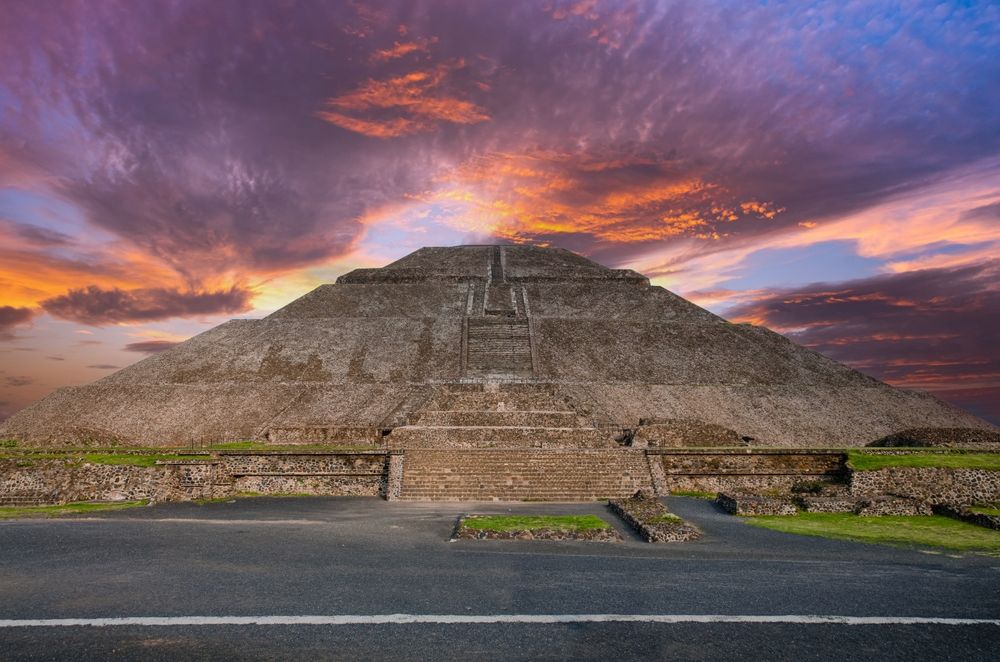
Only 50 kilometers northeast of the Mexican capital, the archaeological site of Teotihuacan is one of the most important and mysterious of all Mesoamerica. Although its direct link with Maya civilization is debated — it was a multi-ethnic metropolis influenced by numerous cultures, including the Maya — Teotihuacan exerted considerable influence on the entire Mesoamerican world, including the great Classic Maya cities like Copán and Tikal. At its peak, between the 4th and 6th centuries AD, the city counted between 150,000 and 200,000 inhabitants, making it one of the largest metropolises of the ancient world.
The Pyramid of the Sun, third largest pyramid in the world with its 65 meters in height and its base of 225 meters per side, is the flagship monument of the site. Climbing its 248 steps is a physically demanding but extraordinarily rewarding experience: from the top, the view extends over the entire city and surrounding landscape. The Pyramid of the Moon, slightly smaller, closes the northern end of the Avenue of the Dead, main avenue 2 kilometers long that structured the entire city. The Temple of the Feathered Serpent (Quetzalcóatl), with its facades adorned with sculpted heads of alternating serpents and divinities, completes this unique architectural pantheon.
Download the audio-guided circuit to discover Mexico on foot and independently
If you visit Teotihuacan from Mexico, why not take advantage of your stay in the capital to explore the historic heart of the city thanks to the Ryo audio-guided circuit "In the Footsteps of the Aztecs"? This pedestrian route of 24 narrated stages takes you through the historic neighborhoods of Mexico, from the Zócalo and the metropolitan cathedral to the Templo Mayor, passing by Diego Rivera's frescoes and colonial palaces. Thanks to interactive navigation and 24 fun audioguides, you explore the Mexican capital in total autonomy, at your own pace, letting yourself be guided by fascinating stories of Aztec and colonial history. An excellent complement to visiting the archaeological sites of the surroundings, to download before your departure to Visit Mexico like a local.
The visit to Teotihuacan is ideally done at opening at 9:00 AM to enjoy the morning coolness before the sun beats down hard. Plan comfortable shoes, a large quantity of water, sunscreen and a hat: the site is entirely open and the distances between monuments are considerable. Allow at least 3 to 4 hours for a complete visit. The museum on site, the Museo de la Cultura Teotihuacana, also deserves a stop to better understand the history and culture of this still largely mysterious civilization.
10. Ek-Balam, the mysterious city of the black jaguar
Only 30 kilometers north of Valladolid, the colonial city in the heart of Yucatán, the archaeological site of Ek-Balam is one of the most precious discoveries for enthusiasts of Maya sites of Mexico. Its name means "Black Jaguar" in Maya, and its history is intimately linked to a legendary king of the same name who would have founded the city in the 4th century AD. The city experienced its peak between the 8th and 10th centuries, controlling an important commercial network in a region rich in natural resources. Less frequented than the neighboring major sites, Ek-Balam allows for an authentic and intimate experience with Maya ruins.
The masterpiece of the site is the Acropolis, a 32-meter high pyramid whose west facade houses one of the best preserved Maya sculptures in the world: the gaping mouth of an earth monster serving as entrance to a royal tomb, surrounded by stucco figures of exceptional fineness representing Maya angels, warriors and divinities. This sculpted facade (portada), protected for centuries under a layer of stucco, was rediscovered during excavations in the 1990s in an extraordinary state of conservation. The site is surrounded by a double stone wall, a rare characteristic in Maya cities, which testifies to its strategic importance.
The visit to Ek-Balam is wonderfully complemented by a swim in the private cenote adjacent to the site, a shallow cenote with crystalline waters that constitutes a well-deserved break after climbing the pyramid. The Valladolid region offers other gems nearby, notably the famous cenote Ik Kil, halfway between Valladolid and Chichen Itza, and the colonial city of Valladolid itself with its colorful streets and authentic atmosphere. By combining Ek-Balam with Chichen Itza and Valladolid, you compose an exceptional day in the heart of Maya and colonial heritage of Yucatán. If you are passing through Mexico before or after this circuit, let yourself be guided in the capital by the Ryo audio-guided circuit, for a complete discovery of Mexican culture, from Aztecs to today.
In conclusion, the 10 emblematic sites of the Maya Empire in Mexico presented in this article form an exceptional itinerary that spans several millennia of history and human genius. From the cosmic grandeur of Chichen Itza to the still buried secrets of Calakmul, from the lacustrine majesty of Muyil to the sculptural finesse of Ek-Balam, each site offers a unique gateway to Maya civilization and its priceless heritage. To best prepare your trip, consider consulting our guide to the most beautiful places to visit in Mexico, and if your itinerary passes through the capital, explore Mexico in depth thanks to the Ryo audio-guided circuit, which offers you 24 narrated stages to Visit Mexico in complete autonomy and rediscover the pre-Hispanic roots of this fascinating country. Have a great trip to the land of the Maya!
FAQ – Frequently asked questions about Maya sites in Mexico
What is the best time to visit Maya sites in Mexico?
The best time to visit the Maya sites of Mexico extends from November to April, during the dry season. Temperatures are pleasant (25 to 30°C), precipitation rare and vegetation less dense. Avoid the rainy season from May to October, especially in July-August where torrential rains can make certain paths impassable. For the Yucatan Peninsula sites (Chichen Itza, Tulum, Uxmal, Cobá, Ek-Balam), the heat is bearable from November to March. For Palenque in Chiapas, expect higher humidity all year round.
Do you need a guide to visit Maya archaeological sites?
A guide is not mandatory but strongly recommended, especially for complex sites like Chichen Itza, Palenque or Calakmul, whose historical and symbolic richness deserves detailed explanations. Certified guides offer their services at the entrance of most major sites. Audio guides are available at certain sites. For visiting Mexico and discovering its Aztec treasures, the Ryo audio-guided circuit constitutes an excellent autonomous and fun alternative to a traditional guide.
How much time is needed to visit the 10 Maya sites of Mexico?
To visit the 10 emblematic sites of the Maya empire in Mexico in good conditions, plan a minimum of 2 to 3 weeks. The Yucatan sites (Chichen Itza, Uxmal, Tulum, Cobá, Ek-Balam, Muyil, Ruta Puuc) can be grouped in 7 to 10 days with Mérida or Valladolid as bases. Calakmul requires 2 to 3 specific days, and Palenque at least 2 days in Chiapas. Teotihuacan is done in one day from Mexico City. Add several days in Mexico to explore the capital thanks to the Ryo circuit.
Can you still climb Maya pyramids in Mexico?
Most Mexican Maya pyramids are now forbidden to climb for conservation and safety reasons. This is the case of El Castillo at Chichen Itza (forbidden since 2006), the Pyramid of the Soothsayer at Uxmal and the Temple of Inscriptions at Palenque. However, the pyramid Nohoch Mul at Cobá reopened for climbing at the end of 2025 with a new wooden access system. At Teotihuacan, it is still possible to climb the Pyramid of the Sun and the Moon. The situation can evolve, it is advised to check access conditions before your visit.
Which Maya sites in Mexico are inscribed on UNESCO's World Heritage list?
Among the 10 sites presented in this article, several are inscribed on UNESCO's World Heritage list: Chichen Itza (1988), Palenque (1987), Uxmal (1996), Calakmul (2002 for natural heritage, 2014 for cultural heritage) and Teotihuacan (1987). This international recognition testifies to the exceptional universal value of these sites which constitute the most eloquent testimony to the greatness of pre-Hispanic civilizations of Mexico. To go further in discovering Mexican heritage, find our complete selection of most beautiful places to visit in Mexico.