
Créé par Emilie, le 20 juin 2026
Votre guide Ryo
25 Best Things to Do in Lisbon in 2026
© Shutterstock
Lisbon is one of those cities that rewards curiosity rather than checklists. Perched on seven hills above the Tagus estuary, it is Western Europe's oldest capital, founded centuries before Paris or London, and its neighbourhoods still feel genuinely distinct, each with its own pace, cuisine and sound. Whether you follow the audio-guided walk through Alfama on Ryo's Lisbon city tour or simply wander in search of a custard tart, you rarely feel like you are consuming a packaged experience.
What surprises most visitors: a monastery begun in 1501 that took a century to finish and never lost a single stone during the 1755 earthquake that levelled the rest of the city; a flea market operating on the same hilltop since the 12th century; an oceanarium sitting on a former industrial wasteland now worth three hours of anyone's time; and a bar street paved in pink that transforms into an open-air concert venue after midnight. This list covers 25 things to do in Lisbon, from unmissable monuments to the kind of afternoon you only discover by asking a local.
1. Jerónimos Monastery
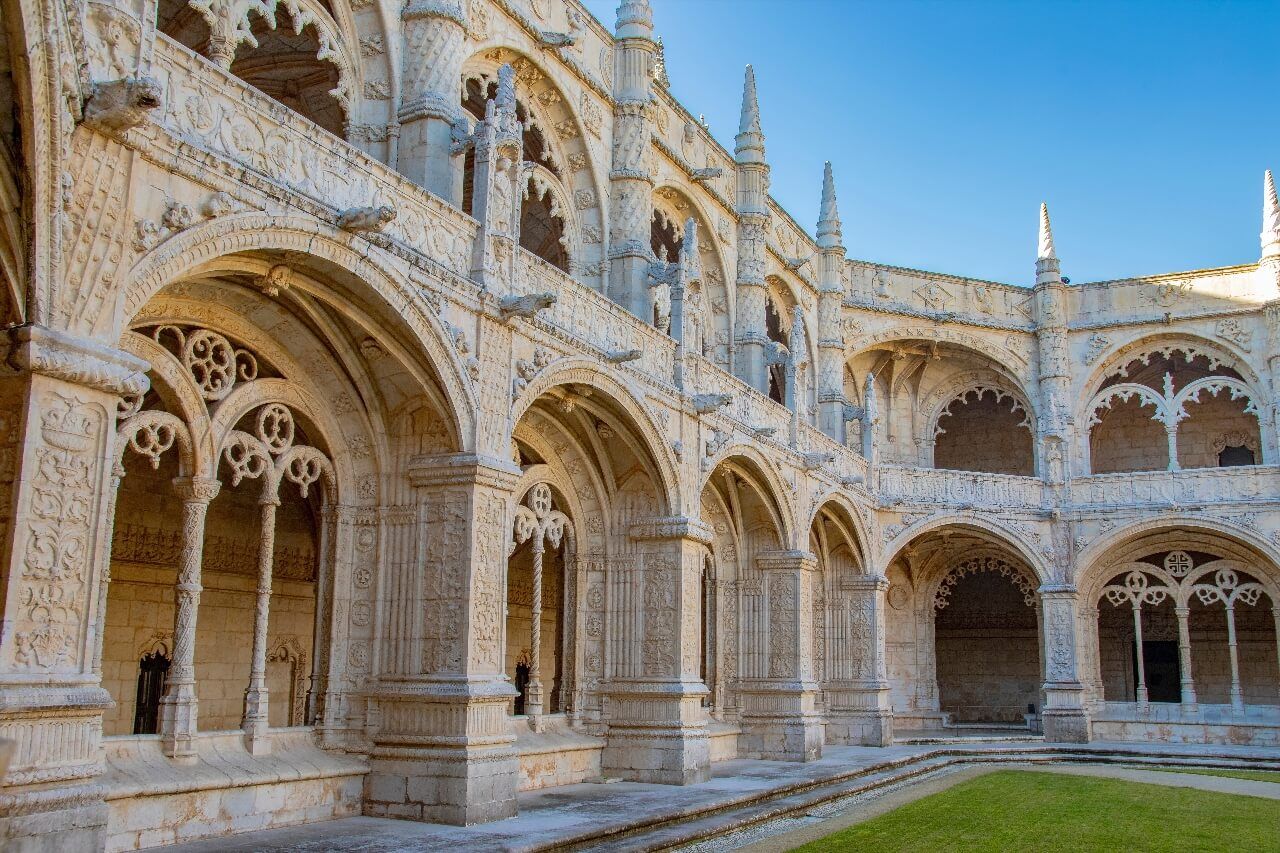
Jerónimos Monastery (Praça do Império, 1400-206 Lisboa, rated 4.5/5 on Google (60 658 avis)) stands at the western end of Belém, about six kilometres from the city centre, and it remains one of the finest examples of Manueline architecture anywhere in the world. Built between 1501 and 1601 to celebrate Vasco da Gama's voyage to India, it was funded largely by a tax on the spice trade, so this impossibly ornate building was, in a very real sense, paid for by pepper and cinnamon.
The south portal is the first thing that stops you cold: a cascade of carved stone saints, ropes, armillary spheres and coral that took sculptors decades to complete. Inside, the nave stretches 92 metres and the six slender columns that support it are carved to look like palm trees, an architectural trick that still works perfectly. The tombs of Vasco da Gama and the poet Luís de Camões lie at floor level near the entrance, almost casual in their placement given what they commemorate.
Admission is €18 for the church and cloister combined; the church alone is free, and the cloister is free on Sundays until 2 p.m. for Portuguese residents. Arrive before 10 a.m. on weekdays to walk the cloister without crowds. The upper gallery gives you a view down into the central garden that most visitors never see because they do not realise there are stairs.
2. São Jorge Castle
São Jorge Castle does not disappoint from below, the silhouette of crenellated towers against a blue sky above Alfama has appeared on so many postcards that you feel you already know it. In person, walking through the gate into the inner ward, the scale becomes real in a way that photographs do not convey.
The site has been fortified for more than 2,500 years. Phoenicians, Romans, Visigoths and Moors each added their own layers before the Portuguese king Afonso Henriques took the castle in 1147, reportedly after a siege that lasted four months. The Moors who surrendered were allowed to remain in the city, they settled in what became the Mouraria quarter, directly below.
The current towers and walls date mostly from the medieval and later Portuguese periods, with significant reconstruction after the 1755 Lisbon earthquake. The archaeological site within the walls has uncovered layers going back to the 7th century BC, and the small museum displays artefacts from each period with clear English labelling.
What genuinely surprises most visitors are the free-roaming peacocks that have lived inside the castle grounds for decades, nobody seems to know exactly when they arrived or why, but they have become as much a part of the experience as the towers themselves.
Admission is €15 for adults; book online in advance, especially between June and September. The views from the battlements take in the entire lower city, the Tagus, and on clear days the hills of the Serra de Sintra to the northwest. Go at opening time (9 a.m.) or in the late afternoon after 4 p.m. to avoid the peak of the tour-group traffic.
3. Belém Tower
Belém Tower (Torre de Belém (Av. Brasília, 1400-038 Lisboa, rated 4.5/5 on Google (112 680 avis))) is the one building in Lisbon that appears on virtually every piece of tourist material, and yet standing next to it on the riverbank, you realise that the photographs always lie about its size. The tower is small, delicate and almost surprising in its refinement compared to the fortress bulk you might expect.
Built between 1514 and 1520 to guard the entrance to Lisbon harbour, it combines Manueline Gothic ornamentation with North African influence in its loggia and watchtower. The rhinoceros carved beneath the main balcony is a famous detail, it is thought to commemorate a real rhinoceros sent to King Manuel I by the Sultan of Gujarat in 1515, the first live rhinoceros seen in Europe since Roman times.
Admission is €15. The interior is narrow and the staircases steep; the roof terrace is the destination, offering views back towards the city and out toward the river mouth. Note that the tower has been undergoing major restoration under Portugal's Recovery Plan, with reopening planned for mid-2026, check the latest status before you travel. Even when the interior is closed, the exterior viewpoint along the riverbank is one of the most photographed spots in the city.
4. Alfama and the Miradouros
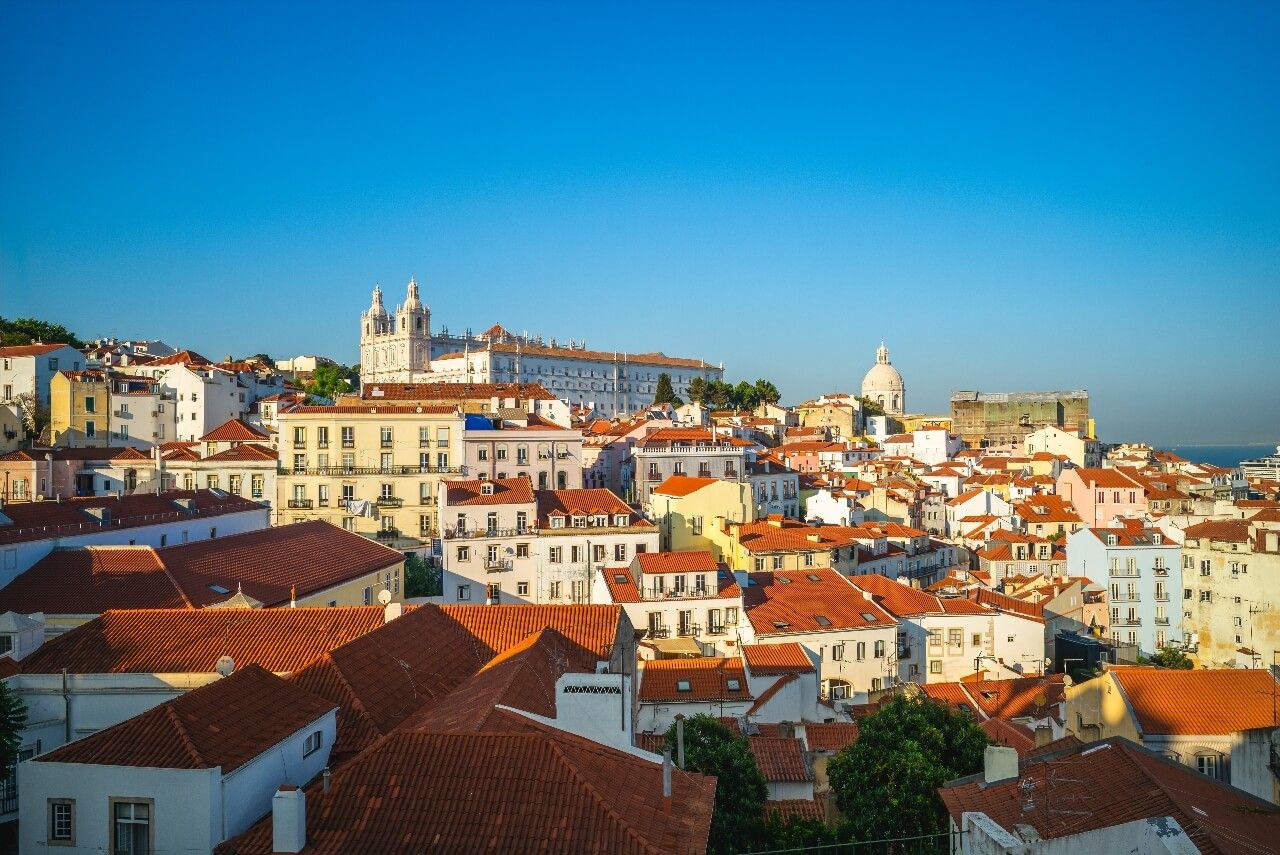
Alfama is the oldest neighbourhood in Lisbon and the one that survived the catastrophic earthquake of 1 November 1755 almost entirely intact. The reason is geological: the district sits on a bedrock of solid schist, while the lower city was built on softer alluvial ground that liquefied and collapsed. The result is that Alfama's labyrinthine street pattern, established under Moorish rule in the 9th and 10th centuries, has never been replanned or regularised.
Walking through it requires a willingness to get lost. The ruas (streets) are rarely wide enough for two people to pass without turning sideways in places; laundry crosses between windows; and the smell of grilled sardines drifts up from restaurants that have no signage visible from the street. Navigating by sound and smell is not a cliché here, it is genuinely the best method.
The neighbourhood has five major viewpoints (miradouros), each with a slightly different personality. Miradouro da Graça is the highest and least visited, popular with locals in the early evening. Miradouro de Santa Luzia has a tiled wall depicting pre-earthquake Lisbon that is worth examining closely. Miradouro das Portas do Sol sits above the rooftops of Alfama itself. Miradouro da Senhora do Monte, a steep climb even by Alfama standards, gives the widest panorama of the entire city including the castle. Miradouro de Santa Catarina (Adamastor), on the western side of the city in Bica, is the favourite meeting point for younger Lisbonites around sunset.
If you want context for what you are seeing, the history of the Moorish city, the role of each quarter in the earthquake's aftermath, the significance of the azulejo tiles you keep passing, the Ryo audio guide for Lisbon provides that layer of interpretation as you walk, without needing to stop and read.
5. Ride Tram 28
Tram 28 (Rua 1 de Maio, 1200 Lisboa, rated 4.2/5 on Google (13 634 avis)) is simultaneously Lisbon's most famous tourist attraction and one of the city's genuine working tram lines, still used daily by residents of Alfama and Graça. The yellow Remodelado trams currently running on the line date from the 1930s, though the line itself was electrified in 1914, and the route they follow, through streets so narrow that you can reach out the window and touch the building walls, was designed for a city in which the tram was the primary means of transport.
The route runs from Martim Moniz in the Baixa through Alfama and up to the Prazeres cemetery in the west, passing through Estrela and the Jardim da Estrela along the way, which means a single ticket covers a substantial slice of the city's geography. A single journey costs €3.30 if you buy on board; much less (around €1.80) with a Viva Viagem card loaded with credit.
Practical reality: in summer, queues for Tram 28 can stretch for 45 minutes at Martim Moniz. Board at a less popular stop, Largo do Chiado or Rua da Conceição, and you will almost always find space. Also watch your pockets; the tram is well-known among pickpockets precisely because the carriages become tightly packed.
6. Time Out Market Lisbon
The Time Out Market opened in the renovated Mercado da Ribeira in 2014 and has since become one of the most copied food-hall concepts in the world, there are now Time Out Markets in Miami, New York, Chicago and a dozen other cities. The original in Lisbon remains the template and, arguably, the best.
The market occupies one half of the 19th-century iron-and-glass Ribeira building. The other half is still a traditional produce market open on weekday mornings, worth visiting for the spectacle of Lisbon's restaurant chefs doing their daily shopping. The food hall side houses around 40 counters run by some of Portugal's best-known chefs alongside street-food specialists and producers.
What to eat: the bifanas (pork sandwiches) from O Zé da Mouraria, anything from Marlene Vieira's counter, and the pastéis de nata from the Aloma bakery counter, which many Lisbonites consider better than the famous Pastéis de Belém. The house white wines served by the glass are uniformly good and inexpensive by northern European standards. The space is open every day until midnight, which makes it a practical option before or after an evening elsewhere.
7. Pastéis de Belém
Pastéis de Belém (R. de Belém 84-92, 1300-085 Lisboa, rated 4.6/5 on Google (97 797 avis)) has been selling its version of the custard tart from the same address since 1837, a remarkable claim even in a city with many old institutions. The recipe for the pastel de nata was reportedly created by monks at Jerónimos Monastery next door, who needed income after the Liberal Revolution of 1820 suppressed the monastic orders.
The tarts are served warm from the oven, dusted with cinnamon and powdered sugar, and genuinely different from the versions sold in every other café in the city, the pastry is thinner, crisper, and the custard filling has a texture that holds its shape better than most imitations. You will pay €1.40 : 1.60 per tart depending on where you sit.
The bakery itself is enormous, a series of tiled rooms that can seat hundreds of people, but queues still form outside on weekends and during summer afternoons. The practical move: go on a weekday morning and eat at the counter, which is faster than waiting for a table.
8. LX Factory
LX Factory (R. Rodrigues de Faria 103, 1300-501 Lisboa, rated 4.5/5 on Google (64 642 avis)) occupies a complex of 19th-century industrial buildings in Alcântara, a rope-making and textile manufacturing site that was abandoned in the late 20th century and repurposed from 2008 onward as a creative hub. It is one of the most convincing industrial-regeneration projects in southern Europe, and it works partly because it has resisted the pressure to become purely upmarket.
The complex houses around 100 tenants: independent restaurants, concept stores, a climbing wall, a yoga studio, a brewery, photography studios and workshop spaces. The anchor tenant is Ler Devagar, a bookshop occupying a former printing room on two floors, with a ceiling hung with a suspended bicycle installation and walls lined floor to roof with books in Portuguese, English and French. It has been named one of the world's most beautiful bookshops by multiple publications and justifies that reputation without feeling self-conscious about it.
The best time to visit is the Sunday market (10 a.m. to 6 p.m.), when additional vendors set up in the central street selling vintage clothing, ceramics, local food products and plants. The resident restaurants fill up fast; arrive before noon or after 2 p.m. for a table without waiting.
In the evenings, LX Factory transforms again: several of its restaurants become dinner venues with live music, and the courtyard hosts events ranging from open-air cinema to DJ nights. Check the monthly programme on the LX Factory website before you visit, some events require tickets bought in advance. The complex is open daily, though many individual shops keep their own hours and close on Mondays. The riverside walk back toward the centre, along the Avenida da Índia, passes the Pilar 7 viewpoint under the 25 de Abril bridge, a glass-floored platform set 80 metres above the Tagus that gives a vertiginous look down at the river traffic. It is one of the most underrated experiences in this part of the city, and a logical pairing with an afternoon at LX Factory.
9. Fado Show in Alfama
Fado, the Portuguese musical genre defined by voices of tremendous range singing lyrics of longing, loss and fate, originated in Lisbon's poorest neighbourhoods in the early 19th century and was classified as UNESCO Intangible Cultural Heritage in 2011. Understanding that context makes listening to it differently.
The casas de fado of Alfama are the authentic venues: small restaurants where a singer performs three or four songs, then is replaced by another, in an informal rotation throughout the evening. The music is accompanied by the twelve-string guitarra portuguesa and the classical guitar. There is no applause during a song, only silence or, when a performance is exceptional, the murmured silêncio called out by the audience to request quiet.
Good venues in Alfama include Clube de Fado (R. de São João da Praça 94, 1100-521 Lisboa, rated 4.4/5 on Google (4 072 avis)), which has been running since 1990 and books the city's best guitarists, and Mesa de Frades in a former chapel on the Rua dos Remédios, which seats only around thirty people. Both require reservations and include a meal, budget €35 : 60 per person depending on what you order. Avoid venues that advertise with laminated menus in multiple languages near the main tourist streets: the music is rarely the priority there.
One practical note: fado restaurants typically begin serving around 8 p.m., and music starts later, sometimes not until 9:30 or 10 p.m. Plan your evening accordingly.
10. Monument to the Discoveries
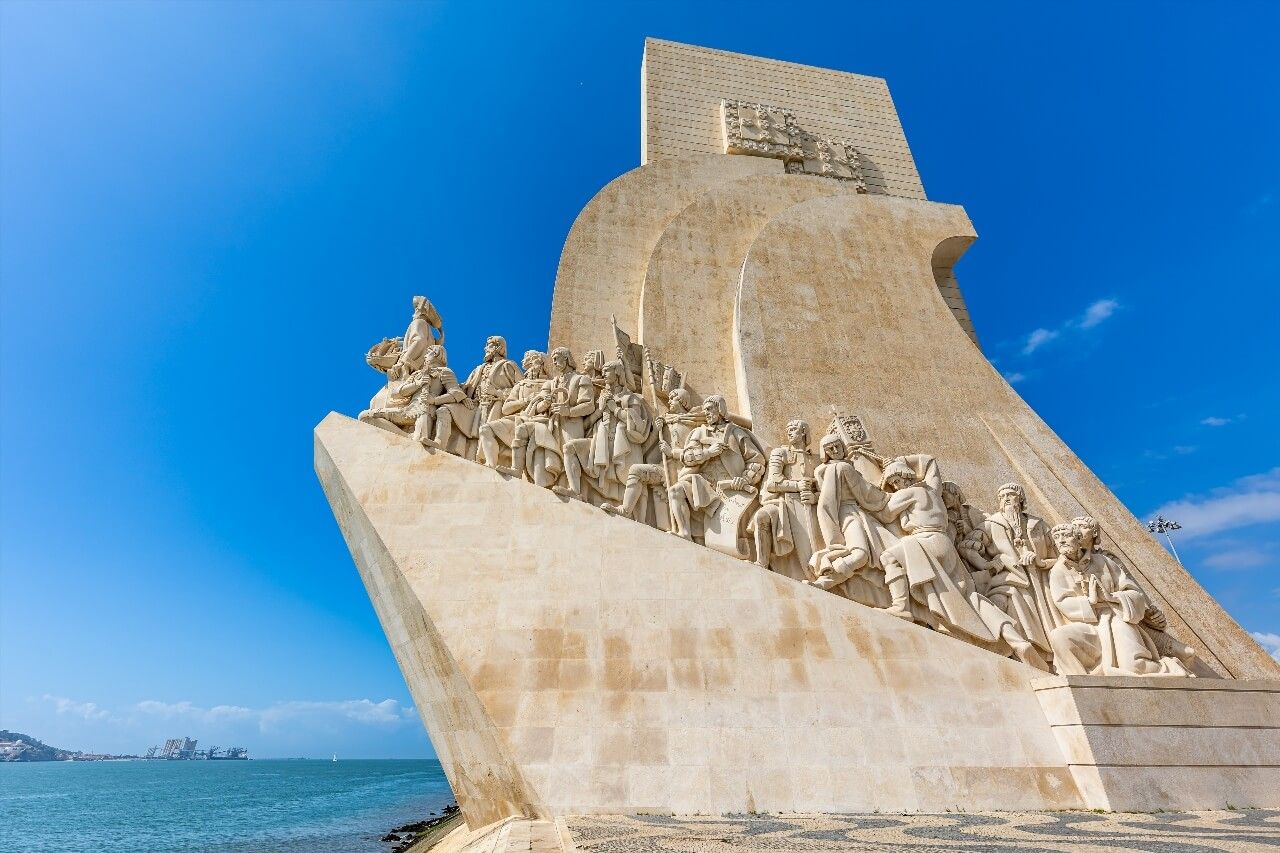
The Monument to the Discoveries (Padrão dos Descobrimentos (Av. Brasília, 1400-038 Lisboa, rated 4.5/5 on Google (20K reviews))) stands on the northern bank of the Tagus in Belém, at the point where the Tagus meets the sea, or close enough, historically speaking, and was built to mark the 500th anniversary of the death of Henry the Navigator in 1960. It is 52 metres tall and shaped like the prow of a caravel.
The monument bears 33 figures on its two flanking sides: explorers, cartographers, missionaries, poets and artists who contributed to Portugal's Age of Discovery. Henry the Navigator leads at the prow. The interior can be visited by lift and stairs; the roof terrace gives an elevated view of the Tagus and the nearby wind rose mosaic on the plaza below, a 50-metre compass set into the paving stones, a gift from South Africa in 1960, showing the routes of the Portuguese navigators across every ocean. Admission is €10.
11. National Tile Museum (Museu Nacional do Azulejo)
The National Tile Museum (Museu Nacional do Azulejo (R. Me. Deus 4, 1900-312 Lisboa, rated 4.6/5 on Google (17 218 avis))) is, by some margin, the most undervisited major museum in Lisbon, and one of the finest in Portugal. It occupies a former convent, the Convento da Madre de Deus, built in 1509, and the building itself is as much the exhibit as the collection it contains.
The azulejo tile tradition in Portugal is not merely decorative. It is the primary medium through which the country recorded its history, geography, religion and social life for five centuries. The panels in this museum range from single geometric tiles in the Moorish tradition to monumental narrative compositions covering entire church walls. The most famous piece is the Grande Panorama of Lisbon, a 23-metre-long tile panel depicting the Lisbon waterfront as it appeared before the 1755 earthquake, assembled between 1700 and 1725. It is the only visual record of what the pre-earthquake city actually looked like at street level.
Beyond the panorama, the Manueline church within the convent is one of the most beautiful small interiors in Lisbon: gold-leaf altarpieces, painted ceilings, and the nave walls entirely covered with 18th-century azulejos. Most visitors spend thirty minutes; you need at least two hours to do the permanent collection justice.
Admission is €8. The museum is in Xabregas, east of the city centre, about 15 minutes by taxi or Uber from Alfama, or reachable by bus. It is rarely crowded even on summer weekends, which is part of its appeal. The rooftop terrace of the café, accessible without a museum ticket, has views over the Tagus and the river's eastern reaches that most tourists never see.
Tile-making workshops are offered several times a week; book in advance on the museum website. If you want to understand why Lisbon's walls, station halls and stairwells are so striking, this is the museum that explains it.
12. Feira da Ladra Flea Market
Feira da Ladra (Campo de Santa Clara, 1100-472 Lisboa, rated 4.3/5 on Google (2 122 avis)), the « Thieves' Market », takes place every Tuesday and Saturday on the Campo de Santa Clara, a sloping square next to the São Vicente de Fora church in the eastern part of Alfama. It has been operating in some form since the 12th century, making it one of the oldest markets in Europe still functioning on its original site.
The market spreads across the square in an unofficial hierarchy: licensed stalls at the top selling antiques, old books, prints, tiles and ceramics; unlicensed vendors lower down, often spreading their wares on blankets and selling anything from used tools and old shoes to religious objects, Soviet-era badges and 1970s Portuguese pop records. Go early, before 9 a.m., for the best finds and the most manageable crowds. By noon in summer it becomes genuinely hot and extremely busy.
13. Sintra Day Trip
Sintra is 40 kilometres northwest of Lisbon, reachable in 40 minutes by train from Rossio station for around €2.55 each way. It is a UNESCO World Heritage Site and one of the most visited destinations in Portugal, which means practical planning matters more here than almost anywhere else in the country.
The town itself sits in forested hills above the Atlantic coast, and its microclimate, noticeably cooler and often mist-covered even in summer, gave 19th-century Portuguese and European aristocracy a reason to build their fantasy palaces here. The result is a concentration of extraordinary architecture in a very small area.
The three main sites require separate admission tickets and separate time:
Palácio Nacional de Sintra (the Royal Palace, in the town centre) is the most accessible: a medieval palace rebuilt in the 15th and 16th centuries with two conical chimneys visible from miles away. Its interior contains some of the finest Manueline and Mudéjar decoration in Portugal. Admission is €13.
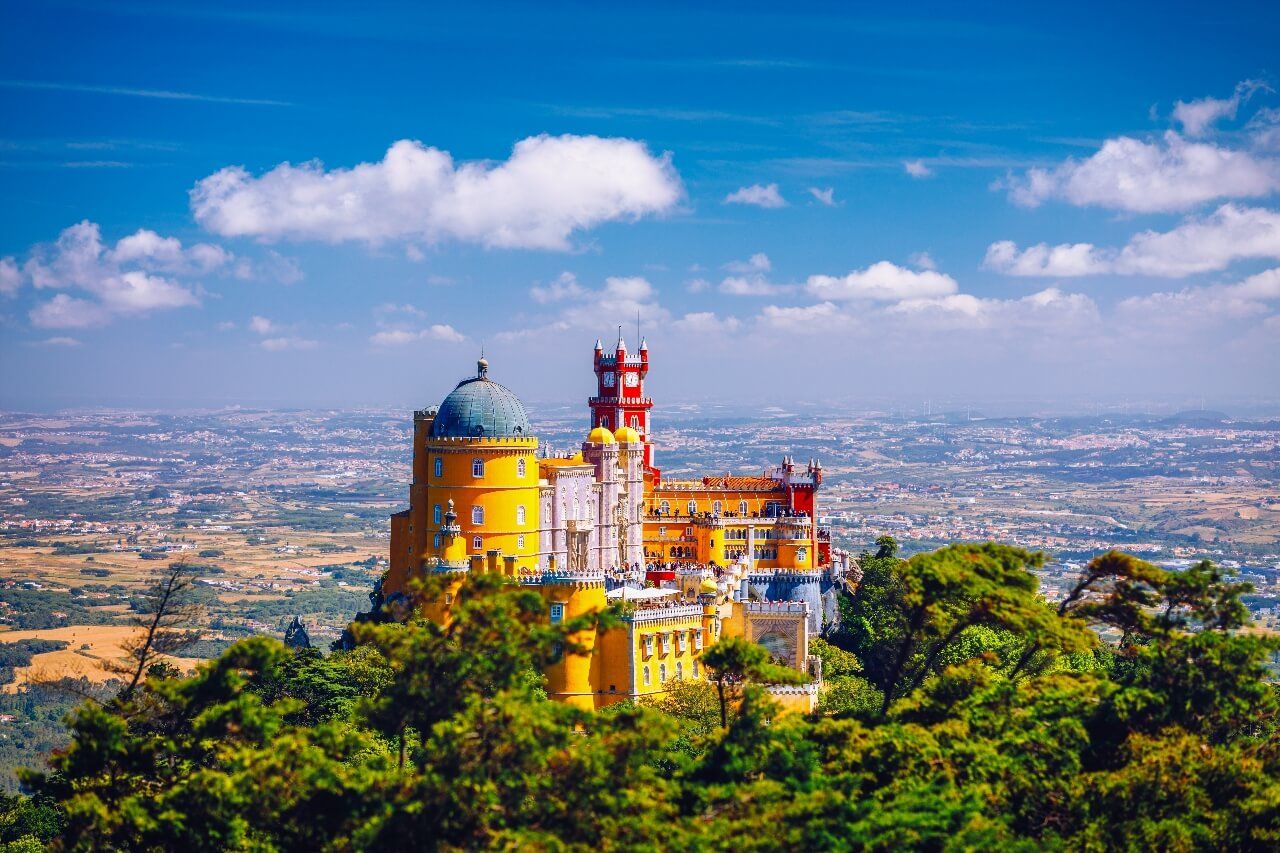
Palácio Nacional da Pena sits on the highest peak above the town and is the most famous, a Romantic palace built in the 1840s for King Ferdinand II using a kaleidoscope of architectural styles, Moorish, Gothic, Manueline, Renaissance, painted in deep red and yellow. The views from its walls, on clear days, take in both the Tagus estuary and the Atlantic. Admission is €20 (palace + park); the park alone is €10. Book online: tickets sell out by 9:30 a.m. in peak season.
Quinta da Regaleira is less a palace and more a theatrical landscape: a neo-Manueline estate built for a wealthy merchant in the early 1900s, with a garden full of grottos, tunnels, towers and an Initiation Well, a 27-metre inverted tower with a spiral staircase descending into the earth, designed with Masonic and Templar symbolism. It is the most singular place in Sintra and, if you only have time for one stop, many visitors consider it the most memorable. Admission is €15.
Practical notes: do not drive to Sintra on a summer weekend. The roads are gridlocked and parking is impossible. Take the train. Within Sintra, buses connect the stations and palaces, but they are slow and crowded; the walk up to Pena takes about 45 minutes from the town centre through pleasant forest. Tuk-tuks and electric carts also make the journey for around €8 : 12 per person. Arrive on the first train of the day, around 7:30 a.m. from Rossio, to have the palaces to yourself for the first hour.
14. Oceanário de Lisboa
The Oceanário de Lisboa (Esplanada Dom Carlos I, 1990-005 Lisboa, rated 4.7/5 on Google (100 956 avis)) opened for Expo '98 on what had been an industrial wasteland at the eastern end of Lisbon, and it remains one of the best aquariums in Europe two and a half decades later. The building itself, designed by architect Peter Chermayeff, appears to float on the Tagus, a glass cylinder surrounded by water on three sides.
The main feature is a central tank of 5 million litres containing a full Atlantic-depth ecosystem: hammerhead sharks, manta rays, sunfish and open-ocean schools of fish moving in coordinated patterns. Four satellite tanks represent different ocean habitats, Antarctic, Pacific, Indian and Atlantic, each with their resident species including sea otters, penguins, sea dragons and tropical fish.
Admission is €25 for adults, €17 for children. Book online; weekend tickets sell out. The aquarium is excellent with children but holds its own without them, the central tank at dusk, with the lights shifting, is one of the more genuinely transportive experiences Lisbon offers. Allow 2 : 3 hours. The surrounding Parque das Nações district, developed for Expo '98, is worth an afternoon in its own right for its contemporary architecture and the 10-kilometre riverside walkway.
15. Pink Street (Rua Nova do Carvalho)
Rua Nova do Carvalho (R. Nova do Carvalho, 1200-290 Lisboa, rated 4/5 on Google (323 avis)), known universally as the Pink Street, is a short, pedestrianised road in the Cais do Sodré district whose entire surface is painted vivid pink. The pink paint has been there since 2011, when a local regeneration project transformed what had been Lisbon's red-light district into its bar and nightlife corridor. During the day it is a pleasant place for a coffee; the photographic possibilities are obvious. After dark, from around 11 p.m. onward, the street fills with a mixture of bars serving cheap beer and cocktails, the sound of several different music genres competing, and a crowd that leans younger and more international than the fado houses of Alfama.
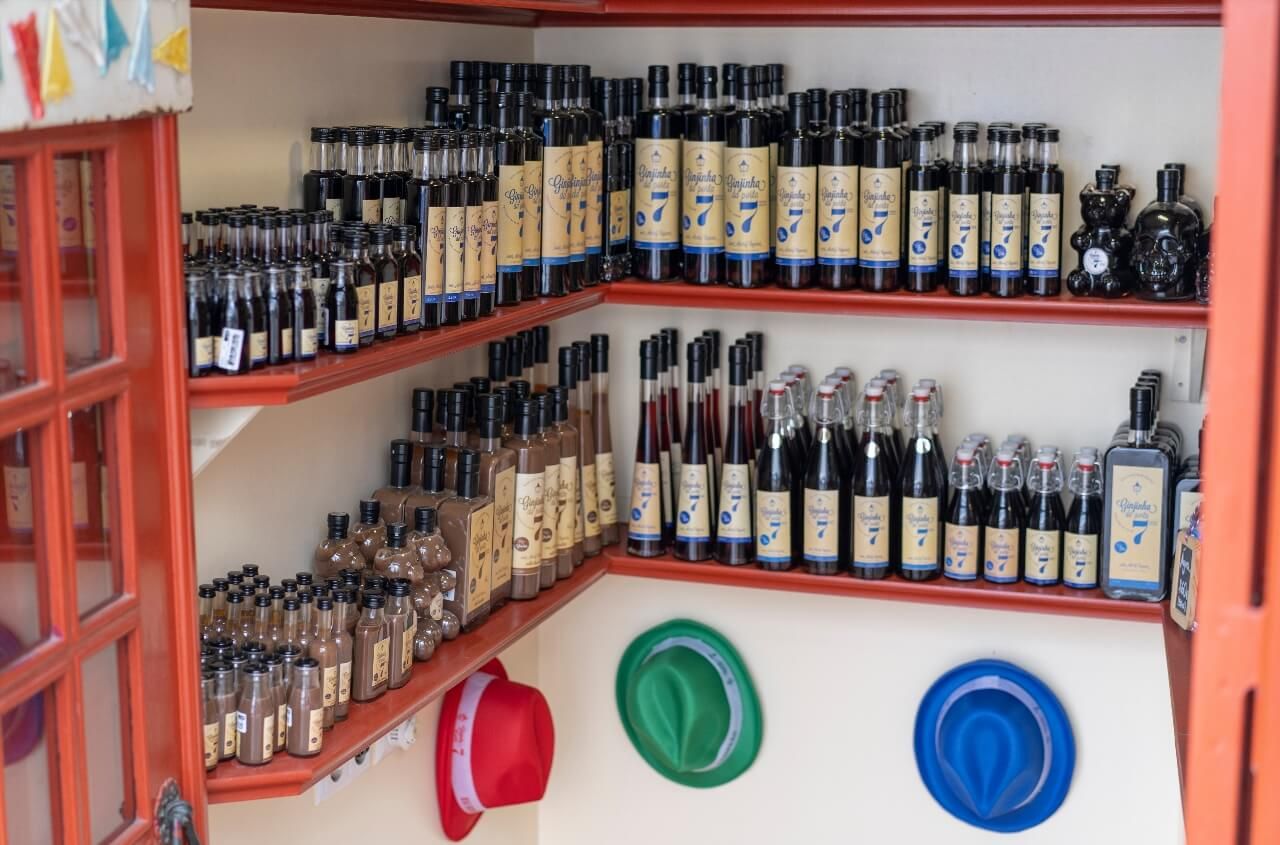
16. Ginjinha and Local Drinks
Ginjinha is a sour cherry liqueur infused with cinnamon and served in a small glass, sometimes, in a version that requires no further explanation, in an edible chocolate shot glass. It has been produced in Lisbon since at least the 1820s and is the city's most identifiable local drink.
The original and most famous vendor is A Ginjinha (also called Ginjinha do Rossio), a tiny kiosk at Largo de São Domingos that has operated since 1840 and has no seating, you stand at the window, order, drink, and move on. The ginjinha here costs around €1.50 a glass and is served with or without the berries (com ou sem elas). Specify when you order.
Beyond ginjinha, the local drinks worth knowing: vinho verde (young, slightly sparkling white wine from northern Portugal, cheap and excellent in Lisbon's simpler restaurants), Super Bock or Sagres (the two ubiquitous Portuguese lagers, both genuinely good on a hot day), and medronho (an arbutus berry spirit from the Alentejo and Algarve, fiery and divisive, found in specialist bars). Portuguese wine culture is excellent and underexplored; asking a restaurant's house wine recommendation is almost always rewarded.
17. Mouraria Quarter
Mouraria (Intendente, 1100 Lisboa, rated 3.6/5 on Google (1 724 avis)) is the neighbourhood established by the Moors who remained in Lisbon after King Afonso Henriques took the city in 1147, which makes it, in effect, the oldest continuously inhabited neighbourhood in the city. The name derives directly from mouros (Moors), and the district has maintained an identity as a zone of cultural mixture and arrival throughout its history.
Today it is one of the most genuinely diverse urban neighbourhoods in Lisbon: African, South Asian, Chinese and Eastern European communities live alongside a growing population of young creatives and long-standing Portuguese families. The result is a neighbourhood whose restaurants serve everything from Goan fish curry to Angolan muamba alongside grilled sardines and bacalhau.
The Intendente Square (Largo do Intendente Pina Manique, 1100-285 Lisboa, rated 4.3/5 on Google (554 avis)) at its eastern edge, once considered dangerous and now lined with tiled café facades and a restored fountain, is one of the most photogenic spaces in the city. The nearby Museu do Fado traces the history of the musical genre with good English labelling and occasional live performances; admission is €5. Mouraria itself was the neighbourhood where fado is thought to have originated, which gives the museum real geographic resonance. The Ryocity audio walk for Lisbon threads through Mouraria as part of its old-city loop and provides context for the layered immigrant history you walk past without otherwise noticing.
18. Museu Nacional de Arte Antiga
The Museu Nacional de Arte Antiga (R. das Janelas Verdes 9, 1249-017 Lisboa, rated 4.6/5 on Google (7 469 avis)) (MNAA), housed in a 17th-century palace in the Janelas Verdes district overlooking the Tagus, is Portugal's national art museum and holds one of the finest collections of Portuguese painting and decorative arts in the world. It is also, by the standards of a major national museum, genuinely undervisited.
The centrepiece of the collection is the Panels of St. Vincent (Painéis de São Vicente de Fora), a polyptych of six panels attributed to the 15th-century Portuguese painter Nuno Gonçalves. Dating from around 1470 : 1480, it depicts some 60 figures including King Afonso V, Henry the Navigator and representatives of all levels of Portuguese society, rendered with a portrait-like precision that puts it among the great works of European medieval painting. The identity of several figures continues to be debated by art historians.
Beyond the Gonçalves panels, the collection includes Japanese Namban screens showing Portuguese traders arriving in Japan in the 16th century (among the most important documentary sources on early Japan-Europe contact), Flemish and German masters, 16th-century Portuguese gold and silver ecclesiastical objects, and a room of Hieronymus Bosch's Temptation of St. Anthony that is alone worth the visit.
Admission is €10. The garden terrace café overlooks the Tagus and is one of the best places in the city to eat lunch. Free on the first Sunday of each month.
19. Tagus River Cruise
The River Tagus (Rio Tejo) is 1,007 kilometres long and drains one fifth of the Iberian Peninsula before reaching the sea at Lisbon. The estuary here, the Mar da Palha or Sea of Straw, so named for the way sunlight hits the water at certain angles, is one of the widest river mouths in Europe, some 15 kilometres across at its broadest point near Lisbon.
Several companies offer river cruises departing from the Praça do Comércio waterfront. A standard one-hour cruise covers the stretch between the Ribeira Market and the 25 de Abril suspension bridge, a nearly identical replica of the Golden Gate Bridge in San Francisco, opened in 1966 and originally named after the dictator Salazar before being renamed for the date of Portugal's 1974 democratic revolution. The Cristo Rei statue visible on the south bank, a direct homage to Rio de Janeiro's Christ the Redeemer, was inaugurated in 1959.
Cruise prices run €20 : 35 depending on duration and operator; sunset cruises command a premium and book out fast in summer. The best views of Lisbon's hillside cityscape are from the water, which is reason enough to take one.
20. Bairro Alto Nightlife
Bairro Alto, the High Quarter, sits on one of Lisbon's seven hills directly above Chiado and, for roughly three centuries after its development in the 16th century, was the city's most fashionable residential address. Today it is Lisbon's primary nightlife district, a grid of narrow streets that transforms completely between day and night.
By day, Bairro Alto is quiet: a few traditional restaurants, a handful of vintage clothing stores, the occasional gallery. After 10 p.m. on Thursday, Friday and Saturday nights, the streets fill with people moving between bars, most of which are genuinely tiny, holding twenty or thirty people, so the overflow spills onto the pavement. The Portuguese have a word, tasca, for this kind of small, informal drinking establishment, and Bairro Alto has more per square metre than anywhere else in the city.
The neighbourhood has no main strip or anchor venue, it is a system rather than a destination. You enter at one end, find a bar by instinct or by the sound of music from an open door, drink cheaply (beer rarely exceeds €2.50), and drift. Clubs in the proper sense, with doors, queues and cover charges, are more concentrated in the nearby Cais do Sodré and Santos districts. Bairro Alto works best between midnight and 2 a.m., before the serious clubs open and the streets begin to thin. The Ryo audio guide for Lisbon covers the history of this quarter's transformation in detail.
21. Rossio Square and the Baixa District
Rossio Square is the geographical and emotional centre of Lisbon, the square around which the city has organised itself since the medieval period. The current pavement is a wave-pattern mosaic in black and white limestone, installed in the 1840s after the earthquake-rebuilt square was remodelled. The two baroque fountains, the bronze statue of Pedro IV atop his column, and the neo-Manueline signage of the Rossio train station to the north all contribute to an ensemble that stops you for a moment regardless of how many cities you have visited.
The Baixa, the Lower District, extends south from Rossio to the Praça do Comércio and the river. It was entirely rebuilt by the Marquis of Pombal after the 1755 earthquake in a rational grid plan, the first example of urban planning of this scale in Europe. The streets are named for the trades that once occupied them: Rua do Ouro (Gold Street), Rua da Prata (Silver Street), Rua dos Sapateiros (Cobblers' Street). Most are now tourist-facing, but the street-level geometry and the restored facades still embody Pombal's project.
22. Livraria Bertrand
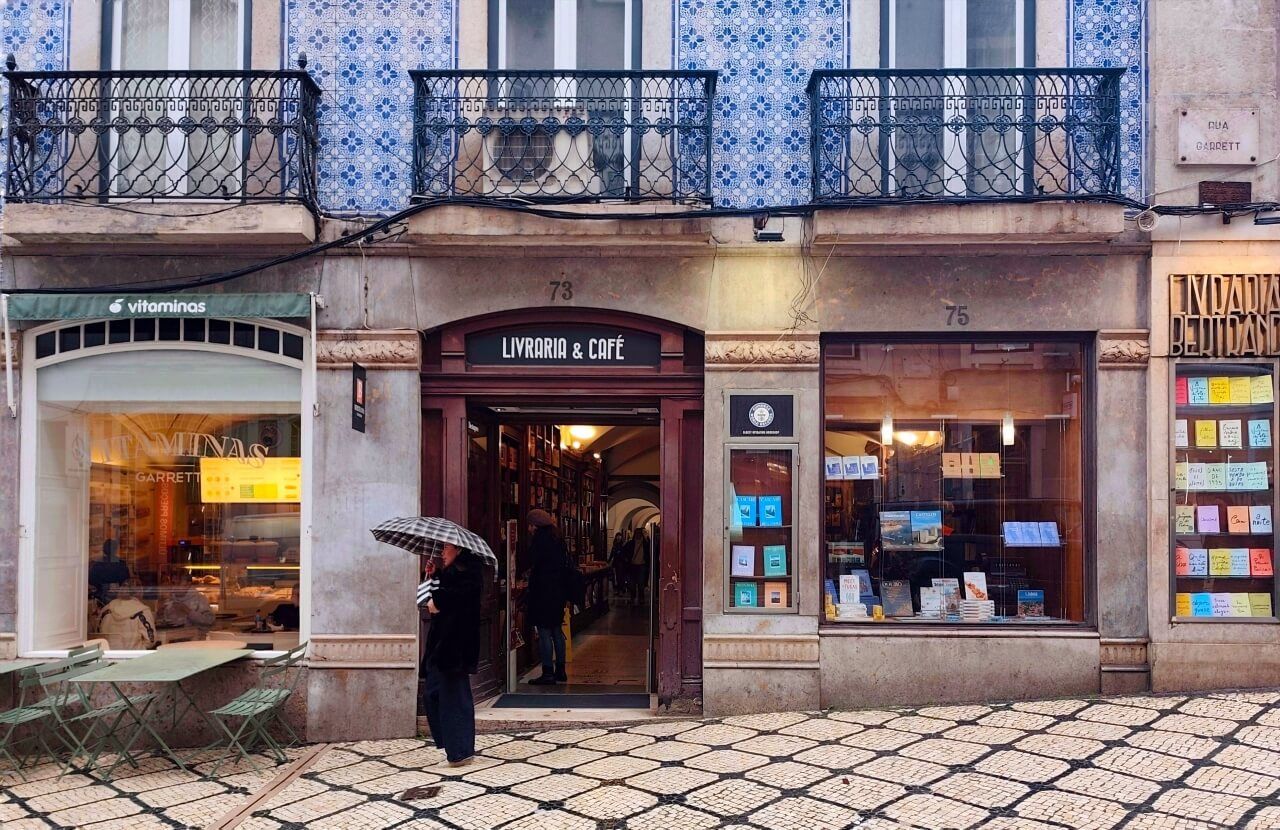
Livraria Bertrand (R. Garrett 73-75, 1200-203 Lisboa, rated 4.6/5 on Google (7 362 avis)) on the Rua Garrett in Chiado holds the Guinness World Record as the oldest operating bookshop in the world, having opened in 1732. It survived the 1755 earthquake (which destroyed the original premises) and relocated to its current address, where it has traded continuously ever since. The shop is small, slightly cramped, and sells mainly in Portuguese, with a reasonable English-language section. The reason to visit is the atmosphere and the knowledge that the room you are standing in has been selling books for nearly three centuries, rather than the specific titles available.
23. Ribeira Waterfront and Praça do Comércio
Praça do Comércio (Praça do Comércio, 1100-148 Lisboa, rated 4.7/5 on Google (130 461 avis)), the Commerce Square, known to older residents as the Terreiro do Paço, is the grandest public space in Lisbon: a three-sided square open to the Tagus, framed by yellow-painted arcades on two sides and the river on the third. The equestrian statue of King José I at the centre was the first bronze statue cast in Portugal, completed in 1775 as part of Pombal's reconstruction of the city.
The waterfront promenade (the Ribeira) extends east and west from the square, connecting to the Time Out Market in one direction and to the Santa Apolónia station in the other. Walking it at any hour has merit: in the morning, the light on the estuary is extraordinary; in the evening, the square fills with people on the steps of the arched arcade and the water turns orange. The Arco da Rua Augusta at the square's northern end, a triumphal arch opened in 1875, has a rooftop terrace accessible by lift (€3.50) that gives a view straight down the Rua Augusta shopping street to the river.
24. Street Art in Mouraria and Intendente
Lisbon has one of the most developed outdoor street-art scenes in Europe, concentrated particularly in the areas around Mouraria, Intendente, Cais do Sodré and along the Calçada da Glória. Unlike in some cities where street art has been tolerated and then commodified, Lisbon's scene retains a genuine mix of commissioned murals, unsanctioned work, and public art projects funded by the municipality.
The GAU (Galeria de Arte Urbana) maintains an outdoor gallery on the Calçada do Lavra and has coordinated large-format commissions across the city since 2008. Work by Vhils, a Lisbon-born artist known for carving portraits into plaster walls, appears in several locations including near the Santa Apolónia station and on the Avenida Fontes Pereira de Melo. His technique of excavating the wall surface rather than painting on top of it is entirely specific to Lisbon's aged-plaster building stock.
Self-guided street-art walks take roughly 2 : 3 hours depending on how far east you go. Free apps and physical maps are available from the GAU office. Several operators also run guided tours, €15 : 25 per person, that include background on individual artists and access to sites not marked on public maps.
25. Day Trip to Setúbal and the Arrábida Coast
Setúbal (Setúbal, 2900 Setúbal, rated 4.4/5 on Google (5K reviews)) lies 50 kilometres south of Lisbon, reachable by bus in just over an hour (direct Rede Expressos service from Sete Rios terminal, €5 : 8) or by car across the Vasco da Gama bridge. The city itself is a working port with a lively fish market, a historic centre organised around the Praça do Bocage, and the Igreja de Jesus, one of the earliest Manueline churches in Portugal, built in 1494.
The real reason to make the journey, however, is the Serra da Arrábida immediately to the south: a ridge of limestone hills running parallel to the Atlantic coast, designated a nature reserve and containing some of the most spectacularly clear blue-green water in Portugal. The beaches, particularly Praia de Galapinhos, Praia de Portinho da Arrábida and Praia dos Coelhos, have water of a colour more commonly associated with the Mediterranean than the Atlantic. The limestone cliffs above them are white and dramatic.
Arrábida is accessible by car (the coastal road requires patience but the views reward it) or by one of several boat tour operators departing from Setúbal's waterfront, a two-hour tour typically costs €25 : 35 and stops at multiple beaches. Swimming is excellent between June and September; the water reaches 22 : 24°C at peak. Go on a weekday: the beaches have limited capacity and the narrow coastal road becomes impassable on summer weekends.
FAQ
How many days do you need in Lisbon?
Three days is the practical minimum to visit the main neighbourhoods without feeling rushed, one day in Belém and Alfama, one in the Baixa, Chiado and Bairro Alto, and a third for a day trip to Sintra or the Arrábida coast. Five days allows you to explore at a more rewarding pace, including the eastern districts (Parque das Nações, Marvila) that most short visits miss. A week is rarely too long.
When is the best time to visit Lisbon?
April, May, September and October offer the best combination of warm weather, long daylight hours and manageable crowds. July and August are genuinely hot, temperatures above 35°C are common, and the main tourist areas are extremely crowded. June is intermediate: warm but not yet at peak. Winter (November to February) is mild by northern European standards (rarely below 10°C), quieter, and significantly cheaper.
Is Lisbon expensive?
Lisbon has become considerably more expensive over the past decade as tourism has increased. That said, it remains cheaper than Paris, Amsterdam or Barcelona for most categories. A meal at a neighbourhood restaurant (tasca) with wine costs €15 : 25 per person; a beer in a non-tourist bar is €2 : 3; museum admissions average €8 : 18. Accommodation has risen sharply, budget €100 : 180 per night for a centrally located hotel in peak season.
How do I get around Lisbon?
The metro covers the main tourist areas and is fast, clean and inexpensive (€1.80 per journey with a Viva Viagem card; a 24-hour pass costs around €7). Walking is practical within individual neighbourhoods but Lisbon's hills make inter-neighbourhood distances feel longer than they are. Uber is widely used and cheap by western European standards. The historic trams (including Tram 28) are atmospheric but slow and often overcrowded; treat them as an experience rather than a transport solution.
What is the best neighbourhood to stay in?
Chiado and Príncipe Real offer the best all-round base: central, walkable to Alfama and the Baixa, good restaurant density and relatively calm at night. Alfama is atmospheric but hilly and less convenient for transport. Baixa is the most central but impersonal and noisier. Santos and Cais do Sodré work well if your priority is nightlife. Budget travellers often find the best value in Intendente and Anjos, which have gentrified significantly while remaining more affordable.
Do I need to book things in advance?
Yes, for several key experiences. Palácio da Pena in Sintra frequently sells out by 9:30 a.m. in peak season, book at least a day ahead. Fado restaurants require reservations, especially on weekends. The Oceanarium sells out on weekend afternoons in summer. For everything else, museums, the castle, Jerónimos, online booking is faster and sometimes marginally cheaper, but walk-up entry is usually possible outside peak season.
Conclusion
Lisbon rewards the visitor who moves slowly, eats wherever the handwritten menu appears in the window, and accepts that getting lost between Alfama and Mouraria is not a problem, it is the plan. Three days lets you see the headline monuments; a week lets the city itself become familiar, the miradouro you return to at dusk, the tasca whose owner now recognises you, the specific corner of Bairro Alto where the music sounds right.
To get the most from the historic core without staring at a phone screen, the Ryocity audio guide for Lisbon walks you through Alfama, Mouraria, Baixa and Bairro Alto with stories of the buildings as you pass them, the layered Moorish, Pombaline and revolutionary histories that explain why each quarter looks the way it does. Whether you spend three days or a week, the city tends to leave people making notes about what they will do differently when they return.