© Shutterstock
 Votre guide Ryo
What to Do in Sintra in 2026: 15 Experiences Between Palaces and Forests
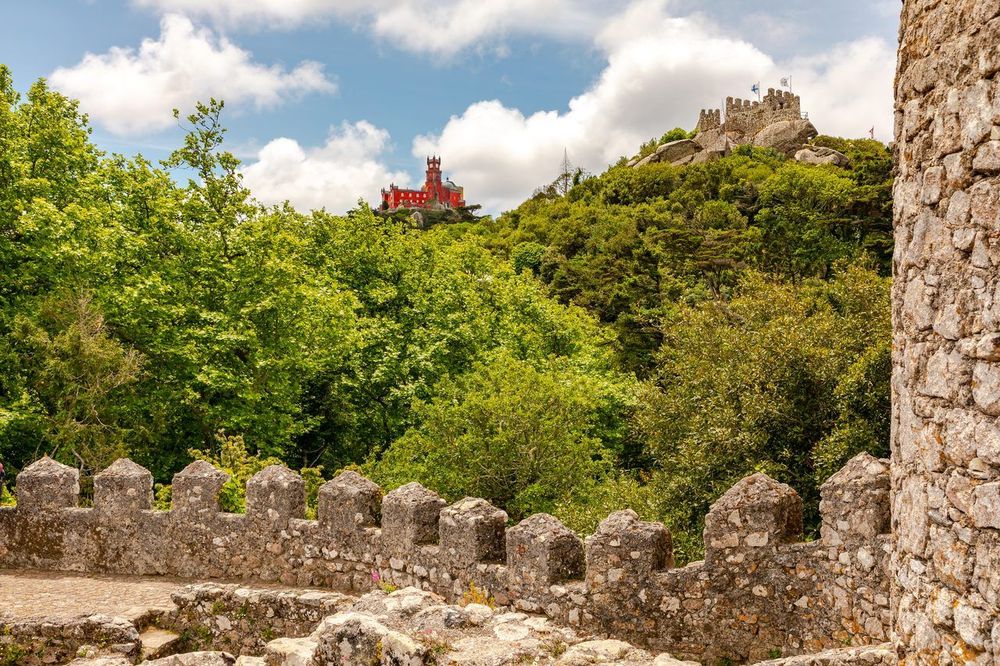
The mist clinging to the hills of the Serra de Sintra at dawn gives the town the feel of a fairy tale rather than a classic tourist destination. Here, a yellow-and-red palace rises from the top of a granite peak, a Moorish castle hugs a mountain ridge, and a well leads underground rather than to water. Asking what to do in Sintra means first accepting one obvious truth: this Portuguese town, listed as a UNESCO World Heritage Site since 1995 under the name "Cultural Landscape of Sintra," packs a density of monuments rarely matched in Europe into just a few square kilometres. A Ryo article dedicated to the town explains in detail how to move from one site to the next without wasting time in queues.
Between the Pena National Palace perched at 450 metres above sea level, an initiatory well with nine levels carved into the subsoil of the Quinta da Regaleira, a wild beach accessible only on foot, and vines planted in sand to escape phylloxera, fifteen experiences naturally take shape. Some can be visited in an hour, others deserve a full half-day. This guide lists them without any imposed tourist hierarchy, so you can plan your own itinerary based on the time you have available.
1. The Pena National Palace, Sintra's Romantic Crown
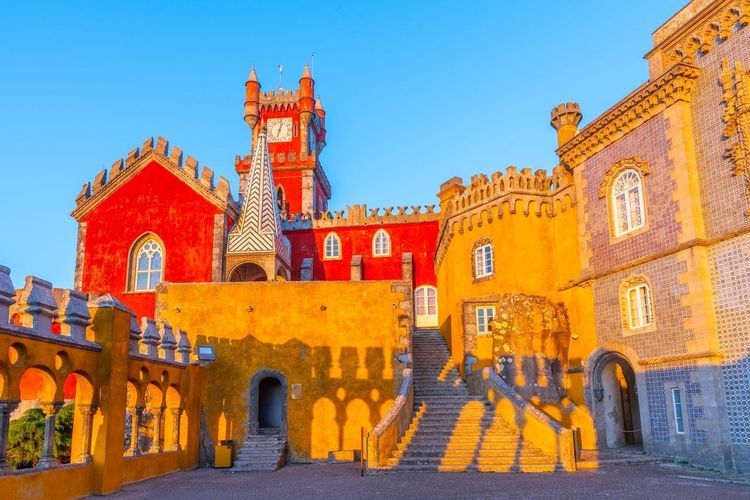
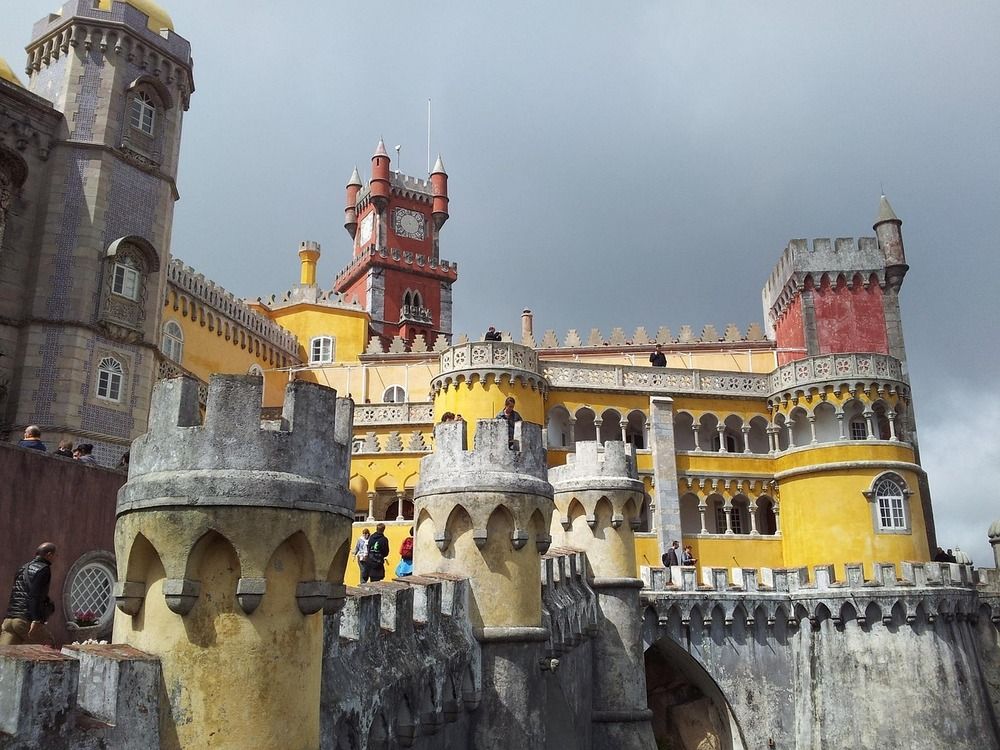
No photograph does justice to the Pena National Palace. Built between 1839 and 1854 on the orders of King Consort Ferdinand II of Saxe-Coburg-Gotha, the building deliberately mixes styles: neo-Moorish turrets, neo-Gothic battlements, neo-Manueline portals, and facades painted in vivid yellow and deep red. The result is surprising, sometimes divisive, but never leaves anyone indifferent. The king wanted a spectacular summer palace visible from Lisbon on a clear day; he got a unique architectural manifesto, today one of the most photographed monuments in Portugal.
The interior is visited along a signposted route through the royal apartments, the 16th-century Manueline chapel (a remnant of the original convent built on this site), and the kitchen converted into a museum. Allow 45 minutes to 1 hour for the interior visit, longer if you stop to examine every detail: the blue ceramics in the corridors, the trompe-l'œil ceiling of the Arab Room, or the furniture left exactly as it was when the royal family departed hastily in 1910.
The combined palace and park ticket costs around 20 euros for an adult (2026 prices, check before visiting), and you can also choose a park-only ticket at around 12 euros, to enjoy the 200 hectares of surrounding forest. The Parque da Pena brings together species from the four corners of the world, brought back by Portuguese ships in the 19th century: California sequoias, Chilean tree ferns, Japanese camellias. A walk of about twenty minutes from the park entrance leads to the palace itself, on a gentle continuous climb.
Book your time slot online at least a week in advance during high season (June to September): the palace limits the number of simultaneous visitors and same-day tickets often sell out before noon. Ideally, arrive at opening time, around 9:30 a.m., to avoid the groups that arrive en masse from 11 a.m. onwards. The Ryo audio-guided tour for the region mentions this timing tip in its route dedicated to the area around Lisbon.
2. The Moorish Castle, the Granite Sentinel Above the Town
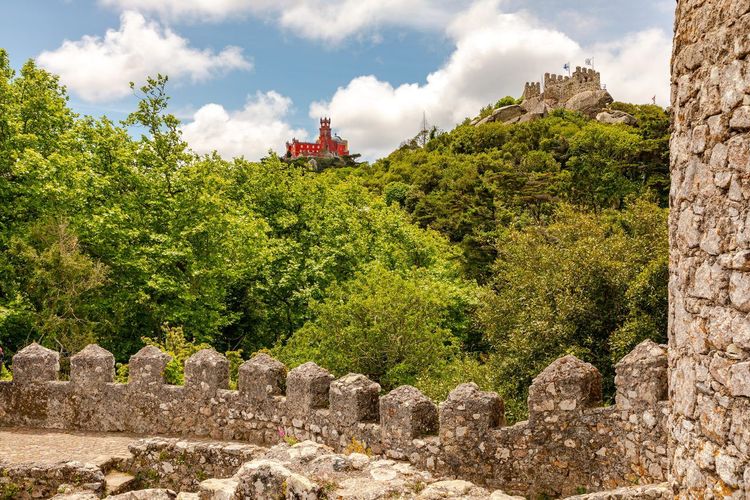
Built in the 8th and 9th centuries by the Moorish occupiers to watch over the plain and the Atlantic coast, the Castelo dos Mouros (2710-405 Sintra, rated 4.6/5 on Google with 24,945 reviews) winds along nearly a kilometre of crenellated walls, following every rocky outcrop on the ridge. The fortress fell to the Christian troops of Afonso Henriques in 1147, the year Lisbon was reconquered, but it was never razed: its gradual abandonment over the following centuries paradoxically preserved it in a state close to its original form.
Climbing the ramparts requires good physical fitness: the steps are uneven, often slippery after rain, and the near-total absence of railings on some sections calls for caution with young children. The effort is justified by the panorama that opens up at 412 metres above sea level, at the highest point called Torre Real: the Pena Palace on one side, the Atlantic Ocean on the other, and the town of Sintra below, reduced to a cluster of red rooftops.
Allow 1.5 to 2 hours to explore the entire site, including the ruins of the Almohad cistern near the former mosque. The trail connecting the castle to the historic centre via Vila Sassetti (see below) offers a far more pleasant alternative to the bus for the descent, provided you have good footwear. The entrance ticket is around 12 euros for an adult, and you can combine it with the Pena Palace ticket through one of the combined passes offered by Parques de Sintra — a deal that quickly pays off if you visit two or three monuments on the same day.
3. The Quinta da Regaleira and Its Initiatory Well
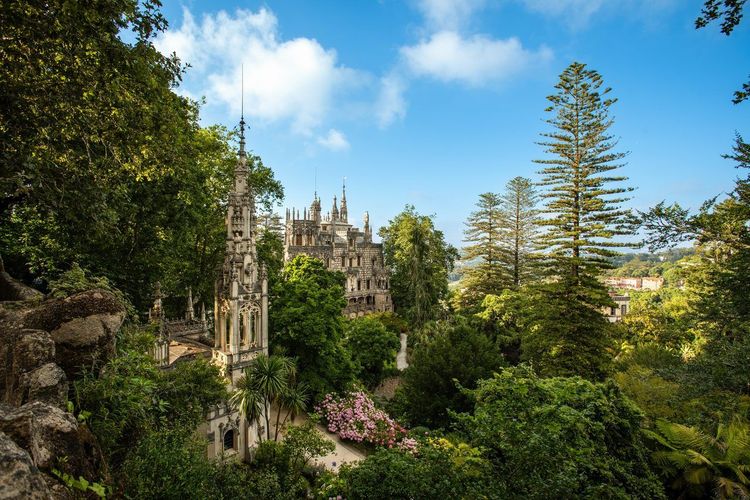
Few private properties have fuelled as many esoteric theories as the Quinta da Regaleira (R. Barbosa do Bocage 5, 2710-567 Sintra, rated 4.7/5 on Google with 40K reviews). Built between 1904 and 1910 for the lawyer and patron Carvalho Monteiro, nicknamed "Monteiro dos Milhões" for the fortune he amassed in Brazil, the neo-Manueline mansion was designed with Italian architect Luigi Manini as a full-scale theatrical set, saturated with alchemical, Masonic, and Templar symbols.
The highlight of the visit remains the Poço Iniciático, a circular well that was never used to draw water: a spiral staircase with nine levels descends 27 metres, an explicit reference to the nine circles of Dante's Hell. At the bottom, a network of damp, dimly lit underground tunnels connects the well to a second structure, the "Inverted Tower," as well as to an artificial waterfall and a lake adorned with a grotto. Many rushed visitors are content to descend the well without exploring the side galleries — a mistake, since the real labyrinth is hidden precisely in these secondary tunnels, which are often deserted.
A Ryo audio guide dedicated to the region explains the symbolism of this garden in detail, useful if you want to understand why every statue, fountain, and artificial grotto follows a precise logic rather than simple decorative taste. Book early in the morning or late in the afternoon: organised groups swarm the well between 11 a.m. and 3 p.m., turning the descent into a queue on the spiral staircase. Allow at least 1.5 hours to fully appreciate the entire park, including the palace.
4. The Sintra National Palace and Its Conical Chimneys
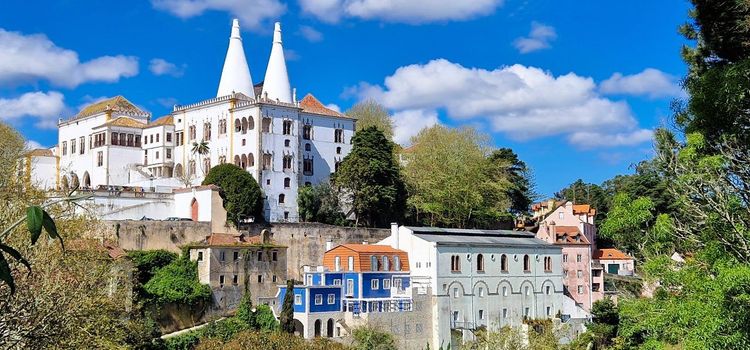
Visible from almost every viewpoint in town thanks to its two enormous white conical chimneys, standing 33 metres tall, the Palácio Nacional de Sintra (Largo Rainha Dona Amélia, 2710-616 Sintra, rated 4.5/5 on Google with 56,605 reviews) (also known as the Palácio da Vila) is the best-preserved medieval royal palace in Portugal. Its origins go back to the Moorish period, but the bulk of the current structure dates from the reigns of John I in the 14th century and Manuel I at the turn of the 16th century, making it a rare testament to continuous royal architecture spanning nearly two hundred years.
The interior features two standout rooms. The Sala dos Brasões, with a coffered ceiling painted with the coats of arms of 72 noble Portuguese families, celebrates the kingdom's aristocracy with an almost obsessive attention to heraldic detail. The Sala dos Cisnes takes its name from the 27 swans painted on the ceiling, each slightly different from the others according to local legend — a detail few visitors take the time to verify.
Unlike the Pena Palace, this one is located right in the town centre, making it possible to visit without a bus or car, simply by walking from the train station. Allow 1 hour for a visit at around 13 euros, and opt for an online booking to avoid the queue that regularly stretches across the square in front of the entrance, especially on spring weekends. Since the monument sits directly on the Praça da República, you can follow the visit with a coffee on a terrace and a pastry break without having to catch a bus — a practical combination when the day's schedule is tight.
5. The Monserrate Palace and Botanical Gardens
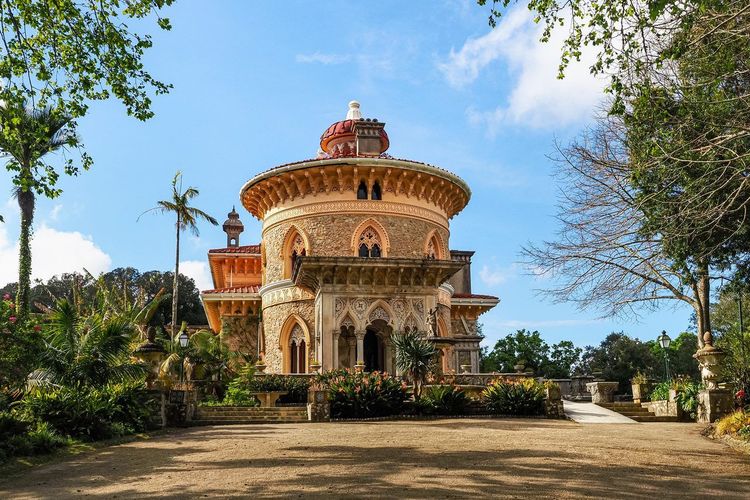
Less well-known than Pena but equally spectacular, the Palácio de Monserrate (2710-405 Sintra, rated 4.7/5 on Google with 14,768 reviews) owes its current appearance to the wealthy British merchant Francis Cook, who in the 1860s had a previous ruined residence rebuilt in a hybrid style blending Mughal and Moorish influences. The carved stone lacework adorning the central dome and the ground-floor arcades required a restoration lasting several decades, only completed in the early 2010s after years of partial neglect.
The main interest of the site, however, lies in its 33 hectares of gardens, considered one of the richest botanical gardens in Europe. Cook employed botanists travelling across five continents to bring back rare species: Australian ferns, giant Mexican cypresses, Asian bamboo, and a camellia collection planted in the 19th century that is now among the oldest in the country. The gardens slope gently down into a humid valley where tropical plants thrive, protected by the microclimate of the Serra.
This site attracts far fewer visitors than Pena or Regaleira, even though it is barely 3 km from the centre. You can therefore stroll through it without the pressure of crowds — a rare luxury in Sintra during high season. Allow 1.5 to 2 hours if you enjoy botany; an hour is enough for a quicker visit focused on the palace.
6. Cabo da Roca, the Westernmost Point of Continental Europe
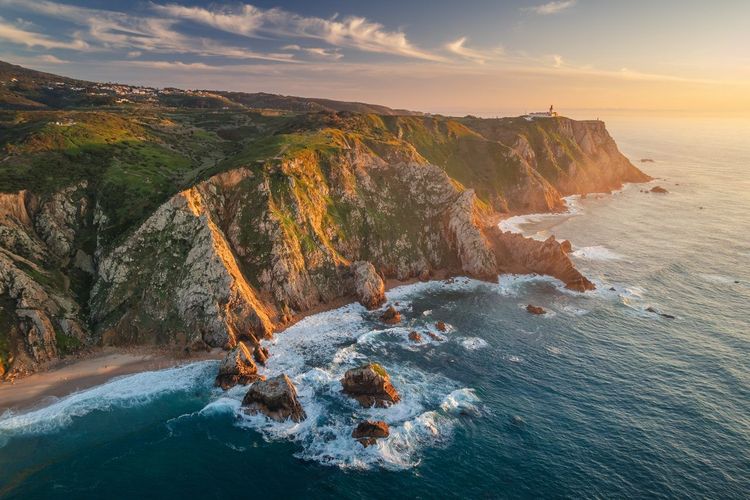
About twenty minutes by road from Sintra, Cabo da Roca (2705-001 Colares, rated 4.8/5 on Google with 69,073 reviews) officially marks the western tip of the European continent, at 38°47' north latitude. A stone cross engraved with a verse by the poet Luís de Camões — "Onde a terra se acaba e o mar começa" ("Where the land ends and the sea begins") — overlooks a 140-metre cliff that drops straight into the Atlantic.
A still-active lighthouse, built in 1772, completes the landscape but cannot be visited inside. The wind blows here almost constantly, often strongly, making a windproof jacket essential even in summer. The on-site tourist office issues a paid certificate attesting to your visit at the westernmost point of Europe — a popular but entirely optional souvenir.
Access by bus from Sintra (line 1624) takes about 30 minutes and entry to the site is completely free; only the parking and the certificate are paid. Many visitors combine Cabo da Roca with the nearby Praia da Ursa beach, about fifteen minutes away by car, or with Azenhas do Mar further north. If you can, time your visit for late in the day: the low evening light transforms the cliff into a far more memorable spectacle than it is under the midday sun, and the tour buses will have already headed back to Lisbon.
7. Azenhas do Mar, the Village Suspended Above the Atlantic
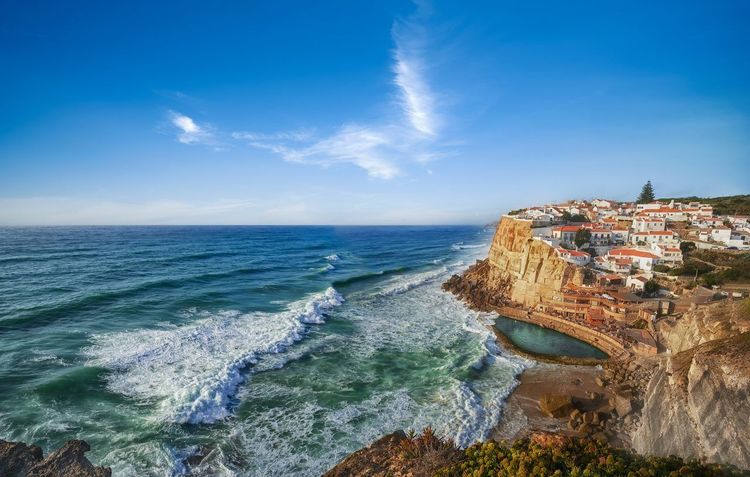
About fifteen kilometres north of Sintra, the white houses of Azenhas do Mar (2705-013 Azenhas do Mar, rated 4.4/5 on Google with 5,034 reviews) literally cling to the cliff, cascading toward the ocean in a tangle of terraces and narrow staircases. The village's name refers to the old tidal mills ("azenhas") that once harnessed the power of the waves to grind grain — now long gone.
The local curiosity is its natural pool carved directly into the rock at the foot of the village, filled by the rising tide and usable in summer when the Atlantic swell allows. Several seafood restaurants occupy terraces overlooking the sea, with views that alone justify the trip, even if prices rise accordingly on summer evenings.
If you plan to have lunch there, book your table in advance at weekends: the restaurants perched on the cliff are fully booked by mid-morning in summer, and the tables directly overlooking the waves go first. Outside mealtimes, the village can be walked through in about twenty minutes, but there is nothing to stop you lingering on the lower terraces, where a few discreet benches offer a bird's-eye view of the pool and the waves breaking into it. Avoid days with heavy swells, however: the waves then wash over the pool wall and make swimming impossible.
You can reach Azenhas do Mar by car (20 minutes from Sintra) or by combining a bus and a walk from Praia das Maçãs, about 3 km to the south. At sunset, a handful of photographers can be found posted on the rocky promontory overlooking the village every evening.
8. The Wild Beach of Praia da Ursa
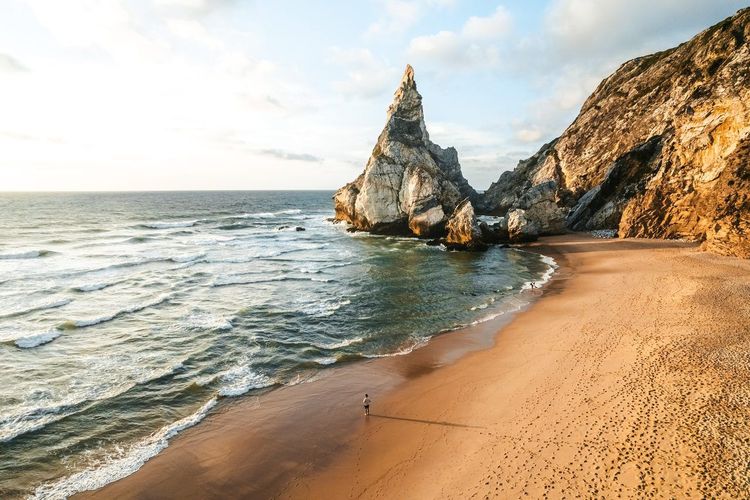
Accessible only on foot from a car park near the hamlet of Ulgueira, about a 20-minute walk along a steep trail, Praia da Ursa (2705-001 Colares, rated 4.8/5 on Google with 1,998 reviews) takes its name from a rock whose silhouette is said to resemble a bear seen from behind. Two imposing rocky outcrops frame this beach, which has no shops, no lifeguards, and no easy access — which explains why it remains far less crowded than the neighbouring beaches.
Swimming is not recommended for inexperienced swimmers: the currents are strong and no lifeguard monitors the area. Come instead for the walk and the scenery, particularly spectacular at sunset, and bring water as nothing is sold on site. The trail becomes muddy and slippery after rain, so plan on appropriate footwear.
One tip few guides mention: check the tide times before heading down. At high tide, the sandy area shrinks considerably and some zones become inaccessible, while at low tide the beach stretches out widely at the foot of the rocks and reveals small additional coves. Allow at least two hours for the round trip and a stop on site, and bear in mind that the climb back up the trail, in full sun on a steep slope, takes more effort than the initial descent.
9. The Capuchos Convent, Austerity Carved in Cork
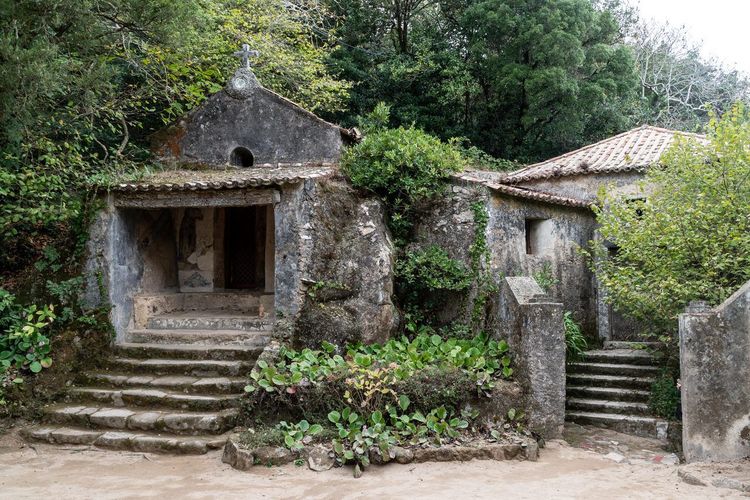
Founded in 1560 by Franciscan monks, the Convento dos Capuchos (Estrada Monserrate, 2710-405 Sintra, rated 4.5/5 on Google with 2,052 reviews) takes austerity to a level rarely reached elsewhere in Portugal. The monastic cells, tiny with low ceilings, are entirely lined with cork — a material abundant locally, thought to insulate the monks from the cold while reminding them, through its very plainness, of the vanity of material comforts.
The site was abandoned after the dissolution of religious orders in Portugal in 1834 and subsequently purchased by wealthy local owners, including Francis Cook (the same patron behind Monserrate), who chose to preserve it rather than transform it. The dense forest surrounding it, a mix of centuries-old cork oaks and ferns, adds to the almost otherworldly atmosphere of the place.
Less visited than the central palaces, often due to its distance (about 8 km from the town centre, accessible by car or taxi), the convent appeals to travellers seeking a sharp contrast with the decorative exuberance of Pena or Regaleira. Allow 45 minutes for the visit, at around 11 euros for admission.
10. Tasting Colares Wine, Grown in the Sand
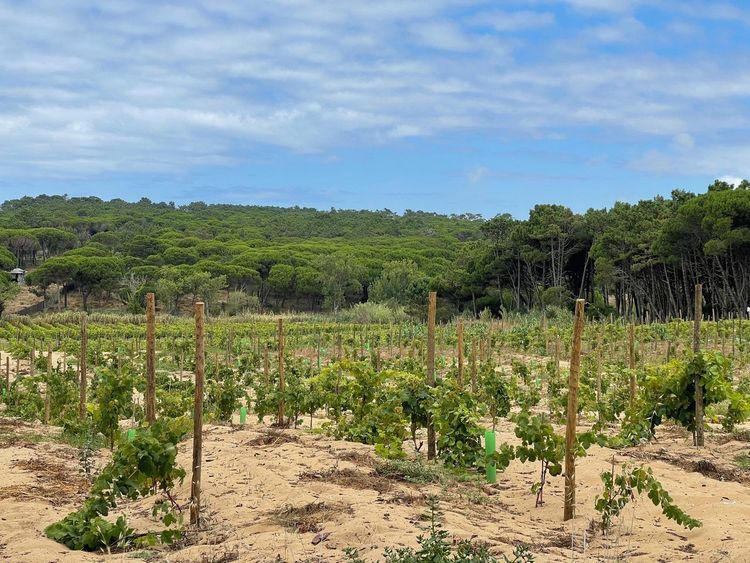
Just a few kilometres from Sintra, the wine-growing region of Colares has for centuries cultivated grape varieties planted directly in the sand of coastal dunes — a peculiarity that saved its vines from phylloxera at the end of the 19th century: the destructive louse cannot survive in this sandy substrate. The Ramisco vines, a native red grape variety, are thus among the oldest ungrafted rootstocks in Europe.
The Adega Regional de Colares (R. Bento de Faria 106, 2705-379 Colares, rated 4.5/5 on Google with 592 reviews), a cooperative founded in 1931, offers tastings by reservation, typically 15 to 20 euros for three to four wines accompanied by local cheeses. The white wine, produced from the Malvasia de Colares grape variety, surprises with its lively acidity, while the Ramisco red often needs several years of ageing to soften. An ideal stop between Cabo da Roca and Azenhas do Mar if you are travelling by car (provided a passenger stays sober to drive).
If wine is not particularly your thing, the region is still worth a detour for its landscapes: the low vine plots, sheltered from the wind by reed hedges, form a striking checkerboard pattern between the dunes and the first houses of Colares. Several independent producers also open their cellars by appointment and are happy to explain how their ancestors planted the vines more than a metre deep to reach the clay layer beneath the sand — exhausting work that explains why this vineyard nearly disappeared in the 20th century before gradually being rehabilitated today.
11. Strolling Through Sintra's Historic Centre on Foot
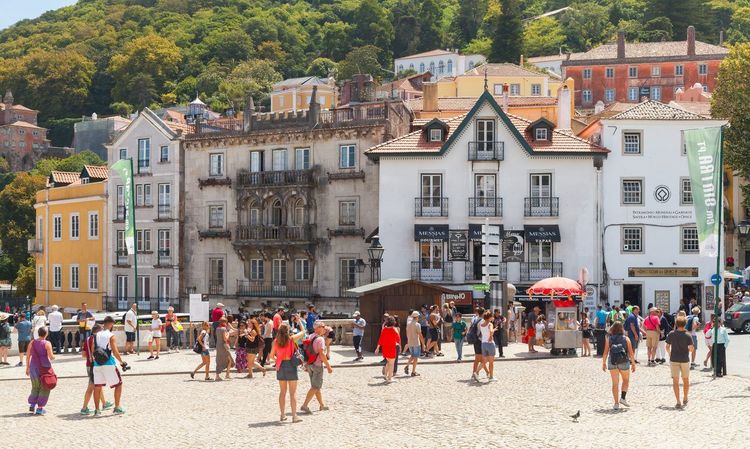
Sintra's historic centre, listed alongside the palaces that surround it, is best explored on foot in an hour or two, through cobbled lanes, azulejo-covered facades, and small shaded squares. The Praça da República, dominated by the conical chimneys of the National Palace, is home to most of the cafés and craft shops — though some terraces can veer into tourist-trap territory.
Beyond the main square, the lanes climb and descend via narrow staircases, revealing unexpected views over tiled rooftops and the surrounding wooded hills. Take the time to get deliberately lost in the side streets, away from the main axis clogged with tourist buses: the best restaurants are often hiding there, cheaper and less formulaic.
A Ryo audio guide dedicated to Sintra offers a walking route that links several points of interest in the centre without retracing the same ground twice — a practical detail when all the streets start to look alike after the third turning.
12. Riding the Historic Tram to Praia das Maçãs

In service since 1904, with a few interruptions over the course of the 20th century, the Elétrico de Sintra connects the Ribeira de Sintra train station to the seaside resort of Praia das Maçãs along an 11.5 km line through pine forest. The journey takes about 45 minutes at a deliberately leisurely pace, allowing you to take in the scenery rather than simply pass through it.
The tram generally runs only at weekends and on public holidays in the low season, and more frequently in summer: check the timetable before planning your day around it, as departures remain infrequent. Once at Praia das Maçãs, a wide sandy beach welcomes surfers and families, with several seafront restaurants to extend the afternoon.
The vintage carriages, in varnished wood with an open platform, are part of the charm: you board as if stepping onto a tram from the early 20th century, with a motorman who still operates the controls manually. The ticket remains very affordable, just a few euros for a single journey, and is paid directly on board. Bear in mind, however, that this journey is an experience in its own right rather than a simple means of transport: if your day is packed, it is better to save the tram for a moment when you are not in a hurry to get back, or you risk a long wait for the next departure.
13. Vila Sassetti and the Forgotten Trails Between Forest and Rock
Less well-known than the grand palaces, the Vila Sassetti estate (Caminho Vila Sassetti, 2710-405 Sintra, rated 4.6/5 on Google with 1,114 reviews) is nonetheless worth a visit for those who prefer walking to queuing. Designed in the late 19th century by Italian architect Luigi Manini — the same man who drew up the Quinta da Regaleira — this private residence (whose interior is not open to visitors) opens its terraced gardens to the public free of charge.
A winding stone staircase winds between terraces planted with camellias and giant ferns, punctuated by belvederes overlooking the valley. What makes Vila Sassetti particularly valuable is its location: the path running through the estate is in fact the most direct and most pleasant shortcut between Sintra's historic centre and the Moorish Castle, bypassing the long wait for bus 434 during peak hours.
The climb from the town to the castle takes about 30 to 40 minutes of continuous walking, through a dense forest of oaks and eucalyptus that provides welcome shade in summer. Few guides mention this route, even though the residents of Sintra use it daily to avoid the crowds at the bus stop. Along the way you will come across the ruins of small chapels and granite outcrops that make excellent photo stops. Plan on good footwear: the slope is sometimes steep and the ground stays damp for much of the year due to the microclimate of the Serra.
14. Tasting Travesseiros and Queijadas, Sintra's Sweet Specialities
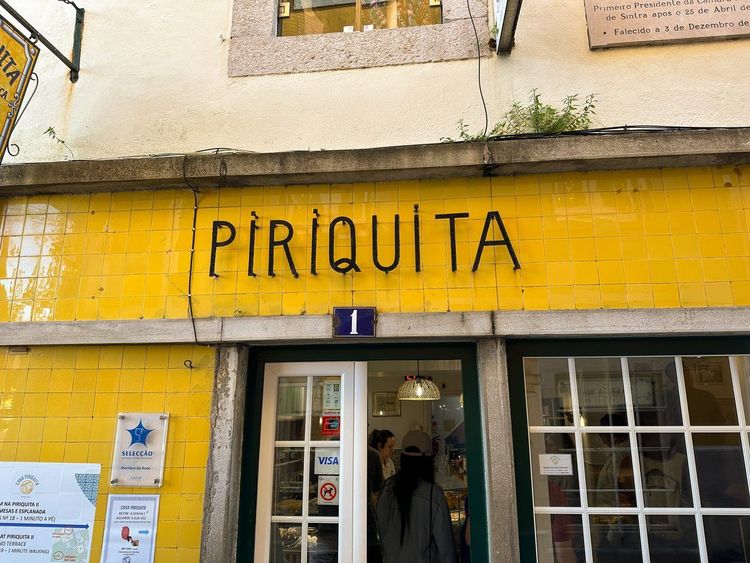
No visit to Sintra would be complete without a stop at a traditional pastry shop to try the town's two iconic sweet treats. The travesseiro is an elongated puff pastry filled with an almond and egg cream, dusted with sugar, while the queijada is a small fresh cheese and cinnamon tart whose recipe is said to date back to the Middle Ages.
The Piriquita pastry shop (R. das Padarias 1, 2710-603 Sintra, rated 4.4/5 on Google with 7,034 reviews), founded in 1862 in a lane in the historic centre, claims to have invented the travesseiro and remains the local reference despite competition from many neighbouring shops that copy the recipe with varying degrees of success. Expect to queue, especially late morning: the small interior has only a handful of tables, and most customers leave with their cardboard box to enjoy their pastries elsewhere. Prices remain modest, around 1.50 to 2 euros each.
A practical detail few visitors know: the establishment has opened a second shop a few metres further up the same street, specifically to handle the crowds. If the queue at the main shop puts you off, try your luck there — the batches are identical. And if you want to take queijadas for the road, note that they keep for several days and travel far better than travesseiros, whose puff pastry loses its crispness by the following day. Round it all off with a short Portuguese coffee, a "bica", to enjoy the full local ritual.
15. Planning Your Visit: Bus 434, Combined Tickets, and the Best Times to Go
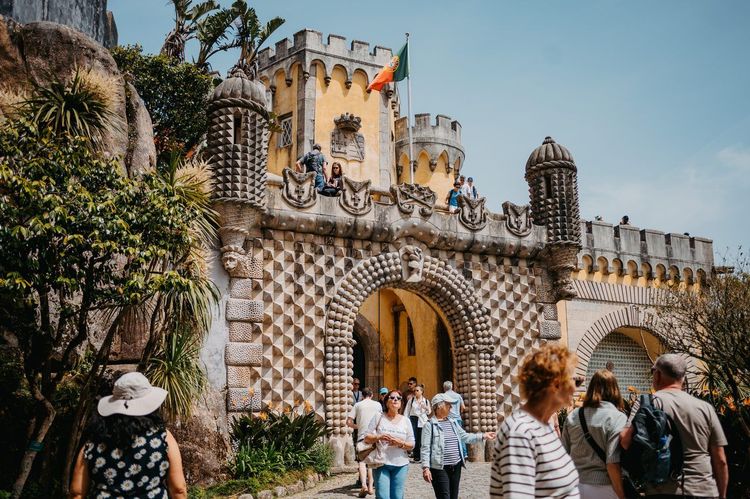
Getting around Sintra without a car relies mainly on the bus 434, nicknamed the "Circuito da Pena", which loops from the train station to the historic centre, the Moorish Castle, and then the Pena Palace before heading back down. The day ticket costs around 15 euros and allows unlimited hop-on hop-off travel throughout the day — a convenient system, but one that is often overloaded: in high season, it is better to arrive at the station before 9 a.m. to avoid a 30-to-45-minute wait at the first stop.
If you are coming from Lisbon, the regional train from Rossio station takes about 40 minutes and runs frequently throughout the day — a far simpler option than driving given the limited and paid parking in Sintra's centre. To visit the main sites (Pena, Moorish Castle, historic centre) in a single day, plan for an early arrival at opening time and be prepared to skip one or two secondary sites: trying to fit everything into one day generally becomes a race rather than a visit.
If you have two days, spread the central sites (Pena, Moorish Castle, National Palace, Regaleira) across the first day, then devote the second to the coast (Cabo da Roca, Azenhas do Mar, Praia da Ursa) accessible by bus or hire car. Also consider the Parques de Sintra combined passes, which group two to five monuments on a single ticket and work out cheaper than buying separately as soon as you visit three or more sites. The Ryo app lists up-to-date bus and main site timetables, useful for adjusting your route in real time rather than relying on printed schedules that are sometimes out of date.
FAQ
How much time should I plan for visiting Sintra?
One day is enough to see the essentials: the Pena Palace, the Moorish Castle, and the historic centre. Two days offer more comfort and allow you to add the Quinta da Regaleira, Monserrate, and a coastal excursion to Cabo da Roca or Azenhas do Mar without rushing.
What can I do in Sintra for free?
The historic centre, the gardens of Vila Sassetti, the view from Cabo da Roca, and the walk to Praia da Ursa are all free. Only the palaces (Pena, Regaleira, Monserrate, Palácio Nacional) require a paid admission ticket.
How do I get to Sintra from Lisbon?
The regional train from Rossio station takes about 40 minutes, with frequent departures throughout the day. It is the simplest option: parking by car remains limited and expensive in Sintra's town centre.
Should I book tickets for the Pena Palace in advance?
Yes, strongly recommended during high season (June to September). The number of simultaneous visitors is capped and same-day slots often sell out before noon. Book online at least one week in advance.
How do I get around Sintra once I am there?
Bus 434 connects the train station, the historic centre, the Moorish Castle, and the Pena Palace in a loop. The Vila Sassetti trail offers a walking alternative between the centre and the castle — more pleasant but more physically demanding.
What is the best time to visit Sintra?
Spring (April–May) and early autumn (September–October) offer a mild climate and fewer crowds than midsummer. Arriving at opening time, around 9 a.m., remains the best strategy regardless of the season.
Sintra in 1 day or 2 days: which should I choose?
One day is enough for a focused overview of the main central sites. Two days allow you to add the Atlantic coast (Cabo da Roca, Azenhas do Mar) and visit the secondary palaces (Monserrate, Capuchos) without sacrificing walking time.
In Summary: Take the Time to Get Lost in Sintra
Sintra cannot be reduced to a list of monuments ticked off hurriedly between two bus rides. The town rewards above all those who accept slowing down: walking up to the Moorish Castle through the forest rather than by road, lingering in the tunnels of the Quinta da Regaleira after the tour groups have passed, or simply sitting on the main square with a still-warm travesseiro. Between royal palaces, botanical gardens, and Atlantic cliffs, the question is never whether there is enough to do, but rather how much time you can realistically devote to it.
If you only have one day, focus on the trio of Pena, the Moorish Castle, and the historic centre, and book your tickets online to avoid losing an hour in a queue. With two days ahead of you, add the coast and the secondary palaces, and leave yourself at least half a day with no fixed programme: it is often in these unplanned moments, around a corner in a lane or along a forest trail, that Sintra reveals what makes it unforgettable.
To plan your visit, head to Ryo to find a dedicated article on the town and refine your itinerary before you leave, timetables and access tips included. The Serra de Sintra, for its part, is waiting for just one thing: for you to take the time to get a little lost in it.