
Créé par Emilie, le 7 mai 2026
Votre guide Ryo
© Shutterstock
Barcelona's Gothic Quarter, the true historic heart of the Catalan capital, houses some of the most beautiful medieval buildings in Europe. Strolling through its narrow and mysterious alleys, you will discover exceptional architectural heritage that testifies to the wealth and power of Barcelona throughout the centuries. From the 13th to the 15th century, this quarter was built stone by stone, offering visitors today an absolutely fascinating journey through time. Prepare to look up at majestic Gothic facades, cross squares steeped in history, and enter religious buildings of striking beauty.
To fully explore this emblematic area and not miss any of its hidden treasures, we recommend following an organized itinerary that will lead you from one monument to another with complete serenity. Discover our audio-guided circuit to visit Barcelona which will allow you to explore the Gothic Quarter at your own pace, with detailed explanations about each point of interest.
Download the audio-guided circuit to discover Barcelona on foot and independently
Ryo offers you a complete itinerary to visit Barcelona in complete autonomy. Thanks to our mobile application, explore the Gothic Quarter and its 26 points of interest with fun and interactive audioguides. An immersive experience that will transform your visit into a true cultural adventure, allowing you to discover the fascinating history of each building at your own pace.
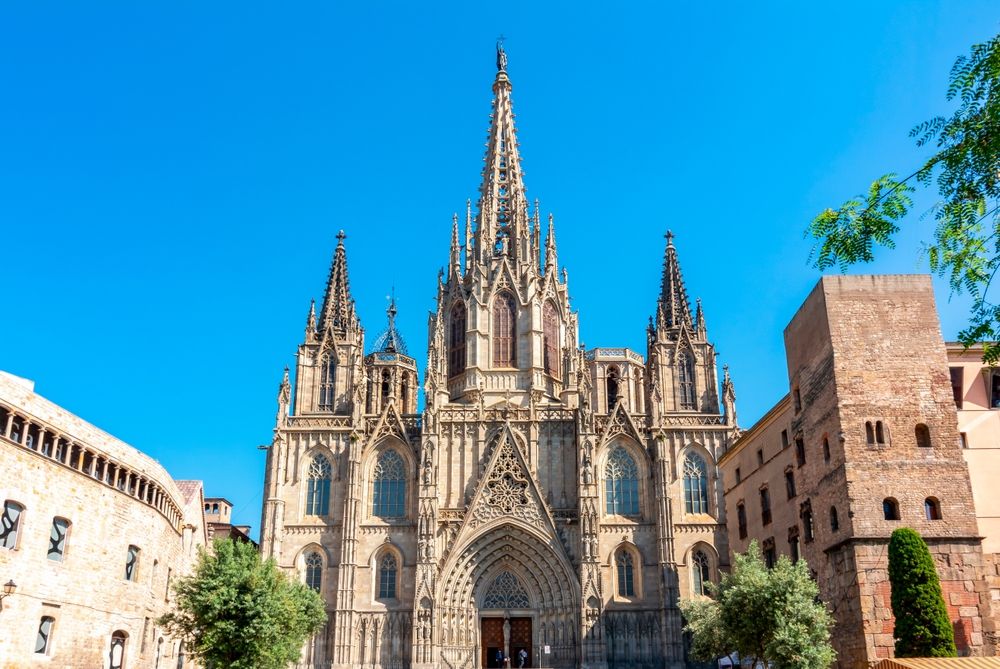
1. Barcelona Cathedral: the jewel of the Gothic Quarter
Majestic and imposing, the Cathedral of the Holy Cross and Saint Eulalia stands at the heart of the Gothic Quarter as a true architectural masterpiece. Built between the 13th and 15th centuries on the foundations of an ancient Romanesque basilica, this Catalan Gothic cathedral impresses with its harmonious proportions and its neo-Gothic facade added in the early 20th century. Construction spanned nearly 150 years, testifying to the ambition and perseverance of medieval builders.
The cathedral's interior reveals a single nave bordered by lateral chapels, where an atmosphere of contemplation reigns. Visitors are particularly amazed by the Gothic cloister that houses thirteen white geese, symbolizing Saint Eulalia's age during her martyrdom. Colored stained glass windows filter light creating a mystical ambiance, while the exterior gargoyles, representing fantastic creatures and real animals, have watched over the edifice for centuries. Don't miss the crypt that contains the sarcophagus of Saint Eulalia, patron saint of Barcelona.
For a complete experience, go up to the rooftop terrace which offers an exceptional panoramic view over the Gothic Quarter and the entire city of Barcelona (Plaça de la Seu, 3, 08002 Barcelona, rated 4.6/5 on Google for more than 45,000 reviews). Visiting hours extend from Monday to Friday from 9:30 AM to 6:30 PM, Saturday from 9:30 AM to 5:15 PM, and Sunday from 2:00 PM to 5:15 PM. The admission fee including full access is approximately 9 euros. The Ryo itinerary will naturally guide you to this unmissable monument during your exploration of the Gothic Quarter.
2. The Palace of the Generalitat de Catalunya: seat of Catalan power
Located on the Plaça de Sant Jaume, the Palau de la Generalitat represents the nerve center of Catalan political power for more than six centuries. Acquired in 1400 by the Catalan authorities, this Gothic palace was gradually enlarged and embellished over the centuries, harmoniously mixing Gothic, Renaissance and Baroque styles. Its main facade, built between 1597 and 1619 by Pere Blai, displays an imposing Renaissance style with its two floors of mullioned windows that give it a majestic appearance.
The edifice today houses the presidency of the Generalitat de Catalunya and constitutes a strong symbol of Catalan identity. Inside, visitors can discover during guided tours organized on certain Sundays the magnificent Gothic courtyard, the Salon de Sant Jordi with its superb coffered ceilings, as well as the chapel of Sant Jordi built in 1432. The richly decorated rooms testify to the historical importance of this institution in the governance of Catalonia. The murals, sculptures and original architectural elements tell the turbulent history of the region.
Facing the Palau de la Generalitat stands the Ajuntament de Barcelona, the city hall, thus creating an architectural confrontation symbolizing the balance of powers between Catalonia and the municipality. This Plaça Sant Jaume has been the theater of numerous major historical events and remains today a gathering place during celebrations and demonstrations (Plaça de Sant Jaume, 4, 08002 Barcelona). Visits are generally free but by reservation for certain Sundays and holidays. Let yourself be guided by the Ryo itinerary to discover all the secrets of this emblematic place.
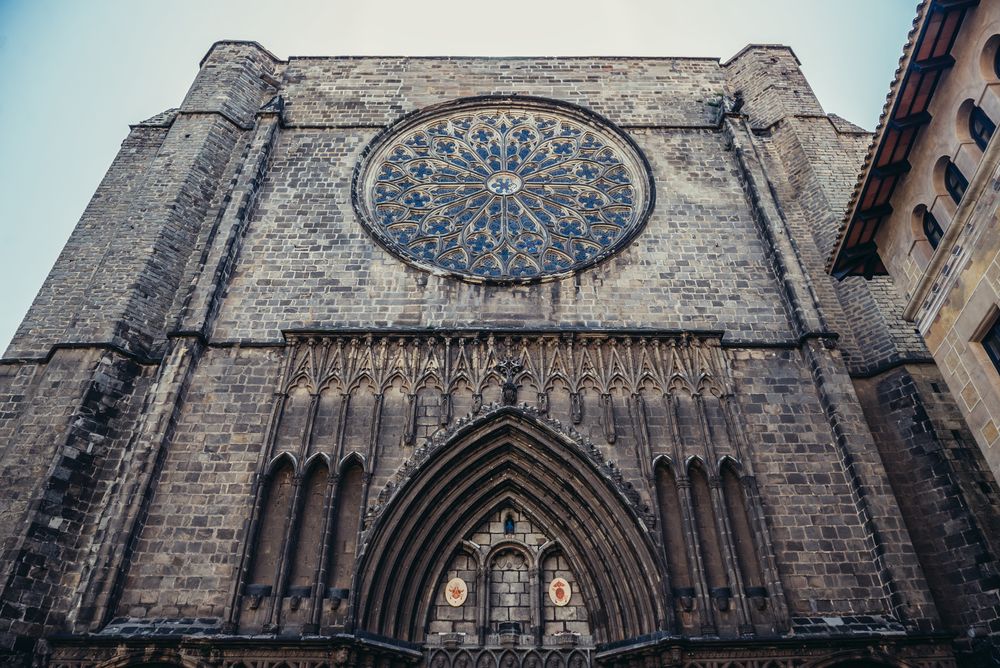
3. Santa Maria del Pi Basilica: the church at the heart of the pines
Nestled on the charming Plaça del Pi, the Santa Maria del Pi basilica takes its name from the pine trees that once bordered this picturesque square. Built between 1319 and 1391, it represents a perfect example of Catalan Gothic architecture with its characteristic exterior sobriety. Its austere facade in cut stone, dominated by an imposing ten-meter diameter rose window, contrasts with the richness of its interior. This rose window, one of the largest in the Gothic world, diffuses magical colored light inside the edifice.
The interior reveals a single nave without transept, typical of Catalan Gothic, which creates a vast and unitary space conducive to contemplation. The lateral chapels opened between the buttresses house remarkable works of art, including some Gothic altarpieces of great artistic value. The octagonal bell tower, 54 meters high and built between 1460 and 1497 by Bartomeu Mas, dominates the quarter and offers a visual landmark in the maze of Gothic alleys. The four original stained glass windows that have survived the centuries add to the mystical atmosphere of the place.
The basilica has known tumultuous periods, notably during earthquakes and fires, but has always been carefully restored to preserve its Gothic authenticity. Today, it regularly hosts classical music concerts that highlight its exceptional acoustics (Plaça del Pi, 7, 08002 Barcelona, rated 4.5/5 on Google for more than 8,000 reviews). Opening hours extend from Monday to Saturday from 10:00 AM to 8:00 PM, and Sunday from 1:00 PM to 8:00 PM. Admission costs approximately 5 euros. Also enjoy the artisan markets that regularly animate the square, adding to the charm of your visit as part of your audio-guided tour of Barcelona.
4. Pont del Bisbe: the emblematic Gothic bridge
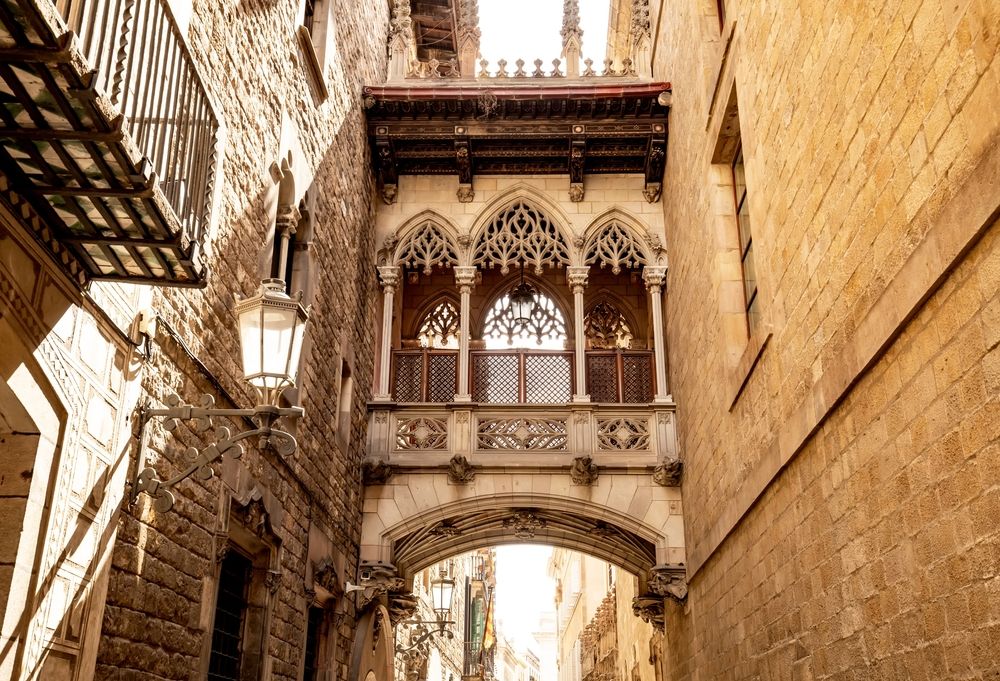
The Pont del Bisbe, or Bishop's Bridge, is undoubtedly one of the most photographed places in Barcelona's Gothic Quarter. Spanning the narrow street del Bisbe, this covered bridge connects the Palau de la Generalitat to the Casa dels Canonges, the former house of the canons. Its neo-Gothic architecture so perfectly integrated into the surrounding medieval setting surprises when you learn it only dates from 1928. Designed by Joan Rubió i Bellver, disciple of the famous Antoni Gaudí, this bridge was created for the Universal Exhibition to beautify the quarter.
The bridge fascinates with its refined sculpted details and its flamboyant Gothic ornamentation that perfectly imitates the medieval style. At the center of the bridge, under the arch, there is a mysterious element that intrigues visitors: a skull pierced by a dagger. According to persistent urban legend, if this skull were removed, the city of Barcelona would collapse. This macabre sculpture adds a mystical dimension to the monument and feeds the imagination of the many tourists who come to immortalize this unique passage. Another tradition holds that visitors walk backwards under the bridge for good luck.
The Pont del Bisbe is part of a remarkable architectural ensemble that testifies to the urban evolution of the Gothic Quarter through the centuries. The street del Bisbe itself, entirely pedestrian, constitutes one of the most charming arteries of old Barcelona with its medieval facades and craft shops. Looking up, you will see the gargoyles that adorn the surrounding buildings, adding to the Gothic atmosphere of the place. This bridge is located on the route of the Ryo audio-guided itinerary, which will allow you to discover its fascinating history and the many anecdotes related to it during your visit to the Gothic Quarter.
5. Plaça del Rei: the medieval heart of Barcelona
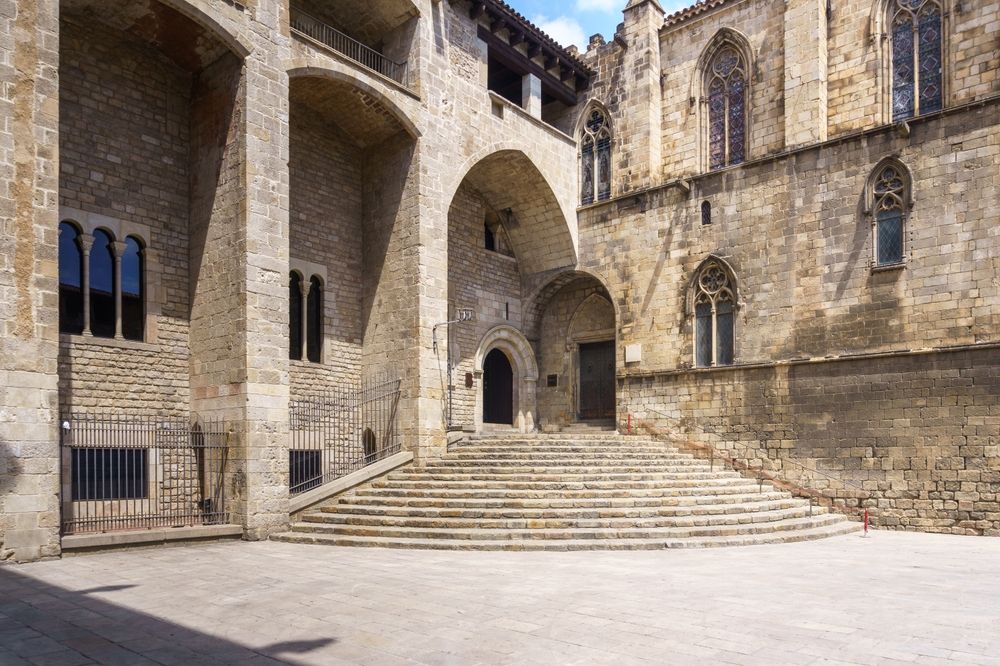
The Plaça del Rei, or King's Square, constitutes one of the best preserved medieval ensembles in Europe and represents a true journey through time. This rectangular square was the center of medieval power in Barcelona, serving as the inner courtyard of the Palau Reial Major, residence of the Counts of Barcelona then the Kings of Aragon. Developed in the 14th century under the reign of King Martin of Aragon, it hosted markets, knights' tournaments and official ceremonies. The atmosphere that reigns in this enclosed square, surrounded by high medieval walls, immediately transports visitors to the era of kings and counts.
The Palau Reial Major majestically dominates the square with its austere facade pierced with geminated windows. Inside, the Saló del Tinell, a Gothic reception hall with impressive vaults, allegedly welcomed Christopher Columbus in 1493 on his return from America, for him to present his discoveries to the Catholic Kings Ferdinand and Isabella. This historic meeting marks a turning point in world history. On the right side of the square rises the Mirador del Rei Martí, a watchtower built in the 16th century by Antoni Carbonell, formerly offering a strategic view over the city and its surroundings.
The chapel of Saint Agatha, built in 1302 by order of King James II, constitutes another architectural jewel of the square. It houses a magnificent altarpiece by Jaume Huguet, a masterpiece of 15th-century Catalan Gothic painting. The Palau del Lloctinent and the Casa Padellàs, which houses the Barcelona History Museum (MUHBA), complete this exceptional architectural ensemble. The museum allows you to go down under the square to discover the Roman remains of ancient Barcino, offering a unique perspective on the historical strata of the city (Plaça del Rei, s/n, 08002 Barcelona, rated 4.6/5 on Google for more than 12,000 reviews). This square naturally figures in the Barcelona visit tour with Ryo, which will reveal all its historical secrets to you.
In conclusion, Barcelona's Gothic Quarter offers an exceptional concentration of historic buildings that testify to the architectural and cultural richness of medieval Catalonia. From the majestic cathedral to the mysterious Pont del Bisbe, passing through squares steeped in history and Gothic palaces, every stone tells a chapter of Barcelona's history. These five unmissable buildings represent only a glimpse of the wonders contained in this fascinating quarter. For a complete and enriching discovery, we invite you to follow the Ryo audio-guided itinerary which will allow you to explore these monuments at your own pace, while benefiting from detailed historical explanations and captivating anecdotes. Whether you are passionate about Gothic architecture, medieval history or simply curious to discover the authentic soul of Barcelona, the Gothic Quarter will amaze you and transport you to another time.
Frequently asked questions
How long does it take to visit Barcelona's Gothic Quarter?
To properly explore the main historic buildings of the Gothic Quarter, allow at least half a day, about 3 to 4 hours. If you wish to visit the interior of monuments and museums, a full day will be necessary. The Ryo itinerary of 2h30 allows you to discover the essentials of the quarter with 26 commented points of interest.
What is the best time to visit the Gothic Quarter?
The best time to visit the Gothic Quarter is early in the morning, between 9 AM and 11 AM, or late afternoon after 5 PM, to avoid the hours of heavy tourist crowds. The narrow alleys take on a particularly magical atmosphere at sunrise or dusk. Spring and autumn offer ideal climatic conditions for strolling through the cobbled streets.
Is entry to Gothic Quarter monuments paid?
Access to the Gothic Quarter itself is free and you can admire the facades of historic buildings freely. However, entry inside the cathedral costs about 9 euros for a complete visit, the Santa Maria del Pi basilica about 5 euros, and the Barcelona History Museum (MUHBA) on Plaça del Rei about 7 euros. The Generalitat palace offers free guided tours on certain Sundays by reservation.
Can you visit the Gothic Quarter with an audioguide?
Yes, absolutely! The Ryo application offers a complete audio-guided circuit to visit Barcelona and its Gothic Quarter in total autonomy. With 26 fun audioguides, interactive navigation and detailed historical commentary, you will discover all the secrets of historic buildings at your own pace. This solution is ideal for a flexible and enriching visit without depending on group schedules.
Is the Gothic Quarter accessible to people with reduced mobility?
The Gothic Quarter presents certain accessibility difficulties due to its narrow cobbled alleys, stairs and sometimes uneven terrain. Some monuments like the cathedral have nevertheless arranged specific access. It is recommended to inquire in advance with each site to know the available amenities. The main squares like Plaça de Sant Jaume and Plaça del Rei are more easily accessible.