
Créé par Emilie, le 7 mai 2026
Votre guide Ryo
© Shutterstock
Madrid is filled with architectural treasures that tell the fascinating history of Spain. From the royal era to Arab influences, through contemporary monuments, the Spanish capital offers exceptional heritage that deserves to be explored. Discover the 9 must-visit historical monuments in Madrid, true witnesses to the cultural and artistic richness of this magnificent city. Each monument reveals a unique facet of Madrid's identity, between tradition and modernity.
1. Plaza Mayor: the historical soul of Madrid
It's impossible to talk about Madrid's must-visit historical monuments without starting with the Plaza Mayor, the true historical heart of the Spanish capital. This emblematic square, built in the 16th century and rebuilt after a fire in the 19th century, impresses with its imposing dimensions and harmonious architecture.
With its red ochre facades and 237 perfectly aligned balconies, Plaza Mayor testifies to Spanish architectural genius. The Casa de la Panadería, adorned with colorful frescoes, and the Casa de la Carnicería majestically frame this rectangular square measuring 129 by 94 meters. At the center stands the equestrian statue of Philip III, recalling the grandeur of the royal era.
Today, Plaza Mayor remains an essential living place where residents and visitors mingle. Its lively terraces and cultural events perpetuate Madrid's popular tradition. To discover all the secrets of this exceptional monument, let yourself be guided by the Ryo itinerary which will reveal the fascinating history of this architectural jewel.
2. The Royal Palace: symbol of Spanish grandeur
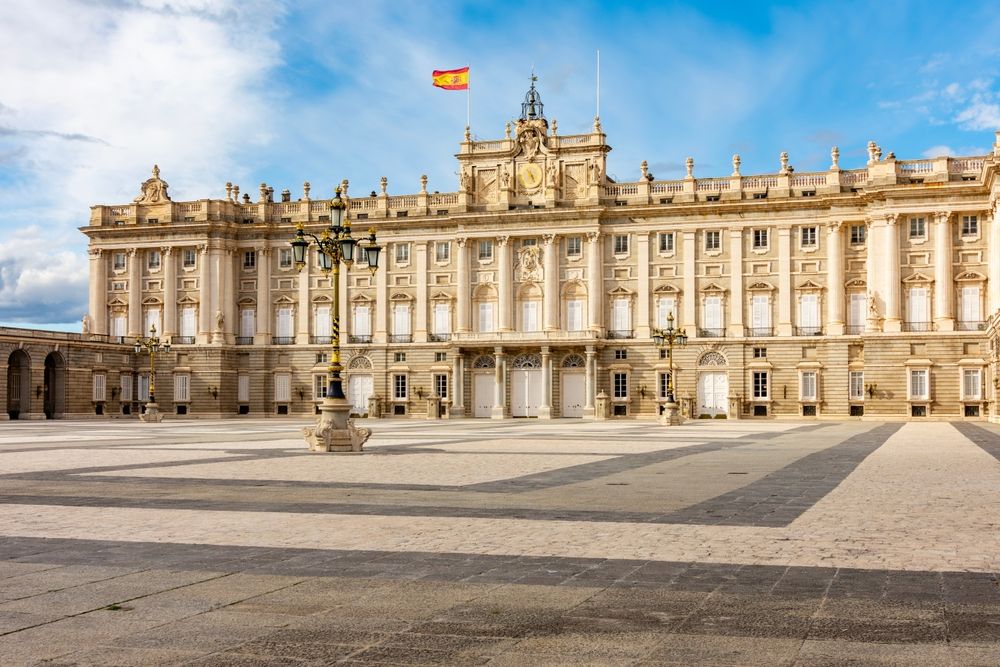
The Royal Palace of Madrid stands as one of Europe's most spectacular historical monuments. Built in the 18th century by order of King Philip V, this baroque palace impresses with its colossal dimensions: over 135,000 square meters and 3,418 rooms, making it the largest royal palace in Western Europe.
The Royal Palace's architecture testifies to the refinement of Spanish decorative art. Its state rooms, adorned with Tiepolo frescoes and period furniture, house exceptional collections: royal armor, musical instruments including a precious Stradivarius, and Flemish tapestries. The Throne Room, with its ceiling painted by Tiepolo, constitutes one of the architectural jewels of this must-visit historical monument in Madrid.
The Campo del Moro and Sabatini gardens harmoniously complete this royal ensemble. Although the Spanish royal family no longer resides there, the palace remains the venue for important official ceremonies. To fully appreciate the richness of this exceptional monument, don't hesitate to follow the Ryo audio-guided itinerary which will unveil the secrets of this royal residence.
3. The Almudena Cathedral: a neoclassical jewel
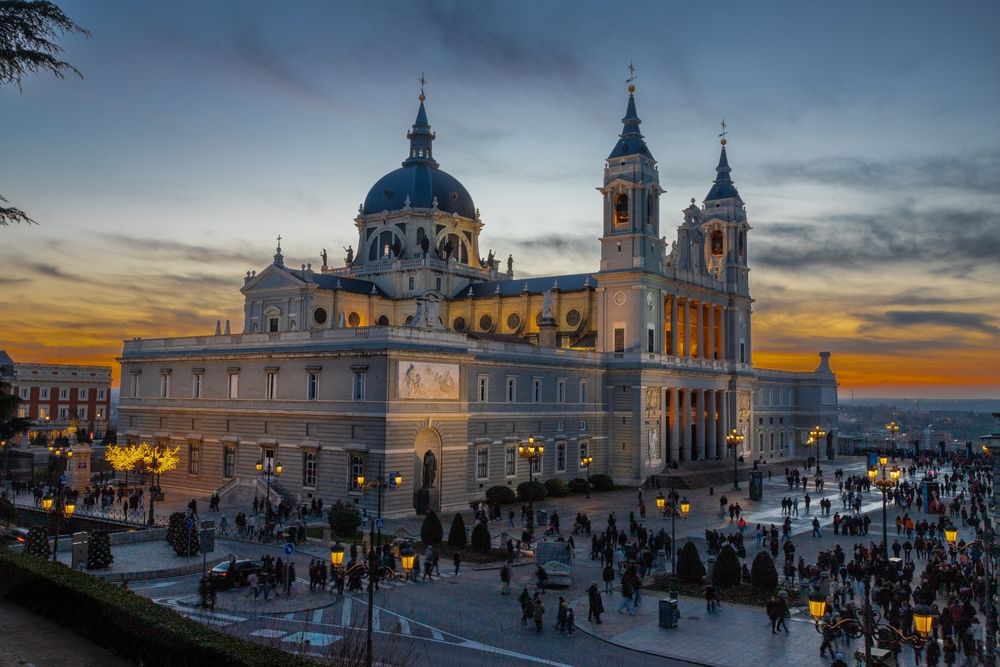
Facing the Royal Palace stands the majestic Almudena Cathedral, a historical monument unique of its kind in Madrid. Unlike traditional medieval cathedrals, this one was completed only in 1993, after more than a century of construction that began in 1883.
The Almudena Cathedral's architecture harmoniously blends several styles: neoclassical facade in harmony with the Royal Palace, neo-Gothic interior with soaring vaults, and neo-Romanesque crypt with impressive dimensions. This architectural diversity makes it one of Madrid's most original historical monuments to visit.
The interior surprises with its contemporary murals in bright colors, the work of 20th-century Spanish artists. The 75-meter-high dome offers an exceptional panorama of the capital. The cathedral takes its name from the Virgin of Almudena, patron saint of Madrid, whose statue adorns the high altar. This must-visit religious monument testifies to Madrid's ability to combine architectural tradition and modernity.
4. The Temple of Debod: an Egyptian treasure in the heart of Madrid
Among Madrid's must-visit historical monuments, the Temple of Debod occupies a unique place. This authentic 2nd century BC Egyptian temple was given to Spain by Egypt in 1968, in gratitude for its help during the rescue of Nubian monuments threatened by the construction of the Aswan Dam.
Reconstructed stone by stone in Montaña Park, this temple dedicated to the gods Amun and Isis presents remarkable Nilotic architecture. Its perfectly preserved hieroglyphic reliefs and interior rooms transport visitors to ancient Egypt, creating a striking contrast with Madrid's urban environment.
Download the audio-guided circuit to discover Madrid on foot and independently
Explore Madrid differently thanks to our interactive audio-guided circuit which takes you to discover the must-visit historical monuments of the Spanish capital. From Plaza Mayor to the Temple of Debod, via the Royal Palace and the Almudena Cathedral, live a unique immersive experience with 24 captivating audio commentaries that reveal the history and anecdotes of each emblematic place.
The sunset from the temple gardens offers one of the most beautiful views of Madrid, with the silhouette of the cathedral and royal palace standing out on the horizon. This unusual historical monument remarkably enriches Madrid's architectural heritage and constitutes an essential stop on your guided city tour.
5. The Puerta de Alcalá: Europe's first triumphal arch
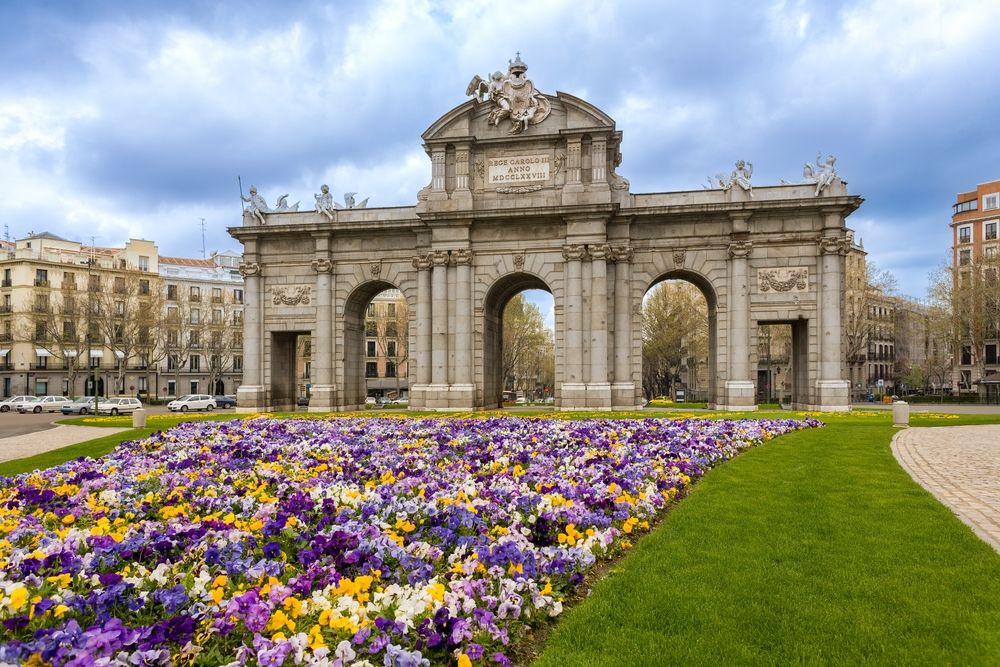
The Puerta de Alcalá constitutes one of Madrid's most photographed historical monuments. Erected in 1778 by order of King Charles III according to plans by Italian architect Francesco Sabatini, it holds the prestigious title of the first triumphal arch built in Europe after the fall of the Roman Empire.
This neoclassical monument in Guadarrama granite impresses with its perfect proportions and sculpted details. With its five arches – three rectangular and two semicircular – and its allegorical decorations representing royal virtues, the Puerta de Alcalá testifies to the urban ambition of the Spanish Bourbons.
Located at the entrance to Retiro Park, it once marked Madrid's eastern limit and the old road to Alcalá de Henares. This must-visit historical monument in Madrid (Plaza de la Independencia, 28001 Madrid, rated 4.4/5 on Google for 15,000 reviews) remains a symbol of Spanish architectural elegance and an obligatory stop for understanding the capital's urban evolution.
6. The Prado Museum: temple of universal art
The Prado Museum is among Madrid's must-visit historical monuments, both for its neoclassical architecture and its exceptional collections. Inaugurated in 1819, this building designed by Juan de Villanueva constitutes one of the world's most prestigious art galleries.
The museum's architecture, with its granite facade and Doric columns, testifies to the neoclassical aesthetics of the early 19th century. Successive extensions, notably Rafael Moneo's in 2007, have allowed this historical monument to adapt to contemporary museographic requirements while preserving its architectural character.
Housing more than 8,000 paintings, the Prado preserves masterpieces by Velázquez, Goya, Rubens and Bosch. The richness of its collections makes this museum much more than a simple monument: a true sanctuary of Western art. The Prado district, inscribed on UNESCO's World Heritage list, confirms the cultural importance of this emblematic Madrid location.
7. Las Ventas Bullring: neo-Mudéjar masterpiece
The Las Ventas Bullring represents one of Madrid's most emblematic historical monuments. Inaugurated in 1931, this bullring designed by architect José Espeliú constitutes Spain's largest arena with a capacity of 23,798 spectators.
Las Ventas' neo-Mudéjar architecture impresses with its decorative richness. The red brick facades adorned with azulejos (ceramic tiles) in the colors of Spanish provinces, the horseshoe arches and Islamic geometric motifs create a unique harmonious architectural ensemble in Madrid.
Beyond their bullfighting function, this bullring constitutes an exceptional historical monument testifying to 20th-century neo-Mudéjar art. The integrated Bullfighting Museum allows visitors to discover the history and culture of Spanish bullfighting. This architectural marvel located at Calle de Alcalá, 237, 28028 Madrid, rated 4.3/5 on Google for 12,000 reviews remains essential for understanding an important facet of Madrid's cultural identity.
8. The Cybele Palace: from post office to city hall
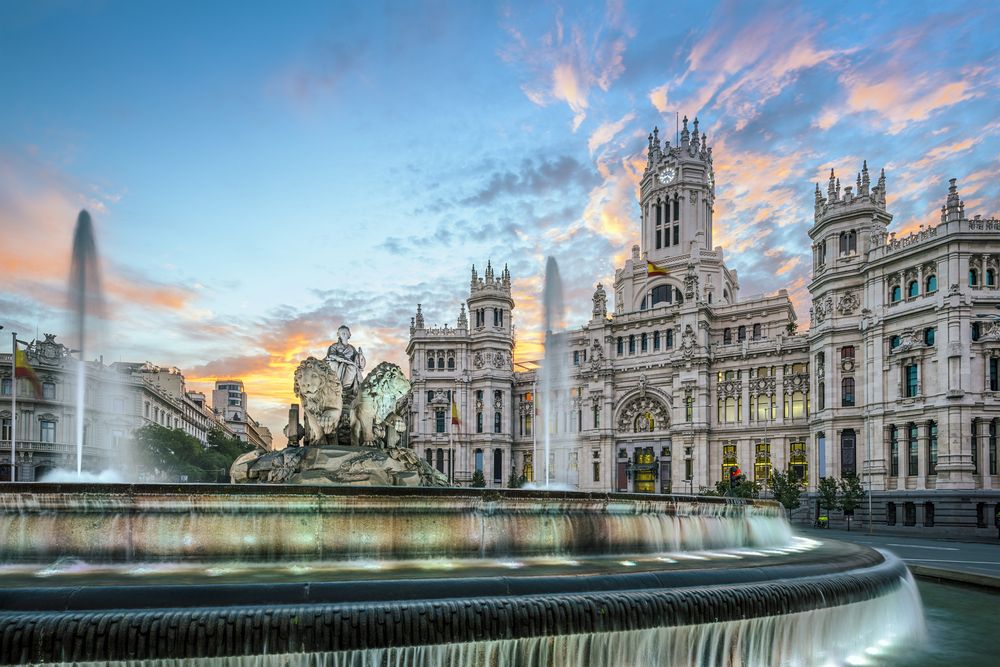
The Cybele Palace (Palacio de Cibeles) is among Madrid's must-visit historical monuments. Built between 1907 and 1919 by architects Antonio Palacios and Joaquín Otamendi, this sumptuous building originally housed the headquarters of the Spanish Post and Telegraph Company.
This monument's eclectic architecture mixes neo-Gothic, neo-Plateresque and Art Nouveau influences. Its 30-meter central tower, sculpted gargoyles and richly decorated facades make this palace one of Madrid's most photographed buildings. The interior, with its courtyards covered by spectacular glass roofs, testifies to the architectural refinement of the early 20th century.
Since 2007, the palace houses Madrid's city hall and the CentroCentro cultural center. Its panoramic terrace offers a breathtaking view of the city, making this historical monument a privileged observation point. Located at Plaza de Cibeles, 28014 Madrid, rated 4.5/5 on Google for 8,500 reviews, it symbolizes the successful transformation of Madrid's historical heritage.
9. Atocha Station: railway architecture and tropical garden
Atocha Station closes our selection of Madrid's must-visit historical monuments in a surprising way. This station, Madrid's oldest (1851), constitutes a remarkable example of 19th-century railway architecture, redesigned after a fire by Alberto de Palacios.
The transformation of the old station into a tropical garden in the 1990s represents a unique architectural feat. Under the magnificent 157-meter-long metal glass roof, a 4,000 m² ecosystem houses more than 7,000 tropical plants of 260 different species, as well as turtles and exotic fish.
This bold conversion makes Atocha station much more than a simple transport infrastructure: a true historical monument where 19th-century industrial architecture harmoniously dialogues with a contemporary landscape concept. This marvel located at Plaza del Emperador Carlos V, 28045 Madrid, rated 4.4/5 on Google for 25,000 reviews perfectly illustrates Madrid's capacity to reinvent its architectural heritage.
To discover all these must-visit historical monuments of Madrid in their urban context, let yourself be guided by the immersive experience offered by Ryo which will allow you to visit Madrid in an authentic and enriching way.
In conclusion, Madrid offers architectural heritage of exceptional richness that testifies to its millennial history. These 9 must-visit historical monuments, from Plaza Mayor to the Temple of Debod, via the Royal Palace and Las Ventas Bullring, tell the fascinating evolution of the Spanish capital. Each monument reveals a unique facet of Madrid's identity, blending royal, religious, artistic and popular influences. For a complete and authentic discovery of these architectural treasures, don't hesitate to explore Madrid thanks to the Ryo audio-guided itinerary which will reveal all the secrets of this extraordinary city.
Frequently asked questions
What is Madrid's oldest monument?
The Temple of Debod is Madrid's oldest monument, dating from the 2nd century BC. Although it's not originally from Madrid but from Egypt, it constitutes the city's oldest structure. Among purely Madrid monuments, the churches of Saint Peter the Old and San Andrés are among the oldest historical constructions.
How long does it take to visit all these monuments?
To visit Madrid's 9 must-see historical monuments, ideally allow 3 to 4 days. One day can be devoted to the historic center (Plaza Mayor, Royal Palace, Cathedral), another to museums (Prado), and a third to more distant monuments like Las Ventas. The Ryo itinerary optimizes your route for efficient discovery.
Which monuments are free in Madrid?
Several historical monuments in Madrid are free: the Temple of Debod, Plaza Mayor, Puerta de Alcalá, and the exterior of all monuments. The Prado Museum offers free access from 6pm to 8pm on weekdays and from 5pm to 7pm on Sundays. The Almudena Cathedral is free except for dome access.
What's the best time to photograph these monuments?
The golden hour (one hour after sunrise or before sunset) offers the best conditions for photographing Madrid's monuments. The Temple of Debod at sunset, Plaza Mayor early morning, and the Royal Palace from the Sabatini gardens in late afternoon constitute privileged moments for photography.