
Créé par Emilie, le 3 juin 2026
Votre guide Ryo
© Shutterstock
Lucerne has no Eiffel Tower, no Colosseum, and yet travellers regularly rank it among the most beautiful cities in Europe. That reputation rests on a simple but extraordinary combination: medieval bridges over glacier-fed water, baroque churches backed by Alpine summits, and a compact old town you can walk end to end in twenty minutes without once feeling like you've seen it all. The things to do in lucerne range from riding a cog railway to the top of a 2 100-metre summit on a cloud-piercing morning, to lingering over a Lucerne Festival concert in a hall that many conductors consider one of the finest acoustic spaces on the continent. If you want to plan your route through the old streets with local stories built in, the Ryo audio guide for Lucerne, The Land of Dragons, is worth downloading before you arrive.
The list below covers 25 experiences: a 600-year-old painting cycle hidden on a wooden bridge, a glacier-carved garden 20 metres underground, the world's largest panoramic painting, a lakeside museum with the original Picasso canvases he sent here in his final years, and a paragliding launch site that puts the entire Alps on display. Some take half a day; others demand no more than a purposeful 20-minute detour. All of them are worth your time.
1. Walk the Chapel Bridge
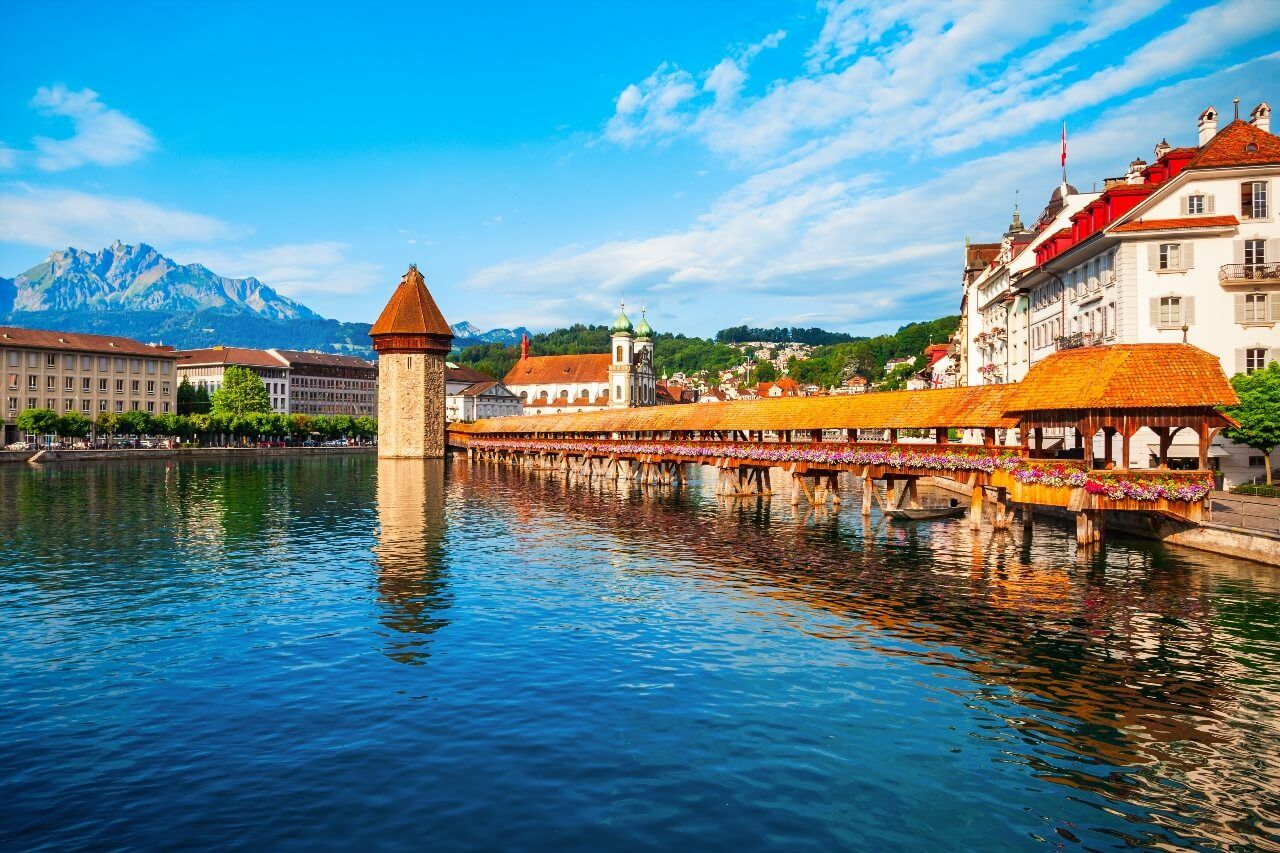
The Chapel Bridge (Kapellbrücke, 6002 Lucerne) is the oldest surviving wooden covered bridge in Europe, first built in 1333 and currently stretching about 204.7 metres across the Reuss River at a diagonal (the original span was over 270 m before successive shortenings in the 19th and 20th centuries). That diagonal is the point: the bridge was never designed purely for pedestrians, but as a defensive fortification linking the city walls on both banks, and the kink in the middle once allowed defenders to enfilade attackers approaching either gateway.
What stops most people mid-crossing is the series of triangular paintings suspended in the rafters. These 112 gable panels (17th century) depict scenes from Swiss history and the lives of patron saints Leodegar and Mauritius. A fire in 1993 destroyed roughly two-thirds of the originals; the surviving panels are clearly darker and older in tone than the restored replacements, and spotting the difference is its own small history lesson. Arrive before 8:30 am to cross without crowds, the bridge empties to almost nothing at that hour and the morning light across the water is excellent. If you cross again at dusk you get a second, very different version of the same view: the flower boxes that locals tend year-round are floodlit against the dark river, and the swans that nest along the quay tend to drift back toward the bridge piers for the night. Look for the small plaque on the south end commemorating the 1993 fire, the section of darker oak immediately above it is original 14th-century timber that survived the blaze.
2. Climb the Musegg Wall
The Musegg Wall (Museggmauer, 6004 Lucerne) is Lucerne's northern medieval fortification, a 870-metre curtain wall with nine towers that dates from the late 14th century. Three of those towers are open to the public free of charge between April and November: the Männliturm, the Luegislandturm, and the Zytturm, the last of which contains a clock from 1535 that still strikes one minute before every other clock in the city, a privilege it has held for nearly 500 years.
The wall walk itself connects several of the towers along a rampart path with views south over the red rooftops and north into the hills. It takes about 30 minutes at a casual pace. There is no lift and the spiral staircases are steep, but for people comfortable with heights the panorama from the Zytturm platform is arguably the best free view in the city.
3. Explore Lucerne's Old Town
The Altstadt (Old Town, 6004 Lucerne) is the densest concentration of experience in the city, and it repays wandering without a fixed itinerary. The core streets, Rathausquai along the northern bank, Unter der Egg on the south, and the tight lanes feeding off both, were laid out in the medieval period and remain essentially intact. What changes them is the detail you notice at different times of day.
The Town Hall (Rathaus), built between 1602 and 1606 in late Renaissance style, sits directly on the river at the Kornmarkt. Its loggia faces the water and was originally used as a grain market, the lower arches still show the wear of centuries of commercial traffic. Directly opposite, painted house facades line the Unter der Egg quay: the most photographed are the Haus zum Ritter (1556), whose exterior fresco cycle by Hans Heinrich Wägmann is one of the largest secular Renaissance paintings in Switzerland, and the Am Rhyn House next door.
Spend time in the side streets rather than the main quay. The Hirschenplatz and the Weinmarkt, Lucerne's former wine market, are lined with guild houses whose painted facades have been maintained or carefully restored since the 16th century. The Weinmarkt fountain at the square's centre dates from 1481; the current basin is a copy, but the stone column with St Michael defeating the dragon is original. Go in the late afternoon when the low sun catches the painted plasterwork and turns everything amber.
The Clock Tower on Kapellgasse is separately covered in Section 22, but if you are mapping a walking route through the old town, plan to pass through Kapellgasse, Pfistergasse, and the Weinmarkt in sequence, it takes under 20 minutes and puts you in front of the best facades without backtracking.
4. Take a Lake Lucerne Cruise
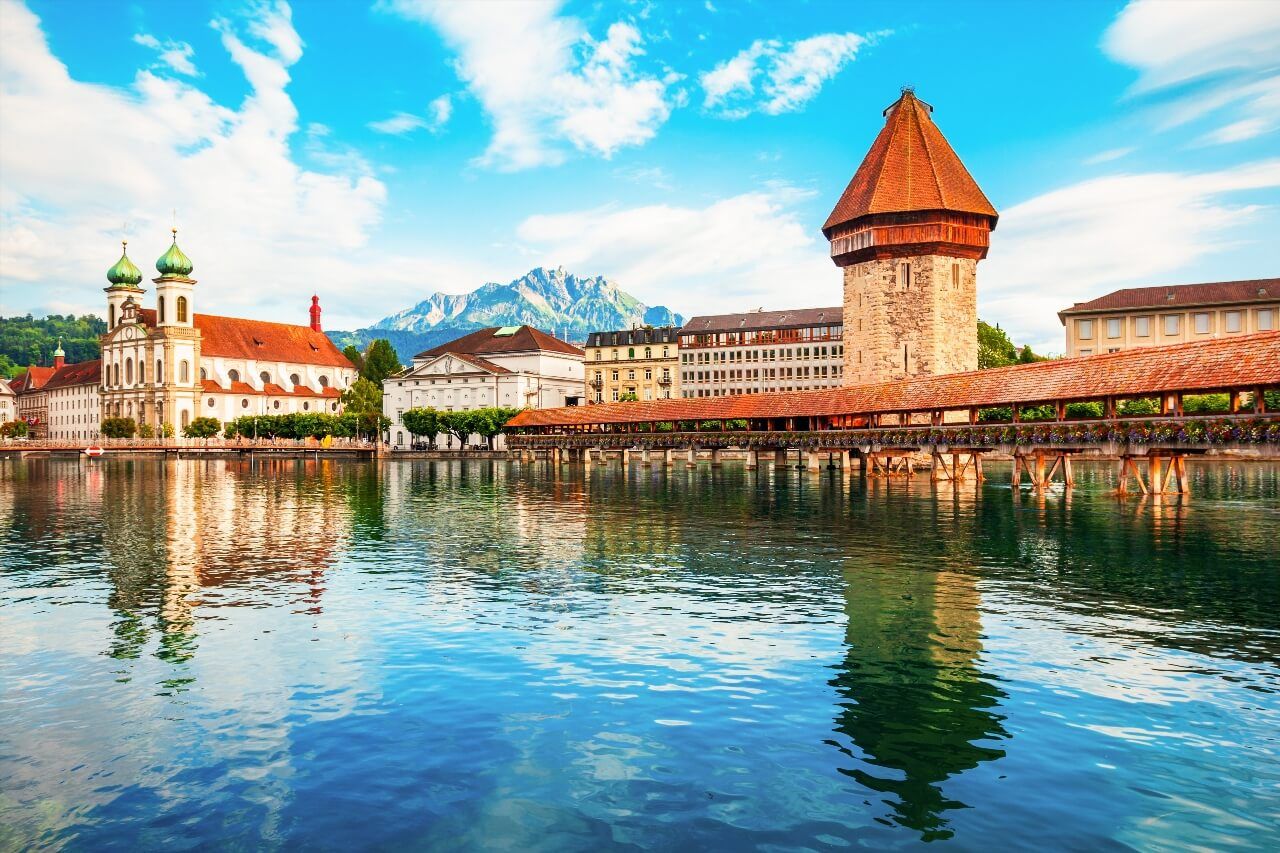
Lake Lucerne (Vierwaldstättersee) is one of the most geographically complex lakes in Switzerland, not a simple oval but a series of interlocking arms stretching between six cantons, with water so clear that you can track the shadow of your vessel on the bottom in shallow sections near the shore. Steamship Company SGV operates regular scheduled services year-round, with vintage paddle steamers running on the longer routes between May and October.
The shortest circuit departs from Bahnhofquai and loops to Kehrsiten-Bürgenstock and back in about 90 minutes, enough to clear the city's immediate waterfront and reach the open southern section of the lake where Pilatus, Rigi, and Bürgenstock all appear simultaneously on the skyline. A full round-trip to Flüelen at the lake's southern end takes 5 hours each way and follows the same water route that William Tell supposedly crossed, according to the legends displayed at each landing stage.
If you hold a Swiss Travel Pass, travel on SGV services is fully covered. Book the upper open deck on paddle steamers, the enclosed salons are beautiful but the view is limited. Early October cruises catch autumn colour on the lower slopes before the first snow dusts the summits above 1 800 metres. If you have the time, the Wilhelm Tell Express themed evening cruise on Wednesday and Saturday nights in summer adds a three-course onboard dinner for around CHF 95, and the sunset hour between Bürgenstock and Weggis is genuinely worth the upgrade.
5. Hike or Ride to Mount Pilatus
Mount Pilatus (2 132 m) looms directly southwest of Lucerne and is visible from almost every point in the old town. The mountain's name, likely from the Latin pileatus (cloud-capped) rather than any connection to Pontius Pilate, despite the local legend, reflects the fact that its summit spends a significant portion of the year in cloud. When it clears, the view takes in 73 Alpine peaks across a 360-degree arc that stretches from the Bernese Oberland to the Black Forest.
The most scenic route is the Golden Round Trip: take the boat from Lucerne to Alpnachstad (45 minutes), then ride the Pilatus-Bahn, the world's steepest rack railway at a 48% gradient, operational since 1889, to Pilatus Kulm at the summit. Return via the Fräkmüntegg cable gondola and the Krienseregg detachable chairlift into the Kriens suburb of Lucerne, then bus or tram back to the centre.
At the summit, the hotel terrace at Pilatus Kulm is the obvious place to stop, but the Dragon Path (Drachenweg) loop trail is worth 30 additional minutes. The path circumnavigates the twin summits of Oberhaupt and Tomlishorn, passing the cave where Lucerne legend places the last dragon sighting in 1421. The legend is charted in detail on the Ryo audio exploration The Land of Dragons, which connects the dragon mythology woven into the city's oldest buildings with the mountain itself.
Practically: the rack railway runs mid-May through mid-November only, outside that window the summit is accessible only by aerial cable car from Kriens year-round. The gondolas and chairlifts operate all year. Return ticket prices sit around CHF 72 : 82 without rail passes; Swiss Travel Pass covers the boat and provides 50% reduction on the mountain sections. Bring a windproof layer even in July, the summit temperature runs 8 : 12°C colder than the city. One detail nobody mentions in the brochures: if you ride up via the rack railway in the first 30 minutes after opening, you'll usually have the summit boardwalks largely to yourself for about an hour before the first cable cars arrive from Kriens, that window is when the early-morning cloud sea (Nebelmeer) below the summit is at its most photogenic, with the Alps poking through like islands.
6. See the Lion Monument
Mark Twain called the Lion Monument (Löwendenkmal, Denkmalstrasse 4, 6006 Lucerne) «the most mournful and moving piece of stone in the world.» Carved directly into a sandstone cliff face in 1820 : 21 by sculptor Lucas Ahorn after a design by Bertel Thorvaldsen, it commemorates the 786 Swiss Guards who died defending the Tuileries Palace in Paris during the Revolution of August 1792.
The lion, 9 metres long, 6 metres high, lies dying, a broken lance in its side, one paw still resting on a shield bearing the French royal lily. The shallow pool in front of it, framed by a semicircle of stone and lime trees, was designed to create a reflection that doubles the composition. Admission is free; the site is open year-round.
What the tourist photos rarely convey is the scale, most people expect something museum-sized and are genuinely surprised by a monument that fills a cliff wall. Go in the morning when the light falls across the relief from the east and the pool reflection is still. The crowd is thinner before 9 am.
7. Ascend Mount Rigi
Mount Rigi (1 797 m) is Lucerne's second great Alpine excursion and, in some ways, the more rewarding one for first-time visitors who want a gentler day. Where Pilatus is dramatic and vertiginous, Rigi is wide-shouldered and pastoral, high Alpine meadows, grazing cattle, and a ridge walk that feels almost Scandinavian in its openness.
The classic approach takes the boat from Lucerne to Vitznau (45 minutes), then the Rigi-Bahn, Europe's first mountain railway, inaugurated in 1871, to Rigi Kulm. The panorama from the summit on a clear day is astonishing: the entire Swiss Mittelland spread below, Lake Lucerne carved into the foreground, and the Bernese Alps rising behind. On exceptionally clear mornings in spring and autumn, the chain of peaks from the Säntis to Mont Blanc is visible.
The mountain is active in winter too, skiing and sledging runs operate from Rigi Kulm and Rigi Kaltbad between December and March, and the Kaltbad mineral spring spa is open year-round. Swiss Travel Pass covers the boat and provides 50% discount on the Rigi-Bahn. For a more athletic day, the Panorama Trail from Rigi Kulm to Staffel and down to Weggis takes approximately 3 hours and passes through terrain largely unchanged since Queen Victoria climbed Rigi in 1868, a fact commemorated at the summit station.
8. Visit the Swiss Museum of Transport
The Swiss Museum of Transport (Lidostrasse 5, 6006 Lucerne, rated 4.6/5 on Google (14 353 avis)) is the most-visited museum in Switzerland, and that statistic undersells it. The site covers around 20 000 square metres of indoor and outdoor exhibits across aerospace, road, rail, water, and cable transport, and the collection includes full-scale vehicles: original locomotives from the 1840s, a Swissair DC-3, the Space Dome planetarium, and a replica of the Gotthard Rail Tunnel that you can walk through.
The section that surprises most adult visitors is the Hans Erni Museum, a dedicated gallery within the complex for Lucerne's most celebrated 20th-century painter. Erni died in 2015 at 106 and left behind a body of work, murals, lithographs, portraits, that documented Switzerland's relationship with technology and progress throughout the post-war era. His enormous mural Schweizer (1939) anchors the gallery.
The IMAX film programme screens throughout the day on a screen roughly 21 metres wide; the aviation hall, including an Airbus A310 cockpit you can enter, is the most popular section for children. Budget 3 : 4 hours for a complete visit. Combined tickets that include the Planetarium and IMAX run around CHF 38 for adults. The museum sits a 15-minute walk from the old town along the lakefront, or take bus 6, 8, or 24 to the Verkehrshaus stop.
9. Explore the Rosengart Collection
The Rosengart Collection (Pilatusstrasse 10, 6003 Lucerne, rated 4.7/5 on Google (989 avis)) occupies a neoclassical building two minutes' walk from the main station and houses one of the most important private collections of classical modernism in Europe. Angela Rosengart, a Lucerne art dealer, assembled the collection over 50 years through direct relationships with the artists, her correspondence with Pablo Picasso ran from the 1950s to his death in 1973 and produced 125 works in the collection, including oil paintings, drawings, and ceramics.
Alongside the Picasso works hang paintings by Paul Klee (who was born in Münchenbuchsee, near Bern, and spent most of his career in Germany and Switzerland), Miró, Cézanne, Léger, and Matisse. The lower floor is dedicated to a documentary photography archive: 200 photographs of Picasso taken by David Douglas Duncan between 1956 and 1973, giving the collection an unusual biographical dimension alongside its art historical weight.
Admission runs CHF 20 for adults. The building itself is worth noting, it was designed in 1924 as a bank, and the vault architecture still shapes the way certain works are hung. Allow 90 minutes and read the wall notes, which draw on the personal correspondence rather than academic catalogue texts.
10. Cross the Spreuerbrücke
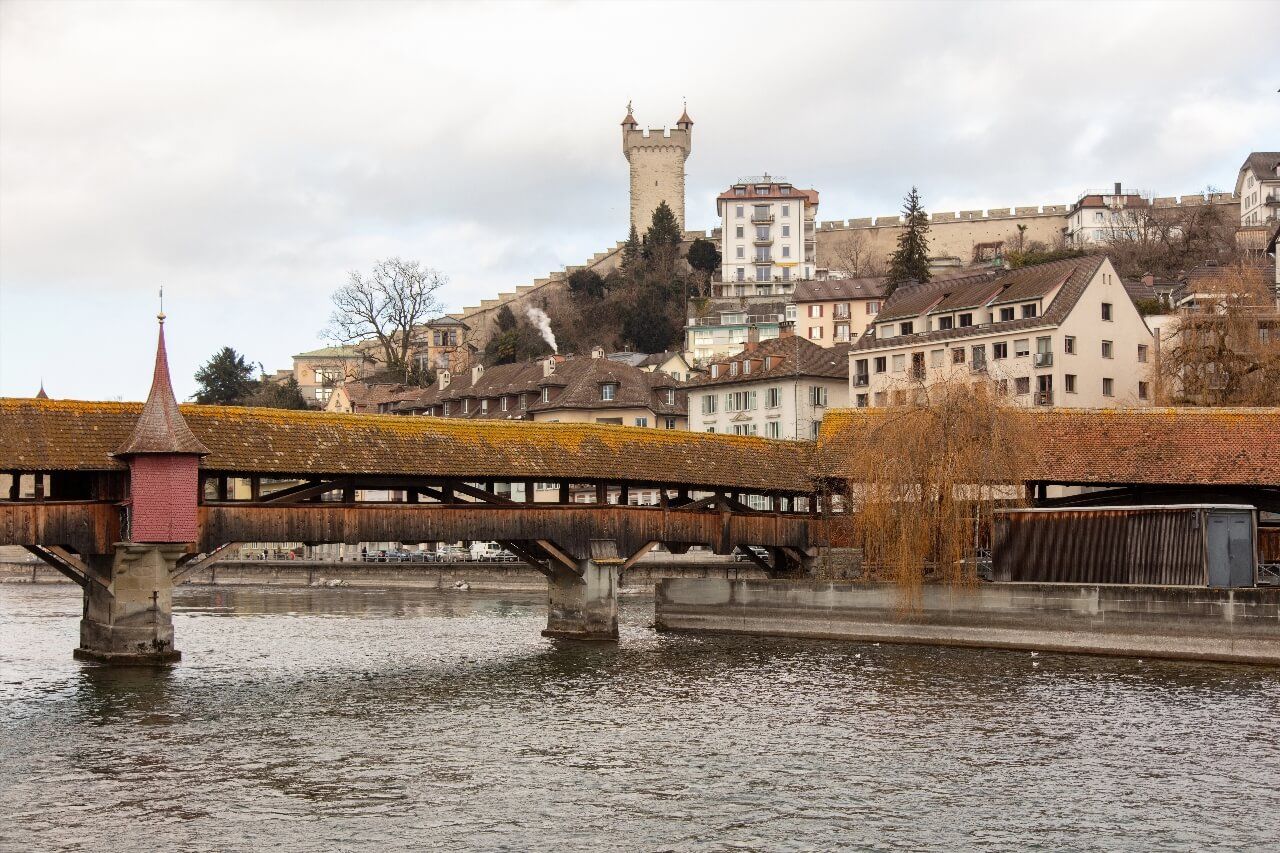
The Spreuerbrücke (Kasernenplatz, 6003 Lucerne, rated 4.7/5 on Google (4 899 avis)) is the other medieval wooden covered bridge in Lucerne and, despite being about 200 metres from the Chapel Bridge, is largely ignored by the tour group circuit. That gives you something Chapel Bridge rarely offers: the experience of a 14th-century painted bridge in near silence.
The paintings here, the Totentanz (Dance of Death) series by Kaspar Meglinger, painted between 1616 and 1637, are darker in subject and better preserved than the Chapel Bridge panels. Each composition depicts Death interrupting a representative of a social class: pope, emperor, knight, merchant, child. The sequence runs the full length of the bridge's interior. The bridge's name ("Chaff Bridge") refers to its original function as the one place where millers were permitted to dump chaff into the Reuss.
11. Tour the Water Tower
The Water Tower (Wasserturm, Rathausquai, 6002 Lucerne) stands at the mid-point of the Chapel Bridge and is one of the city's most photographed silhouettes, octagonal, 34 metres tall, built around 1300 as part of the lakeside defensive wall before the bridge itself was added. The tower has served at various points as an archive, treasury, prison, and torture chamber. It is now owned by the Society of Swiss Officers and occasionally opens for cultural events.
The tower cannot normally be entered, but the best angle is from the Reuss bridge just downstream, looking back toward the bridge-and-tower composition with the old town roof line behind. At night, floodlighting picks out the stone texture and the reflection is the reason this view dominates Lucerne's promotional photography.
12. Visit the Jesuit Church
The Jesuit Church (Jesuitenkirche, Bahnhofstrasse 11A, 6003 Lucerne) was the first large baroque church built north of the Alps, construction beginning in 1666. Its twin towers and the pink and grey stucco interior are a visual shock after the medieval stone of the rest of the old town, inside, the nave ceiling carries a fresco cycle completed in 1761 that covers approximately 750 square metres of vault.
Entrance is free. The church is active for services, so check times before visiting if you want uninterrupted photography. The marble altar (1683) at the far end of the nave is the centrepiece of the composition, framed by pilasters and flanked by figures of Sts Francis Xavier and Francis Borgia. Lucerne's most notable baroque interior sits a five-minute walk from the main station, which makes it an easy stop at the start or end of a day.
The church faces the Reuss on the south bank, cross the nearby Mill Bridge (Spreuerbrücke) afterward for the Dance of Death paintings, and the two experiences pair naturally.
13. Hike the Bürgenstock
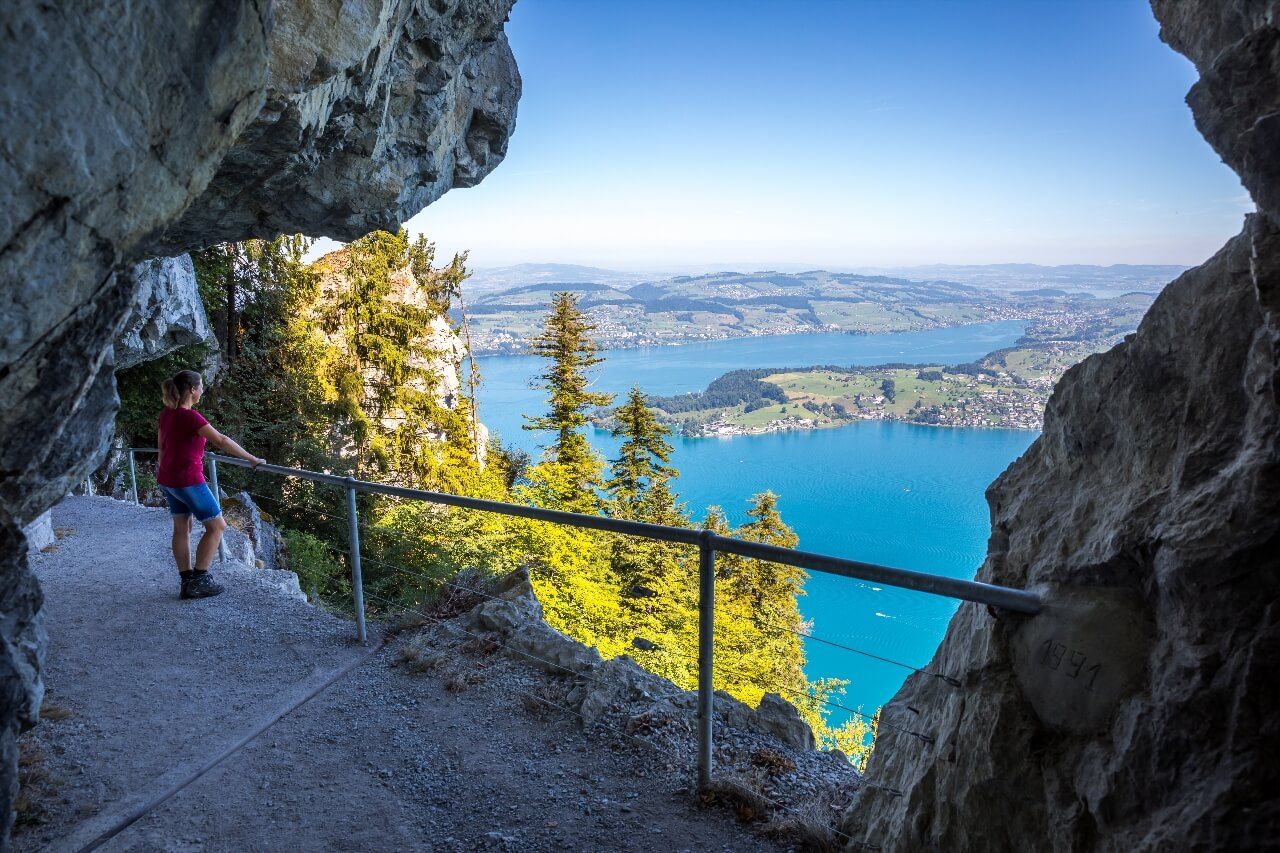
The Bürgenstock (1 128 m) is a narrow limestone ridge rising directly from the eastern shore of Lake Lucerne, roughly 45 minutes by boat from the main pier. It is less famous than Pilatus or Rigi and consequently far less crowded, the trail network above the resort is often empty on weekdays even during summer.
The most dramatic feature is the Hammetschwand Lift, an exterior elevator attached to a cliff face that rises 152 metres in 55 seconds, the highest exterior elevator in Europe, installed in 1905 and still functioning. It deposits you at a viewpoint platform where the lake is visible in both directions, north toward Lucerne, south toward the Urner See arm extending to Flüelen.
The Felsenweg cliff path runs from the lift summit along the ridge for approximately 3 km before descending back to the resort through forest. The full loop, including the lift ascent, takes about 2 hours at moderate pace. The path involves some exposed sections with chains fixed to the rock, comfortable for most walkers, but not suitable for anyone with a serious fear of heights. The Bürgenstock Resort (Bürgenstock Resort, 6363 Obbürgen, rated 4.6/5 on Google (4 641 avis)) has a terrace restaurant at the top if you want lunch before the return boat; book ahead in summer.
Combining the Bürgenstock hike with a lake cruise makes a natural half-day loop: boat out, hike and lift, boat back to Lucerne.
14. Take the Gotthard Panorama Express
The Gotthard Panorama Express is a combined boat-and-train journey from Lucerne south through the Gotthard Massif, considered one of the great scenic train routes in Europe. The route runs Lucerne → Flüelen by boat (2.5 hours, the full southern length of Lake Lucerne) then Flüelen → Lugano by panoramic train through the old Gotthard line, spiral tunnels, stone viaducts, and the Gotthard Road valley carved by glaciers, before descending into the Italian-speaking canton of Ticino.
The journey takes around 5 hours total and operates daily from May to October. Full fare is approximately CHF 85; Swiss Travel Pass holders travel at no additional cost beyond the pass (seat reservation recommended in high season). The panoramic train car windows extend into the roof, giving sightlines that standard trains cannot match on the tunnel approaches.
If you only have one day and want a single long excursion from Lucerne, this route gives you more concentrated landscape variety, lake, mountain pass, valley, and Mediterranean-inflected southern Switzerland, than any single mountain ascent. You can return from Lugano by regular InterCity train through the new Gotthard Base Tunnel (less scenic, 55 minutes) to be back in Lucerne for dinner.
15. Visit the Richard Wagner Museum
Richard Wagner lived in Lucerne from 1866 to 1872, first at the Villa Wesendonck and then at Tribschen, a lakeside villa on a peninsula south of the city where he completed Die Meistersinger von Nürnberg, began Siegfried, and received Nietzsche as a regular visitor. Tribschen is now the Richard Wagner Museum (Richard Wagner Weg 27, 6005 Lucerne), preserving the original rooms along with instruments, scores, and a collection of 19th-century musical automata.
The villa can be reached by boat (Tribschen landing stage) or by a pleasant 20-minute walk along the lakefront path from the old town. The surrounding park and the lakeside terrace are freely accessible; museum admission is CHF 10. Nietzsche described the mornings at Tribschen as the happiest of his life, the letters he wrote during those visits, on display in the museum, make that claim feel plausible rather than hyperbolic.
The museum is small, allow 60 : 75 minutes, and less visited than Lucerne's larger cultural sites, which means staff often have time to discuss individual items in the collection in detail.
16. Explore the Glacier Garden
The Glacier Garden (Gletschergarten, Denkmalstrasse 4, 6006 Lucerne) sits immediately beside the Lion Monument and is consistently underestimated by visitors who treat it as an afterthought to the monument itself. The site preserves the physical evidence of a 20-million-year-old subtropical landscape and the more recent work of Pleistocene glaciers, specifically, 32 glacial potholes (Gletschertöpfe) carved into the limestone bedrock by meltwater between 20 000 and 15 000 years ago, the largest of which reaches 9.5 metres deep and 8 metres wide.
The garden was discovered in 1872 by construction workers excavating a wine cellar, they broke through the ground into a limestone shelf bearing fossilised oysters, coconut palms, and ammonites from a period when central Switzerland lay under a warm sea. The exhibition in the main hall presents the geological sequence from that tropical period through the ice age to the present.
The complex also contains the Mirror Maze, a 19th-century attraction of 90 mirrors that creates a disorienting infinite corridor effect, and an exhibition on Alpine natural history. The combination of profound geological time scales and the slightly eccentric Victorian exhibition atmosphere makes it one of Lucerne's most enjoyable hours. Admission is CHF 18 for adults, with combined tickets available for the Lion Monument's optional paid section. Children consistently rate this among their strongest memories of Lucerne. If you have a Lucerne Visitor Card from your hotel, the Glacier Garden offers CHF 4 off the entry price, and the on-site Sandstone Tower viewing platform (rebuilt in 2021) gives a free upper-level vantage onto the Lion Monument cliff that most visitors miss entirely.
17. Swim or Relax at Lido Lucerne
Lido Lucerne (Lidostrasse 6, 6006 Lucerne, rated 4.4/5 on Google (2 135 avis)) is the city's main public swimming facility on the lake, open from mid-May to mid-September. The site includes a sandy beach area, freshwater pools, a diving tower, and direct access to lake swimming in water that runs 18 : 22°C at peak summer. Entry is CHF 7 for adults; the infrastructure, changing facilities, lockers, restaurant, is maintained to the high standard characteristic of Swiss public facilities.
The Lido sits adjacent to the Swiss Museum of Transport, which makes a natural pairing for a full day: museum in the morning, lunch at the Lido restaurant, afternoon swimming. The lake bottom is visible through the clear water at depths of 3 : 4 metres from the main jetty, a detail that makes lake swimming here feel qualitatively different from most urban bathing venues. Arrive before 11 am on weekends in July and August to find a good spot on the beach section.
18. Attend the Lucerne Festival
The Lucerne Festival runs across three seasons, Easter, Summer (late August to mid-September), and Piano (November), and is considered one of the top five classical music festivals in Europe. The Summer festival draws major orchestras, conductors, and soloists to the KKL Lucerne concert hall for a concentrated programme that typically spans 3 weeks.
The KKL (Kultur- und Kongresszentrum Luzern) was designed by Jean Nouvel and completed in 1998, the main concert hall has an acoustic profile that audio engineers and conductors cite among the best in the world, with a reverberation time tunable between 1.6 and 2.3 seconds depending on concert type. Tickets for the Summer festival range from CHF 30 to CHF 300; many daytime chamber concerts and open rehearsals are priced well below the headline evening events. Check the programme at lucernefestival.ch and book 3 : 4 months in advance for the main orchestra evenings.
19. Browse the Market at Bahnhofstrasse
Bahnhofstrasse (6003 Lucerne) runs along the south bank of the Reuss from the main station toward the old town and hosts one of central Switzerland's most active street market scenes. The Tuesday and Saturday morning fresh produce market extends along the quayside from approximately 7 am to noon, with stalls selling regional cheese, bread, flowers, and seasonal vegetables, local farmsteads from the canton of Lucerne alongside traders from the Emmental and Gruyère.
Separate from the food market, the adjacent Unter der Egg hosts a handicraft and antiques market on selected Saturdays between May and October. The area between the market and the old town bridge provides the best pedestrian loop in the city, from the station along the south quay, across to the north quay via the Chapel Bridge, and back along Rathausquai past the painted houses. This route covers the essential visual programme of the old town in under 40 minutes without entering any paid sites.
20. Try Swiss Cuisine Near the Waterfront
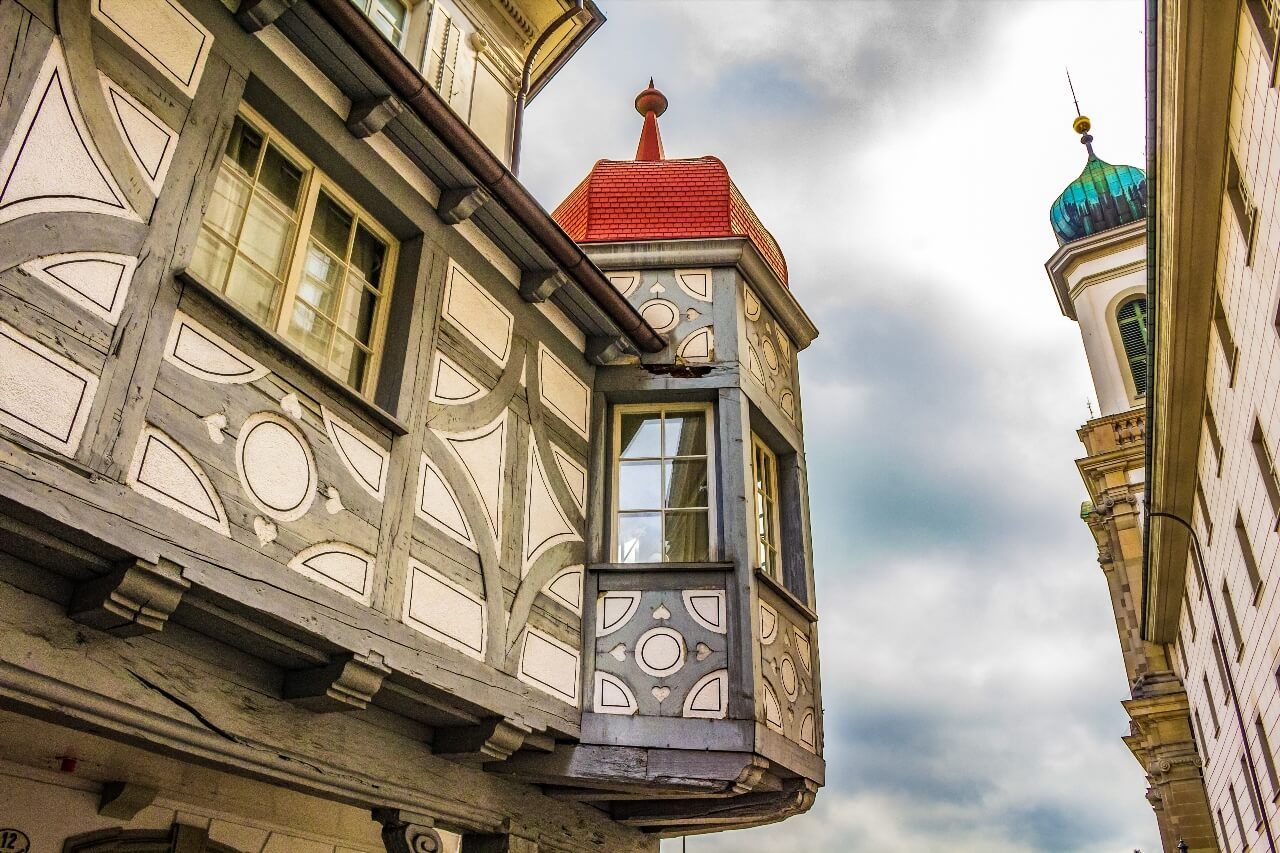
Lucerne's restaurant landscape along the waterfront covers the full spectrum of Swiss regional cooking, with particular strength in the central Swiss traditions that differ from the better-known Zürich or Bernese versions.
Älplermagronen, Alpine macaroni with potatoes, cream, cheese, and fried onions, traditionally served with apple compote, is the central Swiss signature dish and appears on nearly every traditional menu in the city. Restaurant Fritschi (Sternenplatz 5, 6004 Lucerne, rated 4.3/5 on Google (2 213 avis)) near the Sternenplatz has served this dish for over a century; a full portion costs around CHF 24. For fondue in the classic Gruyère style, the establishments along the Rathausquai largely cater to tourist traffic and price accordingly; a better option is Brasserie Bodu on Kornmarktgasse, which serves fondue year-round rather than only in winter.
For something lighter, the Bäckerei Heini chain (multiple locations, main bakery on Hertensteinstrasse) makes the regional speciality Lucerne Leckerli, spiced gingerbread squares with almonds and candied citrus, that has been produced here since the 17th century. Worth picking up a box as an edible piece of local history.
21. Visit the Natural History Museum
The Natural History Museum Lucerne (Kasernenplatz 6, 6003 Lucerne, rated 4.4/5 on Google (424 avis)) is a compact free admission museum housed in the same building complex as the Spreuerbrücke end of the old town. The permanent collection focuses on central Swiss ecology, Alpine flora and fauna, geology, and prehistoric life, with quality dioramas that are significantly better than the museum's modest profile would suggest.
Admission is free on the first Sunday of each month and CHF 9 otherwise. For families with children aged 7 : 12 in particular, the combination of the Natural History Museum and the Glacier Garden (a 10-minute walk away) covers a coherent natural history sequence from deep geological time through to the present-day Alpine landscape. The museum shop stocks a good selection of regional natural history publications in English.
22. Visit Kornmarkt Square and the Clock Tower
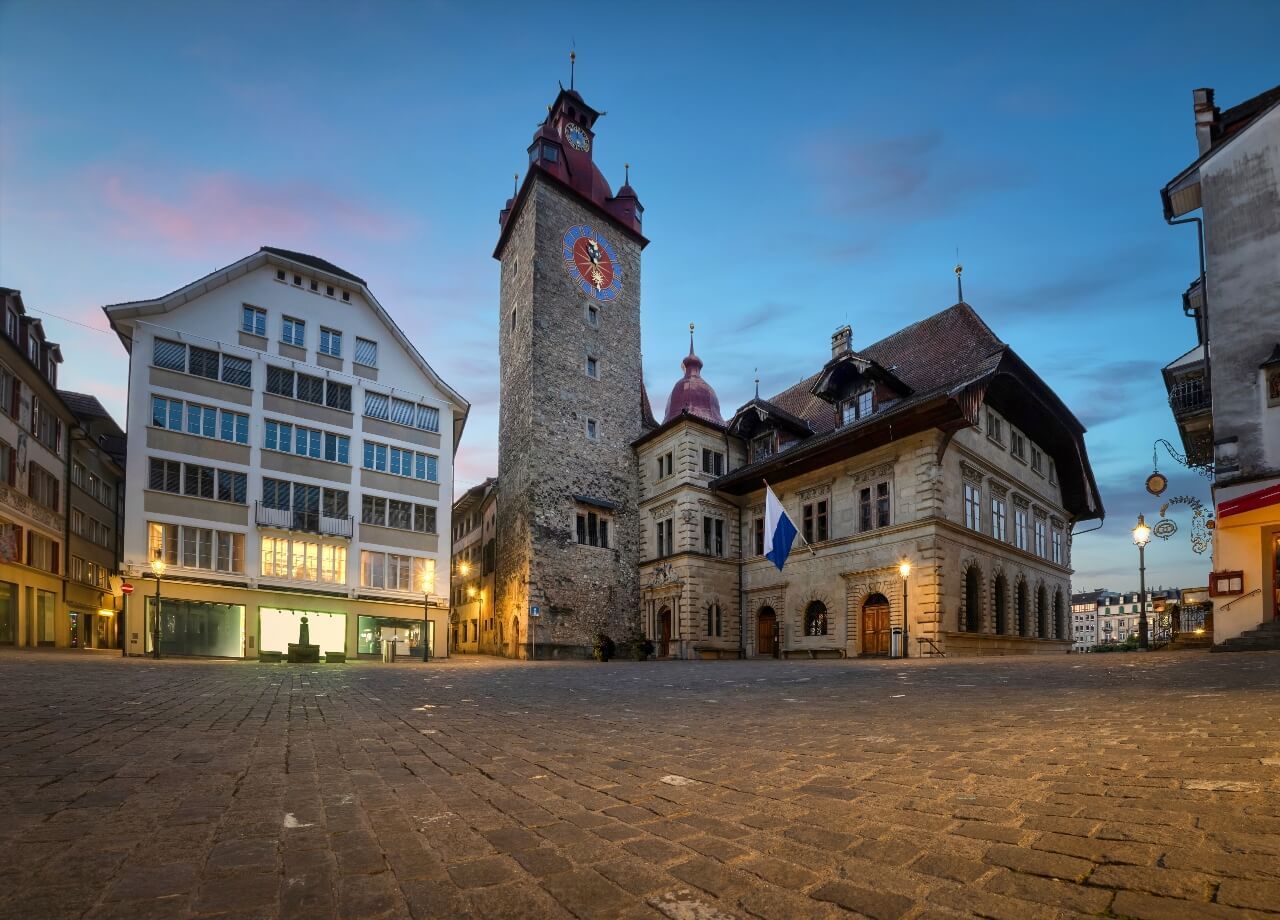
Kornmarkt (Corn Market Square, 6004 Lucerne) is the functional centre of the old town, the point where the north and south quays converge, where the Town Hall faces the river, and where the main pedestrian routes through the Altstadt intersect. The square itself is unremarkable architecturally, but the activity at street level, the flower stalls on market days, the café terraces, the flow of locals through toward the Hertensteinstrasse shopping street, gives it an energy that the more photogenic Chapel Bridge often lacks.
Two minutes south of the Kornmarkt along Kapellgasse, the Clock Tower (Zeitturm) marks what was Lucerne's original city gate before the walls expanded in the 14th century. The tower contains a collection of historic mechanisms and timepieces; it is one of the stops detailed in the Ryo audio exploration The Land of Dragons, which places the tower within the broader narrative of the city's medieval development. The ground floor passageway is open; the upper levels involve a modest entry fee.
23. Take a Day Trip to Engelberg and Titlis
Engelberg is a mountain resort valley 45 minutes by train from Lucerne Central Station (Bahnhofplatz 1, 6002 Lucerne, rated 4.4/5 on Google (7 168 avis)) (direct InterRegio services hourly), sitting at 1 000 metres in a glacial valley beneath the Titlis massif. The town itself, centred on a working Benedictine monastery founded in 1120, is worth half a day before you reach the mountain, but the main draw is the ascent to Mount Titlis (3 238 m).
The cable car system from Engelberg to Titlis includes the TITLIS Rotair, the world's first rotating cable car (since 1992), which makes a full 360-degree rotation during the final 500-metre vertical rise to the summit station. The arrival point includes a year-round glacier walkable on a path cut into the ice, the Cliff Walk suspension bridge (100 metres long, at 3 041 metres altitude), and views into Italy and France on clear days.
Return tickets from Engelberg to Titlis cost around CHF 92; Swiss Travel Pass provides 50% discount. The Engelberg monastery itself has free access to the church and a shop selling the abbey's own cheese, liqueur, and herb products, useful if the mountain is in cloud. Combined train + cable car excursions from Lucerne take a full day to do properly; leave by 9 am.
24. Explore the Bourbaki Panorama
The Bourbaki Panorama (Löwenplatz 11, 6004 Lucerne) houses the largest surviving circular panoramic painting in the world, a 360-degree oil painting, 112 metres in circumference and 10 metres high, depicting the internment of the French Army of the East (the Bourbaki Army) on Swiss soil in February 1871 following their defeat in the Franco-Prussian War. The work was painted by Edouard Castres in 1881 and contains around 4 500 figures.
The experience of entering the panorama room, a circular drum building with a viewing platform at the centre, is architecturally unique. The painting is mounted around the interior at eye level to the painted ground, with a constructed three-dimensional foreground that blends with the painted horizon to eliminate the distinction between object and canvas. The effect is immersive in a way that photograph reproductions cannot capture.
Admission is CHF 14 for adults. An audio guide is included with the ticket and provides commentary on the battle, the humanitarian response (Henri Dunant, who founded the Red Cross, was directly inspired by the Bourbaki crisis), and the individual figures in the painting. Allow 60 : 90 minutes. The Bourbaki sits a three-minute walk from the Lion Monument and Glacier Garden, making all three an efficient afternoon combination.
25. Paraglide Above Lake Lucerne
For those who want to see the lake and the Alpine ring from the air rather than from a summit terrace, tandem paragliding above Lucerne is a well-organised option with launch sites on both Pilatus and Rigi.
The Pilatus launch site at approximately 1 800 metres produces a roughly 20 : 30 minute flight descending to a landing meadow near Kriens, with the lake and old town skyline directly ahead throughout the approach. Several operators, including Air Luzern and Para Center Ringegg, offer tandem flights with certified pilots; prices run CHF 160 : 190 per person. Bookings are weather-dependent and most operators provide same-day or next-morning confirmation. Book the morning slot when thermal conditions are most stable and the lake reflects best in the early light.
FAQ
How many days do you need in Lucerne?
Two days is the practical minimum for seeing the old town properly, completing one mountain excursion (Pilatus or Rigi), and visiting a museum or two. Three days allows you to add a lake cruise, the Glacier Garden, and the Bourbaki Panorama without feeling rushed. Four or five days opens up the longer excursions, the Gotthard Panorama Express to Lugano, a day in Engelberg, and time to simply sit by the lake without checking items off a list.
Is Lucerne expensive?
Lucerne is one of Switzerland's more affordable cities relative to Zürich or Geneva, but Switzerland as a whole is expensive by international standards. Budget CHF 80 : 120 per person per day for food and transport in the city, excluding accommodation. The Lucerne Visitor Card (issued free with most hotel stays) provides free public transport within the city zone and discounts on museums and mountain railways, which can meaningfully offset costs.
What is the best time of year to visit Lucerne?
May, June, and September offer the best combination of settled weather, longer daylight, and fewer crowds than July and August. The mountain views are clearest in autumn (September : October) when summer haze has cleared. December brings the Christmas market on the Franziskanerplatz and the old town bridges lit for the season. The Lucerne Festival's Summer programme in late August is the cultural high point of the year.
Is Lucerne walkable?
The old town core is very walkable, the area bounded by the river, the Musegg Wall, and the lake waterfront can be covered on foot in around 20 minutes. The main attractions outside the old town (Swiss Museum of Transport, Rosengart Collection, Lion Monument, Glacier Garden) are all within a 20-minute walk or a short bus ride. The mountain excursions require boats and cable cars or rack railways, but all depart from central terminals.
Do you need a car in Lucerne?
No. The city's public transport covers all central attractions, and boat services reach the lake excursion points. The SBB rail network from Lucerne Central Station connects directly to the Engelberg valley, the Gotthard route, and the main transfer points for Pilatus and Rigi. A car adds complexity rather than access, parking in the old town is limited and expensive.
Is the Swiss Travel Pass worth it for Lucerne?
For a visit of 3 days or more that includes mountain excursions, yes. The pass covers SBB trains, SGV lake boats, and city buses, and provides 50% discounts on Pilatus, Rigi, and Titlis. A 3-day consecutive pass costs CHF 244 for adults (2026 pricing), roughly equivalent to a Pilatus Golden Round Trip plus two days of boat and train travel. If you plan only city-based activities, the free Visitor Card from your hotel is sufficient.
Lucerne is one of those cities that rewards the traveller who slows down. The mountains, the lake, the medieval streets, and the cultural programme are not competing priorities, they are a single coherent place where each layer makes the others more legible. Start with the Ryo audio guide The Land of Dragons for the old town, pick your mountain for day two, and let the rest of the list fill in around what interests you most. Three days here tends to produce the kind of travel memories that make people come back.