
Créé par Romane, le 14 mai 2026
Votre guide Ryo
© Shutterstock
Bangkok is one of those cities that simply refuses to be summarised. More than 10 million people navigate its streets, waterways and sky-train lines every day, yet visitors keep arriving with the same question: where do you actually begin? The answer is rarely a single temple or a single market, it is a layered accumulation of experiences, from the gold-leaf grandeur of the Grand Palace to a 3 a.m. bowl of boat noodles in a fluorescent-lit alley. To help you navigate it all, the Ryo Bangkok audio guide, part of the broader Ryocity collection of city walks, narrates the old royal district with context that no paper map can replicate.
This guide covers 25 of the best things to do in Bangkok in 2026, the iconic landmarks that genuinely deserve the hype, the neighbourhood dives that most itineraries skip, and the practical details that make the difference between a smooth visit and a sweaty, bewildered one. You'll find a floating market still operating from wooden boats at dawn, a medical museum with preserved human specimens that shocks first-time visitors, a stadium where Muay Thai bouts run nearly every night of the week, and a river island where Bangkok's traffic simply ceases to exist.
1. Wat Phra Kaew & the Grand Palace
No visit to Bangkok begins anywhere else. Wat Phra Kaew, the Temple of the Emerald Buddha, sits within the Grand Palace complex, a 218,400 m² walled city built in 1782 when King Rama I moved the capital across the Chao Phraya River. The two cannot be visited separately; a single ticket (500 baht for foreigners in 2026) covers the entire compound and remains valid for seven days, with one visit to each included site.
The Emerald Buddha itself is smaller than most people expect, carved from a single block of green jasper (not emerald), it stands just 66 centimetres tall, but its significance is immense. It is considered the palladium of the Thai kingdom, and the king himself changes its golden seasonal costume three times a year: once for summer, once for the rainy season, and once for winter. Photography inside the ordination hall is prohibited.
Outside the temple, the surrounding cloister walls are lined with 178 panels of murals depicting the entire Ramakien epic, the Thai version of the Hindu Ramayana. Allow at least 45 minutes for this circuit alone. Hire one of the licensed guides at the entrance if you want the narrative, it transforms the paintings from colourful decoration into a coherent cosmological story.
The Grand Palace buildings themselves, the Chakri Maha Prasat throne hall, the Dusit Maha Prasat pavilion, the Amarin Winichai, are only partially open to visitors, but what is accessible is extraordinary. Dress code is strict: covered shoulders, covered knees, no flip-flops. Sarongs are lent at the gate if needed, but arriving prepared saves queuing time. Go before 9 a.m. to beat both the heat and the tour groups that dominate the space by mid-morning. The official opening window for tourists is 8.30 a.m. to 3.30 p.m., so an early arrival is also a longer one.
2. Wat Pho & the Reclining Buddha
Wat Pho is Bangkok's oldest and largest temple complex, predating the city itself, it was already a place of learning when Rama I developed the site in the 1780s. Its most famous resident is the Reclining Buddha: 46 metres long and 15 metres high, gilded from head to toe, the statue fills an entire building so completely that photographs struggle to capture its scale.
The soles of the feet are the detail most visitors seek out: 108 auspicious characteristics of the Buddha are inlaid in mother-of-pearl across the soles, each panel corresponding to a different quality. The bronze bowls along the inner wall, 108 of them, matching the panels, invite visitors to drop coins, one per bowl, for good fortune.
Wat Pho is also considered the birthplace of traditional Thai massage. The temple still houses a massage school, and you can book a 30-minute traditional massage in the pavilion on the eastern side for around 260 baht, one of the better-value legitimate massages in the city. The complex also contains four large chedis dedicated to the first four Rama kings, each covered in glazed ceramic tiles in distinct colours. Arrive when it opens at 8 a.m.; entry costs 200 baht.
3. Wat Arun, the Temple of Dawn
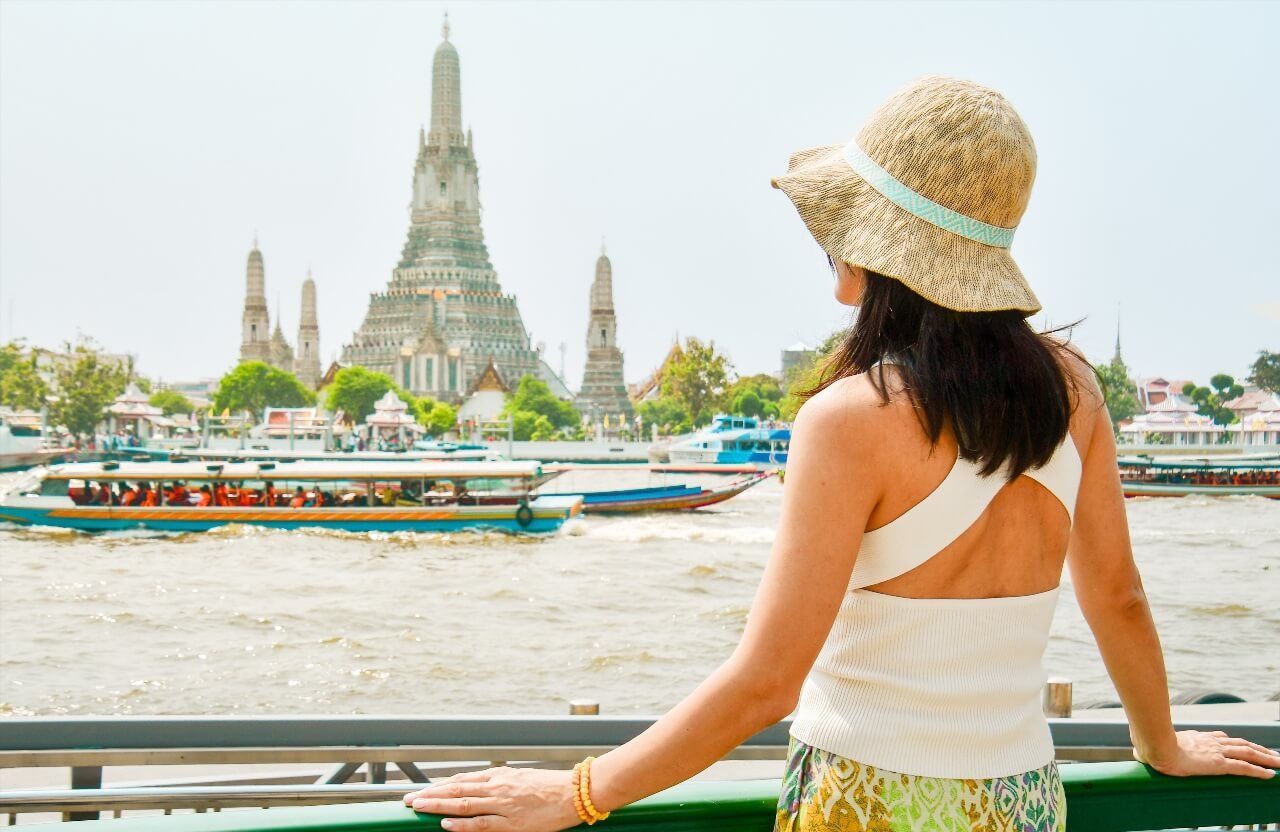
Wat Arun stands on the west bank of the Chao Phraya, directly across from Wat Pho. Its central prang rises approximately 82 metres above the river and is encrusted with millions of fragments of Chinese porcelain and coloured glass, pieces donated by ordinary Bangkokians over the centuries, originally used as ballast in Chinese trade ships.
The best view of Wat Arun is actually from the opposite bank, at dusk, when the ceramic tiles catch the last light in a way that no photograph quite captures. But climbing the steep stairs of the central prang, open to visitors up to the second terrace, gives a perspective across the river and old Bangkok that orientates the entire city. Entry is 100 baht. Cross from the Wat Pho pier by the small cross-river ferry (4 baht each way).
4. Chao Phraya River Cruise
The Chao Phraya River is Bangkok's original highway, and travelling it by boat remains one of the most efficient, and atmospheric, ways to move between the old royal district and the modern city. The express boat service (orange flag, 15 baht flat fare) connects major piers from Nonthaburi in the north to Wat Rajsingkorn in the south, passing Wat Arun, the Grand Palace pier, the Flower Market pier and Asiatique in a single run.
For something more leisurely, the tourist boat (blue flag, 200 baht day pass) stops at nine key piers with an English-language commentary. It runs every 30 minutes from 9 a.m. to 7.30 p.m. The evening dinner cruise industry is large and variable, if you want to eat on the water, Manohra Cruises and White Orchid River Cruise are the more reliable options; avoid unnamed operators offering very cheap packages.
The river at dusk, when cargo barges slide past golden temple spires and the city lights begin to blur in the water, is one of Bangkok's genuinely irreplaceable moments. Build at least an hour of river time into your itinerary regardless of which mode you choose.
5. Chatuchak Weekend Market
With 15,000 stalls spread across 35 acres, Chatuchak is one of the largest markets in the world, and it is only open on weekends. That statistic tends to elicit scepticism until you actually attempt to navigate it. The market is divided into 27 sections, roughly organised by category: antiques, ceramics, clothing, plants, pets, vintage furniture, street food.
Section 26 is a reliable entry point for vintage clothing and local designer pieces. Section 7 covers antiques and collectibles, old Thai ceramics, Buddha amulets, vintage film cameras, pressed tin signs. The plants section (Section 2-4) is remarkable even if you cannot take anything home: orchids sold by the tray for a few hundred baht, bonsai that have been tended for decades.
Arriving early matters here. By 11 a.m. on Saturdays, the aisles between stalls in the more popular sections become genuinely difficult to move through. The serious buyers, both local antique dealers and international wholesale buyers, arrive at 8 a.m. The market officially opens at 9 a.m. on Saturdays and Sundays, closing at 6 p.m., and the official tally of weekend visitors regularly exceeds 200,000 people.
The food zone along the eastern boundary (near the Mo Chit BTS exit) functions as a proper street food market independently of the shopping. Kuay tiew reua (boat noodles), grilled pork skewers, mango sticky rice and fresh coconut water are all available from vendors who have held the same spot for years. Bring cash, most stalls are cash only, and wear the least amount of clothing you can get away with. The covered aisles are hot.
6. Khao San Road
Khao San Road divides opinion sharply among travellers. It is loud, commercially aggressive and almost entirely oriented toward tourists. It is also one of the most energetic streets in Southeast Asia, and dismissing it entirely means missing something genuinely singular.
The strip itself runs barely 400 metres, but the surrounding Banglamphu neighbourhood extends the atmosphere considerably, Rambuttri Road one block north is the quieter, slightly more local version of the same scene. During the day, Khao San functions as a logistics hub: bookshops selling used novels in every language, travel agencies offering bus and boat tickets, street food vendors doing brisk trade in pad thai and fruit shakes. After dark, the volume increases substantially.
The real value of Khao San Road lies in the Banglamphu neighbourhood around it. The Phra Arthit area along the river, three minutes' walk away, has independent cafés, second-hand bookshops and a genuinely local evening market. Khao San is where you absorb the backpacker-meets-Bangkok atmosphere; Banglamphu is where you find the neighbourhood that existed before the backpackers arrived. The Ryo Bangkok Ryocity walking route deliberately skirts this stretch, threading the old royal district instead, so think of Khao San as a separate evening detour rather than part of the historic walk.
7. Damnoen Saduak Floating Market
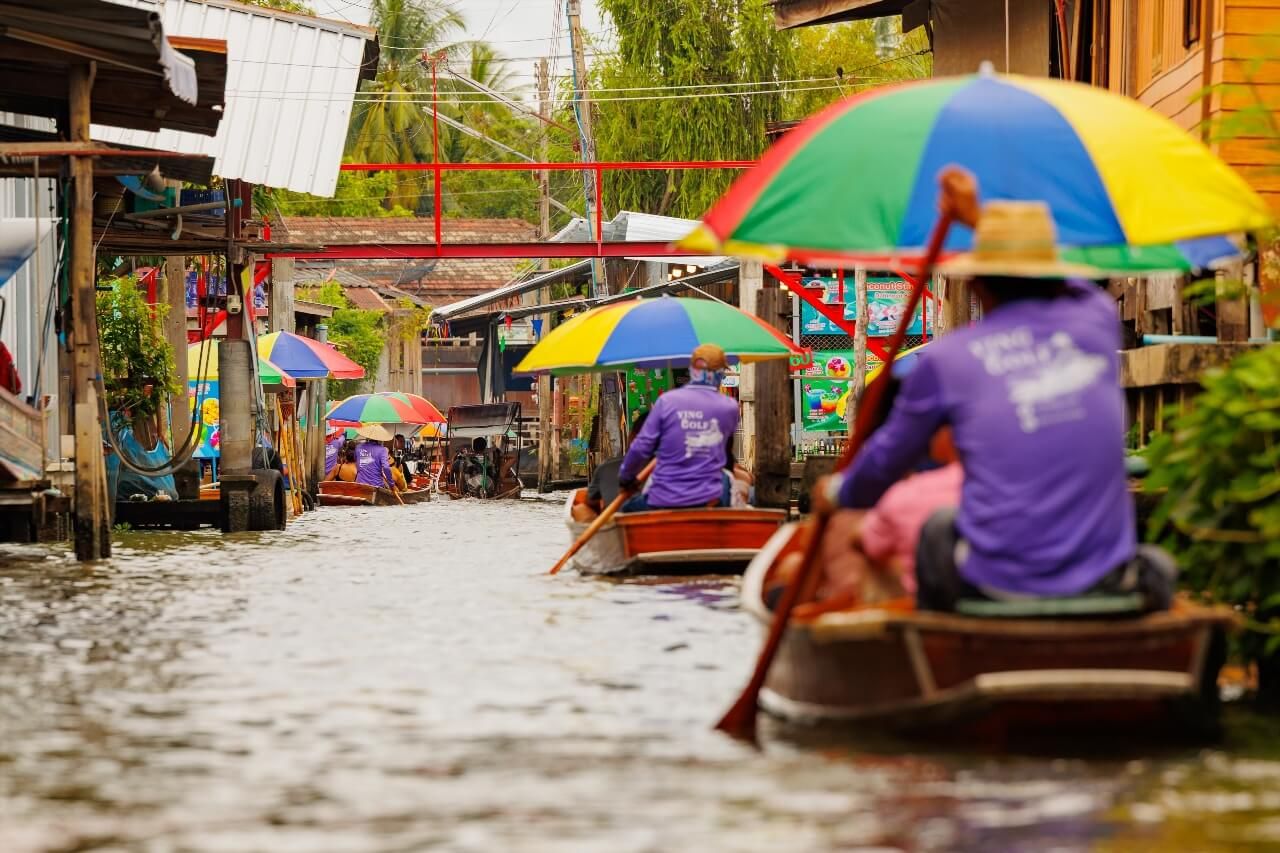
The most photographed image of Thailand, a wooden boat piled with tropical fruit, a vendor in a wide-brimmed hat navigating narrow canals, comes from Damnoen Saduak (Damnoen Saduak, Ratchaburi 70130, rated 3.8/5 on Google (34 034 avis)), located 100 kilometres southwest of Bangkok in Ratchaburi province. Yes, it is a day trip. Yes, it is heavily touristed. And yes, the boats are still there at dawn, still operated by locals, still genuinely photogenic.
The trick is timing. By 9 a.m., tour minibuses have disgorged their passengers onto the wooden walkways and the market tips from atmospheric to crowded. Aim to arrive by 7.30 a.m., hire a longtail boat from the main pier (around 500-800 baht for a 30-minute circuit) and you will find vendors working the canal system before the main crowds arrive. The canal boat circuit passes through narrower channels where vendors from stilted houses sell fresh-made coconut pancakes, pomelos and mangosteen from the water.
Ampawa Floating Market, 45 kilometres from Bangkok in Samut Songkhram, is the less-touristed alternative, it operates on weekends and public holidays from Friday afternoon, and the firefly boat tours on the Mae Klong River after dark are worth the trip alone.
8. Jim Thompson House
Jim Thompson House (6 Soi Kasemsan 2, Rama 1 Road, Pathumwan, Bangkok 10330, rated 4.5/5 on Google (16 949 avis)) is one of Bangkok's most unusual attractions: a collection of six traditional Thai houses assembled by American silk entrepreneur Jim Thompson in the 1960s and now preserved as a museum surrounded by an unlikely garden in the middle of the Silom business district.
Thompson arrived in Bangkok after World War II, recognised the quality of Thai silk weaving, and built an international business that put Thai silk on the global map. In 1967, he disappeared without trace during a walk in the Cameron Highlands of Malaysia, one of Asia's enduring mysteries. The six teak houses were bought from various locations and reassembled on the canal, their interiors left largely as Thompson arranged them: 17th and 18th century Chinese porcelain, Thai antiques, Burmese carvings, paintings from the Ayutthaya period.
Guided tours run every 20 minutes and are included in the 200 baht entry fee. The garden café is a legitimate refuge from the midday heat. Combined tickets are available with the Jim Thompson Art Center nearby, which holds rotating contemporary exhibitions.
9. Lumphini Park
In a city that can feel relentlessly commercial and vertical, Lumphini Park (Rama IV Road, Lumphini, Pathumwan, Bangkok 10330, rated 4.5/5 on Google (40 049 avis)) offers something genuinely different: 57 hectares of green space in the centre of Bangkok, bordered by Silom and Sathorn roads, with a central lake where paddle boats are rented by the hour.
The park operates a particular kind of Bangkok logic. Between 5 a.m. and 7 a.m., it belongs to the joggers, the tai chi groups, the aerobics classes organised on the grass, and the older residents who arrive with folding chairs. By 9 a.m., it shifts to families and couples. In the late afternoon, the aerobics groups return, often dancing to pop music on outdoor sound systems. It is an entirely local experience with no entry fee.
Between November and April, monitor lizards, some exceeding 2 metres in length, emerge from the undergrowth to sun themselves near the lake. They are a genuine, slightly unnerving presence. The park also hosts a weekend book fair each March and open-air concerts on selected evenings; check the Bangkok Metropolitan Administration calendar for current programming.
10. Chinatown, Yaowarat Road
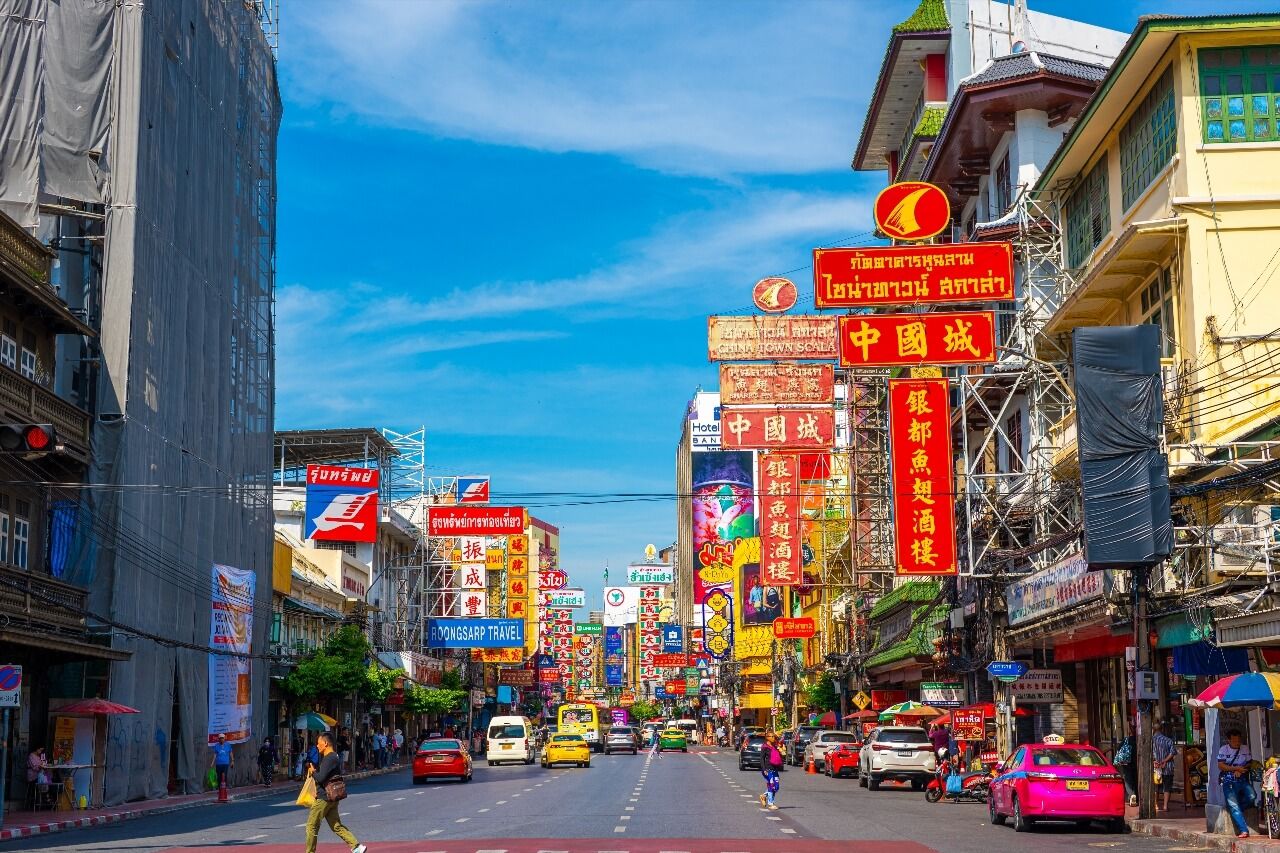
Bangkok's Chinatown, centred on Yaowarat Road, has been a commercial district since the 18th century, when the Chinese community relocated here during the construction of the Grand Palace. The street itself is barely 1.5 kilometres long, but the density of activity, gold merchants, dried seafood vendors, medicine shops, neon signs in Chinese script, makes it one of the most intensely atmospheric neighbourhoods in any city in Asia.
During the day, Yaowarat is primarily a commercial district: gold shops where Thai families buy jewellery as investment (the gold price boards are updated in real time, visible from the street), medicinal herb shops with wooden drawers floor to ceiling, wholesalers of dried shrimp and cuttlefish whose smells announce themselves from the adjacent sois. The Tang To Kang gold shop, operating since 1951, is worth noting as a landmark.
At night, Chinatown transforms. Street food vendors colonise both sides of Yaowarat Road from around 6 p.m.: khao man gai (poached chicken rice), hoy tod (crispy oyster omelette), poo pad pong karee (crab in yellow curry), and the famous guay jub (rolled rice noodle soup with pork offal) from vendors who have operated from the same patch of pavement for decades. The density of eating options per metre rivals anywhere in the city. Arrive by 7 p.m. on weekdays to secure a table at the street-side seafood restaurants before the evening rush. On weekends, walk-up availability disappears by 8 p.m.
The cross-streets off Yaowarat, particularly Soi Nana (not to be confused with the Sukhumvit Nana), have become a creative district with independent bars, concept shops and venues like the Tep Bar, which serves traditional Thai herbal spirits alongside live traditional music.
11. Siam Square & Bangkok's Shopping Malls
Bangkok's shopping infrastructure is genuinely world-class, concentrated around Siam BTS station in a cluster of malls that collectively represent the largest retail area in Thailand. Siam Paragon (991 Rama I Road, Pathumwan, Bangkok 10330, rated 4.5/5 on Google (61 832 avis)) (open 10 a.m. to 10 p.m.) houses a full-scale aquarium in its basement, a multiplex cinema, and a luxury retail floor; CentralWorld next door covers 550,000 m², making it one of the largest shopping centres in the world.
MBK Center, a few minutes' walk west, operates on a different model: a multi-storey market-style mall where individual vendors rent small booths, selling everything from phone accessories and copy goods to legitimate local fashion. The food court on the sixth floor is one of the better-value eating options in the Siam area. For those interested in Thai design, Siam Discovery has been re-oriented around Thai creative industries and local designers.
12. Siriraj Medical Museum
Of Bangkok's many museums, the Siriraj Medical Museum (2 Wanglang Road, Wang Lang, Bangkok Noi, Bangkok 10700, rated 4.3/5 on Google (482 avis)) on the grounds of Siriraj Hospital is the one most likely to stay with you. Located across the river in Thonburi, the complex of six specialist museums covers forensic pathology, parasitology, anatomy and, most notoriously, a preserved collection of criminal specimens including the remains of Si Quey, a convicted serial killer whose body was preserved and displayed in the 1950s as a deterrent.
This is not entertainment for the squeamish. The forensic museum contains preserved organs, real criminal evidence from Thai court cases, and detailed documentation of causes of death, displayed with a clinical directness that reflects a different cultural attitude toward mortality than most Western visitors are accustomed to. The parasitology museum is equally graphic.
The museum complex is genuinely educational and used by Thai medical students. Entry costs 200 baht per museum. Go on a weekday when school groups are less prevalent; take the cross-river ferry from Chang Pier (Wang Lang Pier, 4 baht) rather than navigating the hospital by road.
13. Erawan Shrine
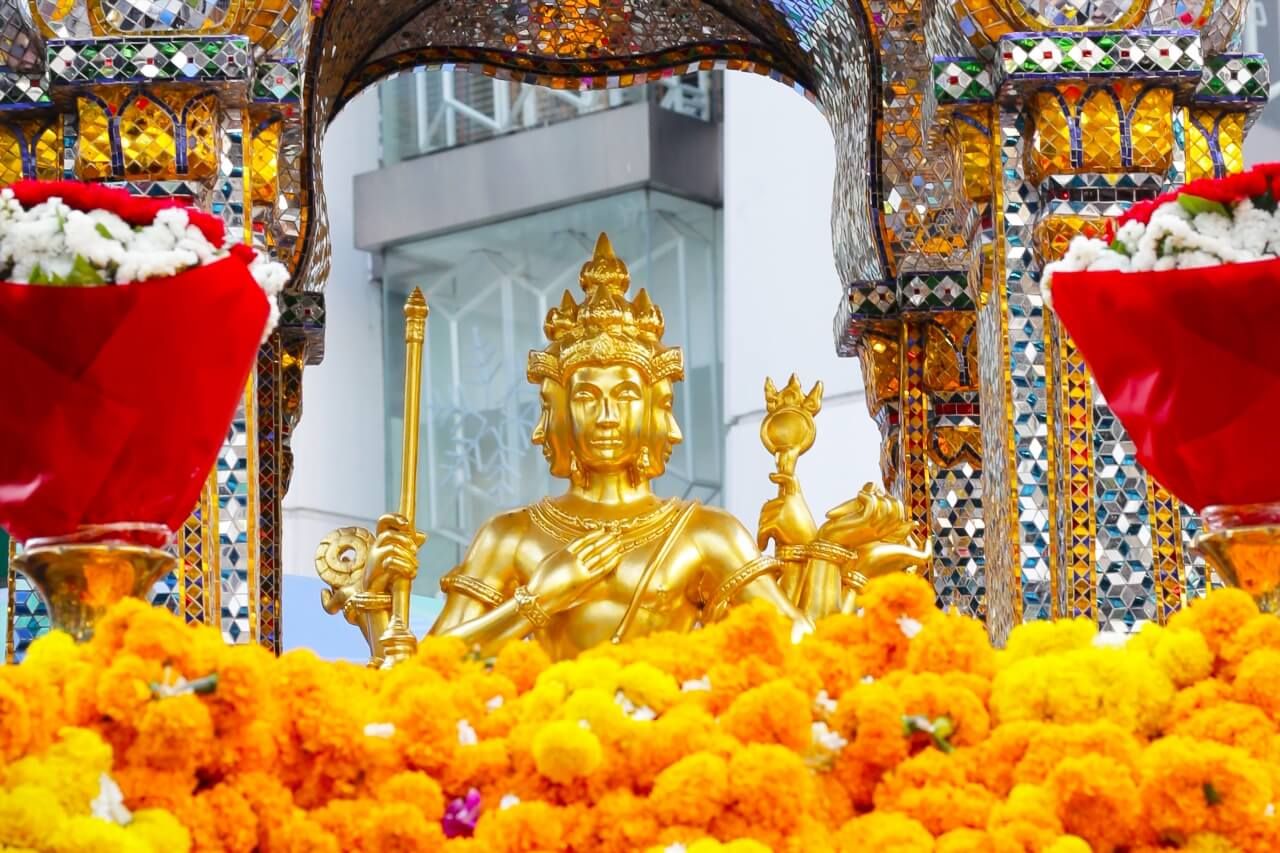
Erawan Shrine (494 Ratchadamri Road, Lumphini, Pathumwan, Bangkok 10330, rated 4.7/5 on Google (6 762 avis)) stands at one of Bangkok's busiest intersections, the corner of Ratchadamri and Ploenchit roads, in the shadow of the Grand Hyatt Erawan hotel, and yet manages to function as a place of genuine religious observation in spite of the surrounding commercial chaos.
The four-faced Brahma deity (Thao Maha Phrom) is believed to grant wishes, and the shrine operates around the clock. Traditional Thai dancers are hired by worshippers whose wishes have been granted to perform as an offering, watching this transaction, the exchange of a wish fulfilled for a commissioned dance performance, is one of Bangkok's small but memorable scenes. The shrine itself was originally erected in 1956 to ward off the bad luck that had reportedly plagued the construction of the adjacent hotel, and it has remained one of the city's most-visited devotional sites ever since. It is free to visit; offerings of marigolds and incense are available from vendors on-site.
14. Rooftop Bars, Vertigo, Sky Bar & Octave
Bangkok's skyline is engineered for this experience. The city's density and flat topography mean that a rooftop bar at the 50th floor commands an unobstructed panorama that cities with natural geography rarely permit. Three venues stand out in 2026.
Vertigo and Moon Bar (Banyan Tree Bangkok, 21/100 South Sathorn Road, Sathorn, Bangkok 10120, rated 4.3/5 on Google (4 363 avis)) on the 61st floor of the Banyan Tree Bangkok is the most established of the high-altitude venues, open-air, genuinely at altitude, with views across the entire central district. Minimum spend applies (around 600-800 baht per person), but the experience justifies the cost.
Sky Bar at the lebua at State Tower (floors 63-64) is the more famous venue, partly because of its appearance in the film «The Hangover Part II», which has made it one of the most photographed bar locations in Asia. The Dome complex includes multiple restaurants and bars on the same level. Dress code is enforced: smart casual minimum, no shorts, no flip-flops. Cocktails start at around 600 baht.
Octave Rooftop Lounge at the Marriott Sukhumvit (floors 45-49, on three levels) is the most accessible of the three, no strict dress code, prices closer to street-level Bangkok, and the multi-level design means there is usually somewhere to stand even when busy. The views east and north over the Sukhumvit corridor are different from the Silom-area rooftops but equally impressive after dark.
For all three: arrive at opening time (typically 5-6 p.m.) to secure a position before sunset. After 8 p.m., queuing is common at weekends.
15. Muay Thai at Rajadamnern Stadium
Muay Thai, the art of eight limbs, using fists, elbows, knees and shins, is Thailand's national sport and one of the most technically sophisticated striking arts in the world. Watching a professional bout at Rajadamnern Stadium (1 Ratchadamnoen Nok Avenue, Pom Prap Sattru Phai, Bangkok 10100, rated 4.8/5 on Google (8 403 avis)) is a different experience from the tourist-oriented shows near Khao San Road: the stadium draws genuine fans, the bouts are serious competitive fights, and the atmosphere, the circular betting that happens in the standing area, the rhythmic wai kru ceremony before each bout, the traditional sarama music played throughout, is specific to this context.
In 2026, Rajadamnern has expanded to fight cards nearly every night of the week, with the flagship Rajadamnern World Series (RWS) running every Saturday from 7 p.m. and standard cards on most other nights from around 6 p.m. Tickets range from 3,000 baht for ringside to 1,500 baht for the upper stand. The upper-stand tickets offer the better view of the full ring geometry; ringside is for those who want to be physically close to the action. Check the current week's schedule on rajadamnern.com before you commit, as the line-up rotates regularly.
Lumpinee Muay Thai Stadium (the newer venue north of the city) is the other established option and hosts its own programme of fights, including some of the international ONE Championship cards. Both stadiums are legitimate; Rajadamnern has the longer history and more central location. Shows typically run from 6.30 p.m. to 10 p.m., covering eight to ten bouts of escalating status.
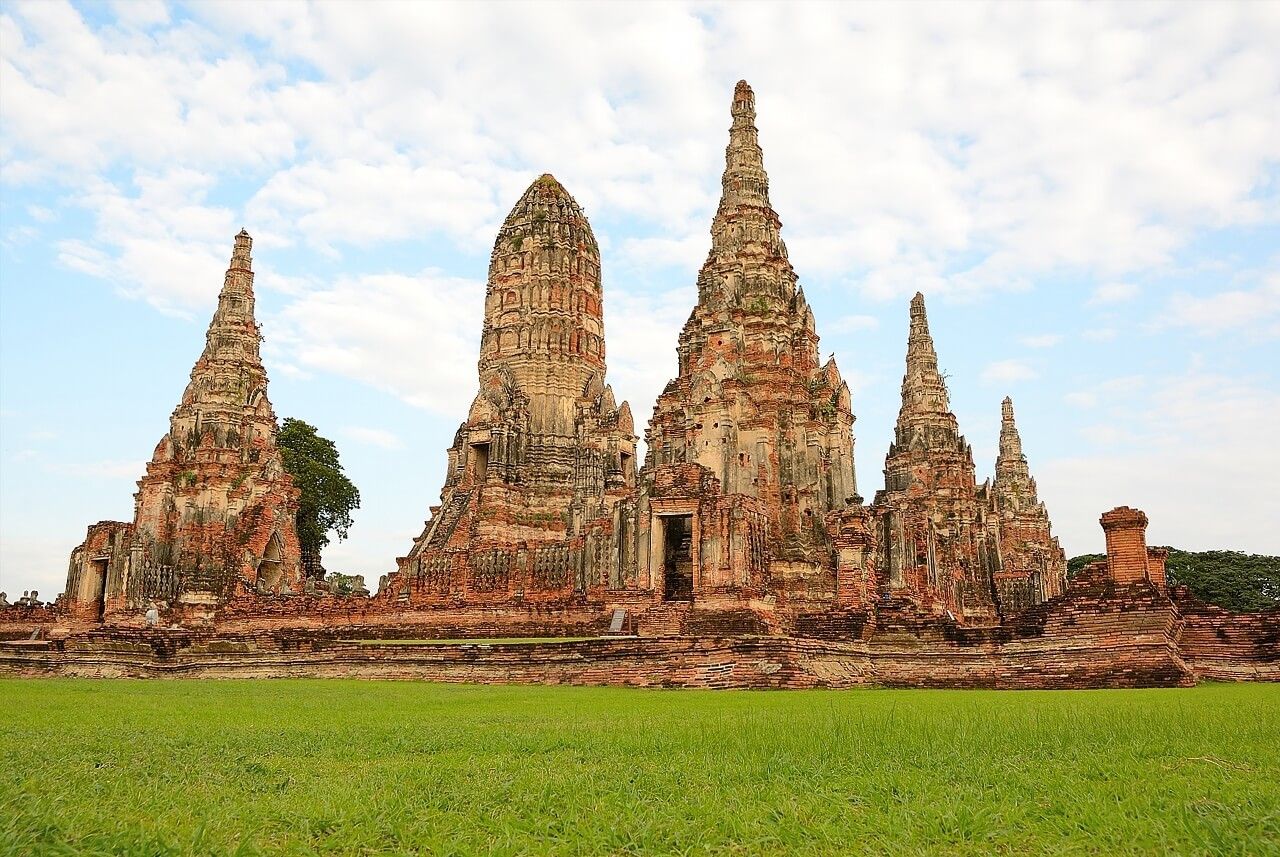
16. Ayutthaya, Day Trip from Bangkok
Ayutthaya was the capital of the Kingdom of Siam for 417 years, from 1351 to 1767, and at its peak was one of the largest and most cosmopolitan cities in Asia, described by French diplomat Simon de la Loubère as larger than London. The Burmese army destroyed it in 1767, and what remains are the ruins of a civilisation: headless Buddha statues, overgrown brick prangs, the remnants of temples that once rivalled Angkor Wat. The site is now inscribed on the UNESCO World Heritage list.
The journey from Bangkok takes 1.5 hours by train from Hua Lamphong station (trains depart every hour, from 30 baht) or about the same by minivan from Victory Monument. The historical park covers the island in the middle of the three rivers that once protected the city; renting a bicycle from the guesthouses near the station (60-100 baht per day) is the standard way to navigate between sites.
The key ruins: Wat Phra Si Sanphet (the royal temple of the Ayutthaya kings, its three restored chedis the most photogenic composition in the park), Wat Mahathat (where the famous Buddha head embedded in tree roots sits, photography is permitted only from a respectful distance), Wat Chaiwatthanaram (best viewed from the west bank of the river, particularly at sunset). Entry to each site is 50 baht separately; a combined pass covers the main ruins.
Ayutthaya repays more than a half-day. The Chao Sam Phraya National Museum houses artefacts recovered from the ruins, including genuine Ayutthaya-period gold jewellery found in the crypts of the royal temples. The night food market near Hua Raw pier, operating from 5 p.m., is the reason to time your return journey for after dark.
17. Klong Saen Saeb Canal Boats
The Klong Saen Saeb canal boat service is not a tourist attraction, it is the working commuter network used by hundreds of thousands of Bangkok residents daily, running east-west across the city from the Golden Mount to the Ramkhamhaeng area in a journey of 18 kilometres that would take an hour by road in traffic.
Boats run every 5-10 minutes from early morning to late evening. Fares range from 10 to 20 baht depending on distance. The boats are fast, the canal is pungent (hold your breath near the motor), and the experience of travelling past the back walls of Bangkok's neighbourhoods, washing lines, temple compounds, street-level commerce glimpsed from the water, is entirely unlike the Chao Phraya tourist experience. There is a particular etiquette to boarding: the boat barely stops, you step on and off in seconds, and the conductor walks the gunwale collecting fares regardless of whether the boat is moving. Get off at Asok pier for Sukhumvit and the BTS connection, or at Pratunam for the wholesale fashion market.
18. Benjakitti Forest Park & Benjakitti Park
Benjakitti Forest Park (Ratchadaphisek Road, Khlong Toei, Bangkok 10110, rated 4.6/5 on Google (10 680 avis)), which opened fully in 2022 after years of development, adds approximately 72 hectares of green space in the Sukhumvit corridor, an area of Bangkok that previously had almost no large parks. The forest park is an extension of the older Benjakitti Park and sits on reclaimed land from the former Thailand Tobacco Monopoly site.
The design incorporates wetland areas, elevated walkways through tree canopy and cycling tracks that make it one of the most sophisticated urban parks in Southeast Asia. The 1.67 km elevated skywalk, which threads above the wetlands at treetop height, has become a destination in itself. Free entry. Best in the early morning when mist sits over the water features and Bangkok's characteristic golden light makes everything look better than it is. The adjacent Benjakitti Park has pedal boats on a central lake.
19. Bangkok Art & Culture Centre
Bangkok Art & Culture Centre (939 Rama I Road, Wang Mai, Pathumwan, Bangkok 10330, rated 4.6/5 on Google (20 267 avis)) (BACC) occupies a large building adjacent to the National Stadium BTS station and functions as the principal public contemporary art space in the city. Entry is free to the permanent galleries; temporary exhibitions occasionally charge.
The building's ramp-style interior, which spirals up around a central atrium, was modelled loosely on New York's Guggenheim and houses gallery spaces on multiple floors alongside independent bookshops, arts-focused cafés and design retailers. The quality of exhibitions varies, BACC is sometimes criticised for uneven programming, but the building itself is worth entering as evidence that Bangkok has sustained a serious contemporary art scene since the mid-2000s. The ground-floor café is also a useful, air-conditioned base if you are working through a Siam-area afternoon and want somewhere quiet to recalibrate.
20. Pak Khlong Talat, the Flower Market
Pak Khlong Talat is Bangkok's wholesale flower market, operating 24 hours a day, 365 days a year, at the southern end of Yaowarat near the Memorial Bridge. It supplies the city's temples, hotels, restaurants and ceremonies with cut flowers, which means its busiest hours are between midnight and 4 a.m., when vendors from across the central plains arrive to deliver and buyers come to stock up before the day begins.
Visiting at 2 a.m. sounds extreme but is entirely safe and completely absorbing: the market at that hour is a working wholesale operation, not a curated experience. Orchids sold by the box for 40 baht, marigold garlands stacked a metre high, jasmine strings being assembled by hand in the half-light. Bring a camera, wear clothes you don't mind getting damp, and avoid blocking the paths of workers moving product.
The adjacent vegetable and produce market runs on the same schedule. The combination of the two, operating in the middle of the night under the arches of the old trading district, is one of those Bangkok experiences that has no parallel in other cities.
21. Asiatique the Riverfront
Asiatique the Riverfront (2194 Charoen Krung Road, Wat Phraya Krai, Bang Kho Laem, Bangkok 10120, rated 4.4/5 on Google (73 215 avis)) occupies a 40,000 m² former dock complex on the Chao Phraya's east bank, converted into an open-air shopping and dining complex that operates from 5 p.m. to midnight. The setting, brick warehouses, Ferris wheel, river frontage, Bangkok's skyline across the water, is designed for atmosphere rather than bargain hunting.
The shopping covers the same ground as Chatuchak but at higher prices and in a more comfortable environment, Thai fashion, handicrafts, leather goods, souvenir-grade lacquerware. The food options range from legitimate Thai restaurants to international chains. The Joe Louis Theatre within the complex offers traditional Thai puppet shows (hun krabok) most evenings, this form of performance puppetry is increasingly rare and worth attending if the schedule aligns. A free shuttle boat runs from Sathorn Pier every 30 minutes from 4 p.m.
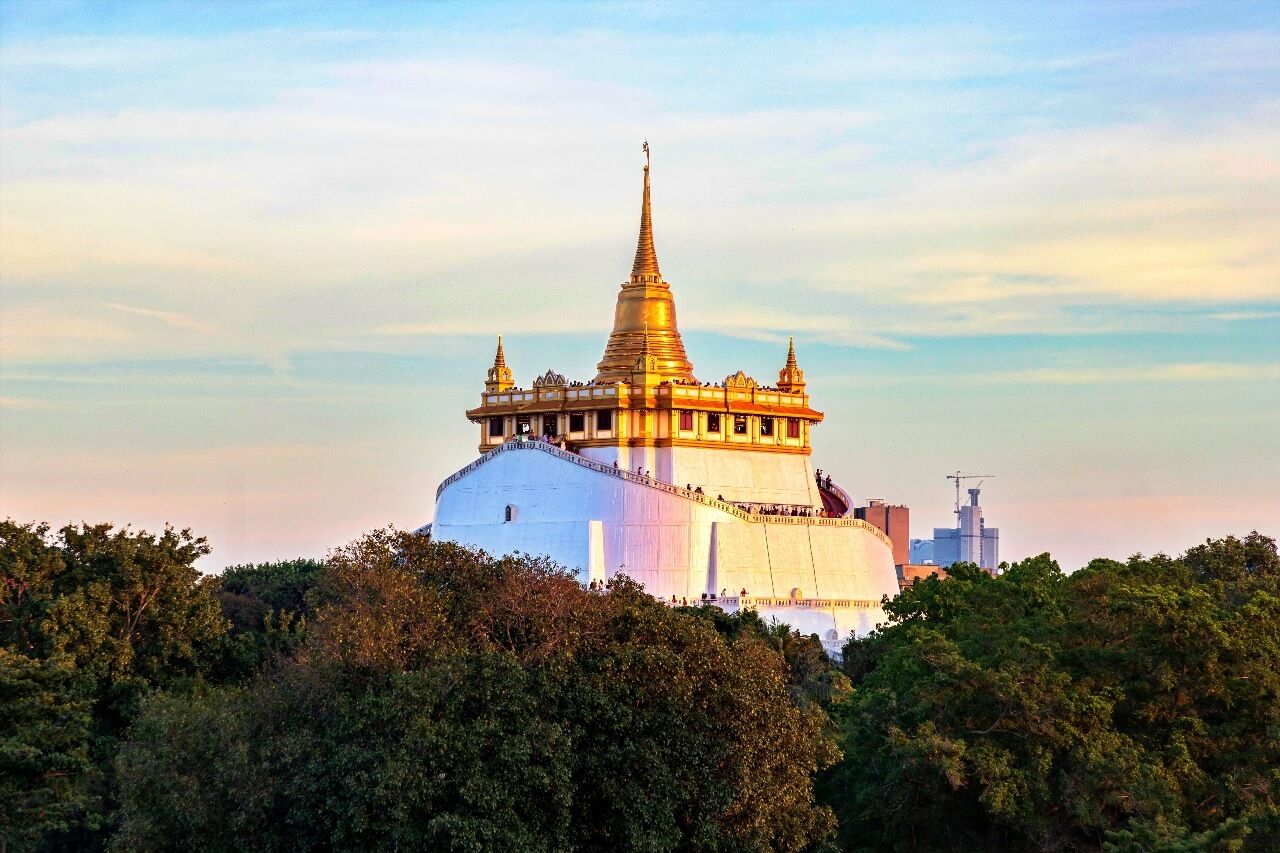
22. Wat Saket, the Golden Mount
Wat Saket is one of Bangkok's most undervisited major temples, partially because the 344 steep steps required to reach the top deter casual visitors, and partially because it lacks the immense scale of Wat Pho or the gold-leaf grandeur of Wat Phra Kaew. This is precisely what makes it worth climbing.
The Golden Mount, a man-made hill built from the rubble of a collapsed royal stupa, rises around 80 metres above the surrounding Banglamphu neighbourhood. The climb winds through a terraced garden of trees hung with prayer bells and coloured flags. At the top, the 360-degree view over Bangkok includes Wat Pho to the south, the Grand Palace and Wat Arun toward the river, and the Banglamphu neighbourhood directly below. The relics of the Buddha are enshrined in the chedi at the summit. Entry is 50 baht. Arrive at dusk, the light on the surrounding temples from this vantage point, as the orange haze of Bangkok's sky deepens, is one of the city's better-kept visual secrets. The annual temple fair, held in November around Loy Krathong, draws crowds the rest of the year never sees, so if your dates align, treat it as a separate event rather than a regular visit.
23. Silom & Bang Rak Neighbourhood
Silom Road (Silom, Bang Rak, Bangkok 10500, rated 4.1/5 on Google (5K avis)) by day is Bangkok's financial centre, offices, banks, the Stock Exchange. By night, it becomes something more complicated: Patpong (the famous red-light district that also houses a night market selling fake goods) sits on two sois off the main road, while a few blocks east, the Silom Soi 4 bar strip is a long-established LGBTQ+ venue.
What most visitors miss is the Bang Rak neighbourhood between Silom and the river, a district of old shophouses, Portuguese-influenced architecture from the 18th and 19th centuries, the oldest Catholic church in Bangkok (Assumption Cathedral, built 1821), and the river-facing lanes where the original farang (foreign) trading community established itself. Charoen Krung Road, the oldest paved road in Bangkok, runs through this area and connects to the old customs house and the Oriental Hotel (now Mandarin Oriental), which has been receiving guests since 1887. This is the corridor the Ryo Bangkok Ryocity audio walk extends into for travellers who finish the royal-district loop and want to keep going.
24. Thai Cooking Class
Learning to cook Thai food in Bangkok is one of those activities that sounds like a tourist cliché until you actually do it, the density of information conveyed in a four-hour class at a serious school compresses what would take months of casual eating to understand. The balance of fish sauce, lime, sugar and chilli in a pad krapao; the difference between nam prik pao (roasted chilli paste) and nam prik gaeng (fresh curry paste); the timing sequence of a stir-fry in a carbon-steel wok over a gas flame strong enough to produce genuine wok hei, these are not things learned from a recipe book.
Silom Thai Cooking School (68 Silom Soi 13, Silom, Bang Rak, Bangkok 10500, rated 4.9/5 on Google (942 avis)) (classes from 1,000 baht) includes a morning market visit to source ingredients and covers five dishes in a half-day. Blue Elephant Cooking School on South Sathorn Road (classes from 2,800 baht) is the premium option, smaller groups, royal Thai cuisine repertoire, a building worth seeing regardless of whether you cook. Both provide printed recipe cards in English.
The class typically includes a market visit, an explanation of core Thai ingredients and their sourcing, the cooking session itself, and eating what you have made. The lunch that concludes a morning class at either school is, by that logic, both the freshest and the most contextually understood meal of your entire trip.
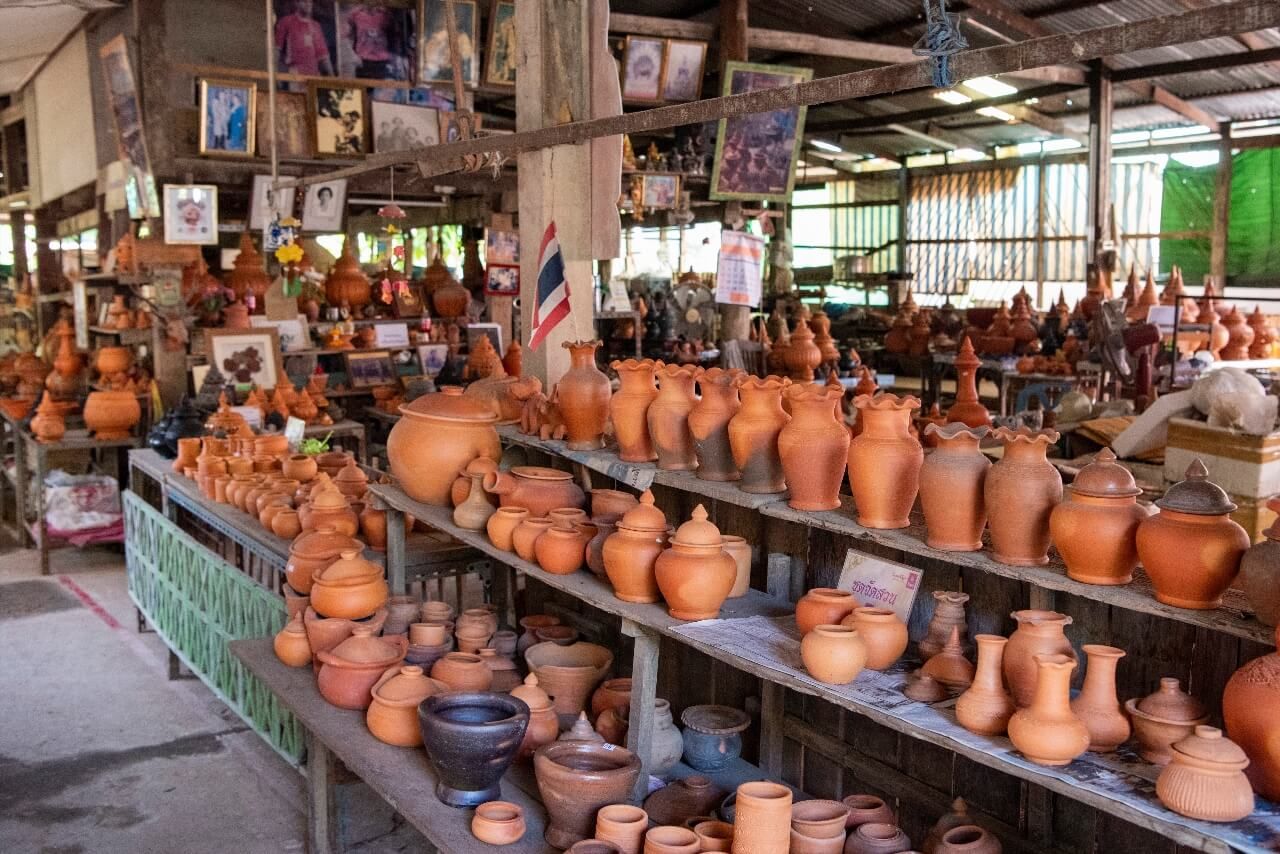
25. Ko Kret Island
Ko Kret (Ko Kret, Pak Kret, Nonthaburi 11120, rated 4.4/5 on Google (771 avis)) is a small island in the Chao Phraya, 30 kilometres north of central Bangkok in Nonthaburi province, created when a canal was cut across a bend in the river in 1722. It has no roads and no cars. This sounds implausible from the centre of Bangkok, but it is straightforwardly true: Ko Kret has no motorised vehicles, and walking its circular path around the island takes about 90 minutes.
The island is home to the Mon community, an ethnic group from mainland Southeast Asia who settled here centuries ago and maintained distinct traditions in pottery, food and Buddhist practice. The pottery tradition is Ko Kret's primary cultural identity: unglazed terracotta pottery made from the island's clay, using techniques passed down from the Mon tradition, is sold from workshops whose fronts open directly onto the walking path.
The weekend market on Ko Kret is busy but not overwhelming, nothing like Chatuchak's scale. The food is the reason to make the trip: Mon-style kanom jeen (fermented rice noodles in curry sauce), fresh roti made to order, and the island's signature crispy fried banana, sold from boats moored at the main pier. Take the BTS to Nonthaburi and a short songthaew (shared taxi) to the pier, then the ferry across (4 baht). Saturdays and Sundays only for the market; the island itself is accessible daily.
FAQ
How many days do you need in Bangkok?
Three full days cover the major temples, one market, one day trip and at least one evening neighbourhood. Five days allows for a genuine pace, one day trip to Ayutthaya, proper time in Chinatown, a cooking class and a rooftop bar evening without feeling rushed. Most first-time visitors underestimate Bangkok's scale: the BTS Skytrain covers only a fraction of the city, and road traffic between areas can consume significant time.
When is the best time to visit Bangkok?
November to February is the standard recommendation: cooler temperatures (averaging 28-32°C), low humidity and minimal rain. March to May is hotter and more humid but less crowded. June to October is the monsoon season, heavy afternoon rain, lower hotel prices and the same temples and markets operating normally. Songkran (Thai New Year, mid-April) is a spectacle worth experiencing, a city-wide water festival that runs for three to five days, but it requires acceptance that you will be soaked.
What is the best way to get around Bangkok?
For most tourist activity, the BTS Skytrain (elevated train, 16-59 baht) and MRT (underground, 16-42 baht) are the most reliable. Buy a Rabbit Card (BTS) for repeat use. For river-adjacent destinations, the Chao Phraya Express Boat is faster than road traffic. Grab (ride-hailing app) is the standard taxi alternative and consistently more reliable than flagging metered taxis in busy areas. The canal boats on Klong Saen Saeb are the fastest east-west option during peak hours.
Is Bangkok safe for solo travellers?
Bangkok is generally considered safe for solo travellers, including solo women. Standard urban precautions apply: be aware of your surroundings at night, use Grab rather than unmarked taxis, and be aware of the gem scam (a common confidence trick involving fake gem stores near major temples, typically involving a well-dressed local who approaches with a story about a relative working at the temple). The temples are heavily policed; tourist police stations exist at major sites. The city ranks consistently among the safest major Southeast Asian cities for visitors.
What should I eat in Bangkok?
Prioritise eating at street level. Pad krapao (stir-fried basil and meat, typically served with a fried egg), khao man gai (poached chicken rice), som tam (green papaya salad), guay tiew (noodle soup in every variation), and mango sticky rice are the non-negotiable fundamentals. The Michelin Guide Bangkok has included street food vendors since 2018, Jay Fai on Mahachai Road (100 baht crab omelette, now with a substantial queue) and T&K Seafood in Chinatown are among the most awarded. For sit-down meals, a mid-range restaurant on Soi 38 in Thonglor or in the Ari neighbourhood will outperform equivalent spending almost anywhere else in Asia.
Do I need to book attractions in advance?
For the Grand Palace and Wat Phra Kaew, online booking is now available and advisable during peak season (December-February), the queue for walk-in entry can exceed 90 minutes. Muay Thai tickets at Rajadamnern should be booked 24 hours in advance if you want ringside seats on a popular night. Cooking classes require advance booking as group sizes are limited. All other attractions on this list operate on walk-in entry without pre-booking requirements.
Final thoughts: building your own Bangkok
These 25 best things to do in Bangkok in 2026 are a starting framework, not a checklist. The city rewards deliberate planning but punishes over-scheduling, so pick three or four anchored priorities per day and leave room to follow a smell, a sound or a recommendation into an alley you had not planned to enter. A morning at Wat Pho can naturally become an afternoon on the river; a 2 a.m. flower-market detour can quietly become the most memorable hour of your trip.
If you want a guided thread through the historic centre rather than a self-built one, the Ryo Bangkok Ryocity audio walk covers the old royal district in depth, connecting the Grand Palace, Wat Pho, Wat Arun and the Chao Phraya riverfront in a narrated walk that supplies the historical and cultural context the visual experience alone cannot. It pairs well with a free morning and a coffee at a Bang Rak shophouse afterwards.
Whether you have two days or two weeks, Bangkok does not resolve into a finished picture. It accumulates. Come back a second time and you will find it entirely different, and equally absorbing, the temples reread, the markets recoloured, the same noodle stall somehow better than you remembered. That, more than any single attraction on this list, is the real reason the city keeps pulling people back.