
Créé par Emilie, le 7 mai 2026
Votre guide Ryo
© Shutterstock
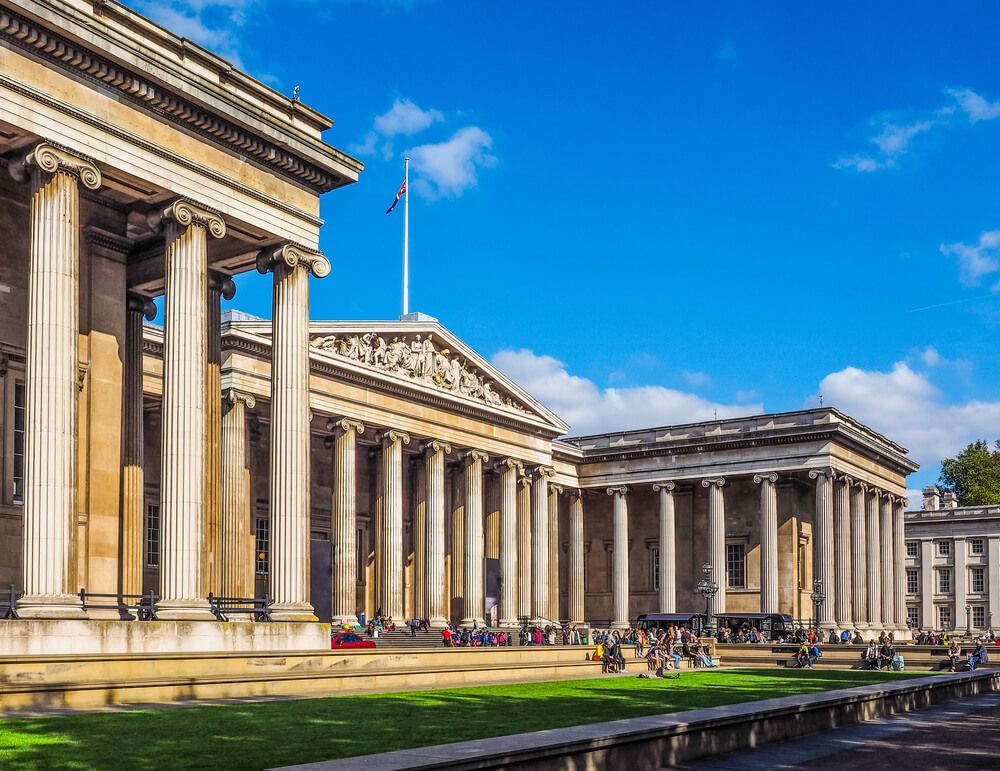
This institution, which has been sharing sublime treasures on world history with the public since 1830, is a must-see place when visiting London. Exhibitions, activities and guided tours teach you a little more about the origins of humanity and its evolution.
Millions of objects, from all eras combined, coming from the four corners of the world and spread over no less than 5 floors await you. Enough to keep you busy for a good while, well sheltered, during a rainy day!
How to visit the British Museum?
By bus
The bus lines below are near the Museum:
- New Oxford Street: 1, 8, 19, 25, 38, 55, 98, 242
- Tottenham Court Road (northbound) / Gower Street (southbound): 14, 24, 29, 73, 134, 390
- Southampton Row: 59, 68, X68, 91, 168, 188
By tube
You will find 4 tube stations near the Museum:
- Tottenham Court Road: 5 minutes walk
- Holborn: 7 minutes walk
- Russell Square: 7 minutes walk
- Goodge Street: 8 minutes walk
By bike
Bike racks are located inside the Museum on the Great Russell Street side, there are also bike rental shops nearby.
By car
Good luck, traffic in London is dense as in all big cities, the nearest car park is located at Bloomsbury Square, WC1A 2RJ.
Why visit the British Museum?
This museum offers a complete visit on the history and cultures found all over the world. Whether you are passionate about art and history, or simply curious, this museum has many pieces of interest that will surely, at some point, capture visitors' attention.
What to see at the British Museum?
The British Museum has many rooms spread over 5 floors as follows:
The lower floors
The lower floor rooms are dedicated to:
Africa, with prehistoric and contemporary pieces, masks, sculptures, clothes, representative pieces of the ancestral Voodoo religion.
Not to be missed: the Ivory pendant mask, an important work of African art.
On the ground floor
The Age of Enlightenment, between 1680 and 1820 many discoveries and knowledge were developed in Europe at that time: discovery of nature, botany, birth of archaeology, analysis of arts and civilization, discovery of ancient writings, studies of ancient religions, explorations, trade...
Ancient Greece, marble figurines, gold jewelry, Parthenon marbles, pottery, amphoras... 1,500 years of history are traced in this museum.
The Roman Empire, until its end in 476 AD, which invaded Europe from Scotland to Constantinople (now Istanbul) and Syria.
Europe and all its mutations, the evolution of states, religions, Europe through different eras is represented in several galleries through a large collection of objects, medieval treasures, Celtic art from the Iron Age, the evolution of everyday life objects...
North America and its indigenous peoples from antiquity to today, clothing, carved poles, pottery, tools...
Mexico, its history from 2,000 BC until the Spanish conquest of the Aztec empire. Thus, the Olmec, Maya, Aztec and Mixtec cultures are represented in this gallery through turquoise mosaic sculptures, gold and jade filigree faces...
The 6 things not to miss on the ground floor:
- The Holy Thorn Reliquary: a medieval reliquary created in Paris and adorned with magnificent precious stones.
- The David Vases: the oldest blue and white porcelain in the world.
- Easter Island statue Hoa Hakananai'a: a colossal statue from Easter Island whose civilization has disappeared.
- The Rosetta Stone: a fragment of stele that allowed Jean-François Champollion to decipher hieroglyphs. A precious help for archaeologists.
- Assyrian Lion Hunt reliefs: an Assyrian engraving representing a king's victory during a lion hunt.
- Parthenon sculptures: different models of marble sculptures from Ancient Greece.
On the upper floors
China and South Asia, 7,000 years of history to explore through a rich collection on writing, rituals, beliefs, trade...
India and its Buddhist sites, their rituals, sculptures, carved relief panels representing narrative scenes on Buddha's life...
Clocks and watches, go back to the origins of clock mechanics by discovering the very first medieval models from the simplest to the most complex, marine chronometers, up to modern horology.
Medieval Europe and its unparalleled treasures, the changes due to wars, politics, the evolution of trade. Sacred art gives a representation of how the divine was interpreted at that time.
Japan, from prehistory to today, there is much to discover about the empire of the rising sun! From the armor of the great Samurai warriors to manga.
Europe from the 15th to 19th century.
Europe from the 19th to 20th century, revolutions and economic growth...
But also: ancient Iran, ancient South Arabia, Anatolia and Urartu, the Etruscan world...
The 5 things not to miss on the floors
- The Lewis Chessmen: a chess set dating from the 12th century, certainly the most famous in the world.
- Oxus Treasure: gold and silver objects from the late 19th century from Afghanistan.
- The Royal Game of Ur: or game of twenty squares, very popular in ancient Mesopotamia.
- The Portland Vase: a Roman vase from the 1st century BC.
- Samurai armour: traditional Japanese armor in medieval Japan.
Where is the British Museum located?
The British Museum is located on Great Russell Street in London WC1B 3DG.
What are the opening hours of the British Museum?
The British Museum opening hours for 2021 are as follows:
- The museum is open every day from 10:00 AM to 5:00 PM, except on Friday when it closes at 8:30 PM.
- Some exhibitions are open after 5:00 PM by reservation.
- The museum is closed from December 24 to 26 as well as on New Year's Day.