
Créé par Emilie, le 20 juin 2026
Votre guide Ryo
35 Best Things to Do in Oxford in 2026
© Shutterstock
Oxford does something most cities can't: it makes you feel like an outsider inside one of the world's greatest intellectual centres, and that friction is exactly what makes a visit so compelling. This is a city where medieval towers crowd narrow streets, where 38 university colleges open their gates to curious strangers, and where the same pubs that served C.S. Lewis and J.R.R. Tolkien still pour pints to anyone who wanders in. If you want to explore the stories embedded in every courtyard and corner, Ryo's Oxford audio guide takes you through the city's most iconic sights with narrated commentary that brings the dreaming spires to life.
This list goes well beyond the obvious. You'll find a 40-million-piece ethnographic collection stuffed behind a Victorian natural history museum, a meadow where Lewis Carroll first told Alice her story, a Roman road that became a bohemian art corridor, and a 14th-century building that stood in for a Hogwarts dining hall before any film crew arrived. When it comes to things to do in Oxford, the city has more options per square mile than almost anywhere in England, here are the 35 that are actually worth your time.
1. Christ Church College
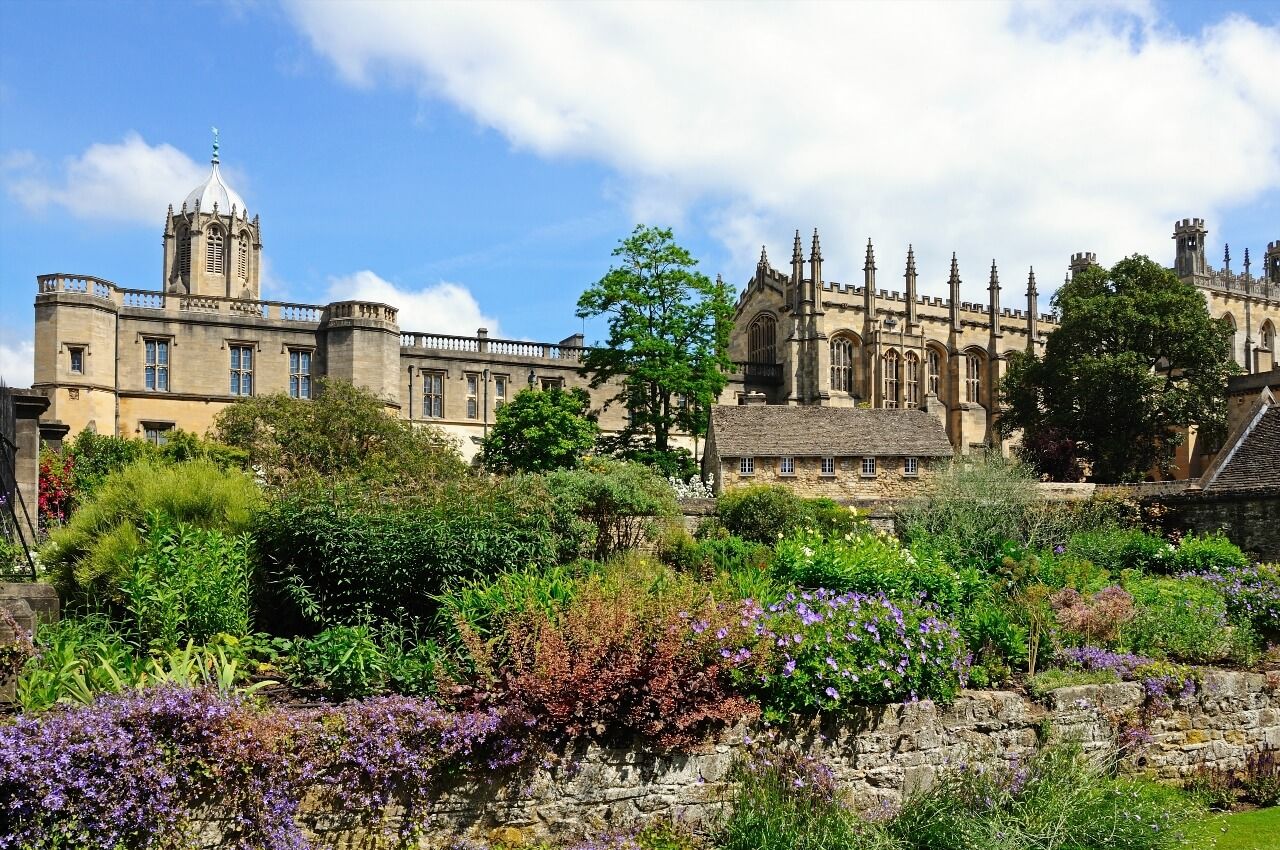
Christ Church is not simply Oxford's most visited college, it is an argument, made in stone and paint and stained glass, that learning and beauty are inseparable. Founded by Cardinal Wolsey in 1524 and refounded by Henry VIII in 1546, it is the only college in the world to share its chapel with a cathedral, and Christ Church Cathedral doubles as the diocesan seat of the Bishop of Oxford. The moment you pass through the Tom Tower, the 1682 gate tower designed by Christopher Wren, the noise of St Aldate's simply falls away.
The Great Hall is the room most visitors come for, and it earns its reputation. Measuring 36 metres long, hung with portraits of alumni that include William Gladstone, Albert Einstein (an honorary degree, not a student), and no fewer than 13 British Prime Ministers, it provided the template for the Great Hall of Hogwarts in the Harry Potter films. The real hall predates the fictional one by roughly 450 years. Meals are still served here to students; visitors can enter when the college is open to tourists, typically between 10:00 and 17:00, for an admission fee of around £19 for adults.
Beyond the Hall, budget time for Christ Church Picture Gallery, a properly serious collection of Old Masters, Tintoretto, Leonardo da Vinci studies, Van Dyck, that somehow remains under-visited. The meadow behind the college, stretching to the confluence of the Cherwell and Thames, is free to enter from the Meadow Gate and rewards an hour of unhurried walking.
2. The Bodleian Library
The Bodleian Library opened in 1602, making it one of the oldest continuously operating research libraries in the world, and it has never lent a single book. That rule, confirmed by statute in 1610, has held even for royalty: Charles I was refused during the English Civil War, and his request was politely declined. Today the Bodleian holds more than 13 million items across a network of buildings, with the original Duke Humfrey's Library of 1488 at the historic core.
For visitors, the essential experience is a guided tour that accesses Duke Humfrey's Library, the medieval chamber whose chained volumes and barrel-vaulted ceiling have appeared in everything from The Golden Compass to the Harry Potter franchise (it filmed as the Hogwarts infirmary and the restricted section). Tours run multiple times daily and cost around £8-£14 depending on level of access. The Divinity School, included in most tour packages, is covered separately under entry 16, but if you're in the Bodleian area, also stop into the adjacent Radcliffe Camera square; the exterior of that rotunda is as breathtaking as any interior.
3. Ashmolean Museum
Britain's oldest public museum, the Ashmolean, opened its doors in 1683, more than a century before the Louvre. Today it houses one of the country's most eclectic collections: Egyptian mummies, Michelangelo drawings, the Alfred Jewel (a 9th-century Anglo-Saxon treasure), Raphael studies, Japanese lacquerwork, and the lantern allegedly used by Guy Fawkes during the Gunpowder Plot of 1605. Entry is free, which makes the Ashmolean one of the great unremarkable bargains in English cultural life.
The current building on Beaumont Street, redesigned by Rick Mather and reopened in 2009, is superb. The central atrium floods the galleries with natural light, and the rooftop restaurant offers a rare high vantage point over north Oxford. Allow at least two hours; the Egyptian galleries on the lower ground floor alone can absorb an entire morning if you let them. The interactive display explaining the Rosetta Stone context (the Ashmolean holds the original trilingual decree fragment that predates the British Museum's famous copy) is worth the detour down.
4. Go Punting on the River Cherwell
Punting is Oxford's most defiantly unhurried activity, and that is precisely why it survives. You hire a flat-bottomed punt from one of several operators, Cherwell Boathouse, Magdalen Bridge Boathouse (High Street, Oxford OX1 4AU, rated 4.4/5 on Google (469 avis)), and Howard's of Oxford are the main options, and then negotiate the River Cherwell by pushing against the riverbed with a long pole. The technique takes about ten minutes to learn and about thirty seconds to get wrong in front of strangers.
Magdalen Bridge Boathouse is the most central launching point, placing you almost immediately in the shadow of Magdalen College's tower. The route upstream toward Victoria Arms pub at Old Marston takes roughly an hour each way through stretches of river where weeping willows skim the surface and the city recedes almost completely. Hire costs run around £25-£35 per punt per hour (carrying up to six people), with chauffeur-guided options available for those who would rather drink Pimm's than struggle with the pole.
If you visit between late April and June, the riverbanks are at their most vivid, wildflowers crowd the margins and the light hits the water at angles that justify every punting photo ever taken.
5. Radcliffe Camera
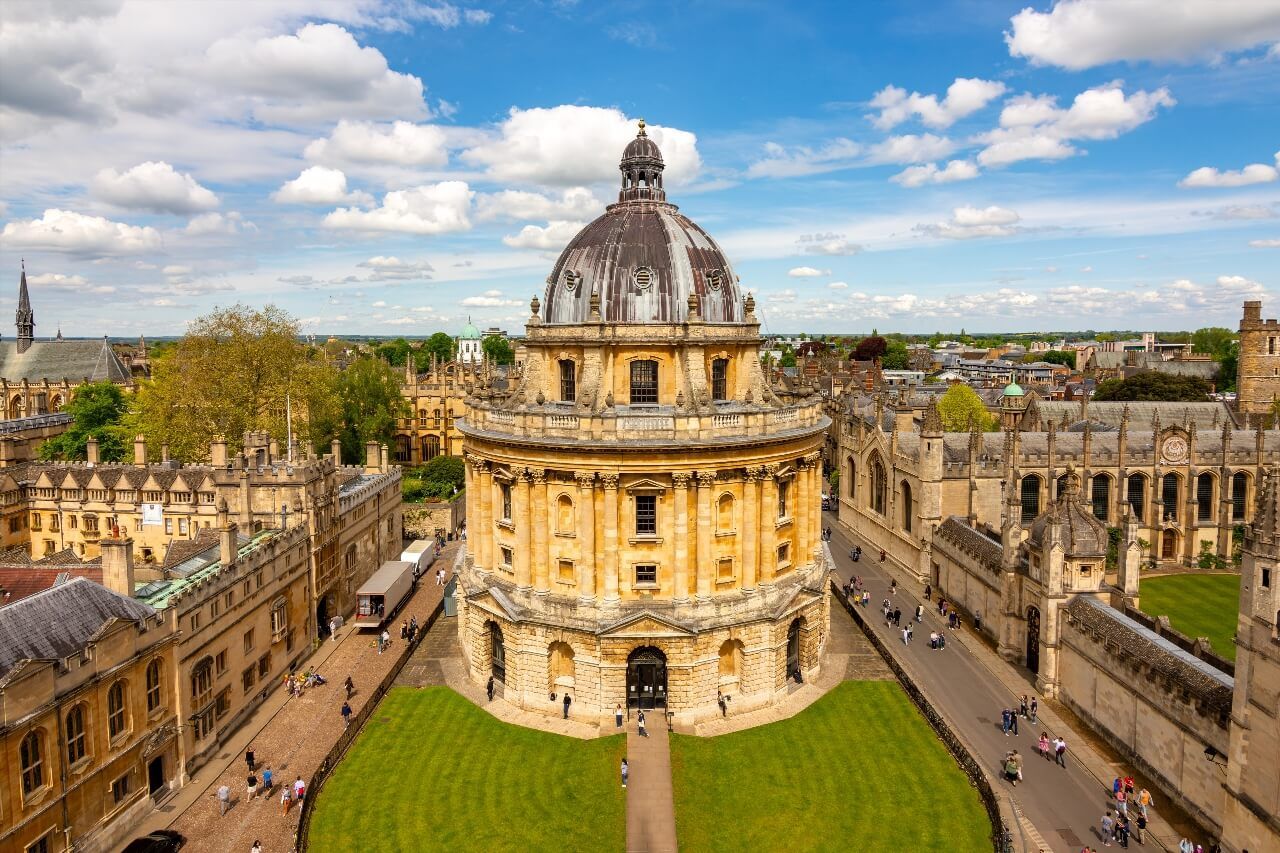
The Radcliffe Camera is the image that defines Oxford for most people who have never visited, and it does not disappoint in person. Completed in 1749 to designs by James Gibbs, it is the first circular library building in England, originally constructed to house a scientific library funded by a bequest from royal physician John Radcliffe. The dome rises 43 metres above Radcliffe Square, and the building's proportions manage to be simultaneously monumental and elegant.
Visitors cannot enter independently, the Camera is part of the Bodleian Library system and accessible only on guided tours. But the square surrounding it is one of Oxford's finest outdoor spaces, flanked by the University Church of St Mary the Virgin, All Souls College, and Brasenose College. Standing there at dusk, when the Bath stone turns amber in low light, is an experience that requires no ticket.
6. Pitt Rivers Museum
No Oxford experience is complete without an afternoon inside the Pitt Rivers Museum (South Parks Road, Oxford OX1 3PP, rated 4.7/5 on Google (3 379 avis)), and nothing quite prepares you for it. Access is through the University Museum of Natural History, you walk through dinosaur skeletons, turn left, push open a heavy door, and suddenly find yourself in a Victorian wonder-cabinet that contains over 500,000 objects from cultures spanning every continent and six centuries of collecting.
The collection was gifted to the University in 1884 by General Augustus Lane Fox Pitt Rivers, who believed that grouping objects by type rather than origin would reveal universal patterns in human development. That philosophy produced displays of extraordinary density: 300 shields arranged by shape, hundreds of amulets from dozens of societies, entire cases of shrunken heads. The Victorian cabinets remain intact, labels written by hand, drawers you can pull open to find more objects inside.
Entry is free, and the atmosphere, dimly lit, faintly Victorian, faintly chaotic, is unlike any other museum in Britain. The Japanese totem pole donated by the Haida Nation and the North American canoe suspended from the ceiling are two objects worth finding. Budget at least 90 minutes; most visitors discover they've been inside for three hours. Ryo's Oxford audio guide covers the Pitt Rivers among its featured stops, giving extra historical context to collections that the physical labels only scratch the surface of, discover the full audio route to prepare your visit.
7. University Museum of Natural History
The University Museum of Natural History (Parks Road, Oxford OX1 3PW, rated 4.8/5 on Google (11 087 avis)) occupies the same building as the Pitt Rivers, but it deserves its own entry. The main hall, a neo-Gothic cathedral of iron and glass designed by Benjamin Woodward and completed in 1860, is a statement of Victorian ambition: the idea that science itself could be housed in a building as beautiful as any church. The arched roof lets in diffuse northern light that falls across dinosaur skeletons, mineral specimens, and zoological displays with a quality that feels almost staged.
The most historically significant room is the Oxford University Museum's lecture theatre (not always open), where in June 1860 Thomas Henry Huxley and Bishop Samuel Wilberforce held their famous debate about Darwin's theory of evolution, one of the defining public arguments of the 19th century. The museum's collection of dodo remains, the most complete in existence, is another reason to stop. Entry is free.
8. Oxford Covered Market
The Oxford Covered Market (Market Street, Oxford OX1 3DZ, rated 4.5/5 on Google (11 490 avis)) has been trading continuously since 1774, making it one of England's longest-running permanent retail markets. It sits in the centre of the city between Market Street and High Street, and on any given Tuesday morning you'll find artisan butchers cutting to order alongside independent bakeries, flower stalls fragrant with seasonal blooms, a shop selling nothing but chess sets, and a café that has been making breakfast for students and locals since most people alive today were born.
This is not a heritage attraction in the theme-park sense. People actually shop here. The Ben's Cookies outlet, occupying a corner stall, has become something of an Oxford institution, the warm double-chocolate cookie is empirically hard to argue with. The market is free to enter, open Monday to Saturday roughly 8:00-17:30, and offers one of the best opportunities in the city to simply stand and watch Oxford's mixture of students, tourists, academics, and long-term residents going about their day.
9. Carfax Tower
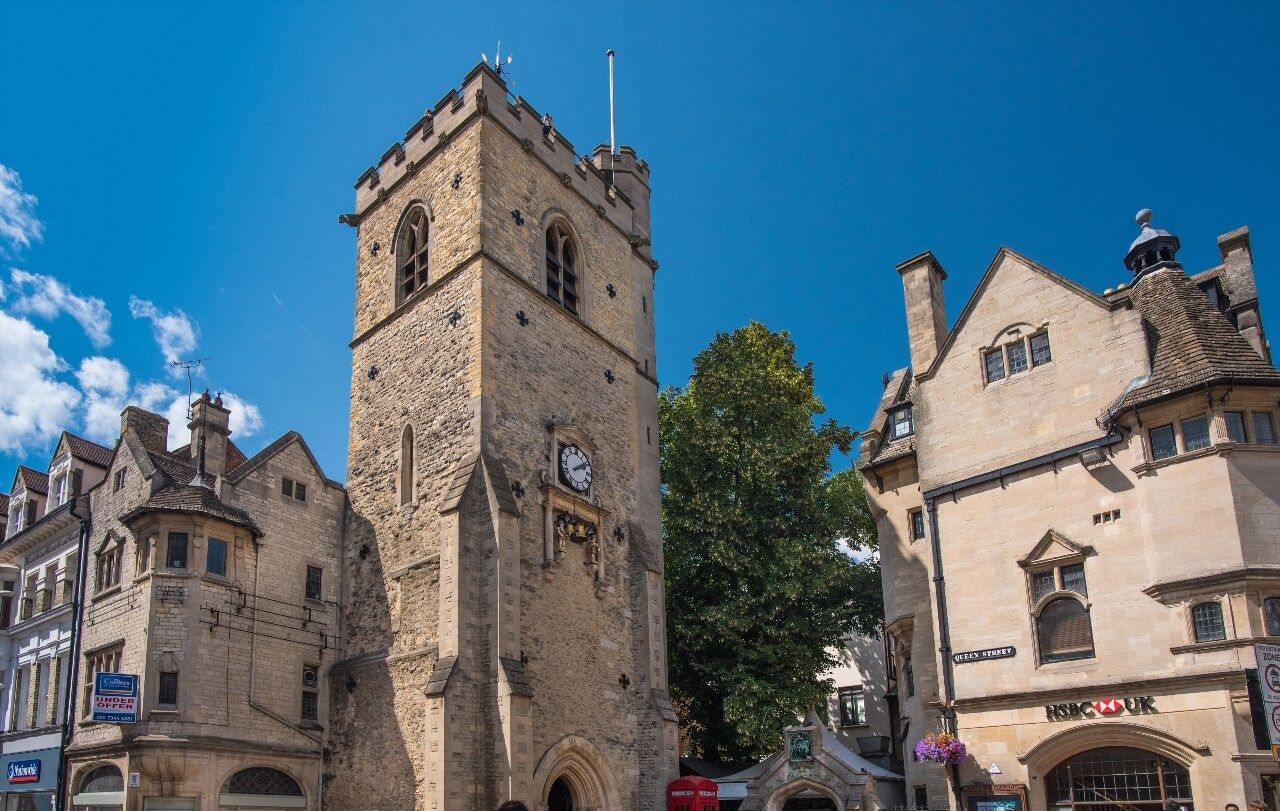
Carfax Tower is the last surviving remnant of the medieval St Martin's Church, demolished in 1896 to ease traffic through the city's central crossroads. The tower dates from the 14th century, and climbing its 99 steps brings you to the highest publicly accessible viewpoint in the city centre, the 23-metre summit offers a view across the spires, rooftops, and towers that gave Oxford its famous epithet. The tower's quarter-boys, mechanical figures that strike the bells every 15 minutes, are worth watching from the street below. Admission is around £3.
10. Bridge of Sighs
Oxford's Bridge of Sighs spans New College Lane, connecting two parts of Hertford College, and despite the Venetian nickname it actually resembles the Rialto Bridge more than the original Ponte dei Sospiri. Designed by Thomas Jackson and completed in 1914, it is purely decorative, the college had easier routes between its buildings, and exists almost entirely for the visual pleasure of the narrow lane below. New College Lane is one of the quietest streets in the city centre, which makes the photograph easier to take without fifty other cameras in frame.
11. Blenheim Palace
About 13 kilometres northwest of Oxford, Blenheim Palace (Woodstock, Woodstock OX20 1PP, rated 4.6/5 on Google (18 584 avis)) occupies a category of its own among English country houses. Built between 1705 and 1722 as a gift from Queen Anne to John Churchill, 1st Duke of Marlborough, following his victory at the Battle of Blenheim, it remains the only non-royal, non-episcopal English country house to hold the title of palace. The UNESCO World Heritage Site designation, awarded in 1987, recognises both the architecture, John Vanbrugh's theatrical English Baroque at its most ambitious, and the 2,100 acres of parkland landscaped by Capability Brown.
Winston Churchill was born here on 30 November 1874, in a room to the right of the Great Hall, and the permanent Churchill exhibition traces his life from that unexpected arrival (his mother Lady Randolph Churchill was visiting and went into labour early) through his wartime premiership. The Palace State Rooms include a tapestry room whose hand-woven Flemish tapestries narrate every major campaign of the first Duke's military career; each tapestry took years to complete and the detail remains extraordinary.
Outside, the parkland deserves as much time as the palace. The Grand Bridge spanning the lake was designed by Vanbrugh with rooms inside its piers, they were never finished, and the view from the south lawn across the Great Lake toward the Pleasure Gardens is one of England's finest landscape compositions. In summer, the maze, butterfly house, and adventure playground make the grounds work equally well for families; in autumn, the estate is near-empty and the colours are remarkable.
Plan around three to four hours for a full visit. Admission covers most of the palace and gardens (around £35 for adults in 2026); the Churchill exhibition and formal gardens are included. The train from Oxford to Hanborough station, followed by a short taxi, is a realistic alternative to driving.
12. Oxford Botanic Garden
The Oxford Botanic Garden (Rose Lane, Oxford OX1 4AZ, rated 4.5/5 on Google (5 630 avis)) was established in 1621, making it the oldest botanical garden in the United Kingdom and one of the oldest in the world. It occupies a 4.5-acre site beside the River Cherwell, just south of Magdalen Bridge, and contains more than 5,000 plant species across its walled garden, glasshouses, and riverside borders.
Water lilies fill the lily pond in summer; the tropical glasshouse maintains a year-round 28°C. The Philip Pullman connection matters here: in His Dark Materials, Lyra and Will agree to meet at a specific bench in the Botanic Garden every year, the real bench, near the Cherwell boundary wall, has become a quiet pilgrimage site for fans of the trilogy. Admission is around £6.50, and the garden is open daily (reduced hours in winter).
13. Oxford Castle & Prison
Oxford Castle (44-46 Oxford Castle, Oxford OX1 1AY, rated 4.4/5 on Google (7 395 avis)) was founded by Robert d'Oilly in 1071, three years after the Norman Conquest, and for the next 900 years served successively as a royal fortress, a county gaol, and ultimately a Victorian prison that closed only in 1996. The site has been transformed into a heritage attraction and boutique hotel complex without losing the architectural substance of the original.
The guided tour, which runs several times daily, takes visitors into the Victorian prison wing, including original cells where inmates slept on wooden boards until the 1850s, and up St George's Tower, the oldest standing structure on site at over 1,000 years old. From the tower's top, the view west across Oxford is different from Carfax: quieter, residential, with the Thames valley visible in the distance. The 13th-century crypt of St George's Chapel beneath the tower is one of Oxford's less-visited medieval spaces and worth the descent.
The castle's history includes a famous escape in 1142 by Empress Matilda, who according to chronicle sources slipped out of the besieged castle in a white cloak across the frozen River Thames during a winter siege. Admission to the heritage tour is around £14 for adults.
14. Museum of the History of Science
The Museum of the History of Science (Broad Street, Oxford OX1 3AZ, rated 4.4/5 on Google (2 543 avis)) occupies the 1683 building that was the Ashmolean's original home, the oldest surviving purpose-built museum building in the world, and it holds one of the finest collections of scientific instruments anywhere. The astrolabes, sundials, microscopes, and early telescopes on display span five centuries and trace the physical history of scientific measurement.
Among the notable objects: the blackboard used by Albert Einstein during a 1931 lecture in Oxford, still bearing his calculations for the expansion of the universe. Entry is free, and the ground-floor gallery alone, arranged around a central table with hands-on displays, repays half an hour of careful looking. The penicillin-related items (Oxford was where Howard Florey's team developed the first injectable penicillin in 1941) add a specifically local layer to the collection.
15. Sheldonian Theatre
Christopher Wren designed the Sheldonian Theatre in 1664, aged just 31, and it remains one of his finest buildings, though it was the one that made his reputation and secured his later commissions, including St Paul's Cathedral. Built to provide Oxford University with a secular venue for its degree ceremonies, it functions as both a performance space and the ceremonial heart of the university to this day. Degree ceremonies, the annual Encaenia, and much of Oxford's formal academic calendar take place here.
Visitors can climb to the cupola for a panoramic view that rivals Carfax Tower, and the painted ceiling by Robert Streater, depicting Truth descending from the heavens onto the arts and sciences, is best appreciated from the floor of the auditorium. Check the Sheldonian's public event calendar; some concerts and lectures are open to non-members at reasonable prices. Admission for the cupola is around £4.
16. The Divinity School and Harry Potter Filming Locations
The Divinity School (Broad Street, Oxford OX1 3BG, rated 4.8/5 on Google (4.1K reviews)) is the oldest teaching room of Oxford University, begun in 1427 and completed in 1483. Its Perpendicular Gothic vaulted ceiling, a lierne vault with carved bosses at every intersection, created by master mason William Orchard, is considered by many architectural historians to be the finest medieval ceiling in England. The room was built to host oral examinations in theology, and the weight of that function seems to press down from the stonework: it is one of Oxford's most impressive interior spaces.
Its popular fame, however, rests on its role in the Harry Potter franchise. The Divinity School was used as the Hogwarts hospital wing in Philosopher's Stone and Chamber of Secrets, while the Bodleian Library's Duke Humfrey's Library appears as the Hogwarts library restricted section. The Christ Church Great Hall provided the template for the Great Hall, and the New College cloisters appear in Goblet of Fire. Oxford's Harry Potter credentials are broader than any single location, but the Divinity School is the most atmospheric of them, the medieval stone and the cinematic memory layer onto each other in a way that is genuinely affecting rather than merely touristic.
Tours of the Divinity School are included in the standard Bodleian Library guided tour (around £14 for the most comprehensive access package). If you've already booked the Bodleian separately, the Divinity School is usually visible as part of that route. Ryo's Oxford audio guide narrates the full Harry Potter connection across multiple city sites, contextualising why Oxford, rather than the more frequently cited Alnwick Castle, forms the architectural backbone of the Wizarding World. Explore the full audio route for commentary that ties locations together rather than treating each as a standalone stop.
17. Port Meadow
Port Meadow (Walton Well Road, Oxford OX2 6ED, rated 4.7/5 on Google (2 524 avis)) is approximately 440 acres of unenclosed common land to the northwest of Oxford, one of the largest areas of uncultivated medieval grassland in England. It has never been ploughed, archaeological surveys have found Bronze Age and Iron Age settlements beneath its surface, preserved by the absence of agricultural disturbance. The meadow floods in winter and spring, becoming a vast inland lake that Oxford residents photograph every January with the equal parts affection and practicality.
The Thames Path runs along the western edge, with the Perch pub at Binsey and the Trout Inn at Wolvercote offering mid-walk destinations. In summer, free-roaming horses and cattle graze the open ground; swimming in the Thames at the Port Meadow stretch is technically legal and widely practiced. Access is free and permanent, this is ancient common land with grazing rights stretching back to the Domesday Book.
18. Christ Church Meadow
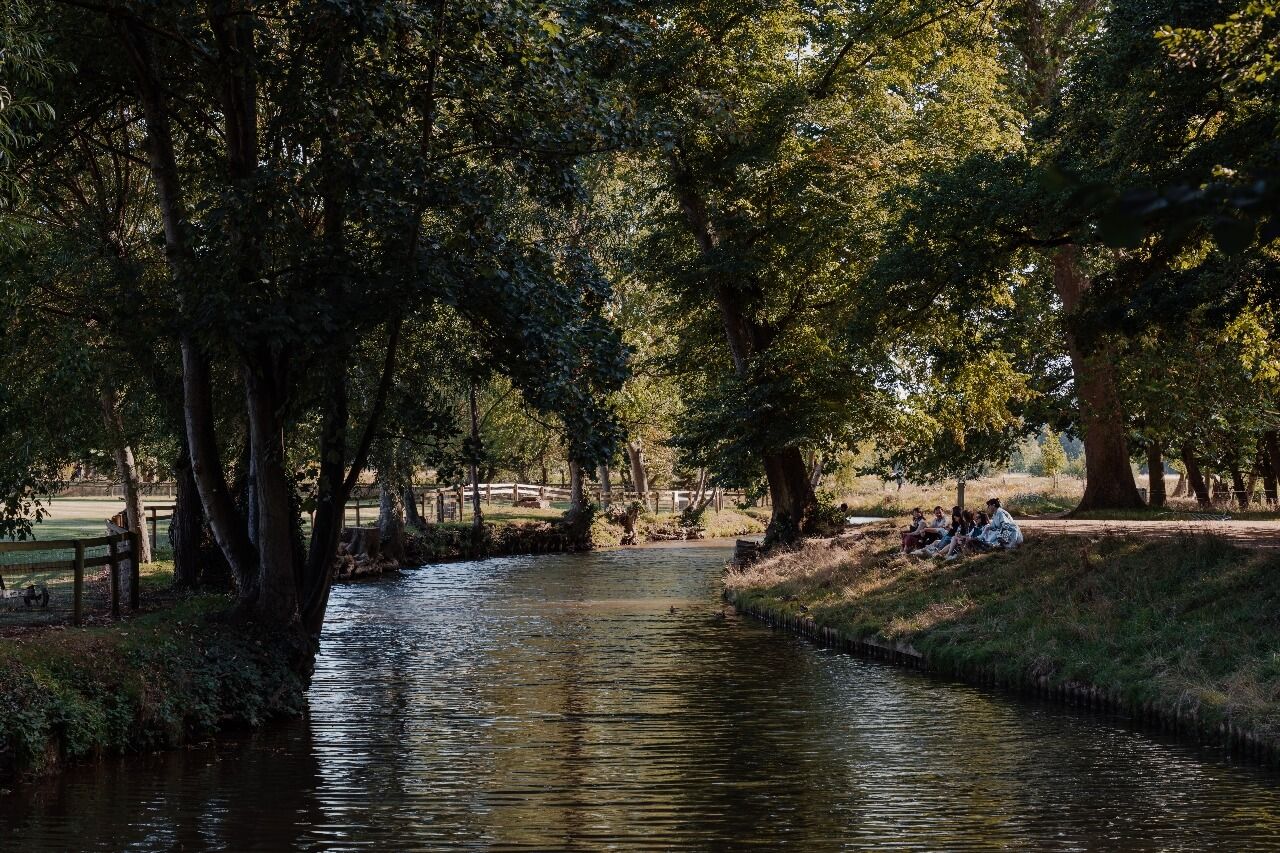
Christ Church Meadow (St Aldate's, Oxford OX1 1DP, rated 4.9/5 on Google (26 avis)) connects the college grounds to the confluence of the River Thames and River Cherwell, forming a green corridor that feels implausibly rural for a city centre. The Broad Walk, a formal lime-tree avenue dating from the 17th century, bisects the meadow from west to east, while the New Walk follows the Cherwell back toward Magdalen Bridge. Free entry is through the Meadow Gate on St Aldate's or the Memorial Garden gate near the boathouses.
The meadow remains in collegiate use for grazing (Oxford's famous collegiate cattle have grazed here since at least the 16th century), which gives the space a working agricultural quality that distinguishes it from parkland. It is at its best in early morning, before the tourist traffic arrives, when the light is low and the cattle move slowly across damp grass.
19. Alice in Wonderland Trail
Lewis Carroll, pen name of Charles Lutwidge Dodgson, mathematics lecturer at Christ Church, first told the story of Alice's adventures underground to three young girls on a Thames river trip on 4 July 1862. The trip started at Folly Bridge and ended at Godstow. The eldest girl, Alice Liddell, was the daughter of Christ Church's Dean Henry Liddell, and Carroll's story about her adventures underground became Alice's Adventures in Wonderland in 1865. The Oxford connection is not incidental: it is the origin.
A self-guided Alice Trail links the key locations across the city: Alice's Shop on St Aldate's (selling Carroll memorabilia since Victorian times and appearing in Through the Looking-Glass as the Old Curiosity Shop), the Christ Church Cathedral where the Liddell family worshipped, and the formal gardens of St John's College which partly inspired the gardens in the novel. The Oxford Story Museum (see entry 20) houses the UK's most comprehensive exhibition on Carroll and Alice. Free self-guided map available from the Visitor Information Centre on Broad Street.
20. Oxford Story Museum
The Oxford Story Museum (Pembroke Street, Oxford OX1 1BP, rated 4.6/5 on Google (932 avis)) opened in 2023 in the Grade II-listed St Ebbe's Church on Pembroke Street, bringing together Oxford's extraordinary literary legacy under one roof. Oxford has produced or influenced more children's literature than any comparable English-speaking city: Lewis Carroll, J.R.R. Tolkien, C.S. Lewis, Philip Pullman, Roald Dahl, and Terry Pratchett all have Oxford connections. The museum uses interactive exhibitions, manuscript displays, and immersive storytelling environments to trace those connections.
The Carroll and Alice exhibition is the most developed, drawing on manuscripts and illustrations to show how the original story evolved from the handwritten Alice's Adventures Underground manuscript (displayed in facsimile; the original is in the British Library) to the Tenniel illustrations of the published edition. The Tolkien section links to the Tolkien Trail around the city (see entry 22). Admission is around £14 for adults, £10 for children, with family tickets available.
21. Museum of Oxford
The Museum of Oxford (St Aldate's, Oxford OX1 1BX, rated 4.3/5 on Google (387 avis)), housed in the ground floor of Oxford Town Hall on St Aldate's, tells the city's own story rather than the university's, a distinction that matters more than it might seem. Oxford predates its university by several centuries; the city was a significant Saxon settlement, a Viking target, and a Norman fortification before the scholars arrived in the 12th century. The museum traces that civic history through archaeological finds, maps, reconstructed interiors, and oral histories from Oxford residents across the 20th century.
Entry is free, and the collection includes items as varied as a Roman mosaic floor fragment found during building work on Broad Street, Tudor pottery from the Covered Market area, and audio recordings of Oxford's long-standing Cowley car manufacturing workers. The section on the 1354 St Scholastica Day Riot, three days of violent conflict between town and gown that killed dozens, gives context to the town-versus-university dynamic that still simmers beneath the surface of civic life.
22. Tolkien's Oxford: Graves, Pubs, and Inspiration
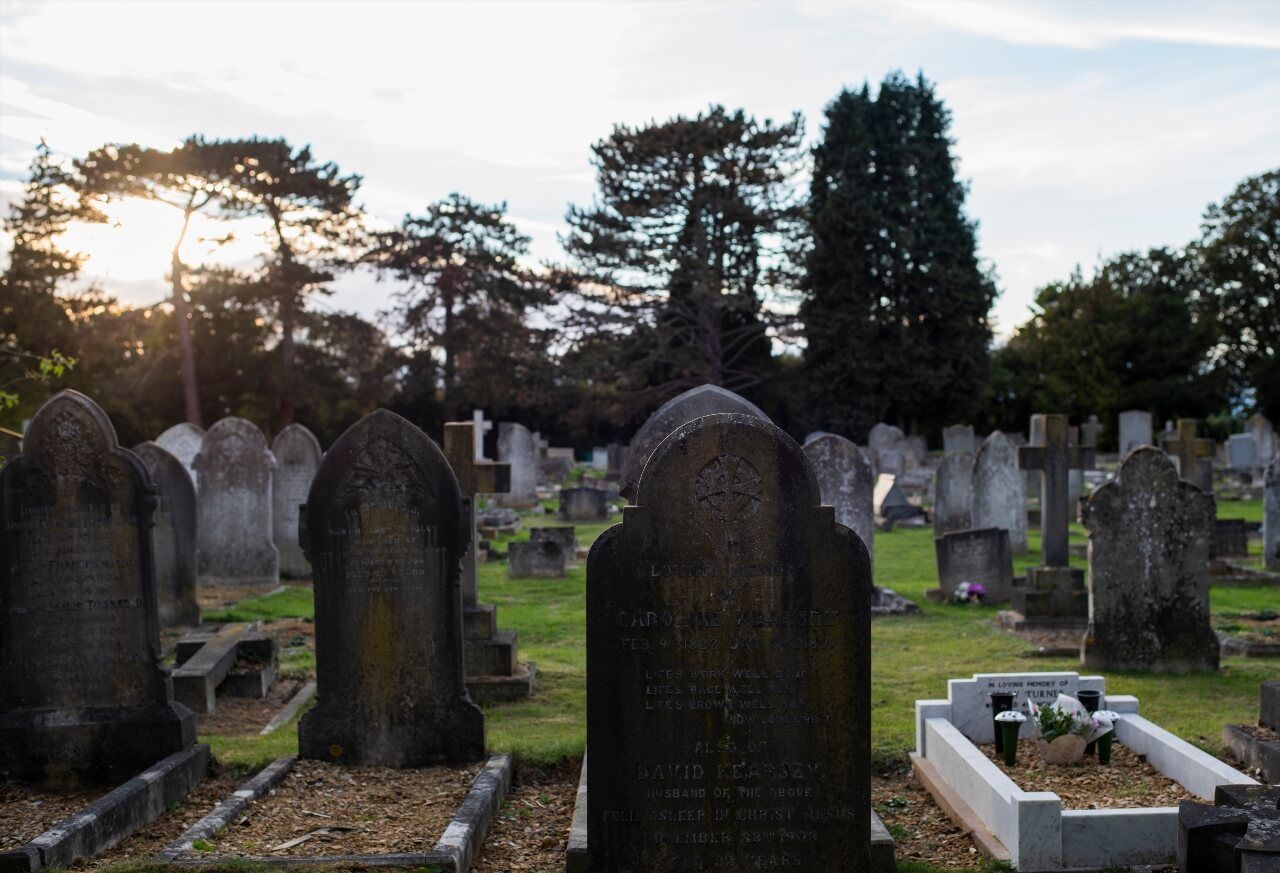
J.R.R. Tolkien lived in Oxford for most of his adult life, first as a student at Exeter College and later as a professor of Anglo-Saxon and English Language. The city saturates his work in ways that are only partly visible to casual tourists. The grave of Tolkien and his wife Edith in Wolvercote Cemetery (Banbury Road, Oxford OX2 8EE, rated 4.6/5 on Google (37 avis)) north of Oxford is a quiet but tangible pilgrimage; fans leave flowers and, sometimes, small figures of Middle-earth characters. Their headstones bear the names Lúthien (Edith) and Beren (Tolkien), the lovers from The Silmarillion who gave up immortality for each other.
The Eagle and Child pub on St Giles' Street is the most famous Tolkien location in the city: from the 1930s through the 1950s, the Inklings, the informal literary group that included Tolkien, C.S. Lewis, Charles Williams, and others, met in the back room known as the Rabbit Room every Tuesday morning. Tolkien read drafts of The Hobbit and The Lord of the Rings aloud here before either was published. The pub changed ownership in 2023 and has been sensitively refurbished; the back room is still there.
C.S. Lewis's grave is in the churchyard at Holy Trinity Church, Headington Quarry, about three miles from the city centre. Lewis lived at The Kilns nearby until his death in November 1963, the same day as John F. Kennedy's assassination, which meant his death was barely noticed in the international press.
23. Weston Library
The Weston Library (Broad Street, Oxford OX1 3BG, rated 4.4/5 on Google (196 avis)) on Broad Street is the Bodleian's public-facing research centre, redesigned in 2015 by Wilkinson Eyre Architects and housing a permanent Treasures Gallery that displays rotating selections from the Bodleian's manuscripts and rare books collection, entirely for free. Past displays have included original manuscript pages from Jane Austen, Wilfred Owen's war poetry, and a first edition Magna Carta. The gallery is small but dense, and the standard of curation is very high. Check the Bodleian website for current exhibitions before visiting.
24. The Varsity Club Rooftop
The Varsity Club (9 High Street, Oxford OX1 4BJ, rated 4.1/5 on Google (1 540 avis)) on High Street operates a rooftop bar and terrace on the fourth floor that offers the best elevated view of Oxford's roofline available without buying a tour ticket. From here you look directly across at Radcliffe Square, the dome of the Radcliffe Camera, and the spires of All Souls and the University Church at an eye level that most visitor photographs miss entirely. The bar is open from early evening; booking ahead on weekends is recommended. Entry is free; drinks at central-Oxford prices.
25. Holywell Street and the Holywell Music Room
Holywell Street is one of Oxford's least-trafficked thoroughfares, running parallel to Broad Street one block north. The architecture is uniformly pre-Georgian, with timber-framed and stone-fronted houses that date mostly from the 17th century and earlier, and the scale is intimate enough to read as a working medieval street rather than a film set. At its eastern end stands the Holywell Music Room (Holywell Street, Oxford OX1 3SD, rated 4.7/5 on Google (210 avis)), built in 1748 and widely considered the oldest purpose-built public concert hall in the world. Regular recitals, chamber music, early music, solo instruments, take place throughout the year, with tickets often under £20. Ryo's Oxford audio guide passes along Holywell Street, noting the architectural details that most visitors walking on Broad Street miss entirely. Access the route here.
26. Gloucester Green Market
Gloucester Green Market runs every Wednesday and Saturday in the pedestrian square behind the bus station, off George Street. Wednesday is the main market day, with stalls covering a broad range of food: Polish baked goods, Ethiopian injera, Thai street food, British charcuterie, Spanish olives, and an excellent Indian spice merchant who will explain the provenance of everything in his stock. Saturday brings more arts and crafts alongside the food. Entry is free and the market runs roughly 9:00 to 14:00. It is consistently one of the more culturally diverse food markets in the south of England.
27. Oxford University Parks
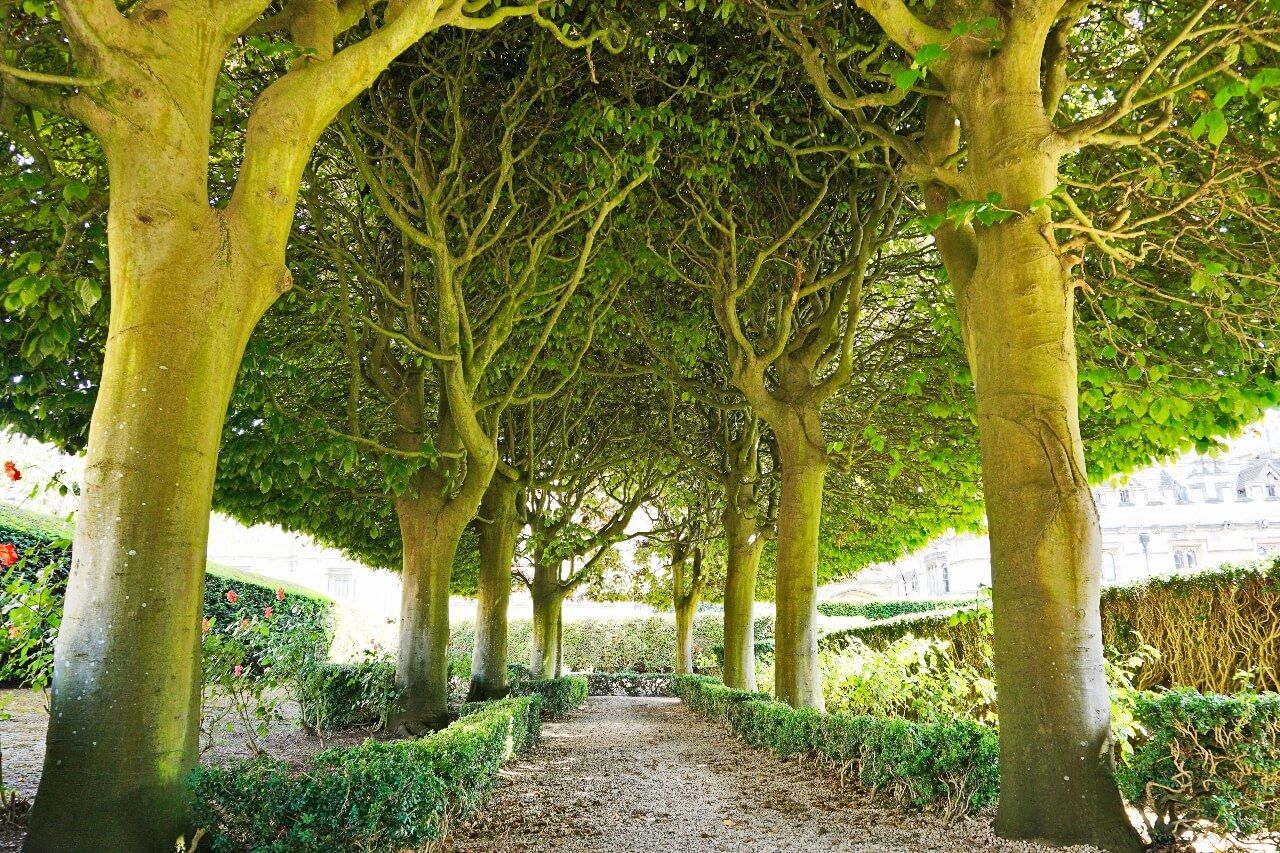
University Parks (South Parks Road, Oxford OX1 3QZ, rated 4.7/5 on Google (1 803 avis)) covers 70 acres of formal parkland along the River Cherwell, north of the city centre, managed by the University and open to the public year-round at no charge. The cricket ground at the south end hosts University matches in summer; the river meadows to the east flood regularly in winter and attract significant numbers of migratory birds. The parks are at their most spectacular in late April and May, when the ornamental trees, magnolias, cherries, chestnuts, are in full bloom against the green.
The route through the parks connects naturally to the University Museum and the Pitt Rivers, making it a logical extension of a science-quarter morning. From the northern boundary you can continue into the suburb of Cutteslowe, or loop back via the Cherwell towpath.
28. Keble College Chapel
Keble College Chapel (Parks Road, Oxford OX1 3PG, rated 4.8/5 on Google (33 avis)) is the most visually arresting Victorian church interior in Oxford, and competes seriously for that title across all of England. Built in 1876 as part of William Butterfield's polychrome brick design for Keble College, the chapel is striped in bands of red, cream, and blue brick that seem deliberately confrontational in a city of limestone. The interior is covered floor to ceiling in mosaic, painted glass, and elaborate stone carving. It is simultaneously overwhelming and coherent.
The chapel houses William Holman Hunt'sThe Light of the World (1851-53), arguably the most famous Victorian religious painting in England, the one showing Christ knocking at a door with no exterior handle. Entry to the chapel is free during visiting hours (check college website for current access times).
29. Cowley Road Street Art
Cowley Road (Cowley Road, Oxford OX4 1XR) is Oxford's most underrated street, a multicultural high street running east from Magdalen Bridge into the suburb of East Oxford, where the population is significantly more diverse than the university-facing city centre. The road and its side streets have accumulated a substantial amount of painted murals and street art over the past decade, ranging from large-scale political pieces to decorative community art on shop shutters.
The most notable concentration is around the junction with Jeune Street and Howard Street, where a series of commissioned murals celebrate the area's Caribbean, South Asian, and East African communities. The Cowley Road Carnival, held every July, transforms the entire street into a parade route and is the largest outdoor festival in Oxfordshire. Walking the full length of Cowley Road from Magdalen Bridge to the junction with Hockmore Street and back takes under two hours and costs nothing.
30. River Cruise on the Thames (Isis)
The section of the Thames running through Oxford is locally called the Isis, from Tamesis, the Roman name for the river, and offers a completely different perspective on the city from the water. Salter's Steamers has been running river cruises from Folly Bridge (Folly Bridge, Oxford OX1 4LB, rated 4.3/5 on Google (1.1K reviews)) since 1858, making it one of England's oldest surviving passenger boat operators. The upstream route toward Iffley Lock passes through water meadows, past the rowing club boathouses, and under Iffley's 12th-century Norman church, which has one of the best-preserved Romanesque doorways in England.
Trips run from spring through autumn; a return cruise to Iffley and back takes around 90 minutes. If you want more flexibility, self-hire rowing boats and motorboats are available from Folly Bridge for independent navigation. The perspective on Oxford from the river, its towers visible above the willows, is one the medieval scholars knew well and most modern visitors never see.
31. Blackwell's Bookshop
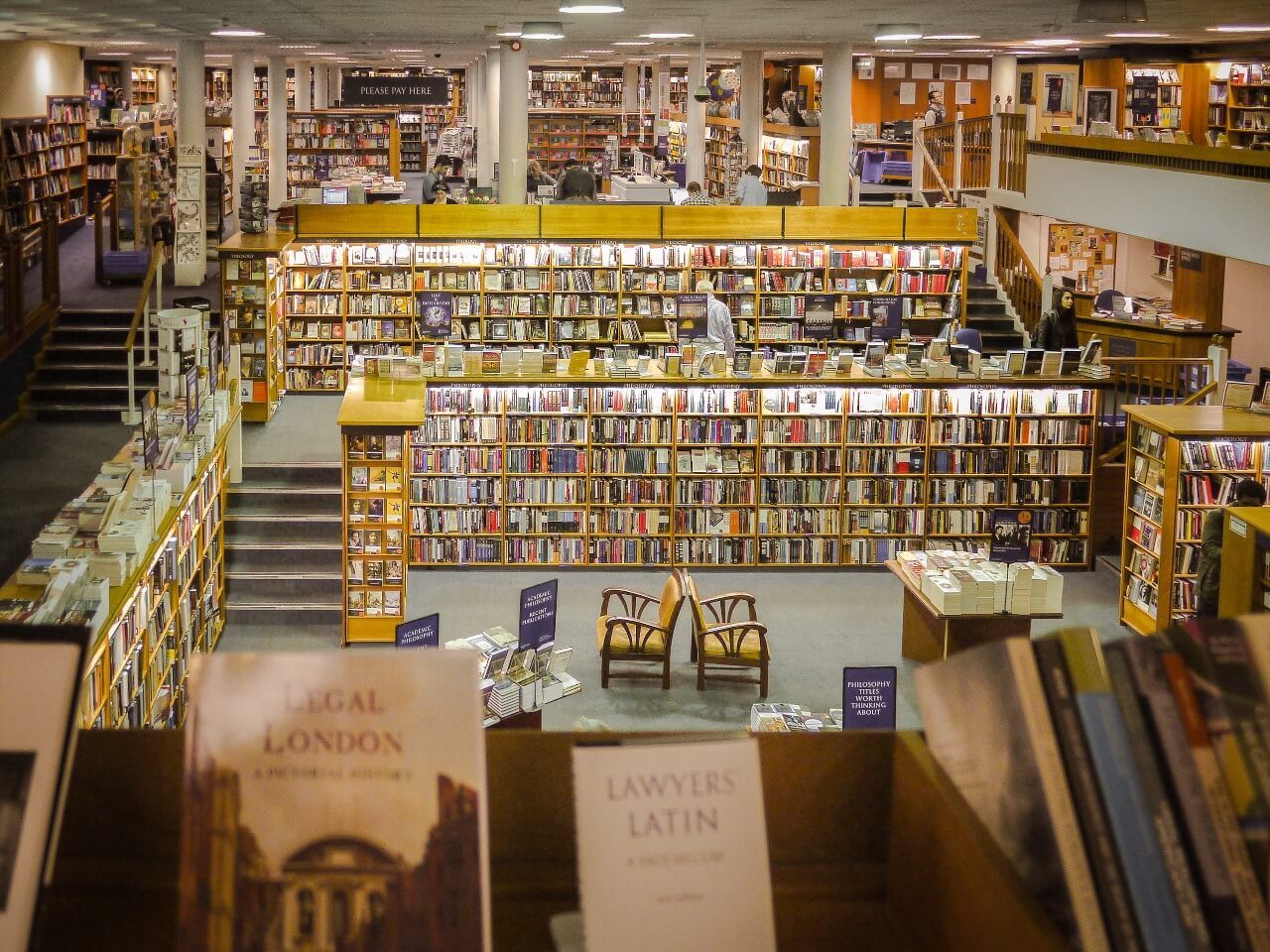
Blackwell's (48-51 Broad Street, Oxford OX1 3BQ, rated 4.8/5 on Google (1 039 avis)) on Broad Street has been selling books from the same address since 1879 and is one of the most famous independent bookshops in the world. The current size is deceptive from the entrance, what appears to be a modest frontage opens into a labyrinth of rooms, stairs, and subject departments that covers several interconnected properties. The Norrington Room in the basement claims to be the largest single room devoted to bookselling in the world: 10,000 square feet, three miles of shelving, and an inventory that runs to several hundred thousand titles.
The Oxford Brookes and University student population keeps the academic sections genuinely up to date; the travel section is legitimately one of the best in England. Blackwell's hosts regular author events, many free. Even if you don't buy anything, and that takes considerable discipline, browsing Blackwell's is a legitimate Oxford experience.
32. The Oxford Union
The Oxford Union (St Michael's Street, Oxford OX1 2DU, rated 4.4/5 on Google (151 avis)) was founded in 1823 and has since functioned as a debating society, a political training ground, and one of the world's most recognisable student institutions. Its members' list reads like a catalogue of 20th-century political life: eleven British Prime Ministers, dozens of Presidents and Prime Ministers elsewhere, plus a roster of writers, journalists, and public intellectuals. The Oxford Union chamber has hosted debates argued by Malcolm X, Mother Teresa, Albert Einstein, Richard Nixon, and the Dalai Lama.
Non-members cannot attend debates, but the Union building on St Michael's Street is worth knowing about for its Pre-Raphaelite murals in the library, painted by William Morris, Dante Gabriel Rossetti, and Edward Burne-Jones in 1857. The murals deteriorated rapidly due to the artists' inexperience with fresco technique, but restoration work has preserved their essential character. Check the Union's public lecture programme; occasional public events do open the space to non-members.
33. The Headington Shark
On a residential street in the suburb of Headington, a 7.6-metre fibreglass shark plunges headfirst into the roof of a terraced house as if it fell from the sky. It did, in a manner of speaking: sculptor John Buckley installed the piece, officially titled Untitled 1986, on 9 August 1986, the 41st anniversary of the Nagasaki atomic bomb, as a statement about the powerlessness of the individual in the face of violence. The owner, Bill Heine, fought the local council for six years before the Secretary of State ruled in his favour and granted planning permission in 1992. The shark remains. The house is private, but the sculpture is visible from the pavement. Take the number 8 or 10 bus from Oxford city centre to the Headington shops stop.
34. South Park Viewpoint
South Park (Morrell Avenue, Oxford OX4 1NQ, rated 4.6/5 on Google (1 988 avis)) sits on a ridge east of the city centre, and the view west from its upper meadow is the closest Oxford gets to a panoramic skyline shot. The full sweep of the dreaming spires, Magdalen Tower, the Radcliffe Camera dome, the University Church spire, Merton's medieval tower, and the distant suggestion of the Bodleian, aligns from this vantage point in a way that no city-centre position replicates. The park is free, open all day, and reached on foot from Headington Road or by bus. Sunset on a clear evening here is difficult to improve upon.
35. Oxford's Pubs and Real Ale Culture
Oxford's pub culture deserves serious attention, not as a footnote to the academic sites but as a distinct strand of the city's history. The concentration of medieval and early modern taverns in the city centre is matched almost nowhere else in England, and several of the pubs that survive have histories that intersect directly with the intellectual and literary life of the university.
The Eagle and Child (49 St Giles' Street, Oxford OX1 3LU, rated 4.3/5 on Google (2 195 avis)) (St Giles' Street) is already mentioned in relation to the Inklings, but its claim on literary history is real: this is where Tolkien read The Lord of the Rings aloud in instalments before publication, and the back room retains the low ceilings and cramped seating that shaped those sessions. The Bear Inn on Alfred Street dates from 1242 and claims to be the oldest pub in Oxford, the interior is hung with hundreds of tie fragments, collected since 1954, from visiting academics, alumni, and a complete set of Oxford University club ties. The Turf Tavern, hidden down Bath Place off Holywell Street, dates from the 13th century and was the setting for Bill Clinton's famous claim that he "didn't inhale" during his Rhodes Scholar years in Oxford. Former US President Clinton was a regular here in the early 1970s.
The Lamb and Flag on St Giles', directly opposite the Eagle and Child, was Tolkien's preferred pub for later years and is still owned by St John's College, with profits funding graduate student bursaries. The White Horse on Broad Street, wedged between two halves of Blackwell's Bookshop, is the smallest and possibly the most atmospheric, with a fireplace that creates conditions in which it becomes genuinely difficult to leave.
For real ale specifically, The Rusty Bicycle on Magdalen Road in Cowley and Tap Social Movement on Oxford's canal wharf offer contemporary craft output alongside the historic pubs. Oxford's CAMRA branch organises an annual Oxfordshire Beer Festival, typically in October. A pub walk linking the city-centre historic taverns takes around three hours and costs whatever you choose to spend at each stop, several of the best pubs, including the Turf Tavern, require a degree of intentional navigation to reach, which filters the crowd considerably. Round off your Oxford visit with Ryo's audio guide, which covers several of the historic pub sites alongside the university landmarks, giving the full picture of a city that has always been as much about conversation as scholarship.
FAQ
How many days do you need to visit Oxford?
Two full days cover the main highlights comfortably: the key university buildings, two or three museums, punting, and one day trip to Blenheim Palace. One day is enough for a first impression if you prioritise ruthlessly, Christ Church, the Bodleian, Ashmolean, and the Covered Market form a coherent single-day route. Three days allows you to add the outlying suburbs (Headington Shark, Cowley Road, South Park) and explore the rivers properly.
Is Oxford expensive to visit?
Oxford has a reputation for expense, but the reality is more nuanced. The majority of the city's museums, the Ashmolean, Pitt Rivers, University Museum of Natural History, Museum of Oxford, Weston Library, History of Science Museum, are entirely free. University college entries typically run £5-£19 per person. The biggest single cost is usually accommodation, which is genuinely expensive relative to most English cities outside London. Blenheim Palace (£35 adults) is the most significant paid attraction.
Can you visit Oxford University for free?
Yes, partially. Several colleges open their grounds to the public at no charge during specific hours, New College, Merton, and Balliol are among those with regular free access. Christ Church (£19), Magdalen College (£8), and a few others charge admission. The university buildings in Radcliffe Square, the Radcliffe Camera exterior, the Sheldonian exterior, the Old Schools Quadrangle, are all freely viewable from the public streets and squares surrounding them.
What is Oxford most famous for?
Oxford is most famous for its university, the oldest in the English-speaking world, founded in the 12th century. Beyond the academic reputation, the city is known for the dreaming spires skyline, its role in the Harry Potter films and C.S. Lewis's Narnia series, J.R.R. Tolkien's connection to the landscape that inspired Middle-earth, Lewis Carroll's Alice in Wonderland, and punting on the Cherwell.
Is Oxford worth visiting as a day trip from London?
Absolutely. Oxford is 56 miles from London Paddington by rail, with fast trains taking around 55 minutes and running every 30 minutes. The city centre is compact enough to walk between most sites without transport. A day trip allows time for the core university buildings, one or two museums, and lunch at the Covered Market. The evening train back is often under an hour, making Oxford one of the most logistically straightforward day trips from the capital.
When is the best time to visit Oxford?
May and June offer the most atmospheric conditions: college gardens are in full bloom, punting is at its busiest, and the university is in term-time with students in evidence. The trade-off is that these months also bring the largest tourist volumes. Late September and October are quieter, with excellent autumn colours in the parks and gardens. July and August are busy but functional; January and February are the quietest months, with shorter opening hours at some colleges but considerably smaller crowds.
Oxford rewards patience and curiosity in roughly equal measure. The city works as a day trip and deepens considerably over two or three days, and the things to do in Oxford keep multiplying the longer you stay, there is almost no point at which you exhaust what it has to offer. For a structured way into its layered history, architecture, and literary connections, the Ryo Oxford audio guide narrates the dreaming spires from the ground up, covering the sites and the stories that sit behind them in equal measure. Download it before you arrive and let the city explain itself.