© Shutterstock
 Votre guide Ryo
The 10 Must-Do Things in Guernsey
Nestled in the English Channel, just a stone's throw from the Norman coast, Guernsey is much more than a simple Anglo-Norman island. Nicknamed the 'green island', it attracts thousands of travelers each year who come to discover its wild beaches, millennial history and Celtic-looking landscapes. Between memories of Victor Hugo, medieval fortifications and fiery sunsets over its golden sand coves, visiting Guernsey offers a complete change of scenery, just a ferry ride away from Saint-Malo. Here are the 10 must-do things in Guernsey to fully enjoy this exceptional destination.
1. Cobo Bay, a Postcard Beach
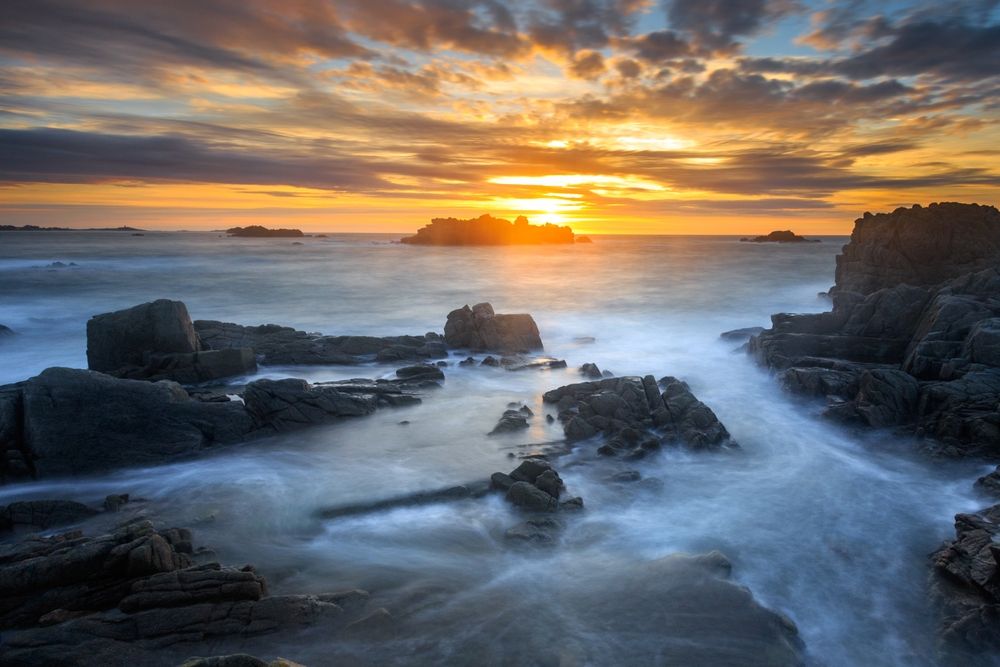
To start your stay in Guernsey on the right foot, head to the west coast and its gem: Cobo Bay (Côbo Coast Rd, Guernsey — rated 4.8/5 on Google for 99 reviews). This bay is among the most beautiful beaches on the island, and for good reason: its golden sand stretches for several hundred meters, framed by rocks with pink reflections that the setting sun transforms into an impressionist painting. The water is crystal blue and the sea's transparency invites swimming from the first sunny days.
Cobo Bay is regularly compared to a Caribbean beach — minus the heat, certainly, but with a wild and authentic charm that major seaside destinations have often lost. It's also the ideal place to witness one of Guernsey's most spectacular sunsets, when the sky blazes over the Atlantic. Romantic and soothing, this place is worth the detour alone.
2. Castle Cornet, Historic Sentinel of Saint-Pierre-Port
Impossible to visit Guernsey without stopping before the imposing silhouette of Castle Cornet (Castle Emplacement, Guernsey GY1 1AU — rated 4.6/5 on Google for 1,276 reviews). Built in the 13th century on a former rocky islet in the port of Saint-Pierre-Port, it is now connected to the island by a breakwater and constitutes one of the most emblematic monuments of the Channel Islands. Eight centuries of history are condensed here, from Norman defense to successive occupations by French and English troops, up to World War II when the German army took it over in turn.
Inside, the castle houses no fewer than five museums tracing the military, maritime and civil history of Guernsey. Each midday, a cannon firing ceremony brings visitors together around two guards in period costume — a moment of spectacle appreciated by all. The castle gardens, carefully maintained, offer a pleasant walk, while the ramparts reveal an unbeatable panoramic view of Saint-Pierre-Port and the surrounding islands of Herm, Sark and Alderney. A must-see visit during your stay in Guernsey.
3. Hauteville House, Victor Hugo's House of Exile
Guernsey and Victor Hugo are linked for eternity. From 1856 to 1870, the writer made Hauteville House (38 Hauteville, Guernsey GY1 1DG — rated 4.5/5 on Google for 629 reviews) his home and creative retreat, after being chased from Jersey for his criticism of Queen Victoria. In this house overlooking the heights of Saint-Pierre-Port, Hugo imposed a rigorous work routine, writing each morning in his legendary Glass Room — an open-air room from which he overlooked the port and the islands of the Channel.
It was here that some of the masterpieces of French literature were born: Les Misérables, Les Travailleurs de la mer — a novel offering a vibrant tribute to the inhabitants of the Channel Islands — but also a large part of La Légende des siècles. Hugo decorated each room himself with meticulous care, mixing carved wood, Chinese ceramics, hangings and personal symbols in a baroque and abundant universe. The house, bequeathed to the City of Paris in 1927 by his descendants, is now a museum open to the public (guided tours only, by reservation, from May to September). An absolutely essential cultural stop in Guernsey.
Download the audio-guided tour to explore Saint-Pierre-Port on foot and independently
To explore Saint-Pierre-Port and discover all the secrets of Guernsey's capital without getting lost, the Ryo audio-guided itinerary is your best travel companion. At your own pace, in complete freedom, the circuit guides you street by street, revealing the history and anecdotes of the most emblematic places. From Hauteville House to the lively waterfront, each step becomes a discovery.
4. La Petite Chapelle, a Mosaic Jewel
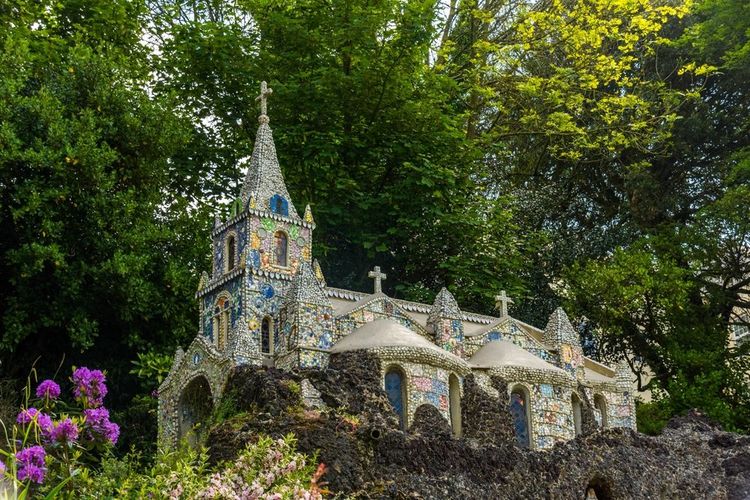
Nestled in the greenery of Les Vauxbelets village, La Petite Chapelle (Les Vauxbelets, Saint-André, Guernsey — rated 4.7/5 on Google for 774 reviews) is one of the most endearing curiosities you can admire during a stay in Guernsey. Built in 1920 by Brother Déodat-Antoine, a religious brother from the Christian Brothers, this miniature chapel was inspired by the sanctuary of Lourdes. Its particularity? Its exterior walls are entirely covered with pieces of porcelain, pebbles, shells and pottery shards, offering a shimmering spectacle from every angle.
La Petite Chapelle is one of the smallest chapels in the world, yet it radiates an extraordinary presence. Over the decades, the inhabitants of Guernsey have contributed to beautifying it by depositing their own porcelain fragments. This place of meditation, both sacred and artistic, testifies to the deep connection between Guernseymen and their religious heritage. Entrance is free and the chapel is open every day. A gentle and luminous stop in your exploration of Guernsey.
5. Strolling in Saint-Pierre-Port, Guernsey's Lively Capital
Saint-Pierre-Port is a human-sized capital that lacks neither style nor character. Perched amphitheater-style on the east coast of the island, it reveals its cobbled streets, colorful facades and picturesque port where yachts and old rigging accumulate. The waterfront, animated with terraces and duty-free shops, invites strolling, while covered markets overflow with local products: Guernsey cheeses, seafood and island specialties.
The town is pleasantly visited on foot, climbing to the heights to enjoy spectacular views of the port and neighboring islands.
6. Candie Gardens, Victorian Garden Suspended Over the Port
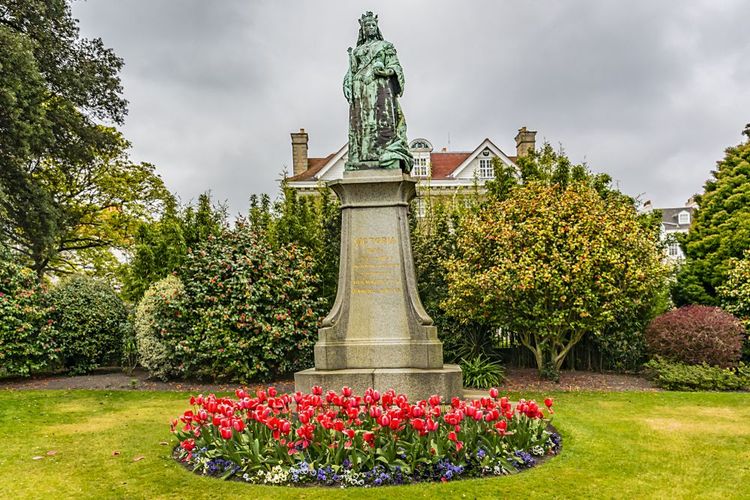
Just a few minutes' walk from the center of Saint-Pierre-Port, Candie Gardens (Candie Gardens, Guernsey GY1 1DA — rated 4.6/5 on Google for 70 reviews) are one of the green lungs of Guernsey's capital. This magnificent Victorian garden, arranged on two levels at the edge of a cliff, offers a breathtaking panoramic view of the port, Herm island and the distant silhouettes of Sark and Alderney. Tropical and subtropical plants thrive there thanks to the island's mild and humid microclimate — a true setting of greenery and colors.
At the heart of the garden stands the famous granite statue of Victor Hugo, created in 1914 by sculptor Jean Boucher. His gaze turned toward the sea, the poet seems to contemplate the horizon from his island of exile. Right next door, the Guernsey Museum offers a permanent collection on the island's history and archaeology, as well as a regularly renewed art gallery. Garden entry is free and accessible every day from dawn to dusk — the ideal meeting point for a contemplative break during your stay in Guernsey.
7. The Islands of Herm and Sark, Island Escapes from Guernsey
One of Guernsey's great riches is being surrounded by small islands accessible within a few dozen minutes by ferry from the port of Saint-Pierre-Port. Among them, two stand out for their exceptional character: Herm and Sark.
Herm is the smallest inhabited Channel Island, and perhaps the most paradisiacal. In just 20 minutes by ferry, you land in a world without cars, without noise, with only grassy paths, pristine beaches like Shell Beach and a desert island atmosphere within reach. Sark, meanwhile, is also devoid of motor cars — the island can only be visited on foot, by bike or by carriage. Its steep cliffs, wild panoramas and preserved feudal traditions make it a unique destination in Europe. Daily ferries connect these two islands to Saint-Pierre-Port throughout the tourist season. An essential excursion during your vacation in Guernsey.
8. Guernsey's Wild Beaches, Between Cliffs and Secret Coves
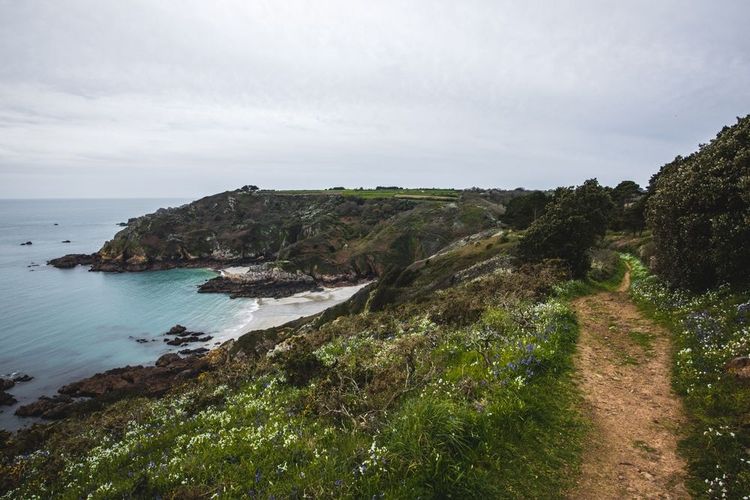
Guernsey is full of superb beaches, often preserved and little frequented, which reward explorers. Each coast of the island has its own personality.
To the south, Petit Bôt Bay nestles at the bottom of a wooded valley, framed by green cliffs. Accessible via a wooded path, this intimate cove is one of the most beautiful on the island. To the west, Vazon Bay is a long stretch of fine sand recognized as one of the cleanest beaches in the United Kingdom. Open to the wind and Atlantic swells, it's ideal for surfing, kiting and water sports. Further north, Port Soif is renowned for its sheltered waters and tranquility, perfect for families in summer. During your stay in Guernsey, try to explore at least two or three of these beaches to appreciate their full diversity.
9. Moulin Huet Bay and Renoir's Path
In the southeast of the island, Moulin Huet Bay is associated with one of the most fascinating episodes in art history. In the summer of 1883, Impressionist painter Pierre-Auguste Renoir stayed on the island for six weeks and created about fifteen canvases from the rocks and heights overlooking this bay, seduced by the unique light of the Channel and the color of the water. His paintings are now found in the world's greatest museums, from London's National Gallery to New York's Metropolitan Museum of Art.
The Renoir Trail invites you to follow in his footsteps from the heights of the coast. Five empty steel frames are installed at the exact locations where Renoir placed his easel, allowing you to mentally superimpose the paintings onto the real landscape — a unique artistic and sensory experience. The walk lasts about an hour and is done as a round trip from the site's parking. A poetic moment to close a beautiful day of discoveries in Guernsey.
10. Les Fouaillages, Europe's Oldest Megalithic Site
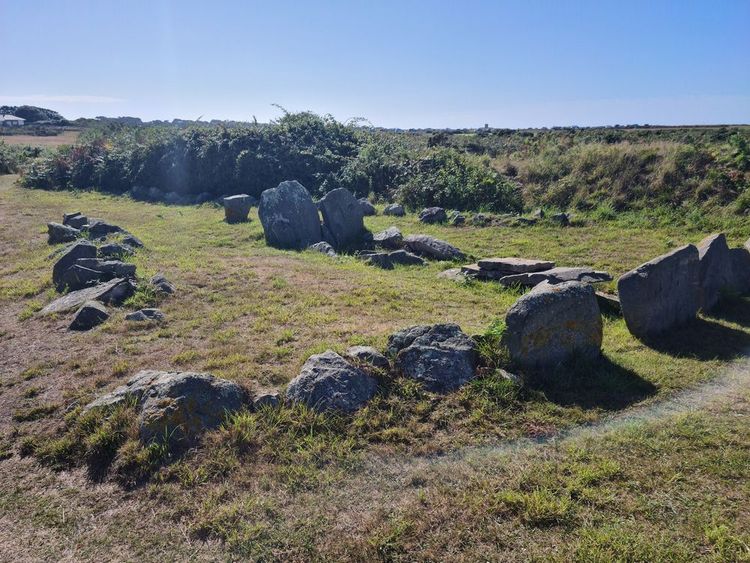
Prehistory enthusiasts will be delighted by a visit to Les Fouaillages (FFW6+XV, Guernsey — rated 4.5/5 on Google for 4 reviews), an exceptional megalithic site located in the north of the island, at L'Ancresse. Dating from nearly 6,000 years before our era, this tumulus formed of two dolmens is considered one of the oldest funeral monuments built by man in Europe. Discovered in 1977 during development work, it has since been the subject of numerous archaeological excavations that have yielded flint tools, ceramics and traces of ancient habitation.
The site, freely accessible and signposted, can be visited in a few minutes but deserves careful observation. It is part of a larger ensemble of megalithic monuments scattered across the island: the Déhus dolmen, La Varde... Silent testimonies of a Neolithic civilization that made Guernsey one of its ritual high places. A journey through time to perfectly conclude your tour of the must-do things in Guernsey.
In conclusion, Guernsey is an island that must be earned and never disappoints. Between its wild beaches, exceptional historical heritage, deep connections to French literature and neighboring islands accessible in a few paddle strokes, it offers a palette of experiences as rich as it is varied. Whether you're a lover of nature, history or culture, you'll find on this Anglo-Norman island enough to feed your curiosity for several days.
FAQ – Visiting Guernsey
How to get to Guernsey from France?
Several maritime connections allow you to reach Guernsey from the French coast. The crossing from Saint-Malo is the most direct (about 2 hours), but ferries also depart from Granville (with a stopover in Jersey) and Diélette during the summer season. By air, you need a stopover from France, usually in London or Southampton. Remember to bring your passport, as Guernsey is not in the Schengen area.
What's the best time to visit Guernsey?
The summer season, from June to September, is ideal for enjoying beaches and water activities. Spring (April-May) offers green nature and fewer crowds. Autumn remains pleasant for coastal hikes. Outside the season, some sites like Hauteville House close their doors (generally from October to April).
What currency to use in Guernsey?
Guernsey has its own currency, the Guernsey pound, whose value is identical to the British pound sterling. Euros are generally not accepted in local shops. Consider changing your currency before leaving or on the ferry by taking advantage of duty free.
How to get around Guernsey?
The island has a good bus network (£1 per journey) serving the main attractions. Bike rental (or electric bike) is very popular and allows you to explore the coasts at your own pace. Car rental is possible from age 21 with a valid license — be careful, speed is limited to 56 km/h throughout the island.
How many days are needed to visit Guernsey?
A 3-day weekend allows you to cover the island's main sites and visit Saint-Pierre-Port in depth. To fully enjoy the neighboring islands (Herm, Sark) and coastal hikes, count 5 to 7 days. Guernsey is not crossed quickly: it's to be savored.