
Créé par Romane, le 16 mai 2026
Votre guide Ryo
© Shutterstock
Chicago does not ease you in gently. The skyline hits you across the water before you've even crossed city limits, and the wind off Lake Michigan makes sure you know you've arrived somewhere serious. But here's what most travel lists miss: the city is as playful as it is monumental. You can spend a morning watching free jazz at a public park, an afternoon suspended 103 floors above the Loop in a glass-floor box, and an evening in a century-old blues club where the bartender knows the musicians by name. If you want fun things to do in Chicago, and you want depth, not just a checklist, you're in the right place. The Ryo audio guide for Chicago takes you through the city's most storied streets with narration built around the history and characters that shaped them, and it pairs well with everything in this list.
Expect surprises. The Field Museum holds 40 million specimens including the largest T. rex skeleton ever found. The Chicago Architecture Center runs boat tours where you drift under 52 movable bridges while a guide explains why the Chicago River once flowed backward, and still does. Lincoln Park Zoo is one of the last free urban zoos in the country, open 365 days a year. And the improv comedy tradition here is so deeply rooted that it gave the world Tina Fey, Stephen Colbert, and Bill Murray, all of whom trained at Second City before anyone knew their names. Chicago rewards you when you go beyond the obvious.
1. Millennium Park and Cloud Gate
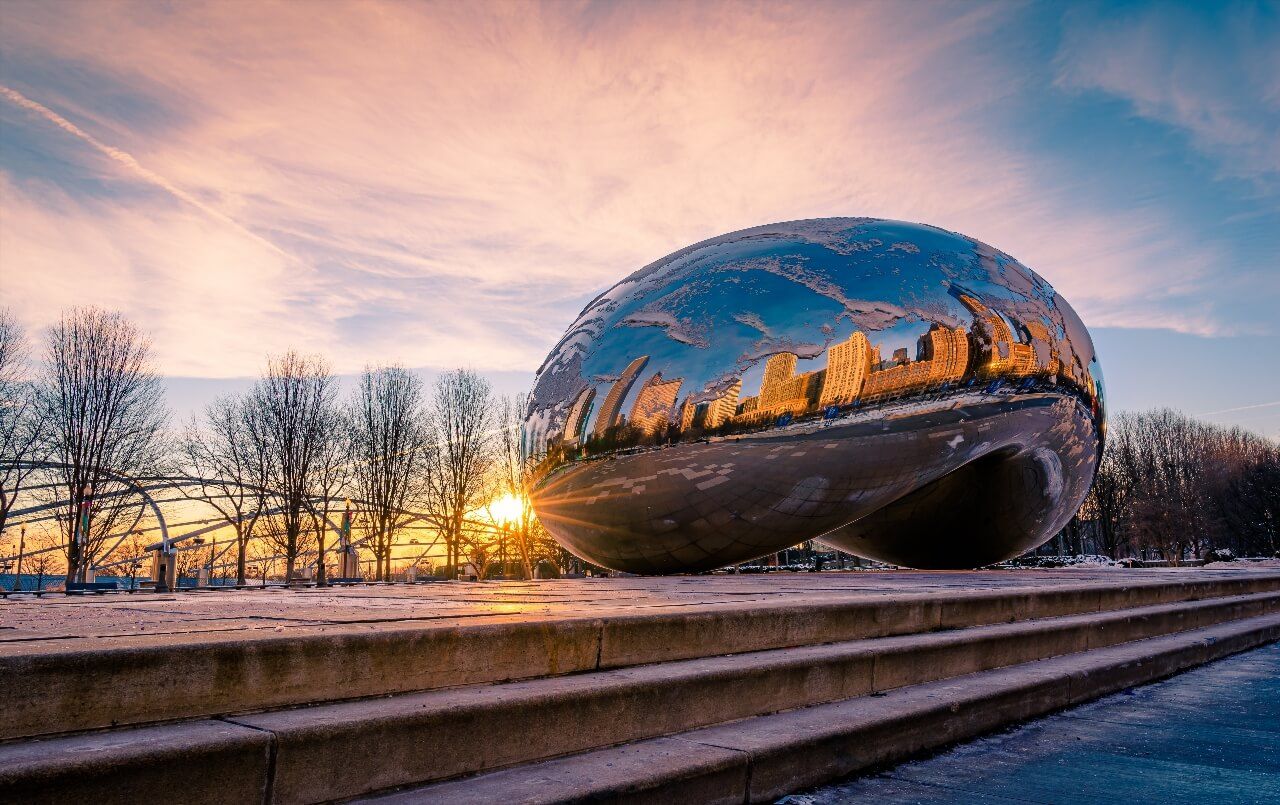
There is almost no better introduction to Chicago than standing in Millennium Park (201 E Randolph St, Chicago IL 60601, rated 4.8/5 on Google (62K reviews)) and watching the skyline reflect across the polished surface of Cloud Gate. Anish Kapoor's 110-ton stainless-steel sculpture, universally known as « The Bean », distorts the cityscape into something liquid and surreal, and no photograph really prepares you for the scale of it. The park itself opened in 2004 on what had been a rusting rail yard for over a century, and it now draws more than 12 million visitors a year, making it the most visited park in the American Midwest.
Beyond the Bean, Millennium Park is genuinely packed with things worth your time. The Jay Pritzker Pavilion, designed by Frank Gehry, has 4,000 fixed seats and a great lawn that holds another 7,000 people for the free outdoor concerts that run all summer. The Crown Fountain, two 50-foot glass-brick towers that project faces of Chicago residents and spout water between them, doubles as a wading area for kids in July and August. In winter, the park's skating rink is free to use (you rent skates separately), and the park stays open year-round.
Arrive early on weekday mornings if you want the Bean to yourself. By 10 a.m. on a summer Saturday, you're sharing the plaza with hundreds of people. The reflection at sunrise, when the towers are gold and the lake is still dark, is worth the early alarm.
2. The Art Institute of Chicago
The Art Institute of Chicago (111 S Michigan Ave, Chicago IL 60603, rated 4.8/5 on Google (37 843 avis)) consistently ranks among the top five art museums in the world, and the collection justifies every superlative. The building itself, a Beaux-Arts monument on Michigan Avenue flanked by two bronze lions installed in 1894, has been the backdrop for everything from Ferris Bueller's visit to Georges Seurat's monumental A Sunday on La Grande Jatte to real-life proposals, first dates, and school field trips that accidentally change the course of someone's life.
The permanent collection spans 5,000 years of human creativity across more than 300,000 works. The Impressionist and Post-Impressionist galleries hold Monet's haystacks series, Picasso's The Old Guitarist, Grant Wood's American Gothic, and Edward Hopper's Nighthawks, four works that you have likely seen reproduced so many times that seeing the originals is briefly disorienting. The modern wing, designed by Renzo Piano and opened in 2009, adds natural light and a pedestrian bridge that connects directly to Millennium Park.
General admission runs $25 for adults, with free entry on Thursday evenings from 5 to 8 p.m. (a genuinely well-kept secret that locals rely on). Plan for at least three hours, and download the museum's free app before you arrive, it has audio commentary for the major works that is noticeably better than the standard audio tour.
3. Navy Pier
Navy Pier (600 E Grand Ave, Chicago IL 60611, rated 4.6/5 on Google (87 274 avis)) stretches 3,300 feet into Lake Michigan and has been Chicago's most-visited attraction for over two decades. Built in 1916 as a municipal shipping dock and entertainment venue, it has been progressively reinvented, most recently in 2016 for its centennial, into a mix of restaurants, entertainment spaces, a children's museum, an IMAX theater, and the Centennial Wheel, a 200-foot Ferris wheel with enclosed gondolas that gives you one of the better views of the Chicago skyline available without paying for a skyscraper observation deck.
The pier works best if you treat it as a launching point rather than a destination in itself. Sailboat and speedboat cruises depart from the south dock throughout the day, and the water taxi that connects Navy Pier to the Riverwalk is both practical and scenic. On Wednesday and Saturday evenings during summer, free fireworks launch from the pier at 9:30 p.m.. the show is short but the location means you get the skyline, the lake, and the fireworks all at once.
A few practical notes: parking at Navy Pier is expensive ($35+ for the day). Take the free Chicago trolley from Michigan Avenue, or the CTA bus routes that stop right at the entrance. The crowds peak between noon and 4 p.m. on weekends; arriving before 11 a.m. or after 5 p.m. gives you the same views with far fewer people.
4. 360 CHICAGO Observation Deck
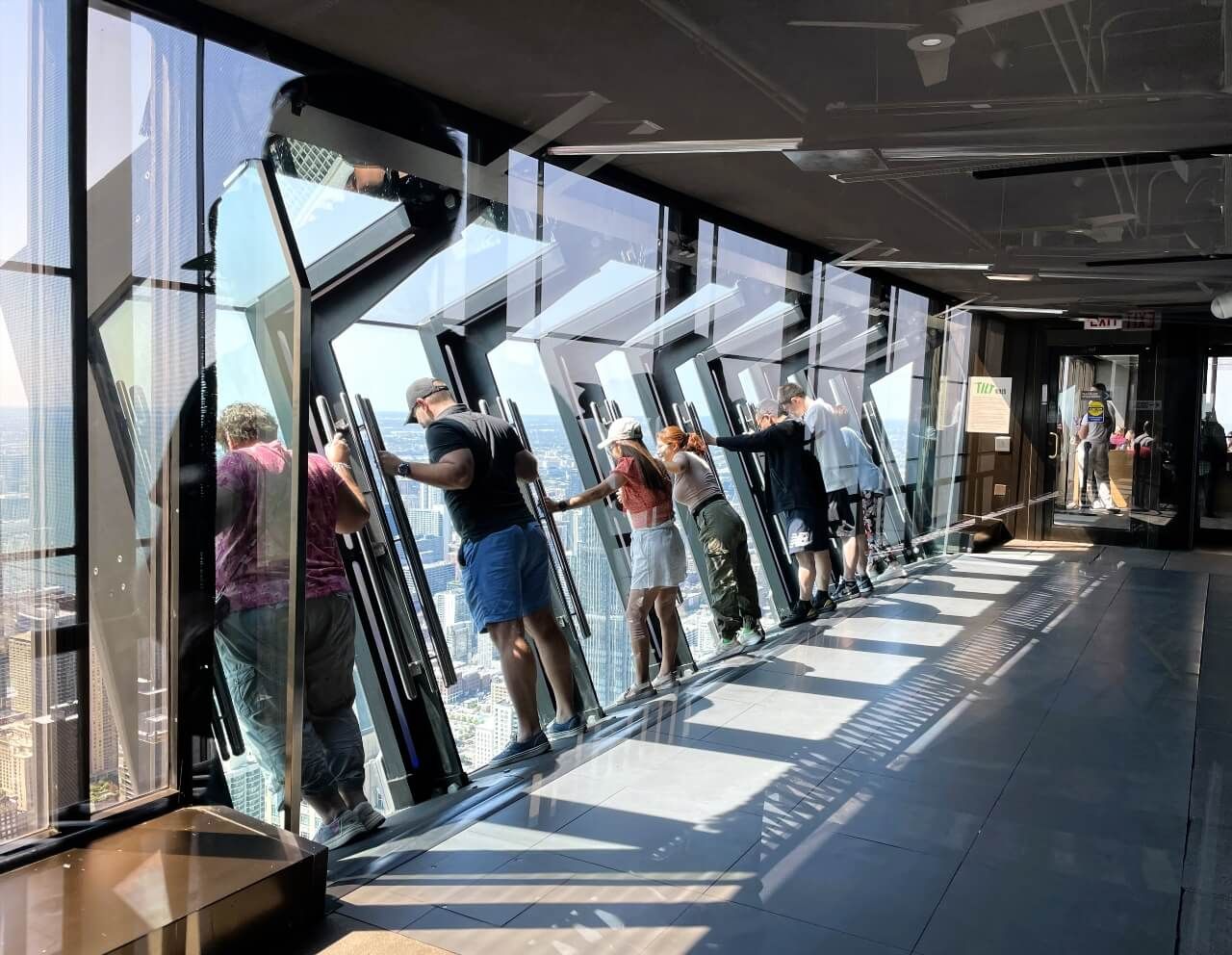
At 875 feet, the 360 CHICAGO (875 N Michigan Ave, Chicago IL 60611, rated 4.5/5 on Google (20 546 avis)) observation deck on the 94th floor of 875 North Michigan Avenue (formerly the John Hancock Center) is the tallest open-air deck in the city, and the views north toward Lincoln Park and Wrigley Field are arguably better than those from the Willis Tower. You're looking along the lakefront rather than over the Loop, which changes the feeling entirely.
The big draw beyond the standard views is TILT, a series of glass panels on the outer wall that slowly tilt outward at a 30-degree angle, extending you horizontally over the street below. It sounds gimmicky, and maybe it is, but the visceral reaction of your body disagreeing with your eyes is genuinely something you won't forget. Tickets run $26 for adults, with a discount if you book online. The deck is open daily until 11 p.m., making it one of the few observation experiences worth doing after dark, when the city's grid of lights stretches to the horizon in every direction.
5. Willis Tower Skydeck
Willis Tower (233 S Wacker Dr, Chicago IL 60606, rated 4.6/5 on Google (36 387 avis)) was the tallest building in the world from its completion in 1973 until 1998, 25 years at the top, which is an almost incomprehensible run in the world of skyscraper records. The Skydeck on the 103rd floor sits at 1,353 feet, and on a clear day you can see four states: Illinois, Indiana, Wisconsin, and Michigan.
The signature experience here is The Ledge, glass-floor boxes that extend 4.3 feet beyond the building's façade, each built from three layers of half-inch laminated glass engineered to hold up to 10,000 pounds. You step onto what appears to be nothing, look down at the street 1,000 feet below, and spend approximately thirty seconds reconsidering every decision that brought you here. Then you realize you're absolutely fine, and you stay for another ten minutes. Children love it. Adults pretend to be calm and then grab the wall.
Tickets run $30 for adults and must be booked in advance during peak season (May through September), walk-up lines can stretch to 90 minutes on busy days. The multimedia exhibition on the Skydeck floor walks you through Chicago's architectural history and the story of the building's construction, and it's worth the extra 20 minutes even if you've already had your fill of floor-to-ceiling views. Go on a weekday morning for shorter queues and cleaner sightlines.
6. Maggie Daley Park
Directly east of Millennium Park and connected to it by a pedestrian bridge, Maggie Daley Park (337 E Randolph St, Chicago IL 60601, rated 4.7/5 on Google (8 527 avis)) is the version of the public park that city planners dream about but rarely achieve. It replaced an aging parking structure and opened in 2015, and it does something genuinely clever: it segments the space so that different age groups each have something unmistakable to do without getting in each other's way.
The climbing walls, two of them, side by side, designed to look like a miniature mountain range, are the most visually striking feature and available free of charge from spring through fall. The mini-golf course (seasonal, small fee) winds through sculptural landscapes. The skating ribbon in winter is longer and more interestingly shaped than the Millennium Park rink, and the light-up path makes it photogenic in a way that standard rinks aren't. This park is where Chicagoans with young children actually spend their weekends, and that local density is part of what makes it worth a visit.
7. The Chicago Riverwalk
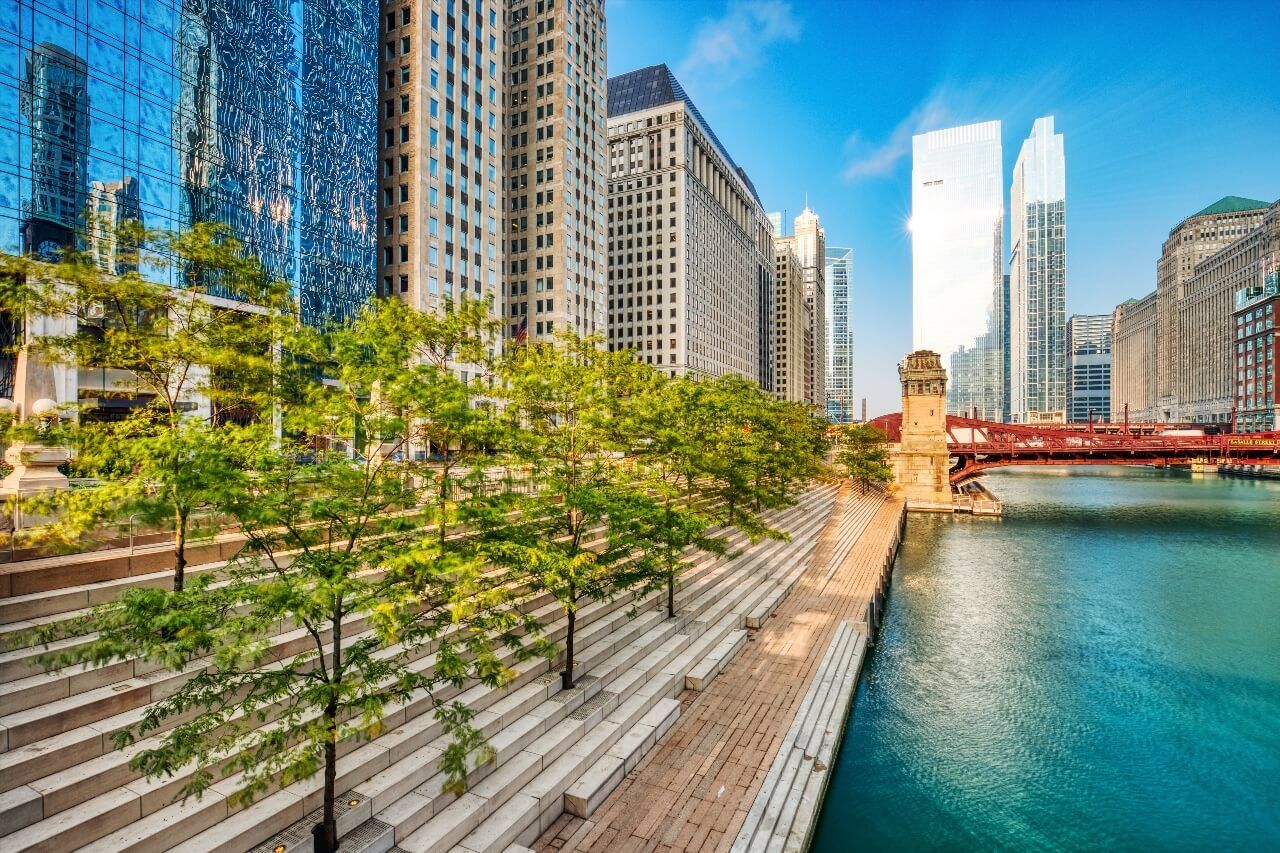
The Chicago Riverwalk (2 W Riverwalk S, Chicago IL 60601, rated 4.8/5 on Google (19K reviews)) is one of the great urban waterfront projects of the last twenty years. Running 1.25 miles along the south bank of the Chicago River from Lake Shore Drive to Lake Street, it was built in stages between 2011 and 2016 and transformed what had been an underused industrial embankment into a series of distinct "rooms", each designed with a specific purpose and character.
There's a boat launch for kayak rentals, a fishing pier, a dog-friendly lawn, an open-air performance stage, a beer garden, and at least a dozen restaurants with outdoor seating at water level. The Chicago Water Taxi connects several Riverwalk stops to Navy Pier and stops further west, and it's one of the best-value experiences in the city: the trip itself is a $6 ferry ride past some of the finest concentration of early 20th-century commercial architecture in the world.
What makes the Riverwalk particularly rewarding is the perspective. Most of Chicago's famous buildings, the Wrigley Building, the Tribune Tower, the Marina City corncobs, are best seen from street level, but the Riverwalk puts you below street level, looking up at their bases and the bridges arching overhead. On a warm evening, the entire walk fills with people eating, drinking, and watching the boats. Forty-five movable bridges cross the river within city limits, and watching even one raise and lower for a passing sailboat is a reminder of how much of the city's infrastructure is still designed to move.
Start at Michigan Avenue and walk west for the best concentration of architecture. The Ryo audio guide for Chicago covers several of the key buildings visible from the Riverwalk with the kind of backstory that makes the facades suddenly readable.
8. Wrigley Field
Wrigley Field (1060 W Addison St, Chicago IL 60613, rated 4.8/5 on Google (35 346 avis)) opened in 1914 and is the second-oldest Major League Baseball park in the country, after Fenway Park in Boston. But visiting Wrigley is not really about baseball, or not only about baseball. It's about a neighborhood that has organized its entire identity around a ballpark for over a century, and the rare case where the surrounding streetscape is as interesting as the venue itself.
The ivy-covered outfield walls are the park's most iconic feature, planted in 1937 by Bill Veeck. The manual scoreboard, operated entirely by hand, is the last of its kind in major league baseball and hasn't been replaced despite decades of pressure. If you're attending a day game (and day games at Wrigley are strongly preferred by most who have done both), arrive on Waveland and Sheffield Avenues an hour before first pitch, the rooftop bars on the buildings across the street are a legal viewing option that the Cubs organization eventually licensed rather than blocked.
Even if baseball isn't your thing, a stadium tour is available on non-game days and takes you behind the dugout, onto the field, and into the press box. The Wrigleyville neighborhood around it, packed with sports bars, diners, and the kind of brick two-flats that define North Side Chicago, is worth an afternoon of wandering regardless.
9. The Field Museum
The Field Museum (1400 S Lake Shore Dr, Chicago IL 60605, rated 4.7/5 on Google (30 254 avis)) is one of those institutions that surprises you with its scale even after you've been warned. The building alone, a Greek Revival marble palace on the Museum Campus at the edge of Lake Michigan, takes a moment to absorb. Inside, the numbers are staggering: 40 million specimens across anthropology, botany, geology, and zoology, of which roughly 1% are on public display at any given time. Founded in 1893 as a legacy of the World's Columbian Exposition, the museum was renamed for retail magnate Marshall Field, whose initial donation of $1 million made the institution possible.
Sue, the T. rex skeleton in the Stanley Field Hall, is the most complete Tyrannosaurus rex ever discovered, with more than 90 percent of her bones recovered. She's been at the museum since 1997, after the Field outbid private collectors at a Sotheby's auction for $8.36 million (backed by Disney, McDonald's, and the California State University system, who underwrote the purchase to keep her in the public realm). Her actual skull, too heavy to display on the mount, sits at eye level in a separate case nearby. Looking at a real 40-foot predator that walked the earth 67 million years ago, with every bone in place, is one of those experiences that recalibrates your sense of deep time in a way that photographs do not.
Beyond Sue, the Ancient Egypt galleries (which include a reconstructed Old Kingdom mastaba you can walk through), the Underground Adventure interactive exhibit (you experience the world at the scale of a small insect), and the Grainger Hall of Gems, which holds the 1,840-carat Tanzanite stone, the largest faceted tanzanite in existence, are all worth dedicated time. The Native North America Hall reopened in 2022 after a years-long redesign in collaboration with tribal advisors, and it represents one of the more thoughtful presentations of Indigenous history at any major American museum. Admission runs $24, $30 for adults, with free or discounted entry on certain Illinois resident days. Allow a full day if you can; most people leave wishing they had more time.
10. Shedd Aquarium
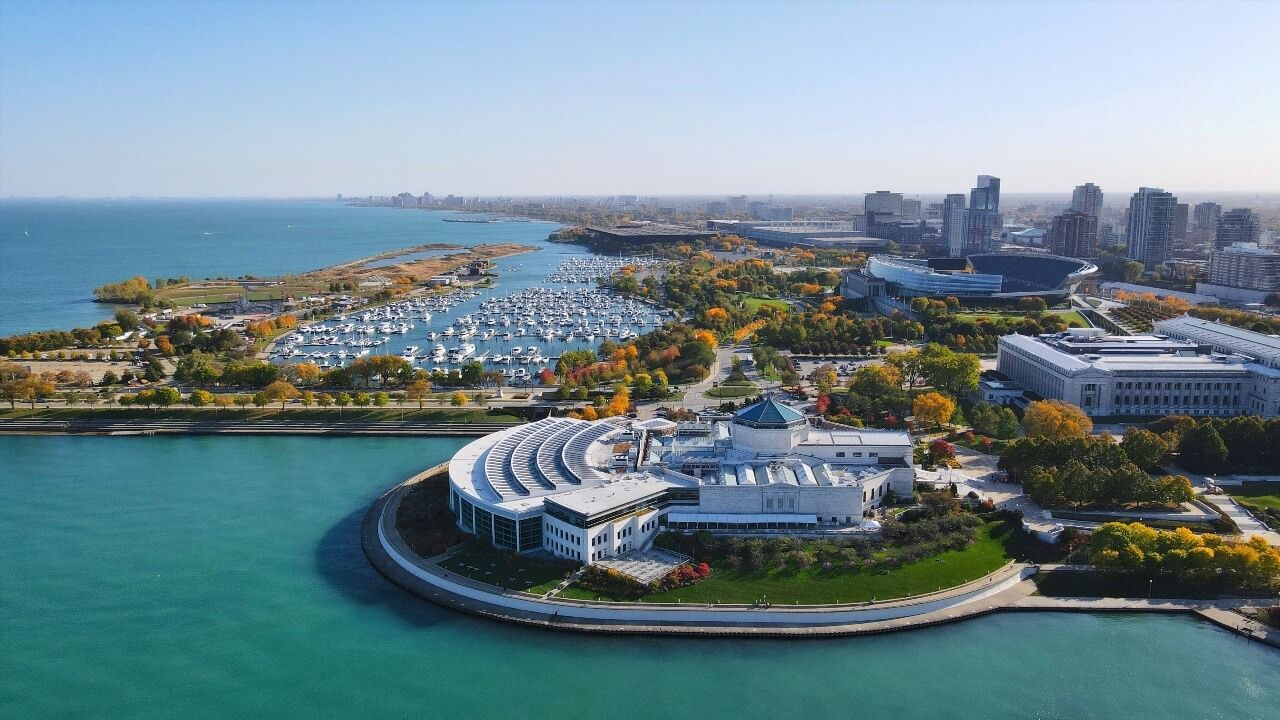
Shedd Aquarium (1200 S Lake Shore Dr, Chicago IL 60605, rated 4.5/5 on Google (32 361 avis)) sits on the Museum Campus between the Field Museum and the Adler Planetarium, and it houses more than 32,000 animals across 1,500 species, making it one of the largest indoor aquariums in the world. It opened in 1930 and has been continuously expanded since, with the current centerpiece being the Abbott Oceanarium: a 3-million-gallon saltwater arena where beluga whales and Pacific white-sided dolphins are the main residents.
What sets Shedd apart from many big-city aquariums is the density of live presentations woven into the experience. The dolphin shows, the 4D theater, and the dedicated coral reef diver presentations that happen throughout the day in the main tank mean there's always something timed to catch. The Wild Reef section, 750,000 gallons of water simulating a Philippine coral reef, with sandbar sharks circling above, is genuinely immersive in a way that even experienced travelers tend to respond to. Admission runs $40, $50 for adults, high for an aquarium, but the breadth of the experience is hard to argue with.
11. Adler Planetarium
The Adler Planetarium (1300 S Lake Shore Dr, Chicago IL 60605, rated 4.2/5 on Google (2 805 avis)) occupies the outermost point of Northerly Island, which means it juts into Lake Michigan and offers one of the most dramatic unobstructed views of the Chicago skyline available anywhere in the city, and that view is free, even if you don't go inside. The planetarium itself, opened in 1930 as the first modern planetarium in the Western Hemisphere, runs several show formats in its two dome theaters, including shows specifically designed for young children and longer, more technical presentations about current astronomical events.
The Digital Theater shows are the main draw, running roughly 45 minutes and projected on a dome that fills your entire field of vision. The café on the lower level has full skyline views through floor-to-ceiling windows. On Free Tuesday afternoons (the first Tuesday of most months), admission to the permanent galleries is waived, the dome show tickets remain payable but at reduced rates. Worth building a Museum Campus day around.
12. Chicago Architecture Center Boat Tour
If you do one thing on this list that you wouldn't ordinarily choose for yourself, make it this. The Chicago Architecture Center (111 E Wacker Dr, Chicago IL 60601, rated 4.7/5 on Google (2 036 avis)) runs river and lake architecture tours that are, without any real competition, the single best way to understand why Chicago looks the way it does and why that matters. The city rebuilt itself from the ground up after the Great Chicago Fire of 1871 at a moment when steel-frame construction and the passenger elevator had just become viable, and the result was a 30-year burst of architectural experimentation that produced the modern skyscraper as a building type. Louis Sullivan, Daniel Burnham, John Wellborn Root, William Le Baron Jenney, the names you'll hear repeatedly on this tour, were not just designers; they were inventing the structural and aesthetic language that every later high-rise on earth would borrow from.
The 75-minute river cruise takes you along both branches of the Chicago River under an almost continuous canopy of historic and contemporary buildings. Your guide, Chicago Architecture Foundation docents are voluntary experts, not tour industry staff, will walk you through the Wrigley Building (1924, Gothic white terracotta), the Tribune Tower (1925, with 120 stones embedded in its base from famous world structures including the Taj Mahal, the Berlin Wall, and the Moon), the Aqua Tower (2009, with undulating floor plates designed to reduce wind turbulence and provide every unit with an unobstructed lakefront view), and dozens more.
What you learn on this tour is not just architectural trivia. It's an urban history class that explains why Chicago's neighborhoods are laid out the way they are, why the river runs backward (reversed by civil engineers in 1900 to prevent sewage from reaching Lake Michigan's drinking water intake, a feat of hydraulic engineering that was considered impossible until it was done), and how a city that burned to nothing in two days rebuilt itself into one of the most photographed skylines on earth. Tickets run $48, $54 for adults and should be booked in advance; the architecture tours fill up days ahead during summer. Evening departures offer the towers lit up against the sky, which is worth the extra planning.
The Chicago Ryo audio walking guide covers several of the same buildings from street level with different historical context, combining the boat perspective with the street perspective gives you a richer read of the city than either alone, and the audio narration keeps your hands free for photographs instead of scrolling through a PDF guidebook.
13. Buckingham Fountain
Buckingham Fountain (301 S Columbus Dr, Chicago IL 60605, rated 4.7/5 on Google (16 714 avis)) in Grant Park is one of the largest fountains in the world. Donated to the city in 1927 by Kate Buckingham in memory of her brother, it circulates 1.5 million gallons of water per hour, and the central jet reaches 150 feet high. The fountain runs mid-April through mid-October, with a free light-and-music show every evening on the hour between 8 p.m. and 11 p.m.
14. Lincoln Park Zoo
Lincoln Park Zoo (2001 N Clark St, Chicago IL 60614, rated 4.6/5 on Google (38 126 avis)) is one of the oldest zoos in North America, founded in 1868 when the Central Park Zoo in New York sent Chicago two swans as a neighborly gift. Today it houses more than 200 species and, critically, charges nothing for admission, a free policy it has maintained since it opened and has no plans to change. This makes it one of the genuinely great gifts the city offers visitors who arrive without a big budget or with children who can't commit to a four-hour museum visit.
The Regenstein African Journey section houses giraffes, gorillas, and African wild dogs in naturalistic habitats. The Pritzker Family Children's Zoo features woodland animals, river otters, brown bears, beavers, in settings specifically designed for children under ten. The zoo is set within Lincoln Park itself, Chicago's largest park at 1,208 acres, which means you can extend the visit into a lakefront walk, a picnic on the grass, or a stop at the nearby Lincoln Park Conservatory, a Victorian glass greenhouse with a palm house, a fern room, and a cactus house, also free to enter.
15. Chicago's Lakefront Trail
Chicago's Lakefront Trail runs 18.5 miles along the shore of Lake Michigan, from Ardmore Avenue in the north to 71st Street in the south, with the lake on one side and the park system on the other for nearly the entire length. It is one of the most used recreational corridors in the United States, with an estimated 100,000 users on peak summer days, and it is almost entirely flat, paved, and separated from automobile traffic.
You don't need to walk or run all 18.5 miles to get the essential experience. The stretch from Fullerton Avenue to Museum Campus (roughly 5 miles) captures the full range of what the trail offers: the sandy beaches at North Avenue and Oak Street, the view of the skyline from the point just north of Navy Pier, the Museum Campus with its three institutions clustered at the water's edge, and the wide grassy lawns of Grant Park. Bikes are available from Divvy, Chicago's bike-share system, at dozens of stations along the route.
One practical note for summer visitors: the trail splits into a pedestrian path and a separate cycling path between Fullerton and Ohio Street. Stay on the correct side, cyclists on this stretch move fast and the separation exists for good reason. Early mornings on the beach sections, particularly at North Avenue Beach, are among the quieter and more atmospheric times in Chicago, with the skyline visible across the water as the city wakes up.
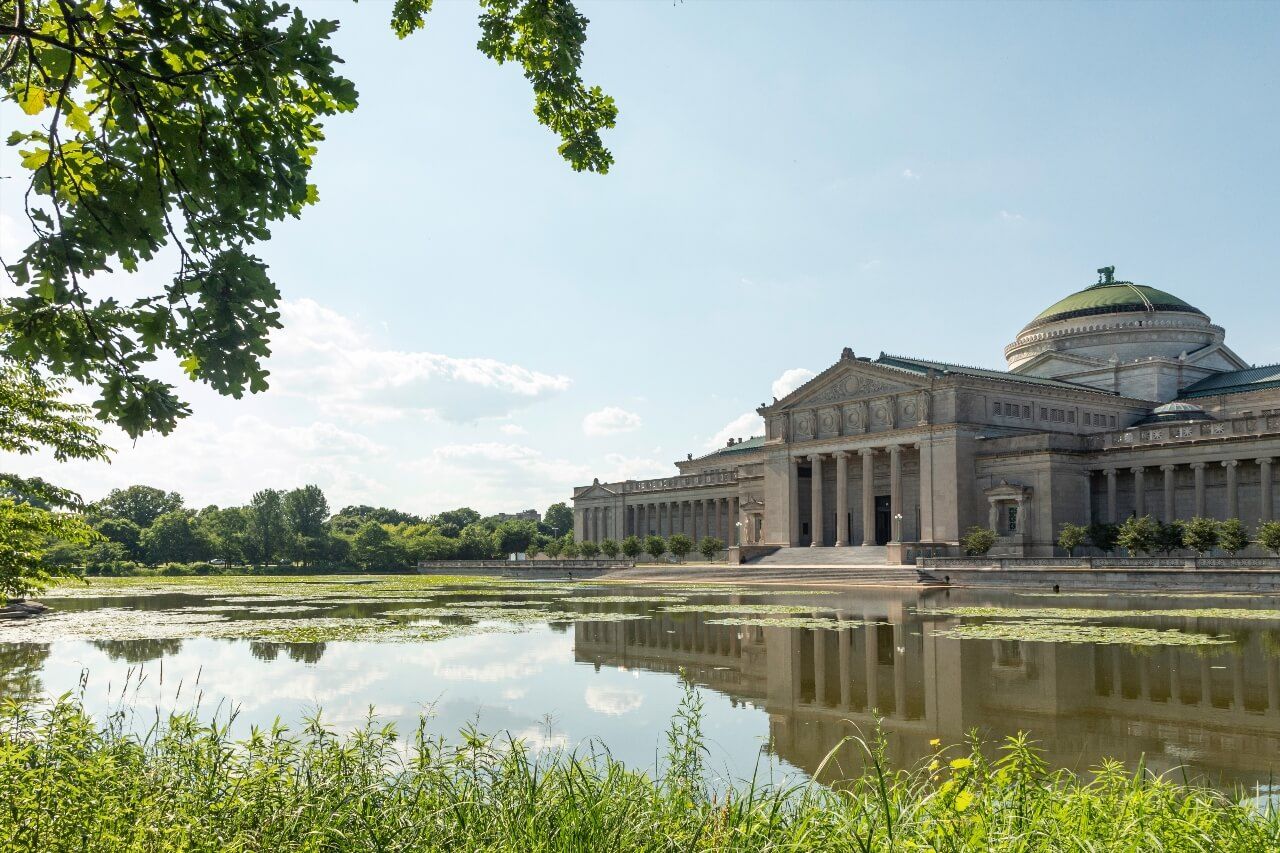
16. Museum of Science and Industry
The Museum of Science and Industry (5700 S Lake Shore Dr, Chicago IL 60637, rated 4.7/5 on Google (34 819 avis)) in Hyde Park is the largest science museum in the Western Hemisphere, housed in the former Palace of Fine Arts from the 1893 World's Columbian Exposition, a building so structurally important that the city refused to demolish it and converted it instead. The exterior alone is worth the trip to the South Side: a neoclassical marble structure that once hosted exhibits for the fair that introduced the Ferris wheel, the zipper, and Cracker Jack to the American public.
Inside, the scale is overwhelming in the best way. The U-505 submarine, a German naval vessel captured during World War II, is displayed in an underground gallery that lets you walk through the actual hull. The Coal Mine experience takes you 50 feet underground in a simulated mine shaft. The Smart Home is a fully functional residence built inside the museum to demonstrate sustainable technology. The Science Storms exhibit features a 40-foot indoor tornado and a 30-foot replica tsunami wave that cycles every few minutes.
The Christmas Around the World exhibit in December, when the museum fills with trees decorated by immigrant communities from over 50 nations, draws visitors from across the Midwest for good reason. Regular admission runs $21, $38 for adults. The museum is about 20 minutes from downtown by the Metra Electric Line, which is both faster and more interesting than the CTA bus alternatives.
17. Giordano's Deep-Dish Pizza
Deep-dish pizza is not just a Chicago cliché, it is a genuinely different food than the flat pizza found everywhere else, and eating it in the city where it was invented carries a context that matters. Giordano's, founded in 1974 by two Sicilian brothers who adapted their mother's stuffed pie recipe to Chicago tastes, is the restaurant that most people mean when they say they want authentic deep dish. The formula involves a buttery crust pressed into a deep pan, a thick layer of mozzarella laid directly on the dough, the fillings, and then the tomato sauce on top (reversed from what you'd expect), which means the cheese doesn't burn and the sauce is fresh-tasting rather than cooked down.
Allow 45 minutes for your pizza to bake after ordering. This is not a place to visit between stops, build it into a relaxed meal. The River North and Loop locations are most convenient for visitors.
18. The Chicago Cultural Center
The Chicago Cultural Center on Michigan Avenue is a public building that most visitors walk past without going inside, which is a genuine mistake. Built in 1897 as the city's main public library, it now hosts free art exhibitions, concerts, and lectures year-round. The interior, specifically the two stained-glass domes in Preston Bradley Hall and the G.A.R. Rotunda, ranks among the finest decorative architecture in the city. The larger dome, 38 feet in diameter, uses Tiffany-style glass. Admission is free.
19. Wicker Park Neighborhood
Wicker Park (1425 N Damen Ave, Chicago IL 60622, rated 4.6/5 on Google (1 257 avis)) in the Northwest Side is the neighborhood that does Chicago's creative reputation the most visible justice. The intersection of Milwaukee, North, and Damen Avenues, known locally as « the Six Corners », is the commercial heart of a district that holds record stores, independent bookshops, vintage clothing boutiques, tattoo studios, gallery spaces, and some of the better restaurant-per-block ratios in the city.
The neighborhood developed in the late 19th century as a wealthy enclave (the mansions along Pierce and Leavitt are still standing and still impressive), was reclaimed by Polish and Puerto Rican communities in the mid-20th century, and went through the creative class transition in the 1990s that produced bands like Smashing Pumpkins and Liz Phair, both of whom recorded their early work in local studios. That layered history, immigrant, working-class, avant-garde, is still readable in the architecture and in the mix of businesses if you know what you're looking for.
The Wicker Park Farmers Market runs on Sundays from June through October at the Wicker Park field house. Spend an afternoon walking south into Bucktown for more of the same energy with slightly more upscale restaurants.
20. Second City Comedy Club
Second City (1616 N Wells St, Chicago IL 60614, rated 4.5/5 on Google (149 avis)) opened on December 16, 1959 in a bar in the Old Town neighborhood, and over the following six decades it trained most of the major figures in American comedy. The list is not short: John Belushi, Bill Murray, Gilda Radner, Dan Aykroyd, Harold Ramis, Tina Fey, Steve Carell, Stephen Colbert, Amy Poehler, Mike Myers. The improv and sketch format that Saturday Night Live eventually popularized was refined here, in a 300-seat theater on North Wells Street, across decades of live experimentation in front of paying audiences.
The main stage show runs Wednesday through Sunday evenings and is a polished revue of topical sketches, physical comedy, and short-form improv. It runs about two hours, tickets cost around $30, $45, and the bar serves throughout. On Friday and Saturday nights, Second City also offers a free improv set following the main show, the cast takes audience suggestions and does 30 : 45 minutes of unscripted work. This is often funnier than the main show and is worth staying for even if you're tired.
If you're more interested in the method than the performance, the Conservatory at Second City offers day workshops and weekend intensives open to the public. These are not targeted at aspiring professionals; they're open to anyone who wants to understand how the form works.
21. Chicago Blues Scene
Chicago didn't invent the blues, that happened in the Mississippi Delta, but Chicago electrified it. When musicians like Muddy Waters and Howlin' Wolf arrived from the South in the 1940s and early 1950s, they plugged in, sped up the rhythm, and built the electric Chicago blues sound that directly influenced rock and roll, soul, and basically everything that followed. The Chicago Blues Festival in June is the largest free blues festival in the world, running three days in Grant Park with multiple stages and hundreds of performers.
Year-round, BLUE Chicago on North Clark Street and Buddy Guy's Legends (700 S Wabash Ave, Chicago IL 60605, rated 4.6/5 on Google (3 628 avis)) on South Wabash are the two clubs with the most consistent live music schedules, running shows most nights from around 9 p.m. Buddy Guy himself, a Rock and Roll Hall of Fame inductee and one of the last living links to the first generation of Chicago electric blues, still performs at his own club several times a year, usually in January during a residency he's kept up for decades. Cover charges typically run $10, $20, and the later you arrive, the better the music tends to be.
22. Garfield Park Conservatory
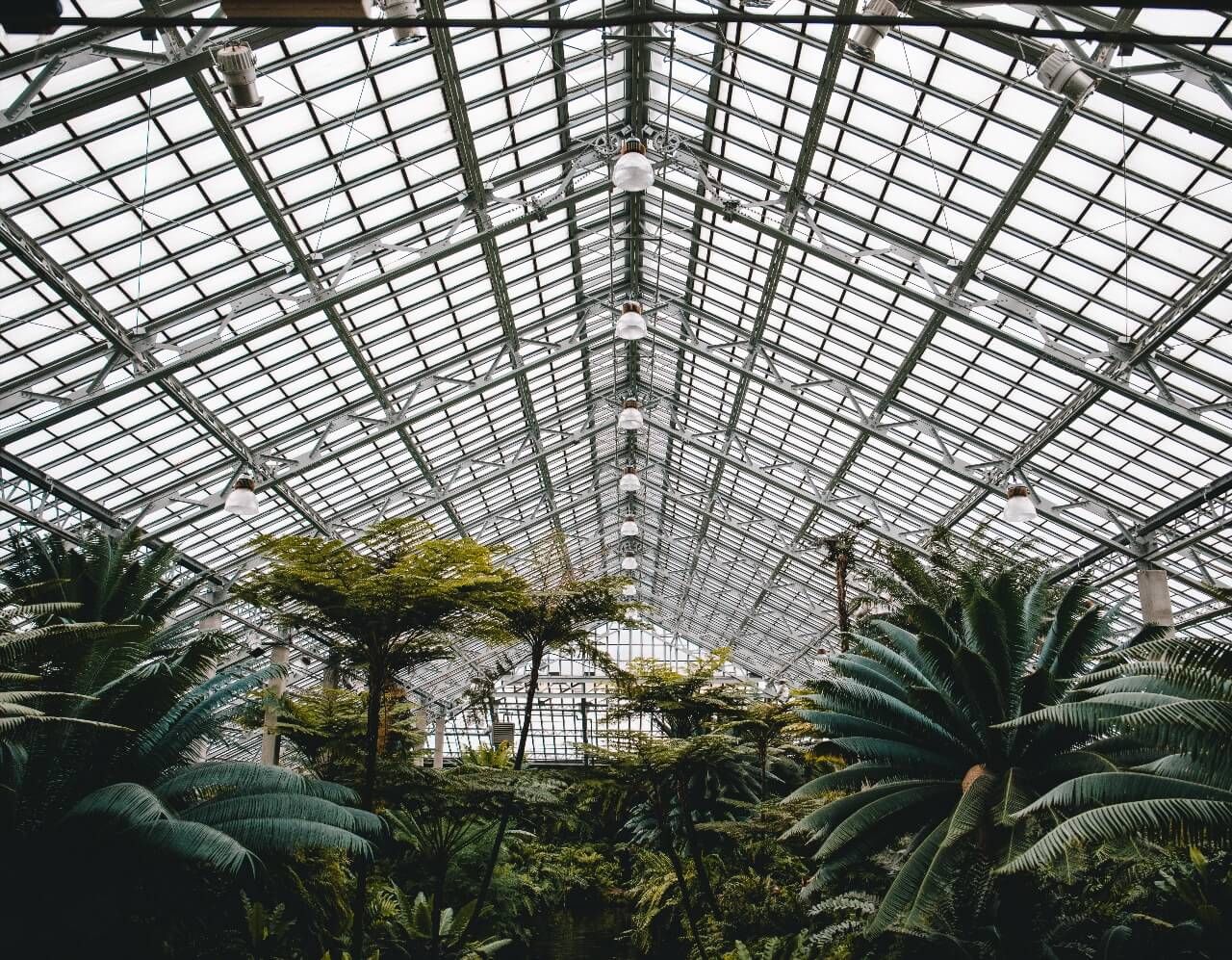
Garfield Park Conservatory (300 N Central Park Ave, Chicago IL 60624, rated 4.8/5 on Google (10 424 avis)), designed by Jens Jensen and completed in 1908, is one of the largest publicly accessible botanical conservatories in the United States. Eight rooms span 4.5 acres of indoor growing space: a Palm House, a Fern Room with species dating to the Carboniferous period, a Cactus House with specimens growing in the same soil since the 1920s, and a Show House of rotating seasonal displays. Admission is free, and the building sits 25 minutes from downtown by CTA Green Line.
23. Kayaking the Chicago River
Seen from a kayak at water level, the Chicago River becomes something else entirely. The buildings that define the skyline from above street level now tower almost vertically over your boat, and the bridges, 45 movable bridges within city limits, more than any other city in the world, frame the views in ways that change every hundred yards. The river is clean enough to paddle safely (a remarkable turnaround from the early 20th century, when it functioned as an open sewer) and calm enough that beginners can handle it without difficulty.
Urban Kayaks near the Riverwalk rents single and tandem kayaks with basic instruction, and no experience is required. Rental runs around $25/hour per person. The most rewarding route takes you from the main branch west toward the confluence of the North and South Branches, a stretch that keeps you in view of major architectural landmarks for most of the trip. Go on a weekday morning before the tour boats pick up and you'll have long stretches of the river essentially to yourself.
24. Rooftop Bars With a View
Chicago's density of high-rises means that rooftop bars here can offer something that few cities match: a 360-degree view of a genuinely spectacular skyline at the price of a cocktail. The key is knowing which ones are worth the crowd and which are mostly there for the Instagram traffic.
Cindy's Rooftop (12 S Michigan Ave, Chicago IL 60603, rated 4.4/5 on Google (5 472 avis)) at the Chicago Athletic Association Hotel on Michigan Avenue is the most consistently excellent option. Set at the 13th floor directly across from Millennium Park, it offers unobstructed views of the Bean, the Pritzker Pavilion, and Lake Michigan, with a menu serious enough to justify the drink prices. The Rooftop at Coda in the West Loop is newer and tends to attract a younger crowd. J. Parker at Hotel Lincoln in Lincoln Park combines skyline views with a rooftop that feels less like a performance venue and more like an outdoor living room, lower-key, easier to get a table, and with a good selection of local craft beers.
For all three: reservations are strongly recommended Friday and Saturday evenings from June through August. Weeknight visits are both easier to manage and more local in character, the crowd is predominantly Chicagoans rather than visitors, which changes the energy significantly.
25. Chicago Food Tour and the French Market
Chicago's food culture is built on immigration waves that left permanent culinary marks: Polish sausages in Avondale, Puerto Rican jibaritos in Humboldt Park, Cantonese roast duck in Chinatown, Italian beef sandwiches (the bread dipped in the cooking juices, the beef piled high, the sport peppers on top) everywhere. Understanding the food here means understanding the city's social history, and a structured food tour makes that connection explicit.
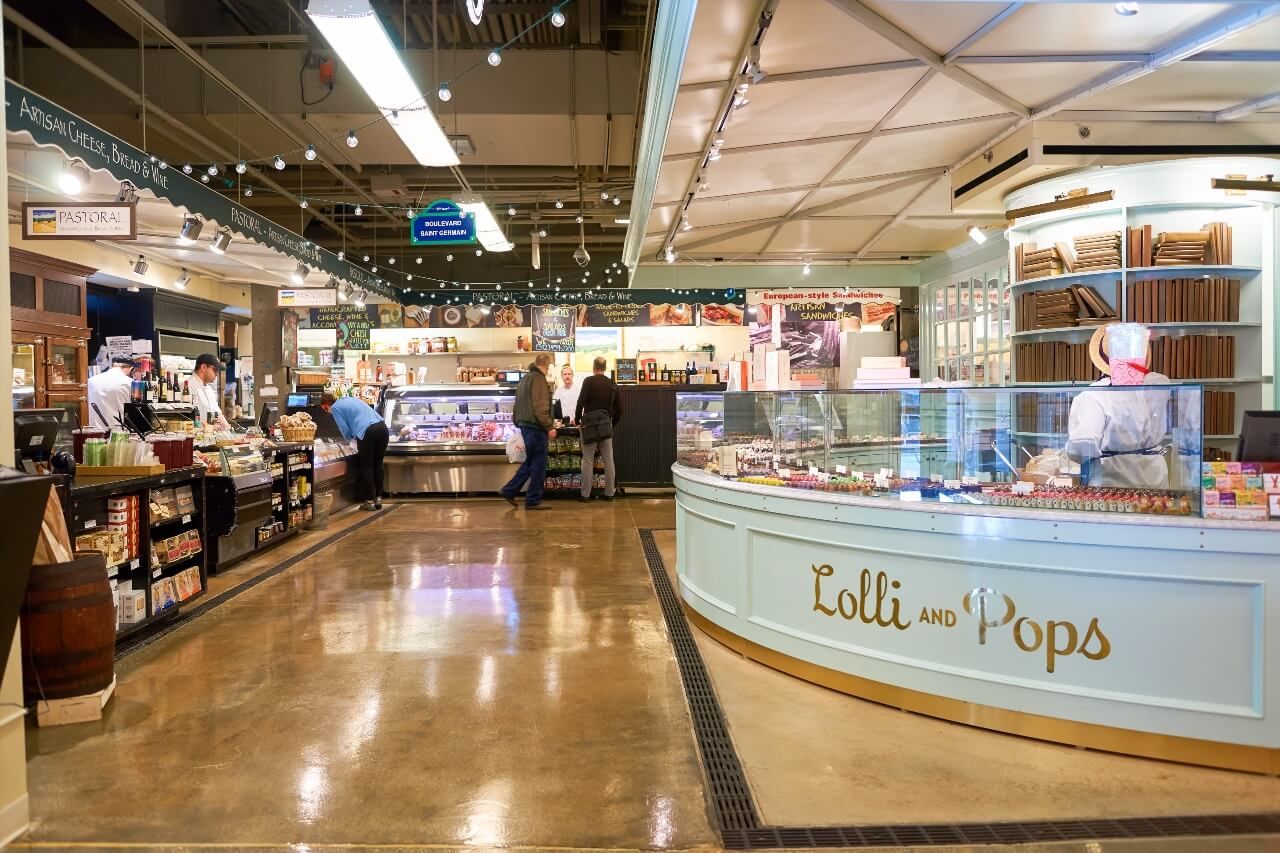
Chicago Food Planet Tours runs walking tours in neighborhoods including Lincoln Park, River North, and Wicker Park. Each tour covers 4 : 6 stops over two to three hours, and the guides are selected for knowledge of neighborhood history as well as food. Prices run $65, $80 per person. For something more independent, the Chicago French Market (131 N Clinton St, Chicago IL 60661, rated 4.4/5 on Google (1 728 avis)) inside the Ogilvie Transportation Center (at Madison and Canal) runs Monday through Saturday and collects around 30 local vendors under one roof, butchers, cheese shops, prepared food stalls, a coffee roaster, a fishmonger, in a space designed specifically to support local producers rather than chains.
If you only eat one thing in Chicago, make it an Italian beef sandwich from Al's Beef on Taylor Street, the original location from 1938, where the sandwich form was invented. Order it «dipped» (the whole thing submerged in the cooking jus) and «hot» (sport peppers). This is not elegant food. It is, however, specifically and unmistakably Chicago.
FAQ
What is the best time of year to visit Chicago?
Late May through early October gives you the full city experience: warm weather, open lakefront beaches, outdoor concerts, boat tours, and rooftop bars. June and September are the best individual months, June for the music festivals (Chicago Blues Festival, Millennium Park concert season), September for fewer crowds and comfortable temperatures in the 15 : 22°C range. Winter in Chicago is serious, wind chills below -20°C are common in January, but the indoor attractions are world-class and hotel prices drop significantly.
How many days do you need in Chicago?
Three days is the minimum to cover the main loop attractions, a Museum Campus visit, one neighborhood exploration, and one evening of live music or comedy. Five to six days gives you time to go deeper: a Museum of Science and Industry visit, a day on the lakefront, a boat tour, and enough evenings to hear different kinds of music. A week makes sense if you want to understand more than one neighborhood or are traveling with children who need a slower pace.
Is Chicago expensive to visit?
Chicago is mid-range for a major American city. Several major attractions are free or low-cost: Lincoln Park Zoo (free), Millennium Park (free), Chicago Cultural Center (free), Garfield Park Conservatory (free), Lakefront Trail (free). The big museums (Field Museum, Shedd Aquarium, Art Institute) run $24, $50 per adult. Budget $150, $200 per day per person for mid-range accommodation, museums, meals, and local transport.
What neighborhood should I stay in?
The Loop and River North are the most central: everything from the lakefront to the Riverwalk to the major museums is within walking distance or a short CTA ride. Lincoln Park and Wrigleyville are better for visitors who want a more residential feel with easy access to both the lakefront and the North Side neighborhoods. Wicker Park suits travelers who prioritize nightlife, independent restaurants, and creative district energy.
Is Chicago safe for tourists?
The tourist areas of Chicago, the Loop, Magnificent Mile, River North, Lincoln Park, Wrigleyville, Wicker Park, the Museum Campus, are safe and heavily trafficked. Chicago's crime statistics are widely reported but reflect conditions in specific far South and far West Side neighborhoods not typically visited by tourists. Standard urban precautions apply: be aware of your surroundings, use rideshares at night in unfamiliar areas, and ask your hotel front desk for neighborhood-specific guidance if you're planning to venture beyond the standard tourist geography.
What is Chicago known for architecturally?
Chicago is where the modern skyscraper was born. After the Great Chicago Fire of 1871, the city rebuilt with newly available steel-frame construction technology and created the first generation of buildings that used a structural skeleton rather than load-bearing walls, freeing floors to be wider, taller, and more windowed than anything built before. The Chicago School of Architecture defined the look and logic of the modern city office building. Today the skyline holds over 30 buildings taller than 600 feet, and the Chicago Architecture Center offers both walking and boat tours that give you the full historical context.
Conclusion
Chicago offers more than any single visit can absorb, and that is not a complaint so much as an argument for coming back. Whether your version of a great day in this city involves standing in a glass box 1,353 feet above the Loop, eating a dripping Italian beef sandwich on Taylor Street, listening to electric blues at midnight on South Wabash, or watching a free improv set in Old Town, the city has the infrastructure, the history, and the attitude to deliver it. Chicago does not perform for visitors; it lets you in on what it already is, and that, more than any single landmark, is the reason it stays in your head long after you've gone home.
If you want a way to thread these experiences together rather than treating them as a checklist, the Ryo audio guide for Chicago walks you through the architectural and historical layers on foot, building the narrative as you move from the Loop along the river to Millennium Park and beyond. Pair it with one of the boat tours, an afternoon on the Lakefront Trail, and an evening in a neighborhood like Wicker Park or Wrigleyville, and you'll leave with a version of Chicago that the standard postcard itinerary never quite delivers. The Ryocity guide is the simplest way to make the city legible on your terms, and to come away with a sense of why Chicagoans are so unreasonably loyal to a place that, by their own admission, has weather that should not be tolerated by any reasonable person.