





RyoCity
The Gifted City
Montpellier, France
RyoCity
The Gifted City
Montpellier, France
3.5 km
Distance
1h30
Durée
21
Audios
Boucle
Parcours
Shutterstock
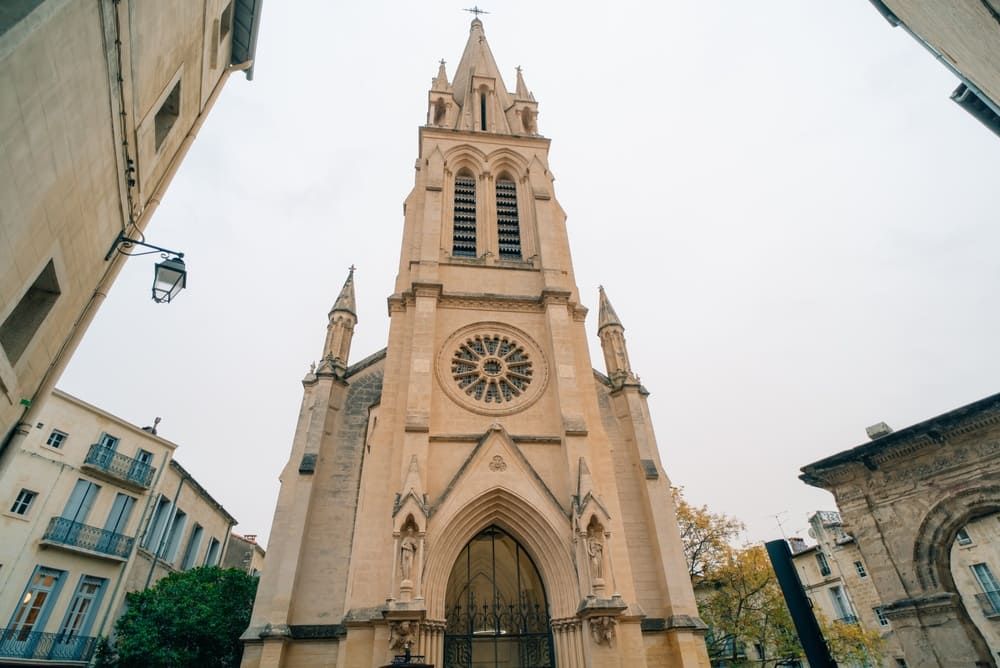
When you arrive at this square, your gaze is immediately drawn to the towering bell tower of the former Sainte-Anne church — a landmark visible from all over Montpellier. And by “former,” we don’t mean there’s a new church nearby with the same name. No, the story is a bit more unusual than that. Sainte-Anne’s origins date back to the 13th century, when a booming wine trade triggered a surge in Montpellier’s population. The initial church built here, however, didn’t have an easy path. Like many religious buildings in France, it suffered during the Wars of Religion, sustaining major damage. Rebuilt from 1655 and expanded later on, it was ultimately deemed unsafe by an architect in 1845. The city decided to demolish it and build a sturdier neo-Gothic version in its place — the very one you see today, crowned in 1889 with a bell tower soaring 70 meters into the sky. Despite these efforts, Sainte-Anne struggled to fully embrace its spiritual mission. It’s as if its destiny always lay elsewhere. In 1986, during a special ceremony, the church was officially deconsecrated. Five years later, it was reborn as a space for contemporary art exhibitions and cultural events. Today, the Carré Sainte-Anne has reopened after several years of closure due to structural concerns with its bell tower, which had begun to show signs of subsidence. The building has been fully restored, preserving its neo-Gothic architecture while reinforcing its interior spaces. It now once again hosts contemporary art exhibitions, with an immersive installation by internationally renowned artist JR marking the reopening. And still, rising proudly above the city at 70 meters high, its slender spire — affectionately known as “Montpellier’s egret” — continues to watch over the urban landscape.
