





RyoCity
The Plantagenet City
Le Mans, France
RyoCity
The Plantagenet City
Le Mans, France
2 km
Distance
1h00
Durée
21
Audios
Boucle
Parcours
Shutterstock
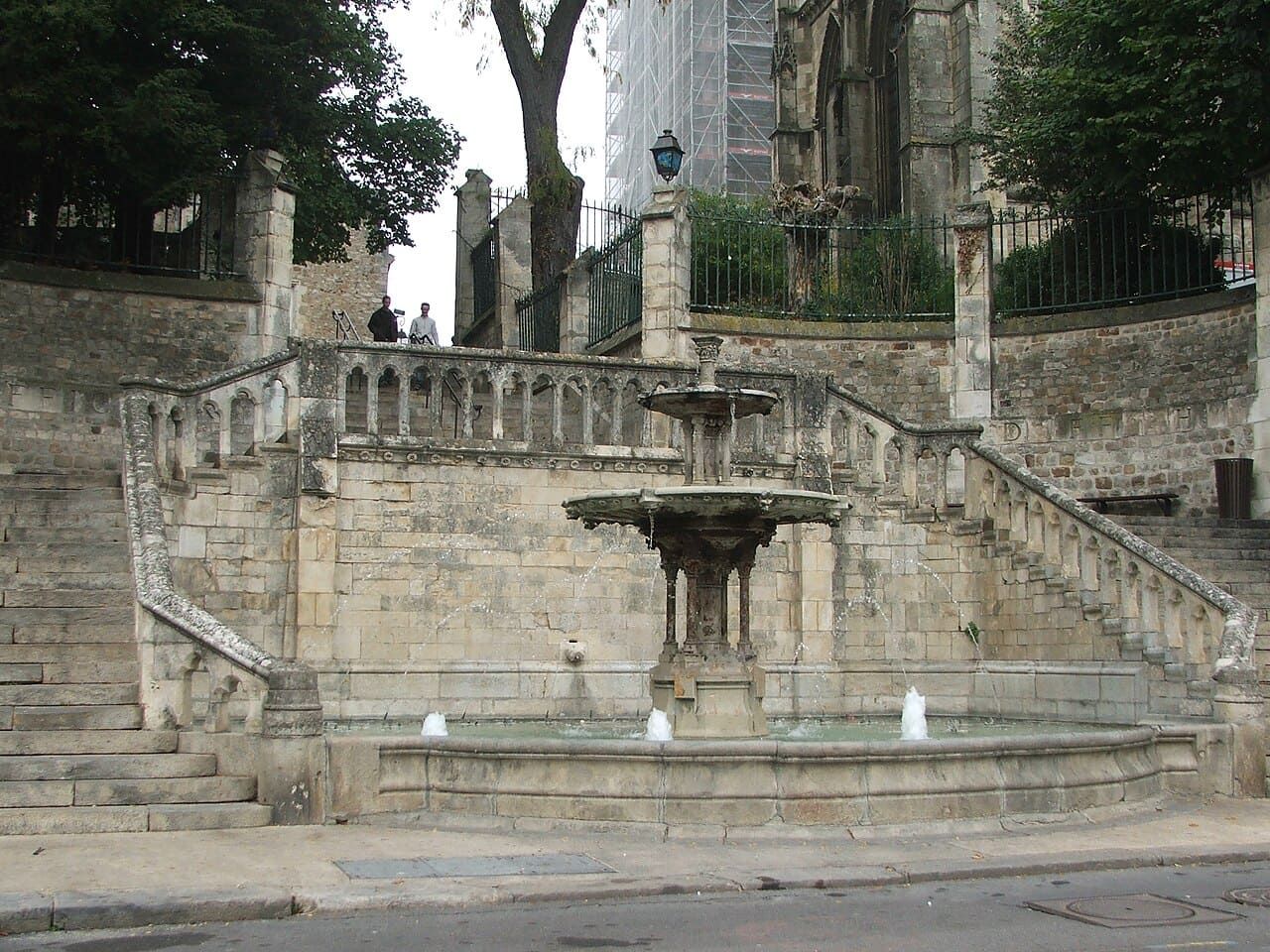
You are now standing before the Jet d’Eau fountain, set like a stage at the foot of Saint-Julien Cathedral. While its elegance and the gentle murmur of its water immediately draw the eye, this fountain is also an important marker in the urban history of Le Mans. It was inaugurated in 1854, at a time when the city was undergoing major changes with the arrival of the railway. In many ways, it was a fountain of modernity, designed to beautify the city centre and celebrate the vitality of a rapidly developing town. During this period, the authorities undertook major urban works, and the square where you now stand was completely transformed. Before the fountain, there was… nothing but a large void. In the Middle Ages, this space was occupied by a deep defensive ditch, part of the fortifications protecting access to the cathedral. By the 19th century, it had become obsolete and unsanitary, so it was filled in to create this broad esplanade, with the fountain installed at its centre. Made of cast iron by the Doré-Chevé workshops, it features a hexagonal basin, a central bowl, and a graceful small obelisk from which jets of water spring. Both decorative and symbolic, it represents water tamed and displayed in the public space, in keeping with the 19th century’s hygienist spirit. The fountain was recently restored to its full splendour. Around it, the stones still tell their story. Nearby, you can see a high retaining wall: this is one of the surviving parts of the medieval earthwork built in the 14th century to reinforce the cathedral’s defences. Fearing an attack during the Hundred Years’ War, the city fortified the exposed Gothic chevet. At this time, the Forgeur Tower was built, the round remnant you can see on your right. Its name came not from a craftsman, but from a cathedral clerk responsible for finances, known as the “forgeur.” The tower was part of an improvised defensive system of ditch, wall, and turret, built in urgency to protect the sanctuary. Today, this area blends layers of history with present-day life: medieval fortifications, 19th-century redesign, and a lively contemporary atmosphere. The square still hosts one of the city’s most vibrant markets every Wednesday, Friday, and Sunday morning, a place where history and local life meet at every step.
