





RyoCity
Capital of Porcelain
Limoges, France
RyoCity
Capital of Porcelain
Limoges, France
5.8 km
Distance
2h30
Durée
28
Audios
Boucle
Parcours
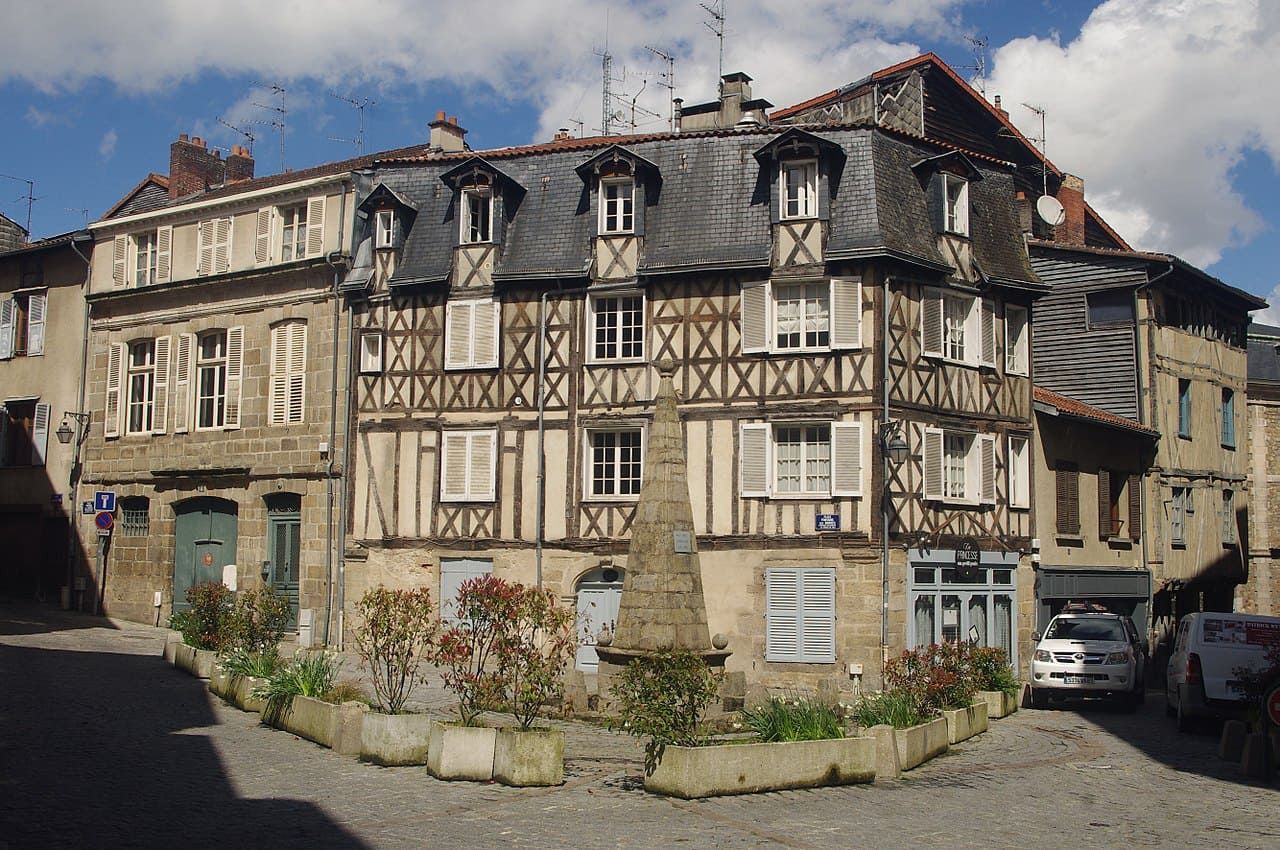
©Danielclauzier CC BY-SA 4.0. <https://creativecommons.org/licenses/by-sa/4.0/deed.fr>via Wikipedia Commons
The square you’ve just stepped into has a completely different feel from the others you’ve seen so far. Gone are the Haussmann-style buildings and neoclassical façades—here, it’s the warm red brickwork that brings a splash of color and a distinctive charm to this part of Limoges. This circular square was created in the 18th century, after the old city walls were torn down. In 1712, it was named Place Dauphine in honor of the Dauphin, the future King Louis XV. Later, in 1775, the square was redesigned by Turgot, the royal intendant and Controller-General of Finances, who gave it the look you see today, complete with those signature red brick buildings. Over the years, the square changed names several times to reflect the political shifts of the time—it became Place des Sans-Culottes, Place de la Liberté, and Place de la Révolution before finally being named after Denis Dussoubs in the mid-19th century. Born in Haute-Vienne in 1818, Denis Dussoubs was a key figure in the 1848 Revolution in Limoges. Just three years later, during Louis-Napoléon Bonaparte’s coup, he walked alone and unarmed toward the soldiers guarding the barricades in Paris, trying to convince them to support the Republic. He was shot and killed on the spot, dying a martyr at just 33 years old. The square was renamed in his memory, and for a time, a statue of Dussoubs stood at its center—until it was melted down during the Second World Wa. Today, the square remains one of the city’s liveliest places, lined with cafés and restaurants that make it a favorite gathering spot for locals.
