





RyoCity
Echoes of the Middle Ages
Sarlat-la-Canéda, France
RyoCity
Echoes of the Middle Ages
Sarlat-la-Canéda, France
1.1 km
Distance
1h00
Durée
16
Audios
Boucle
Parcours
©Anthony Baratier CC BY-SA 4.0.
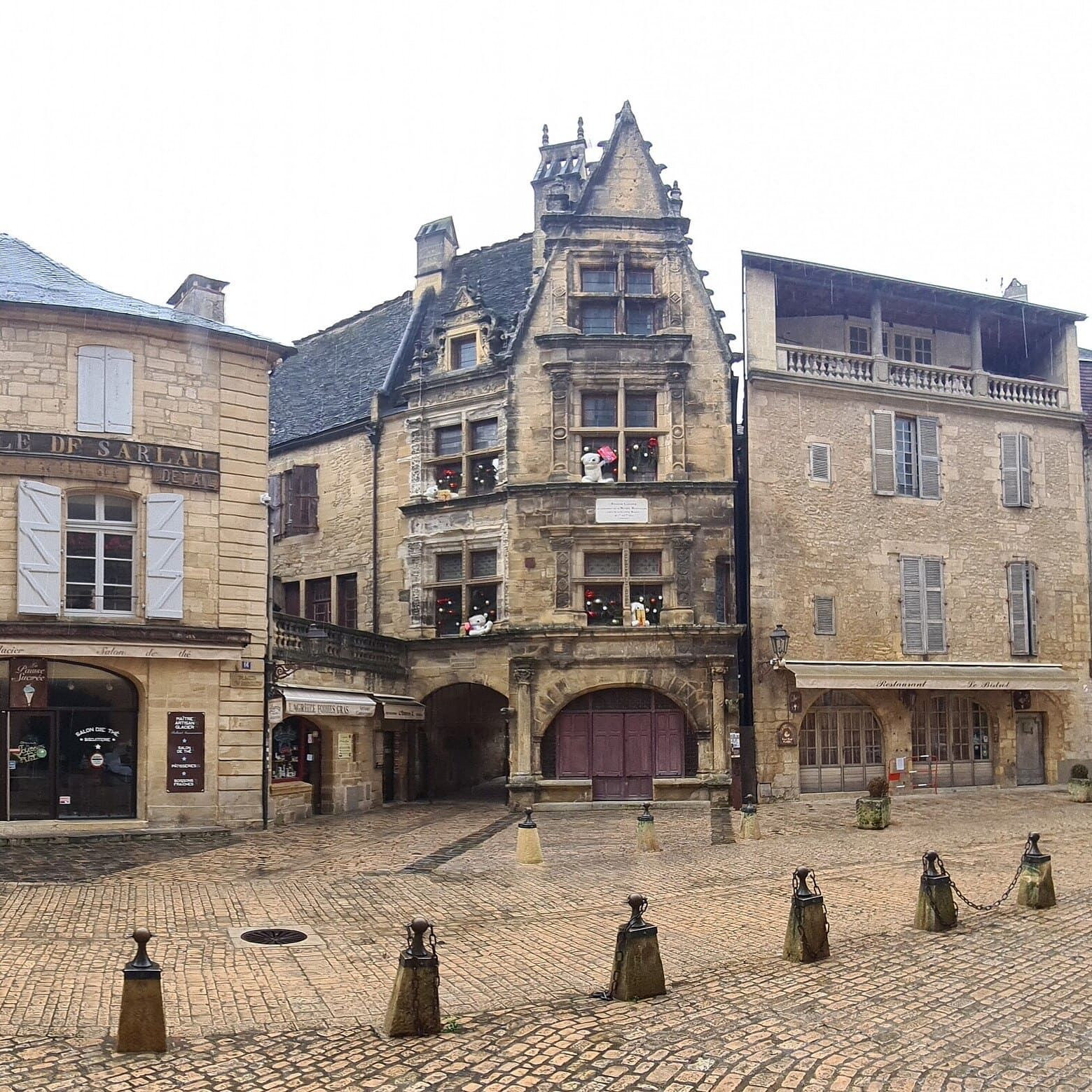
On Place du Peyrou, every facade has a story to tell, and together they form one of Sarlat’s most beautiful architectural scenes. Right in front of you stands the Maison de La Boétie, perhaps the town’s most famous treasure. Built in 1525, it’s a perfect example of Renaissance elegance, with its finely sculpted facade, mullioned windows, and graceful slate roofs. This is where Étienne de La Boétie was born in 1530 — a writer, humanist, and lifelong friend of Michel de Montaigne, best known for his Discourse on Voluntary Servitude. Listed as a Historic Monument since 1889, the house was carefully restored in the early 20th century and remains one of Sarlat’s true icons. All around, the square is framed by grand old houses that trace the town’s evolution through the ages — timber-framed dwellings from the 15th century, elegant 18th-century stone facades, slate roofs glinting in the sunlight, and carved dormer windows that lend the whole square its timeless charm. Each detail speaks of Sarlat’s prosperous past and its importance in the heart of the Périgord. If you follow the Passage des Enfeus, which runs alongside the cathedral, you’ll come across one of the town’s most intriguing monuments: the Lantern of the Dead. This tall, round tower with its narrow openings dates back to the 12th century, though its exact purpose remains a mystery. Some believe it was built after the canonisation of Saint Bernard of Clairvaux, who visited Sarlat in 1147 and left a deep impression on the townspeople. Others think it once held a flame — a light meant to guide the souls of the departed toward the afterlife. That uncertainty only adds to its fascination. Is it a religious monument, a commemorative tower, or a spiritual beacon? Perhaps a bit of all three. Whatever the truth, its distinctive silhouette has become one of Sarlat’s most recognisable landmarks. Feel free to take a short detour to see it up close before continuing on to the cathedral.
