





RyoCity
Behind the Scenes of the City That Invented Everything
Saint-Étienne, France
RyoCity
Behind the Scenes of the City That Invented Everything
Saint-Étienne, France
3.6 km
Distance
1h30
Durée
20
Audios
Boucle
Parcours
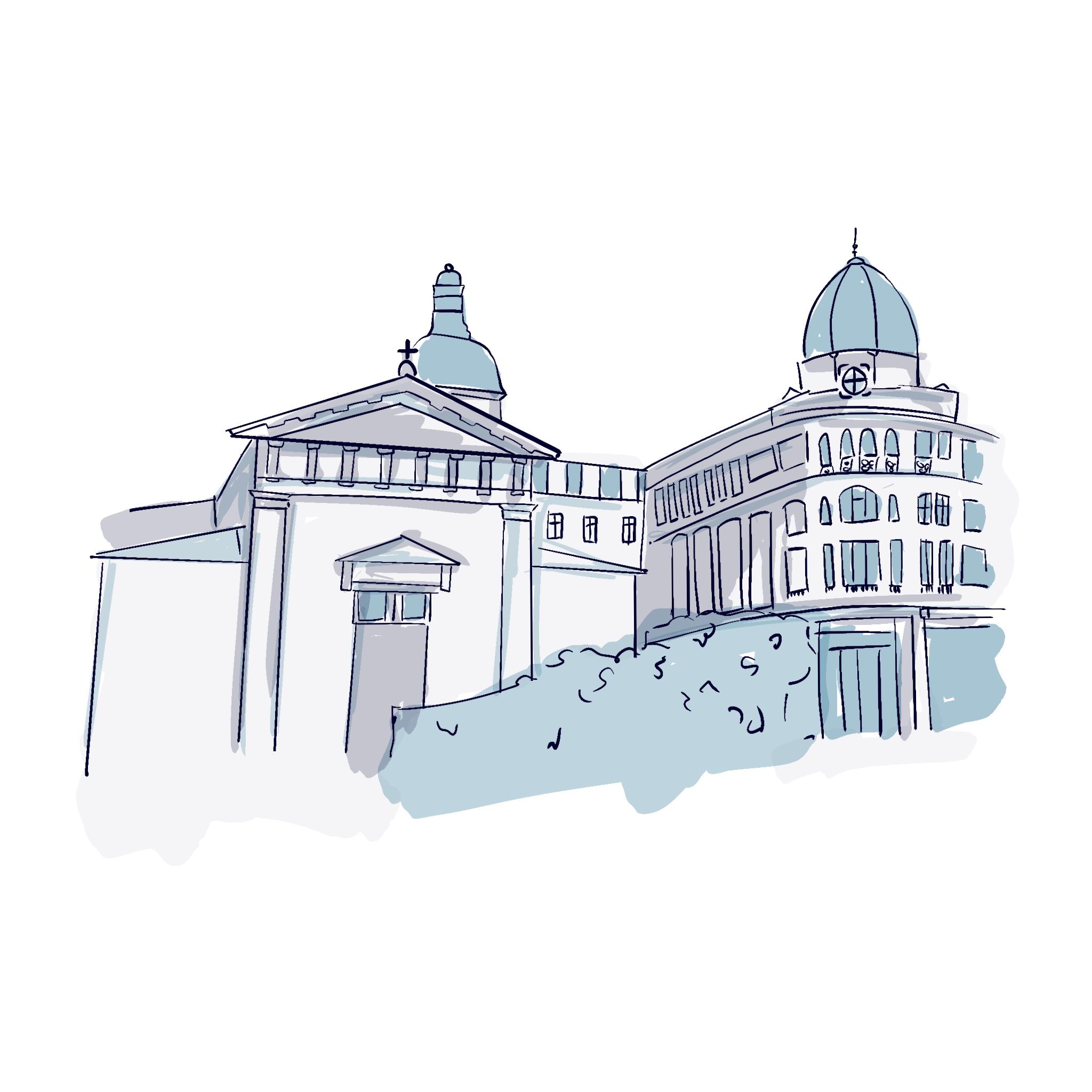
You’re now standing on Place Waldeck-Rousseau. Take a look around: on one side, the Church of Saint-Louis; on the other, the imposing façade of the former Galeries Lafayette. Two buildings, two very different stories, two completely different atmospheres. The Church of Saint-Louis is the elder of the two. It began life in the seventeenth century as nothing more than a small chapel. As the city grew, so did the need for a proper church, and in the nineteenth century the entire building was rebuilt. It hasn’t always had an easy history—back in 1836, the wooden ceiling suddenly collapsed and had to be replaced with the brick vault you can still see overhead today. Simple, solid, and neoclassical, the church continues to welcome both worshippers and visitors, a discreet yet essential landmark right in the heart of Saint-Étienne. Facing it is a building you can’t miss: the former Nouvelles Galeries department store. Its story starts in 1866 with a couple, Charles Démogé and his wife, who opened a “Grand Bazaar” right here. After Charles passed away, his widow took over and made a bold move. She joined forces with the brand-new Nouvelles Galeries chain and entrusted the rising star of architecture, Léon Lamaizière, with the construction of a real department store. When the store opened in 1895, it was a revolution. For the first time, everything could be found under one roof—from clothing to household goods—set within a modern, spectacular setting. The concept was both simple and groundbreaking: wherever you went in France—Saint-Étienne, Marseille, Paris—you would find the same shopping experience, with a recognizable façade, a corner turret, a sweeping staircase, and interior galleries arranged in a familiar way. Here in Saint-Étienne, the building became nothing short of a shopping temple, a shining symbol of modernity for over a century. Closed in 2004, it has since been restored and protected, though it has lost the soul of that classic French department store that made it such a success. What remains, however, is a precious witness to the golden age of commerce in Saint-Étienne. Before moving on, see if you can spot the “W” worked into the paving stones—a nod to Pierre Waldeck-Rousseau, the politician who gave workers the right to form unions. And in a working-class city like Saint-Étienne, that little tribute couldn’t be more fitting.
