





RyoCity
Seaside Glamour and Timeless Stories
Deauville, France
RyoCity
Seaside Glamour and Timeless Stories
Deauville, France
5 km
Distance
2h00
Durée
20
Audios
Boucle
Parcours
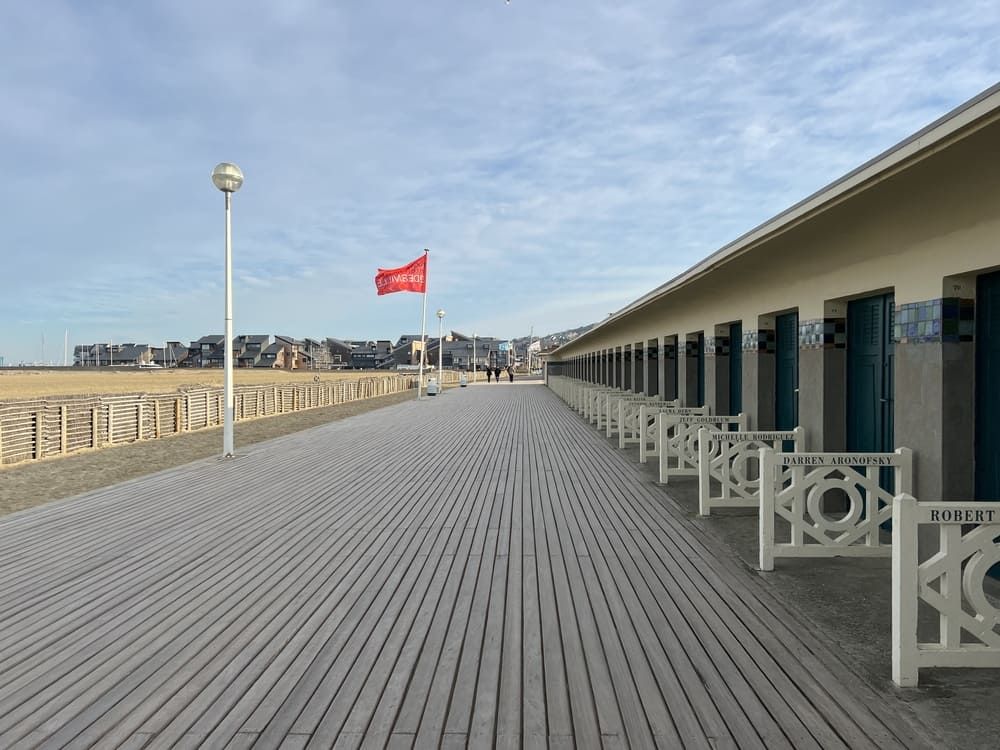
©Chabe01 CC BY-SA 4.0.
You’ve arrived at Deauville’s most famous walkway: the legendary Planches. Before they existed, there were only rows of old wooden beach huts lined up on the sand. But in the early 1920s, the town wanted something worthy of its reputation. In 1923, it unveiled the “Pompeian Baths,” a striking Art Deco bathing complex of concrete and mosaics, complete with 250 cabins, elegant lounges, and even an American bar. To complement this new seaside temple, a boardwalk was built in tropical azobé wood, chosen for its resistance to sea spray. That was the birth of the Planches, originally stretching 444 meters, then lengthened over the years. Today, with extensions, they run well beyond 700 meters. Back then, Deauville was as much about seeing and being seen as it was about fresh sea air. Well-dressed ladies strolled under parasols, gentlemen in hats, and a proper promenade was essential, elegant, practical, and a way to avoid sinking polished shoes into the sand. What really made the Planches legendary, though, are those white cabins with their distinctive openwork concrete railings, each bearing a name. Not just any names, but those of American actors, actresses, and filmmakers invited to the Film Festival, a French version of the Hollywood Walk of Fame, right by the sea. As you wander, you’ll come across Clint Eastwood, Nicole Kidman, Steven Spielberg, Meryl Streep, or Natalie Portman, all etched here for eternity. And then there are the images that define Deauville: those colorful parasols, only five shades, each tied with its signature knot of fabric, have become the town’s most photographed symbol. The beach feels unthinkable without them. And of course, there’s that unforgettable scene: a couple running hand in hand across the sand, set to Francis Lai’s famous “chabadabada.” In 1965, Claude Lelouch drew inspiration here for A Man and a Woman, a film that went on to win the Palme d’Or at Cannes and two Oscars in Hollywood, sealing Deauville’s place in cinema’s romantic imagination. Since 2006, the square leading onto the Planches bears the film’s name. So take your time as you walk. Every step carries a little of Deauville’s story: seaside tradition, glamour, and cinema. The Planches are more than a wooden path by the sea; they’re an open-air stage where anyone can feel like the star of a classic film.
