





RyoCity
Timeless Medieval Beauty
Siena, Italy
RyoCity
Timeless Medieval Beauty
Siena, Italy
3 km
Distance
1h30
Durée
21
Audios
Boucle
Parcours
Shutterstock
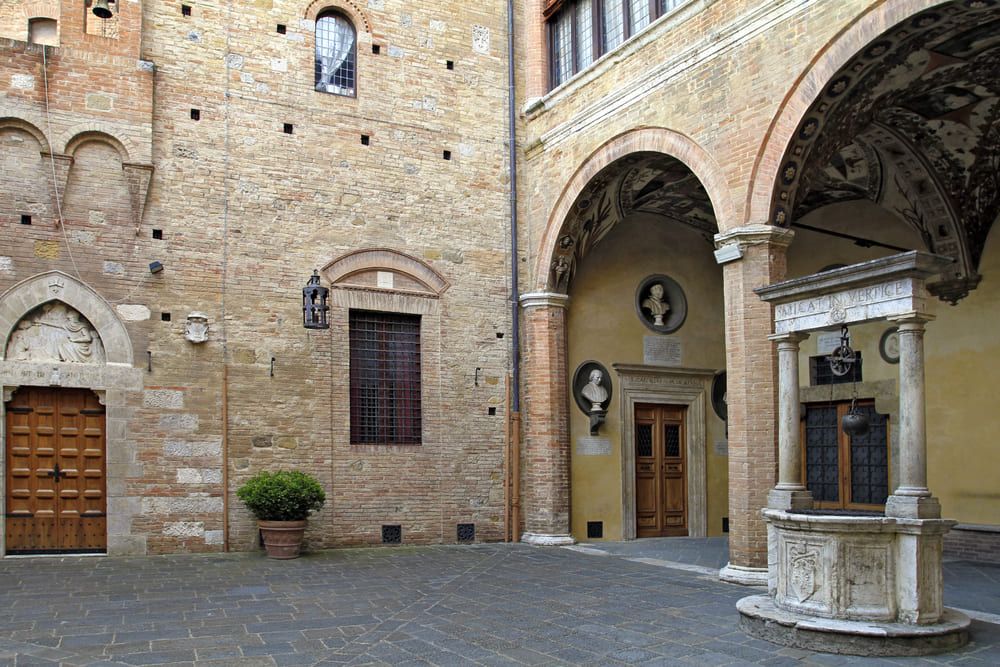
You’ll recognize Palazzo Chigi Saracini right away by its long, slightly curved Gothic façade, which at first glance recalls Siena’s Palazzo Pubblico, though their histories couldn’t be more different. The palace was first built in the 12th century by the powerful Marescotti family, whose emblem—an eagle with outstretched wings—still appears above every window. In 1770, Marcantonio Saracini bought the building and set about reshaping it, and just over a century later, in 1877, it passed into the hands of the Chigi family. The true transformation came with Guido Chigi Saracini, a passionate music lover, who in 1932 founded the Accademia Musicale Chigiana here. Since then, it has grown into one of the world’s most prestigious music academies. Renowned musicians such as Claudio Abbado, Daniel Barenboim, and Salvatore Accardo all studied here, and the palace still houses a remarkable collection of historic instruments, including several Stradivari. If the doors happen to be open, step inside the courtyard: one of its porticoes is decorated with frescoes and coats of arms, among them a tribute to Pope Pius II. Born Enea Silvio Piccolomini here in Siena, he became one of the great Renaissance figures—a humanist, diplomat, and writer before ascending to the papacy in 1458. His legacy in Siena is immense, not least the magnificent Piccolomini Library adjoining the cathedral.
