





RyoCity
Where Wisdom Keeps You Young
Coimbra, Portugal
RyoCity
Where Wisdom Keeps You Young
Coimbra, Portugal
6 km
Distance
2h25
Durée
26
Audios
Boucle
Parcours
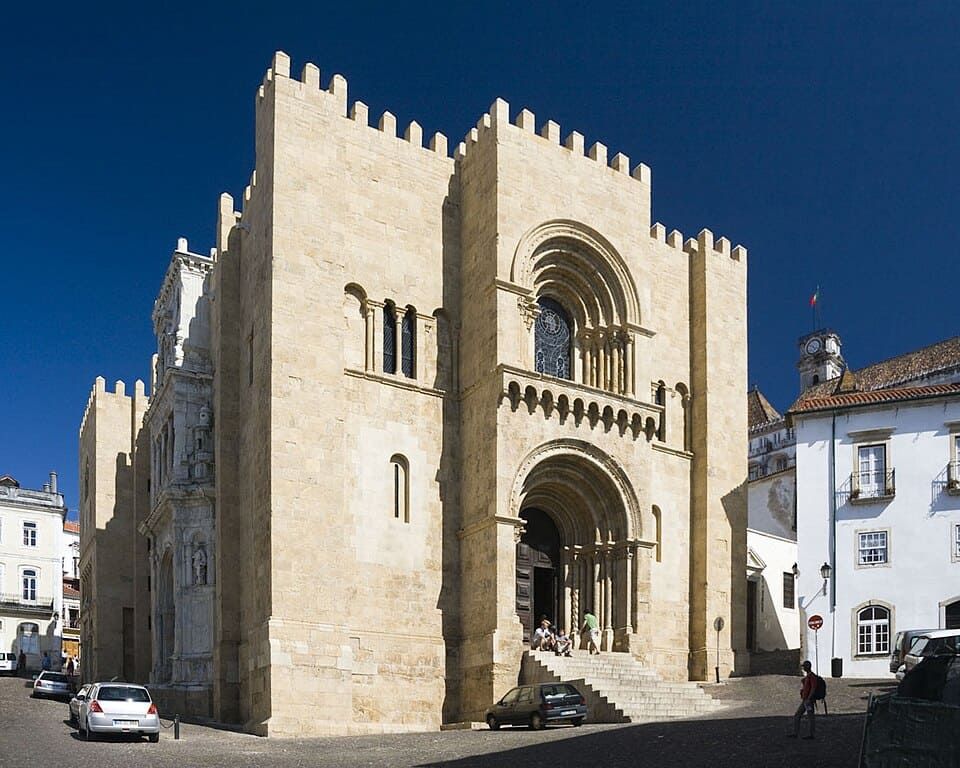
©Lilear00 CC BY-SA 3.0. <https://creativecommons.org/licenses/by-sa/3.0/deed.fr>via Wikipedia Commons
We’re now standing in front of one of the oldest and most striking examples of Romanesque architecture in Portugal. The Sé Velha de Coimbra feels frozen in time. Construction began during the reign of Afonso Henriques, Portugal’s first king, and between 1162 and 1320 it took shape into the cathedral you see today — the only one from the Christian Reconquest still standing with its original structure intact. Its builders were two Frenchmen, Bernardo and Roberto, who also oversaw construction of Lisbon’s cathedral. Take a moment to admire the single-arched and crenellated entrance, a rare and beautifully balanced design. If you walk to the north side of the building, you’ll come across the Porta Espaçosa, or “Spacious Gate.” This is one of Coimbra’s emblems, crafted by João de Ruão, with finely carved details inspired by the Italian Renaissance. The interior of the cathedral is accessible with a ticket, and it’s equally impressive, with its Gothic lantern tower, the lavishly gilded main altarpiece, and its 13th-century cloister, considered the oldest in the country. Take a moment to look across from the entrance to the Sé Velha. Not at the beige house, but the next one, covered in white tiles, with a painted portrait of a man with glasses and curly hair. That’s José Afonso, better known as Zeca Afonso. He was born in Aveiro in 1929, died in Setúbal in 1987, and spent the 1940s living on the second floor of this house. A towering figure in 20th-century Portuguese music, Zeca Afonso started out with Fado de Coimbra before turning to ballads, and then rising to fame for his protest songs. A fierce opponent of Salazar’s dictatorship, he’s the voice behind “Grândola, Vila Morena”, the song that became the unofficial anthem of the Carnation Revolution on April 25, 1974. To this day, it’s sung across Portugal at commemorations and protests. If the melody feels familiar, it may be because it was featured in the final moments of the Spanish show, La Casa de Papel, or Money Heist, Season 5, Episode 5, as a tribute to its spirit of resistance. Beneath the mural, you’ll see a few lines from the song. In English, they read, “At every street corner, a friend, In every face, equality. It’s the people who lead, In you, oh city.”
