





RyoCity
A well-kept Roman secret
Mérida, Spain
RyoCity
A well-kept Roman secret
Mérida, Spain
6.5 km
Distance
2h40
Durée
19
Audios
Boucle
Parcours
Shutterstock
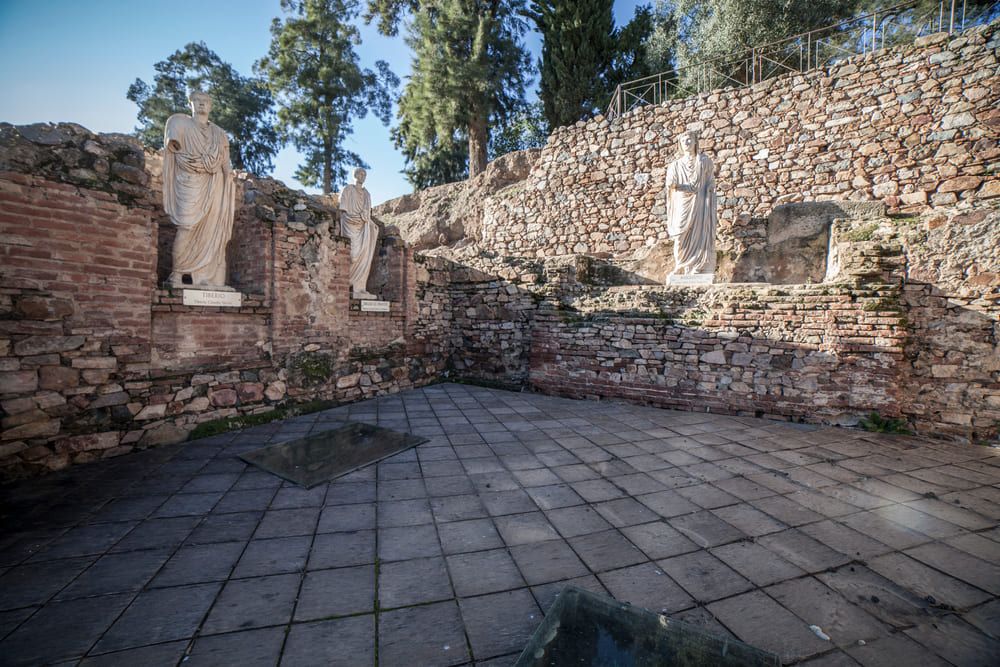
Since we've mentioned him so much, let’s get to know Augustus a bit better, whose statue is standing in front of you. First things first, he was the first Roman Emperor.You might be thinking, "Wasn’t that Julius Caesar?" Not quite. Julius Caesar did a lot to build the empire, and he even got the title of “Imperator,” but he was a general and a dictator, not an emperor. Before that, Rome was a Republic. Power was in the hands of the Senate, which controlled magistrates who were elected by the assembly of citizens. Every year, two consuls were elected to govern, and in times of crisis, they could appoint a dictator for six months with total power. However, that balance didn’t last. The Republic started to crack when powerful generals like Caesar and Pompey used their military success and massive wealth to take control. The rivalry between them eventually plunged Rome into civil war, which ended with Caesar’s assassination. That’s when Augustus stepped in. His name was Gaius Octavius, and he was Caesar’s great-nephew and adopted son, officially named in Caesar’s will in 44 BC. Octavian, as he was then known, took over and inherited Caesar’s legacy. To avenge Caesar’s murder, he teamed up with Mark Antony, a close ally of Caesar, and with Lepidus, a top religious figure. The three of them formed a political alliance and hunted down Caesar’s enemies. As is often the case with power, things got complicated. Lepidus was pushed out, Mark Antony ran off to Egypt with Cleopatra, and Octavian wasn’t having any of it. Another civil war followed, ending with the famous Battle of Actium in 31 BC, where Mark Antony and Cleopatra took their own lives. Octavian became the undisputed ruler of Rome. The Senate, grateful and a bit scared, gave him sweeping powers and honoured him with the title “Augustus,” meaning “the exalted” or “the chosen one of the gods.” Then began the Roman Empire. Augustus set out to shape the empire with lasting reforms: he expanded the provinces, reorganised the army, stabilised the grain supply, promoted marriage and family life, and encouraged population growth. He also poured money into building projects and beautifying cities across the empire, including here in Merida. Much of what survives from the Roman world today was made possible under his rule. So, there you have it, Augustus in a nutshell. I’ll leave you with his own parting words: “I found Rome a city of bricks, and I left it a city of marble.”
