





RyoCity
Isle of Kings
Palma de Mallorca, Spain
RyoCity
Isle of Kings
Palma de Mallorca, Spain
5 km
Distance
2h00
Durée
26
Audios
Boucle
Parcours
©Enric - CC BY-SA 4.0 <https://creativecommons.org/licenses/by-sa/4.0/deed.fr>via Wikipedia Commons
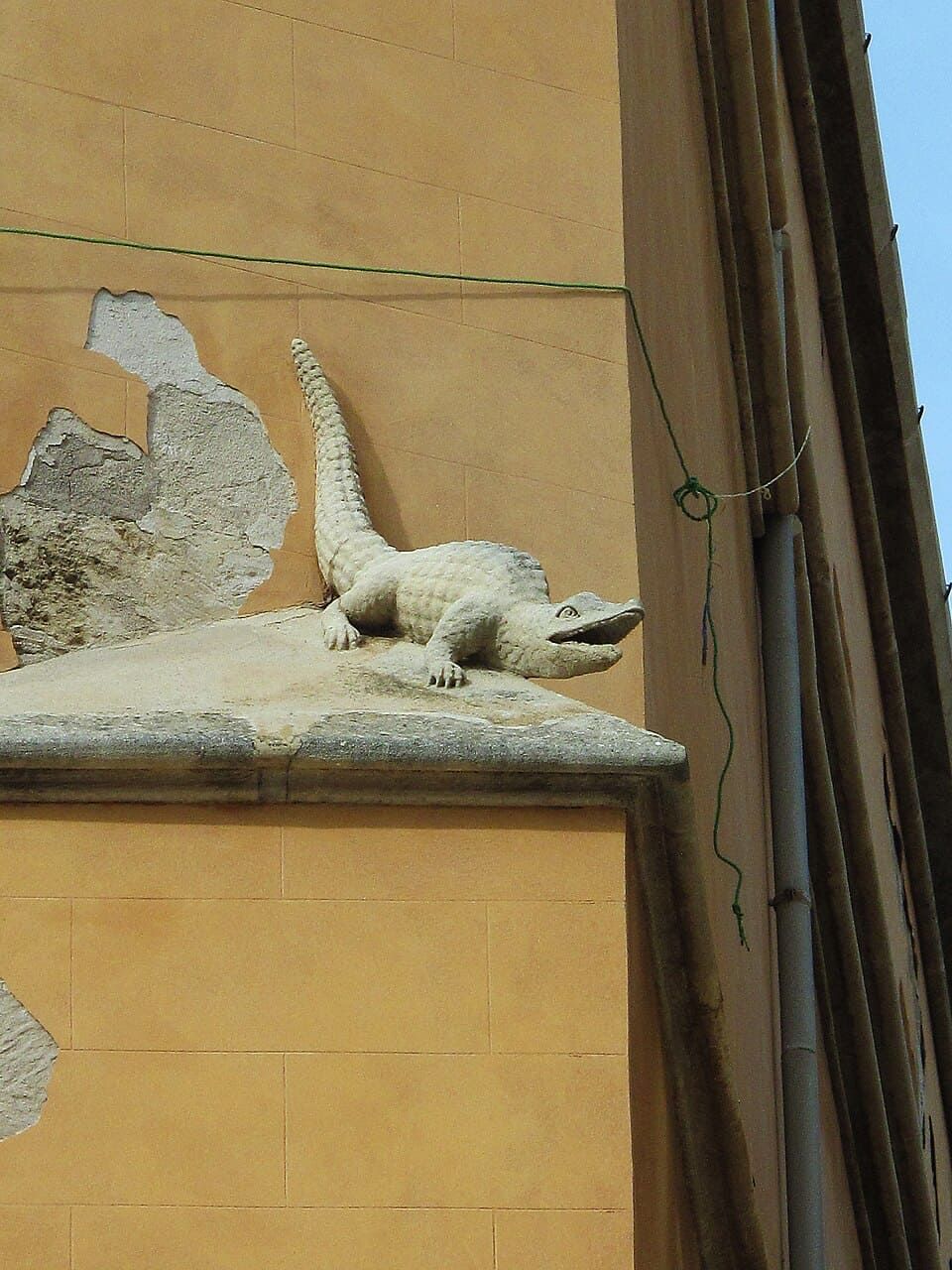
Here you are in a lovely little square, facing the Diocesan Museum and a beautiful neo-Gothic villa at number 3. Now, take a look at the façade - can you spot a small sculpted crocodile? It's not on the door, but much higher up, right at the corner where the street turns to your right. This little guy is actually a miniature version of Palma's famous dragon - which, you've probably guessed by now, was really a crocodile! Let me take you back to the 16th century. A strange beast was terrorizing the locals and supposedly devouring children. The deeply religious and superstitious townspeople believed these tragedies were divine punishment, and they didn't pay much attention to the few witnesses who swore they'd seen a fierce creature with a long green tail. Eventually, hardly anyone dared to venture out after dark. Then one evening, Captain Bartomeu Coch came riding up to the city gates to court his beloved - because every good story needs a charming hero, right? Well, he heard a strange noise and suddenly found himself face to face with this unknown beast. Without hesitation, he drew his sword and killed what he thought was a dragon. Then he brought his trophy right to his sweetheart's window to prove his love. I mean, flowers wilt, but who wouldn't be impressed by a dragon on a spear! Of course, our brave captain hadn't actually slain a dragon - it was a one-meter-long African crocodile that had probably escaped from a ship as a baby and grown up in the city's sewers. Far too small to actually eat people - that part's just folklore - but you can easily imagine how it would have terrified the locals! And that's how the legend of the Drac de Na Coca was born. There's even a traditional song about it that you should definitely look up later to get into the spirit! But here's the amazing part - you can actually see this famous crocodile-dragon! It's been stuffed and displayed right here in the Diocesan Museum since the early 1900s, when Captain Coch's family generously donated it for all of us to enjoy!
